
.jpg/250px-Oslo,_Vigeland_Park_(2).jpg)


.jpg/2000px-Oslo,_Vigeland_Park_(2).jpg)
Community hub
Recent from talks
Contribute something
Nothing was collected or created yet.
Frogner Park
View on WikipediaFrogner Park (Norwegian: Frognerparken) is a public park in the central West End borough of Frogner in Oslo, Norway.[1] The park is historically part of Frogner Manor and is Oslo's largest park, open to the public at all times. It includes the manor house which is the seat of Oslo Museum, the nearby Henriette Wegner Pavilion, the Vigeland installation of sculptures (Norwegian: Vigelandsanlegget) created by sculptor Gustav Vigeland, Frogner Baths, Frogner stadion, Frognerparken Café, the restaurant Herregårdskroen and the largest collection of roses in the country with 14,000 plants of 150 species. Frogner Park is the most visited tourist attraction in Norway.
Key Information

.jpg)

Frogner Manor was historically one of the largest estates in the modern Oslo area. Both the park, the entire borough of Frogner as well as Frognerseteren derive their names from Frogner Manor. The manor house is located in the south of the park, and houses Oslo Museum, which opened there in 1909. The nearby Henriette Wegner Pavilion commemorates the philanthropist and women's rights pioneer Henriette Wegner and was moved from Blaafarveværket in 1837. Frogner Park was gradually opened as a public park from 1904 and the 1914 Jubilee Exhibition was held there. From 1924, Gustav Vigeland's sculpture installation was built in parts of Frogner Park.[2] It consists of sculptures as well as larger structures such as bridges and fountains. The installation is not a separate park, but the name of the sculptures within the larger Frogner Park. The Vigeland installation is sometimes called "Vigeland Park" or "Vigeland Sculpture Park." The director of Oslo Museum Lars Roede said "Vigeland Park" "doesn't really exist" and is "the name of the tourists," as opposed to "Oslo natives' more down-to-earth name, Frogner Park."[3] However, the name Vigeland Park (Vigelandsparken) is used by the Vigeland Museum on its website and printed materials to refer to the Vigeland installation in both Norwegian and English.
The park of Frogner Manor was historically smaller and centered on the manor house, and was landscaped as a baroque park in the 18th century by its owner, the later general Hans Jacob Scheel. Wegner Park, a romantic landscape park, was built around 1840 by then-owners, industrialist Benjamin Wegner and Henriette Wegner. Wegner's romantic park still exists in the areas near the manor house. Large parts of the estate were sold to give room for city expansion in the 19th century, and the remaining estate was bought by Christiania municipality in 1896 and made into a public park.
Frogner Park is the largest park in the city and covers 45 hectares;[4] the sculpture installation is the world's largest sculpture park made by a single artist. Frogner Park is the most popular tourist attraction in Norway, with between 1 and 2 million visitors each year,[5] and is open to the public at all times. Frogner Park and the Vigeland installation (Norwegian: Frognerparken og Vigelandsanlegget) was protected under the Heritage Act on 13 February 2009 as the first park in Norway.[6][7]
History
[edit]


In the middle of the 18th century Hans Jacob Scheel, then owner of the Frogner Manor, laid out a Baroque garden adjacent to his new manor house. It was expanded by the people who followed him, starting with Bernt Anker (1746–1805) who bought Frogner in 1790 and expanded the main building. Benjamin Wegner bought the manor in 1836 and he transformed the garden into a romantic park around 1840. Later, most of the arable land was sold to private developers.
Around one square kilometer remained when the City of Oslo bought the property in 1896 to secure space for further urban development. The municipal government decided around 1900 to make a park for recreation and sports. Frogner Stadium was opened near the road and the area near the buildings was opened to the public in 1904. Norwegian architect Henrik Bull designed the grounds and some of the buildings erected in Frogner Park for the 1914 Jubilee Exhibition. [8][9]
The municipal government subsequently decided that Gustav Vigeland's fountain and all his monuments and statues should be placed in the park. The area was ready for Gustav Vigeland fountain in 1924 and the final plan was released in 1932 by the city-council. Most of the statues depict people engaging in various typically human pursuits, such as running, wrestling, dancing, hugging, holding hands and so on. However, Vigeland occasionally included some statues that are more abstract, including one statue, which shows an adult male, fighting off a horde of babies.[10]
-
 Would-be General and Chamberlain Hans Jacob Scheel (owner of Frogner from 1747) laid out a baroque garden around 1750
 -
 Industrialist Benjamin Wegner (owner of Frogner from 1836) transformed the garden into a romantic park around 1840
 -
 Philanthropist Henriette Wegner
 -
 Landscape architect and city gardener Marius Røhne was a central person in the development of the park from the early 1900s
 -
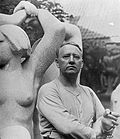 Sculptor Gustav Vigeland created the sculpture arrangement in the centre of the present enlarged park from the 1920s until his death in 1943

.jpg)
.jpeg)


Henriette Wegner Pavilion
[edit]
The Henriette Wegner Pavilion was built in 1824 at Blaafarveværket as a wedding gift to Henriette Wegner from Benjamin Wegner, the director and co-owner of Blaafarveværket. It was moved to Frogner Park in 1837 after the Wegner family acquired Frogner Manor. It is located within the section of Frogner Park known as Wegner Park, the romantic landscape park built for the Wegners around 1840.
The pavilion is a tea pavilion shaped like a classical octagonal round temple with a colonnade, inspired by structures from Greco-Roman antiquity but made with Norwegian materials.
The ceiling is a painted replica in miniature of the dome of the Pantheon, Rome, that makes the room appear larger. The pavilion underwent a restoration from 2023 and reopens in 2024, its 200th anniversary.
Manor house
[edit]
The manor buildings are located in the southern part of the park. The buildings in Danish country house style were built in the 1750s when Hans Jacob Scheel took over the property. After Bernt Anker, who was Norway's richest man, took over the estate in 1790, the buildings were further extended, and the manor house became one of the most important meeting places of Norwegian high society. They were rebuilt again by the industrialist Benjamin Wegner, who became owner in 1836 and who moved the tower to the main building.


Under Wegner, some surrounding buildings were also built, the Henriette Wegner Pavilion on the nearby hill "Utsikten" (The View) and the coachman house at the main gate in front of the manor house. In front of the main buildings is also a sundial built for Wegner.
Today, the manor buildings are occupied by Oslo City Museum.
Outside the manor buildings, there is also a café opened in 1918, Frogner Park Café, and a restaurant opened in 1960, Herregårdskroen (Frogner Manor Restaurant).
Flora and gardens
[edit]Frogner Park contains a large rose garden, the Frogner Rose Garden, with 14,000 roses spread across 150 different species. The roses in Frogner Park are maintained according to biological principles.
Today, there are approximately 3,000 trees in Frogner Park. Some of them are more than 250 years old, with trunk circumferences of up to 5.5 meters. Among the park's trees, there are many exotic varieties, such as magnolia, sequoia, ginkgo, and walnut.
In 2012, Frogner Park received the Nordic quality label Green Space Award, the first Norwegian green space to do so.
Wegner's romantic park
[edit]Wegner's romantic park was built around 1840 by the manor's then-owners Benjamin Wegner and Henriette Wegner. The Wegner park replaced the old baroque garden. It was built in a romantic garden style that had replaced the baroque ideal in the late 18th century.
Vigeland installation – the sculptures in Frogner Park
[edit]The Vigeland installation (Norwegian: Vigelandsanlegget), originally called the Tørtberg installation, is located in the present centre of Frogner Park. It is the name of the arrangement of sculptures and not of an area as such, as the entire park is called Frogner Park.[3] The Vigeland installation in Frogner Park is sometimes referred to as "Vigeland Park," but this name has no official status, is not commonly used in Oslo and is considered inaccurate; the director of Oslo Museum Lars Roede said "Vigeland Park" "doesn't really exist" and is "the name of the tourists," as opposed to "Oslo natives' more down-to-earth name, Frogner Park."[3] The legal name of the entire park in accordance with the Place Name Act (stadnamnlova) is Frognerparken (Frogner Park).[11] The sculpture installation was, as part of Frogner Park, protected under the Heritage Act on 13 February 2009 under the name Frogner Park and the Vigeland installation (Norwegian: Frognerparken og Vigelandsanlegget), enshrining its name Vigelandsanlegget in law.[6]
.jpg)
The sculpture area in Frogner Park covers 80 acres (320,000 m2) and features 212 bronze and granite sculptures, all designed by Gustav Vigeland. The Bridge was the first part to be opened to the public, in 1940. The Bridge forms a 100 metre (328 ft)-long, 15 metre (49 ft)-wide connection between the Main Gate and the Fountain, lined with 58 sculptures, including one of the park's more popular statues, Angry Boy (Sinnataggen). Visitors could enjoy the sculptures while most of the park was still under construction. At the end of the bridge lies the Children’s Playground, a collection of eight bronze statues showing children at play.
Most of the statues in the park are made of Iddefjord granite.[12]
Originally designed to stand in Eidsvolls plass in front of the Parliament of Norway, the bronze Fountain (Fontenen) is adorned with 60 individual bronze reliefs, and is surrounded by an 1800 square metre black and white granite mosaic.

The Vigeland installation's granite and wrought iron Main Gate also serves as the eastern entrance to Frogner Park from Kirkeveien. From there an 850 m (2,790 ft) long axis leads west through the Bridge to the Fountain and the Monolith, and ends with the Wheel of Life. The Main Gate consists of five large gates, two small pedestrian gates and two copper-roofed gate houses, both adorned with weather vanes. It was designed in 1926, redesigned in the 1930s and erected in 1942. It was financed by a Norwegian bank.
The Monolith Plateau is a platform in the north of Frogner Park made of steps that houses the Monolith totem itself. 36 figure groups reside on the elevation, representing a “circle of life” theme. Access to the Plateau is via eight wrought iron gates depicting human figures. The gates were designed between 1933 and 1937 and erected shortly after Vigeland died in 1943.
At the highest point in Frogner Park lies the park's most popular attraction, the Monolith (Monolitten). The name derives from the Latin word monolithus, from the Greek μονόλιθος (monolithos), μόνος meaning "one" or "single" and λίθος "stone", and in this case is a genuine monolith, being fabricated from one piece of solid stone. Construction of the massive monument began in 1924 when Gustav Vigeland modelled it in clay in his studio in Frogner. The design process took ten months, and it is supposed that Vigeland used sketches drafted in 1919. A model was then cast in plaster.[13]
In the autumn of 1927 a block of granite weighing several hundred tons was delivered to the park from a quarry in Halden. It was erected a year later and a wooden shed was built around it to keep out the elements. Vigeland’s plaster model was erected next to it for reference. Transferring the design began in 1929 and took three masons 14 years to accomplish. The Monolith was first shown to the public at Christmas 1944, and 180,000 people crowded into the wooden shed to get a close look at the creation. The shed was demolished shortly afterwards. The Monolith towers 14.12 metres (46.32 ft) high and is composed of 121 human figures rising towards the sky.
At the end of the installation's axis there is a sundial, forged in 1930 (there is also an 1830s sundial outside the manor house in the south of the park), and finally the Wheel of Life stone sculpture, carved 1933–1934. The wheel depicts four adults, a child and a baby (the baby and child are on opposite sides).
The latest addition to the park is a statue titled Surprised (Overrasket), originally completed in plaster in 1942 only months before one of the models for the work, Austrian refugee Ruth Maier, was sent to Auschwitz and murdered. A bronze cast made in 2002 is now installed in the park.[14][15][16]
Sports and bathing facilities
[edit]
On the outskirts of Frogner Park is Frognerbadet (Frogner Baths), which opened in 1956. Old Frogner Stadium opened in 1901 and was the city's main arena for skating. In 1914 the current Frogner Stadium was built right next to the old stadium. At the site of the old Frogner Stadium, there are now tennis courts.
In popular culture
[edit]- The book The Doomsday Key written by author James Rollins has scenes in Frogner Park
- The Norwegian movie Elling features a scene in which the sex-obsessed Kjell-Bjarne admires the sculptures of the park with Elling.
- The science fiction novel Mockymen by Ian Watson utilizes the park as a plot point.
- The song "Vigeland's Dream"' on Eleanor McEvoy's album Out There describes a walk in the park.
- The science fiction novella The State of the Art by Iain M Banks includes a walk in the park by the main characters.
- In the detective thriller The Leopard, part of the Harry Hole series, Frogner Park is the scene of a sensational murder case.
- In the TV series The Love Boat, some of the crew visited and saw the Vigeland sculptures in Frogner Park in a two-episode special.[17]
- The 2017 film The Snowman features scenes in the park.
Transport
[edit]Frogner Park can be accessed by different means of public transport.
Line 12 of the Oslo Tramway and Bus Route 20 both have several stops to the east of Frogner Park; including the tramway stops "Frogner plass", "Frogner stadion" and the controversially named "Vigelandsparken" outside a large gate that is incorrectly believed by many tourists to be the "main gate"; despite the name "Vigelandsparken" is not an official name of the park and was according to the Friends of Frogner Park association chosen because tourists mistakenly believe it to be the name of the park, despite not being used locally.[18]
Several lines of Oslo Metro have stops near Frogner Park (Majorstuen, Borgen).
Gallery
[edit]-
 Frogner Park's front gate
 -

-

-
 The monolith
 -
 Frogner Pond seen from the main bridge
 -
 Frogner Park
 -
 Frogner Pond
 -

-

-


.jpg)


.jpg)


References
[edit]- ^ "Frogner Park. Interactive Google Street View image and map". Geographic.org/streetview. Retrieved 2017-07-02.
- ^ Frogner Park (Visitnorway.com)
- ^ a b c Einar Solvoll (2008-11-14). "Aften spør for deg". Aftenposten.
Vigelandsparken finnes egentlig ikke! Vigelandsanlegget er en del av Frognerparken, som er det store restarealet av Frogner hovedgård [...] turistenes Vigelandsparken [...] Oslo-folkets mer jordnære navn, Frognerparken
- ^ Frognerparken (Frogner Park's friends) Archived 2010-05-27 at the Wayback Machine
- ^ Om Frognerparken Archived 2012-06-22 at the Wayback Machine, Frognerparkens Venner
- ^ a b Frognerparken og Vigelandsanlegget Archived 2014-12-20 at the Wayback Machine, Kulturminnesøk
- ^ Miljøverndepartementet: «Frognerparken fredet» besøkt 13 February 2009
- ^ Welcome to Frogner Park (Agency for Outdoor Recreation and Nature Management)
- ^ Jubileumsutstillingen i Kristiania, 1914 (Geir Tandberg Steigan)
- ^ History of Frogner Park (Aktiv I Oslo.no) Archived 2011-06-02 at the Wayback Machine
- ^ "Frognerparken," in Sentralt stedsnavnregister (The National Place Name Register), Norwegian Mapping and Cadastre Authority
- ^ Inge, Bryhni; Askheim, Svein. "Iddefjordsgranitt". Store Norske Leksikon (in Norwegian). Retrieved 9 October 2017.
- ^ Monolitten (Vigeland-museet)[permanent dead link]
- ^ NRK P2 7 August 2002 (read online 3 September 2012)
- ^ http://www.aftenposten.no/amagasinet/article2042118.ece Archived 2007-10-14 at the Wayback Machine Aftenposten om Ruth Maier, Norges «Anne Frank»
- ^ http://www.vigeland.museum.no/no/frognerparken/andre-skulpturer[permanent dead link] Accessed 3 September 2012
- ^ source: viewed these episodes on MeTV network
- ^ Frognerparkens Venner, published by Friends of Frogner Park, 2009, no. 1
Further reading
[edit]- Roede, Lars (2012). Frogner hovedgård; bondegård, herskapsgård, byens gård, Pax forlag, ISBN 8253034962
- Sanstøl, Jorunn (ed.) (1996). Frognerparken – fra dyrket mark til byens park. Byminner, No. 1/2–96, Oslo Bymuseum/Frognerparkens venner
- Stępnik, Małgorzata. Modernist sculpture parks and their ideological contexts – on the basis of the oeuvres by Gustav Vigeland, Bernhard Hoetger and Einar Jónsson, „The Polish Journal of Aesthetics”, No. 47 (4/2017), pp. 143–169. e-ISSN 2353-723X / p-ISSN 1643-1243
- Wikborg, Tone (1985). Gustav Vigeland – His Art and Sculpture Park (Oslo: Aschehoug) ISBN 82-03-16150-2
External links
[edit]
- Frognerparkens venner (Friends of Frogner Park)
- Oslo City Museum
- Vigeland Sculpture Arrangement and the Vigeland Museum
| International | |
|---|---|
| Geographic | |

Frogner Park
View on GrokipediaOverview and Location
Geography and Boundaries
Frogner Park is situated in the Frogner borough of western Oslo, Norway, forming a key green space in the city's central West End. It is generally bounded by Kirkeveien and Middelthuns gate to the north, Bygdøy allé to the west, Elisenbergveien and Frognerveien to the south, and residential areas along Kristinelundveien to the east. Its extent reaches southward toward the area encompassing the Vigeland Maze and eastward into residential zones of the Frogner neighborhood. To the west, the park is bounded by Bygdøy allé, near the Frognerkilen inlet—a branch of the Oslofjord—offering proximity to the waterfront.[8][9][10] The park's topography consists of gently sloping terrain, rising from about 20 meters above sea level in its lower western sections to around 40 meters in the higher northern and eastern parts, creating a varied landscape suitable for pedestrian pathways and open recreation. This elevation profile supports features like cascading ponds fed by the Frognerelva river and expansive lawns that facilitate drainage and scenic views across the site. The overall layout integrates ponds, tree-lined paths, and grassy expanses totaling approximately 45 hectares (110 acres).[11][12][8] Embedded within the affluent Frogner district, known for its elegant residential architecture and proximity to cultural institutions like the Oslo City Museum, the park serves as a vital recreational lung for the surrounding upscale community. Its western proximity to Frognerkilen offers partial vistas of the Oslofjord, enhancing its role as a connective green corridor between urban neighborhoods and the city's maritime edge.[9][8][13]Size and Visitor Statistics
Frogner Park spans a total area of 45 hectares (110 acres), establishing it as the largest park in central Oslo and a vital green space for the city's residents and tourists alike.[5] Within this expanse, approximately 32 hectares (80 acres) are dedicated to the Vigeland Sculpture Installation, featuring over 200 works by the artist Gustav Vigeland and serving as a dedicated subset for artistic display and contemplation.[14] This scale allows for diverse recreational activities, from leisurely strolls along winding paths to larger gatherings in open meadows, contributing to the park's role as a multifaceted urban oasis. The park attracts 1 to 2 million visitors annually, making it Norway's most visited tourist attraction and a cornerstone of Oslo's cultural landscape.[12] These figures underscore its enduring popularity, driven by the interplay of natural beauty, historical elements, and the iconic sculptures that draw both international travelers and local families throughout the year. Usage patterns reflect its accessibility, with the park remaining open 24 hours a day, seven days a week, year-round, free of charge and unrestricted even at night.[15] Peak visitation occurs during the summer months, when warmer weather and extended daylight hours amplify crowds for outdoor recreation, picnics, and seasonal events, often swelling the daily footfall significantly compared to quieter winter periods.[16]Historical Development
Origins and Early Ownership
The site of Frogner Park originated as a significant agricultural estate on the outskirts of medieval Christiania (present-day Oslo), dating back to the 13th century as one of the area's largest and oldest properties. The land changed hands among various owners before being acquired by the church during the Middle Ages, functioning primarily as ecclesiastical property used for farming and related activities.[17] By the 17th and 18th centuries, Frogner Hovedgård had transitioned into private noble ownership under Danish-Norwegian elites, serving as a multifunctional estate for agriculture, timber production, and hunting grounds. In 1747, Major Hans Jacob Scheel, a prominent military officer, purchased the property and established it as his permanent residence, constructing the original manor house around 1750 in a neoclassical style with a central log structure that forms the core of the present building. Scheel also initiated the development of formal gardens, laying out a baroque-style landscape adjacent to the manor for leisure and aesthetic purposes.[18] Ownership passed to the Anker family in 1790, when Bernt Anker, Norway's wealthiest merchant and shipowner at the time, acquired the estate and expanded its facilities to reflect his status. Anker enlarged the main building and added opulent features, including a grand ballroom in the 1790s, while continuing to utilize the grounds for agricultural and recreational hunting activities. These early private developments laid the foundation for the estate's evolution into a landscaped park, though further transformations occurred in the following century.[19]19th-Century Transformations
In 1836, the Frogner estate was acquired by the German-born Norwegian industrialist Jacob Benjamin Wegner, who served as director of the Modum Blaafarveværk cobalt works and sought to establish a family retreat amid his business pursuits.[20] Wegner expanded the property for residential use, demolishing the south wing of the manor and relocating its tower to the main structure to modernize the layout.[20] This acquisition marked a pivotal shift toward private leisure development, building on the estate's earlier agricultural roots while prioritizing aesthetic enhancements for his family.[21] Around 1840, Wegner oversaw the transformation of the grounds into a romantic English-style landscape park, featuring winding paths, artificial ponds, and plantings of exotic trees to evoke natural serenity.[22] The park incorporated serpentine walks, wooded groves, and water features that contrasted with the formal Baroque gardens of prior centuries, creating an idyllic setting for family strolls and social gatherings.[23] These changes emphasized ornamental beauty over utility, with carefully curated vistas and informal groupings of foliage enhancing the estate's romantic allure.[24] A key addition during Wegner's tenure was the Henriette Wegner Pavilion, an octagonal neoclassical structure relocated from Blaafarveværket and erected in the park in 1837 as a wedding gift and tea house for his wife, Henriette Wegner (née Seyler).[24] The pavilion, featuring a painted ceiling modeled after the Pantheon in Rome, served as a serene pavilion for afternoon teas and overlooked the evolving landscape.[24] By the late 19th century, under subsequent owner Fredrik Georg Gade (who purchased the estate from Wegner in 1848), much of the arable farmland was gradually converted to ornamental gardens and open spaces, reducing agricultural production in favor of expanded recreational areas.[20] This evolution reflected broader trends in 19th-century estate management, prioritizing leisure and aesthetics over farming.[22]20th-Century Public Acquisition and Expansion
In 1896, the City of Kristiania (now Oslo) acquired the remaining estate of Frogner Hovedgård from private owners to preserve it as urban green space amid rapid city expansion.[25][26] This purchase encompassed approximately one square kilometer of land, including the manor house and surrounding grounds, which were intended to serve as a public recreational area for residents.[25] By the early 20th century, the area was formally designated as a public park, with the eastern section opening to visitors in 1904 and official planning approved in 1905 to facilitate recreational use.[25] Initial expansions included infrastructure for leisure activities, such as the construction of Frogner Stadium and a bridge in 1914 to host the city's Jubilee Exhibition, and the addition of tennis courts north of the main entrance in 1923.[25] These developments transformed the former private estate into a vital urban oasis, building on its existing romantic landscape features. A pivotal agreement in February 1921 between sculptor Gustav Vigeland and the City of Oslo granted him a new studio at Frogner in exchange for donating his entire body of work to the municipality upon his death.[27] This contract enabled the integration of Vigeland's sculptures into the park, with the city council allocating the western area for the sculpture installation in 1924.[25] The park's boundaries were formalized in their current form during the post-World War II period.[25]Architectural Landmarks
Frogner Manor House
Frogner Manor House, the central building of the historic Frogner estate, features a main structure with its central section constructed in 1750 under the ownership of merchant Hans Jacob Scheel, who developed the property as a Baroque-style residence. The building was significantly expanded between 1791 and 1792 by timber magnate Bernt Anker, who added wings on either side, creating a three-wing layout characteristic of neoclassical design with a symmetrical yellow brick facade. A tower was later added around 1840, and further modifications included a new entrance wing in 1950 by architect Erling Viksjø and an expansion in 1981 by P.O. Fjeld to accommodate museum functions.[28][17] The interiors preserve 18th- and 19th-century elements, showcasing Rococo, neoclassical, and Empire styles with period furnishings such as crystal chandeliers, gilded stuccowork, and mirrors in key rooms. Notable features include Bernt Anker's opulent ballroom from the 1790s, serving as a grand banquet hall with lavish decorations, and portraits by artist Asta Nørregaard alongside 19th-century landscape photographs of Christiania (now Oslo). These preserved spaces highlight the manor's residential heritage from 1750 to 1900, offering insights into elite Norwegian life during that era.[19][17] The Oslo City Museum has been housed in Frogner Manor since its founding in 1905; since 2006, it has operated as a department of the Oslo Museum, displaying exhibits focused on Norwegian urban history, including artifacts, photographs, and installations on Oslo's development from the 19th century onward. One prominent exhibition, "The Twenties," explores 1920s Oslo through themes of technological innovation, social changes, and cultural shifts like jazz and women's rights. Guided tours, available in Norwegian and English on Sundays and special occasions, allow visitors to explore rooms such as the banquet hall, with self-guided options via audio apps for broader accessibility.[29][17][19][30] As the focal point of Frogner Park, the manor integrates seamlessly with its surrounding grounds, where original adjacent orchards and formal gardens have been transformed into expansive lawns and open spaces as part of the park's public evolution in the 20th century. This positioning underscores the manor's enduring role as a cultural anchor amid the park's recreational landscape.[17]Henriette Wegner Pavilion
The Henriette Wegner Pavilion, a neoclassical tea pavilion, was originally constructed around 1824 at Blaafarveværket in Modum, Norway, and relocated to Frogner Park in 1837 by industrialist Benjamin Wegner as a wedding gift to his wife, Henriette Wegner (née Seyler).[31][32] Designed as a pleasure structure for family gatherings, it exemplifies early 19th-century romantic estate architecture and is named in honor of Henriette Wegner, a prominent philanthropist and early advocate for women's rights who supported education and social causes in Norway.[33] The pavilion's relocation enhanced the social amenities of the Frogner estate, serving as a symbol of the Wegner family's affluent lifestyle and cultural aspirations during their ownership from 1819 to 1896.[31] Architecturally, the pavilion features an octagonal form reminiscent of a Greek-Roman round temple, with a columned portico and an interior dome painted as a faithful copy of Rome's Pantheon, emphasizing neoclassical ideals of harmony and antiquity.[31] Constructed primarily from Norwegian materials, it stands on a small hill known as Utsikten, offering views toward Frogner Manor and integrating seamlessly with the surrounding romantic landscape garden developed around 1840.[31] The structure's elegant proportions and decorative elements, including the coffered ceiling, reflect 19th-century romanticism's blend of classical revival and natural integration, making it one of the park's earliest preserved leisure buildings after the manor itself.[31] Protected as a cultural heritage site since the mid-20th century, the pavilion underwent comprehensive restoration in 2023, which was completed by 2025, involving exterior and interior refurbishments, including repainting of the Pantheon-inspired ceiling, to preserve its historical integrity while adapting it for modern use.[31] Today, it functions primarily as a small art gallery and exhibition space, available for seasonal rental to artists and cultural organizations for displays and sales, with a net area of approximately 21 square meters accommodating up to 10 visitors.[32] It also hosts guided tours and collaborative events with local cultural groups, such as Frognerparkens Venner and the Oslo Museum, underscoring its ongoing role in the park's artistic and educational programming, though food and drink services are prohibited to maintain the space's focus on cultural activities.[32]Landscape and Gardens
Flora and Plant Collections
Frogner Park's rose garden represents the largest such collection in Norway, encompassing more than 14,000 rose plants across 150 distinct varieties.[34][5] These roses, maintained as a key botanical feature, reach their peak bloom during June and July, creating vibrant displays amid the park's open spaces.[35] The park's arboreal landscape includes a diverse array of tree species, such as linden, maple, elm, poplar, and ash, many of which date back to 19th-century plantings around Frogner Manor.[36] Exotic species like ginkgo and magnolia further enrich the collection, contributing to seasonal highlights such as autumn foliage.[37] Approximately 3,000 trees in total populate the grounds, supporting varied ecosystems within the urban setting.[38] Seasonal flora enhances the park's botanical appeal, with spring tulips, summer perennials, and colorful autumn displays managed by Oslo Municipality's Parks and Landscape Agency (Bymiljøetaten).[26] These efforts align with broader urban green corridor strategies, promoting habitat diversity for arboreal and floral elements.[26]Romantic Park Design and Features
Frogner Park's romantic design draws heavily from the English landscape style, characterized by curvilinear paths that wind through the terrain to evoke a sense of natural discovery, rather than rigid symmetry. Around 1840, industrialist Benjamin Wegner, who acquired the estate in 1836, commissioned the transformation of the existing baroque garden into this picturesque layout to mimic wild, untamed nature while providing serene viewpoints across the grounds.[24][39] Key features of this design include serene ponds that reflect surrounding foliage, ornate bridges spanning small streams, and sculpted hillocks that create varied elevations for enhanced scenic drama. These elements were influenced by broader European romanticism, which celebrated the sublime beauty of nature and the emotional resonance of irregular landscapes, departing from the formal geometry of earlier French and baroque gardens. Hidden groves of trees offer secluded retreats, fostering an intimate connection with the environment and encouraging leisurely exploration.[24] Following the park's public acquisition by the City of Oslo in 1896 and its opening to visitors in 1904–1905, the romantic design evolved to accommodate broader recreational use. Post-1905 adaptations, guided by landscape architect Marius Røhne's 1917 plan, included the expansion of open lawns for communal gatherings while preserving the park's whimsical, irregular charm and increasing accessibility. This evolution maintained the core principles of natural irregularity, ensuring the park's romantic essence endured amid growing urban demands.[24][39]Vigeland Sculpture Installation
Historical Commission and Layout
The Vigeland sculpture installation in Frogner Park originated from a pivotal agreement in 1921 between sculptor Gustav Vigeland and the City of Oslo. Facing the demolition of his existing studio to make way for a new library, Vigeland negotiated a contract that granted him a dedicated studio and apartment at Frogner in exchange for bequeathing all his future works—along with his existing collection—to the city upon his death; the studio building itself would serve as a museum thereafter.[27][4] Site preparation for the installation began in the 1920s, following the 1914 Jubilee Exhibition that had temporarily occupied much of the area with pavilions and structures. These temporary buildings were largely demolished post-exhibition to clear space, and the uneven terrain was graded and reshaped to accommodate Vigeland's envisioned layout, transforming the former exhibition grounds into a cohesive sculptural landscape.[25] Upon approval of the project in 1924, Vigeland not only created the sculptures but also designed the overall layout, organizing the installation along an 850-meter axial path running from the south entrance (Main Gate) to the elevated Monolith plateau. This linear arrangement is divided into five thematic zones—the Main Gate, the Bridge, the Fountain, the Plaza, and the Monolith—allowing visitors to progress through a narrative sequence of human life stages amid landscaped grounds.[25][40] The installation unfolded in phases over two decades, with bronze sculptures modeled and cast primarily from 1924 to 1933 for elements like the Bridge figures, followed by granite carving in the 1930s for larger works such as the Monolith (begun 1929 and completed 1942). Site-specific positioning accelerated in the late 1930s, with the Bridge opening in 1940 and the Fountain basin installed in 1944; Vigeland died in 1943, but the full 32-hectare arrangement was unveiled progressively through 1949 under city oversight, marking the completion of his lifelong project.[25][2]Key Sculptures and Artistic Themes
The Vigeland sculpture installation in Frogner Park delves into the human condition, portraying universal themes of birth, love, conflict, and death through over 200 nude figures rendered in dynamic, expressive poses that emphasize emotional intensity and physical vitality.[2] These works, executed primarily in bronze, granite, and wrought iron, reject clothing to underscore the timeless and essential aspects of humanity, drawing from modernist influences while focusing on life's cyclical nature and interpersonal bonds.[41] One of the most iconic pieces is the Monolith, a towering 17-meter granite pillar carved from a single block, with the stone raised in 1928 and carving completed in 1942, featuring 121 intertwined human figures of men, women, and children climbing upward in a spiraling mass.[6] Crowned by a female figure at its apex, the sculpture symbolizes humanity's collective striving for spiritual elevation and the interconnectedness of existence amid life's challenges.[42] Positioned at the park's highest point, it serves as a focal point for the installation's exploration of aspiration and unity. At the heart of the arrangement lies the Fountain, known as the Fountain of Life, a bronze ensemble conceived in 1906 and modeled around 1909, with installation completed in 1947, that centers on a large basin upheld by six male figures representing different life stages, surrounded by twenty tree groups interwoven with human forms from infancy to old age.[43] The cascading water evokes fertility and renewal, while the encircling trees illustrate the burdens and joys of existence, encapsulating the eternal cycles of birth, growth, decay, and rebirth.[43] Among other notable icons, the Angry Boy (Sinnataggen), a bronze figure modeled as part of the Bridge sculptures from 1925 to 1933, captures a young child's tantrum with clenched fists and furrowed brow, highlighting raw emotional expression within themes of play, energy, and vitalism.[44] Complementing this are granite groups from the 1920s, such as those depicting entangled figures in poses of struggle and tension, reinforcing the installation's motifs of conflict and human resilience. In total, the park features over 200 such pieces across its materials, forming a cohesive narrative of life's complexities.Recreational Facilities
Sports Grounds and Stadium
Frogner Stadium, situated on the southeastern edge of Frogner Park along Middelthuns gate, originated as a skating rink established by the Oslo Skating Club on January 6, 1901, initially located south of its current site near Kirkeveien.[45] Due to the 1914 Jubilee Exhibition on Frogner grounds, the facility was relocated northward and reopened at its present location on January 10, 1914, marking it as a central venue for organized sports in Oslo.[45] With a capacity of approximately 4,200 spectators, the stadium supports track and field athletics, soccer matches on its 11-a-side artificial turf pitch, and serves as the home ground for teams including the Oslo Vikings American football club.[46] It was transferred to Oslo Municipality ownership in 1928, undergoing significant renovations, including the replacement of concrete tribunes with embankments in 1995 and a full reopening in 2010 after upgrades to the athletics areas.[47] In winter, the stadium adapts for ice-based sports through the preparation of artificial ice starting in mid-October, enabling operations from November to mid-March.[48] Adjacent to the stadium, the Sonja Henie Ice Hall, opened in November 2020, provides indoor facilities for figure skating, ice hockey, and training, complementing the outdoor ice rink.[45] This setup facilitates 400-meter speed skating races, bandy competitions, and public skating sessions, preserving its historical role as a premier Norwegian venue for skating until the post-World War II period when larger arenas emerged.[47] The ice surface, maintained over 2–3 weeks, ensures consistent conditions for both competitive events and recreational use during the colder months.[48] Complementing the stadium, Frogner Park includes dedicated grounds for other organized activities, such as 12 outdoor tennis courts managed by Frogner Tennis club, suitable for league play and training.[49] Badminton areas are available for casual and club matches, often set up on open lawns, while multi-use fields accommodate team sports like soccer and ultimate frisbee for amateur groups.[9] These sports facilities are overseen by Oslo Municipality, with time allocations and bookings coordinated through Oslo Idrettskrets to support local clubs and public access.[50] Floodlights installed at key areas, including the stadium and tennis courts, permit evening practices and events, enhancing year-round utilization.[48]Bathing Pools and Outdoor Amenities
Frognerbadet, the park's primary bathing facility, is an extensive outdoor swimming complex that opened in 1956 and serves as a key venue for water-based recreation in Oslo.[51] The complex features two 50-meter competition pools, a dedicated children's pool, a water slide, and diving towers ranging from 1 to 10 meters in height, all supported by large sunbathing lawns for relaxation.[52] These pools are heated during the operating season to ensure comfortable use even in variable Nordic weather.[51] Complementing the pools, Frogner Park offers diverse outdoor amenities that enhance casual leisure across its expansive grounds. Visitors can utilize designated picnic zones and barbecue areas on the lawns, where families and groups often gather for meals amid the greenery.[9] Scattered playgrounds provide play equipment for children, including swings and climbing structures, integrated into the park's open spaces to promote family-friendly activities.[5] Well-maintained paths traverse the park year-round, accommodating walking, jogging, and cycling, with bike racks available near key entrances for convenience.[9] The bathing pools operate seasonally from May to August, aligning with Oslo's warmer months, while the surrounding paths and amenities remain accessible throughout the year.[52] Frognerbadet enforces standard safety protocols, including on-site lifeguards during open hours, and requires entry fees—as of 2025, 170 NOK for adults (18–66 years), 35 NOK for children (3–17 years), and 120 NOK for seniors (67+ years or with discount card).[53][51] These features collectively support up to several thousand daily visitors during peak summer periods, fostering a vibrant hub for public recreation.[5]Cultural and Modern Significance
Role in Popular Culture
Frogner Park has been featured in several Norwegian films, serving as a backdrop for scenes of introspection and urban life. In the 2001 comedy-drama Elling, directed by Petter Næss, the protagonists visit the park at night, where the monumental sculptures provide a poetic setting for their personal reflections and interactions.[54] The 2017 thriller The Snowman, adapted from Jo Nesbø's novel and directed by Tomas Alfredson, includes opening scenes and credits filmed in the park during winter, highlighting its snowy landscapes as part of Oslo's atmospheric crime narrative.[55] In literature, the park appears in James Rollins's 2009 science fiction novel The Doomsday Key, where key action sequences unfold amid the Vigeland sculptures, emphasizing the site's dramatic and symbolic environment.[56] Additionally, Jo Nesbø's Harry Hole detective series references the park, notably in The Redeemer (2005), where a murder occurs at Frognerbadet, the park's open-air bathing complex, integrating it into Oslo's gritty fictional crime landscape.[57] The park frequently appears in media portrayals that showcase Scandinavian design and public spaces. Documentaries such as the PBS episode of Rick Steves' Europe (Season 6, Episode 607, 2010) highlight Frogner Park as a quintessential example of Oslo's blend of art and nature, with the Vigeland installation representing modern Norwegian cultural expression.[58] Similarly, the New Scandinavian Cooking episode "An Edible Park" (Season 5, Episode 505, 2014) explores the park's grounds for foraging and culinary traditions, underscoring its role in contemporary lifestyle media.[59] The "Angry Boy" (Sinnataggen) statue has gained widespread online popularity for its expressive depiction of childish frustration, often shared in viral content that captures visitor interactions and the sculpture's emotional resonance.[44] Frogner Park's artistic legacy extends to influencing contemporary installations and photography, where its monumental human forms inspire explorations of emotion and urban harmony. Exhibitions like "Vigeland + Munch – Behind the Myths" (2015) at the Munch Museum draw parallels between Vigeland's themes and modern interpretations, fostering new artistic dialogues on Norwegian identity.[60] The park serves as a frequent subject in photography, with its sculptures providing dynamic compositions that have appeared in travel exhibits and creative portfolios, evoking Oslo's modernity through visual narratives of human vitality.[61] As a tourism icon, Frogner Park is prominently featured in promotional materials by Visit Norway and Visit Oslo, symbolizing the nation's fusion of natural beauty and cultural innovation, attracting over a million visitors annually as a free, accessible emblem of Scandinavian design.[9][5]Events, Conservation, and Contemporary Use
Frogner Park hosts a variety of annual events that engage both locals and visitors throughout the year. In summer, the park serves as a venue for yoga sessions, with organized classes held on Sundays in locations such as near the bridge entrance, attracting participants for outdoor wellness activities. Cultural festivals and community gatherings also occur, including family-oriented events like A Walk in the Park Oslo, a free summer celebration featuring music and activities in the park's open spaces. During winter, the adjacent Frogner Stadion transforms into an outdoor ice skating rink, open seasonally from late November to March, offering skate rentals and drawing crowds for recreational skating under the lights.[62][63][64] Conservation efforts for Frogner Park are overseen by Oslo Kommune's Agency for Urban Environment (Bymiljøetaten), which has managed the site as a public green space since the early 2000s, emphasizing preservation of its historical and natural elements. The Vigeland sculptures, comprising over 200 works in bronze, granite, and wrought iron, undergo regular maintenance through a rotating conservation program handled by specialists at the Vigeland Museum, including multiple cleanings per summer season to remove weathering and pollutants. A notable restoration project in 2008 involved chemical-free cleaning of the granite sculptures using high-pressure water techniques by Kärcher, restoring their original appearance without damaging the patina. Biodiversity programs align with Oslo's broader urban nature initiatives, promoting native flora and fauna integration, such as monitoring invasive species and enhancing green corridors connected to the surrounding Oslomarka forest, to support ecological balance in the 45-hectare park.[65][66][67][26][68] In contemporary use, Frogner Park functions as a vital community hub in central Oslo, where residents and tourists alike gather for picnics on its expansive lawns, especially during mild summer evenings. The park has also become a site for public protests and demonstrations, hosting events like the 2022 climate activist actions against the oil industry, where yellow paint was thrown on sculptures to highlight environmental concerns, and political rallies such as the No Dictators Day gatherings in 2025 near the Abraham Lincoln statue. Educational programs, coordinated through the Vigeland Museum, include guided tours and interactive sessions for school groups and kindergartens, focusing on sculpture history and artistic themes to foster cultural appreciation. Post-2020, Oslo Kommune has intensified sustainable tourism efforts in the park, promoting low-impact visitation through public transport encouragement and eco-friendly guidelines to balance high visitor numbers with environmental preservation.[69][70][71][72][73] Ongoing challenges in the park include vandalism prevention and climate adaptation for its flora. Incidents such as the 2021 defacement of the famous "Sinnataggen" (Angry Boy) bronze statue with scratches and the 2022 activist actions underscore the need for vigilant monitoring, addressed through regular patrols by park staff and rapid restoration by conservators to protect cultural heritage. Climate adaptation measures focus on the park's diverse plant collections, with Oslo Kommune implementing strategies like selective planting of resilient species and monitoring for drought effects, as part of city-wide efforts to mitigate rising temperatures and extreme weather impacts on urban greenery.[74][26][68]Access and Transportation
Public Transit Connections
Frogner Park is well-served by Oslo's integrated public transport system operated by Ruter, with several tram lines providing direct access to key entrances. Tram routes 12 and 19 stop at Frogner Stadium and Vigelandsparken, offering a quick connection from Oslo Sentralstasjon in approximately 15 minutes.[75][76] Route 15 also serves the Vigelandsparken stop, facilitating easy access from central areas like Jernbanetorget near the main station.[77] Bus services further enhance connectivity, with lines 20, 30, and 45 departing from the city center and stopping near Frogner Plass or Volvat, about a 10-minute walk from the park's main gates. Since 2019, many of these routes have incorporated electric buses as part of Oslo's push toward sustainable transport, reducing emissions while maintaining frequent service.[78][79] The Frogner area is proximate to metro stations on the T-bane network, with Majorstuen station—served by lines 1 and 2—located roughly a 10-minute walk from the park. This provides an alternative for travelers arriving from outer suburbs or the airport via connecting lines.[76][80] Cycling is a popular and eco-friendly option, supported by dedicated bike lanes leading from downtown Oslo directly to the park's perimeter. Upon arrival, visitors can secure their bikes at designated racks located near major entrances, integrating seamlessly with the city's extensive bike-sharing program.[81][82]Pedestrian and Accessibility Features
Frogner Park offers multiple entry points for visitors, with the primary southern entrance featuring the ornate wrought-iron Main Gate on Kirkeveien, providing direct access to the Vigeland Sculpture Park area. The northern entrance is located near Frogner Manor, now housing the Vigeland Museum, allowing seamless integration with the park's historical structures. These entrances facilitate pedestrian exploration across the expansive grounds, which include approximately 4-5 km of well-maintained trails suitable for walking.[83][25][84] Accessibility features in the park prioritize inclusive mobility, with wheelchair-friendly paved paths extending throughout the 45-hectare site, enabling visitors with mobility impairments to navigate the sculptures, green spaces, and water features. Pedestrian bridges crossing ponds and streams are also equipped for wheelchair access, ensuring broad reach to key attractions. Rest areas with benches are scattered along routes to accommodate diverse needs.[85][9] Signage within the park includes informational boards detailing sculpture locations and park history, available in multiple languages to assist international visitors. Digital aids, such as mobile apps from Oslo tourism resources, support navigation to specific artworks and paths.[5] Safety measures enhance pedestrian experience, with paths generally well-lit during evening hours and routine seasonal maintenance, including snow removal in winter, to maintain usability year-round. Emergency services are accessible via standard Norwegian lines, integrated with the park's public layout.[86][87]References
- https://www.wikidata.org/wiki/Q20902321