Hubbry Logo
Frozen orbitFrozen orbitMain
Open search
Frozen orbit
Community hub
Frozen orbit
logo
7 pages, 0 posts
0 subscribers
Be the first to start a discussion here.
Frozen orbit
Frozen orbit
from Wikipedia

In orbital mechanics, a frozen orbit is an orbit for an artificial satellite in which perturbations have been minimized by careful selection of the orbital parameters. Perturbations can result from natural drifting due to the central body's shape, or other factors. Typically, the altitude of a satellite in a frozen orbit remains constant at the same point in each revolution over a long period of time.[1] Variations in the inclination, position of the apsis of the orbit, and eccentricity have been minimized by choosing initial values so that their perturbations cancel out.[2] This results in a long-term stable orbit that minimizes the use of station-keeping propellant.

Background and motivation

[edit]

For spacecraft in orbit around the Earth, changes to orbital parameters are caused by the oblateness of the Earth, gravitational attraction from the Sun and Moon, solar radiation pressure and air drag.[3] These are called perturbing forces. They must be counteracted by maneuvers to keep the spacecraft in the desired orbit. For a geostationary spacecraft, correction maneuvers on the order of 40–50 m/s (89–112 mph) per year are required to counteract the gravitational forces from the Sun and Moon which move the orbital plane away from the equatorial plane of the Earth.[citation needed]

For Sun-synchronous spacecraft, intentional shifting of the orbit plane (called "precession") can be used for the benefit of the mission. For these missions, a near-circular orbit with an altitude of 600–900 km is used. An appropriate inclination (97.8-99.0 degrees)[4] is selected so that the precession of the orbital plane is equal to the rate of movement of the Earth around the Sun, about 1 degree per day.

As a result, the spacecraft will pass over points on the Earth that have the same time of day during every orbit. For instance, if the orbit is "square to the Sun", the vehicle will always pass over points at which it is 6 a.m. on the north-bound portion, and 6 p.m. on the south-bound portion (or vice versa). This is called a "Dawn-Dusk" orbit. Alternatively, if the Sun lies in the orbital plane, the vehicle will always pass over places where it is midday on the north-bound leg, and places where it is midnight on the south-bound leg (or vice versa). These are called "Noon-Midnight" orbits. Such orbits are desirable for many Earth observation missions such as weather, imagery, and mapping.

The perturbing force caused by the oblateness of the Earth will in general perturb not only the orbital plane but also the eccentricity vector of the orbit. There exists, however, an almost circular orbit for which there are no secular/long periodic perturbations of the eccentricity vector, only periodic perturbations with period equal to the orbital period. Such an orbit is then perfectly periodic (except for the orbital plane precession) and it is therefore called a "frozen orbit". Such an orbit is often the preferred choice for an Earth observation mission where repeated observations of the same area of the Earth should be made under as constant observation conditions as possible.

The Earth observation satellites are often operated in Sun-synchronous frozen orbits due to the observational advantages they provide.

Lunar frozen orbits

[edit]
Low orbits

Through a study of many lunar orbiting satellites, scientists have discovered that most low lunar orbits (LLO) are unstable.[5] Four frozen lunar orbits have been identified at 27°, 50°, 76°, and 86° inclination. NASA described this in 2006:

Lunar mascons make most low lunar orbits unstable ... As a satellite passes 50 or 60 miles overhead, the mascons pull it forward, back, left, right, or down, the exact direction and magnitude of the tugging depends on the satellite's trajectory. Absent any periodic boosts from onboard rockets to correct the orbit, most satellites released into low lunar orbits (under about 60 miles or 100 km) will eventually crash into the Moon. ... [There are] a number of 'frozen orbits' where a spacecraft can stay in a low lunar orbit indefinitely. They occur at four inclinations: 27°, 50°, 76°, and 86°"—the last one being nearly over the lunar poles. The orbit of the relatively long-lived Apollo 15 subsatellite PFS-1 had an inclination of 28°, which turned out to be close to the inclination of one of the frozen orbits—but less fortunate PFS-2 had an orbital inclination of only 11°.[6]

Elliptical inclined orbits

For lunar orbits with altitudes in the 500 to 20,000 km (310 to 12,430 mi) range, the gravity of Earth leads to orbit perturbations. Work published in 2005 showed a class of elliptical inclined lunar orbits resistant to this and are thus also frozen.[7]

Classical theory

[edit]

The classical theory of frozen orbits is essentially based on the analytical perturbation analysis for artificial satellites of Dirk Brouwer made under contract with NASA and published in 1959.[8]

This analysis can be carried out as follows:

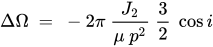
In the article orbital perturbation analysis, the secular perturbation of the orbital pole from the term of the geopotential model is shown to be

which can be expressed in terms of orbital elements thus:

Making a similar analysis for the term (corresponding to the fact that the earth is slightly pear shaped), one gets

which can be expressed in terms of orbital elements as

In the same article the secular perturbation of the components of the eccentricity vector caused by the is shown to be:

where:

  • The first term is the in-plane perturbation of the eccentricity vector caused by the in-plane component of the perturbing force
  • The second term is the effect of the new position of the ascending node in the new orbital plane, the orbital plane being perturbed by the out-of-plane force component

Making the analysis for the term one gets for the first term, i.e. for the perturbation of the eccentricity vector from the in-plane force component

For inclinations in the range 97.8–99.0 deg, the value given by (6) is much smaller than the value given by (3) and can be ignored. Similarly the quadratic terms of the eccentricity vector components in (8) can be ignored for almost circular orbits, i.e. (8) can be approximated with

Adding the contribution

to (7) one gets

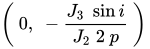
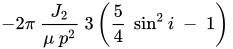
Now the difference equation shows that the eccentricity vector will describe a circle centered at the point ; the polar argument of the eccentricity vector increases with radians between consecutive orbits.
As

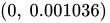
one gets for a polar orbit () with that the centre of the circle is at and the change of polar argument is 0.00400 radians per orbit.


The latter figure means that the eccentricity vector will have described a full circle in 1569 orbits. Selecting the initial mean eccentricity vector as the mean eccentricity vector will stay constant for successive orbits, i.e. the orbit is frozen because the secular perturbations of the term given by (7) and of the term given by (9) cancel out.

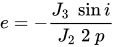
In terms of classical orbital elements, this means that a frozen orbit should have the following mean elements:
Modern theory

[edit]

The modern theory of frozen orbits is based on the algorithm given in a 1989 article by Mats Rosengren.[9]

For this the analytical expression (7) is used to iteratively update the initial (mean) eccentricity vector to obtain that the (mean) eccentricity vector several orbits later computed by the precise numerical propagation takes precisely the same value. In this way the secular perturbation of the eccentricity vector caused by the term is used to counteract all secular perturbations, not only those (dominating) caused by the term. One such additional secular perturbation that in this way can be compensated for is the one caused by the solar radiation pressure, this perturbation is discussed in the article "Orbital perturbation analysis (spacecraft)".

Applying this algorithm for the case discussed above, i.e. a polar orbit () with ignoring all perturbing forces other than the and the forces for the numerical propagation one gets exactly the same optimal average eccentricity vector as with the "classical theory", i.e. .

When we also include the forces due to the higher zonal terms the optimal value changes to .
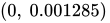
Assuming in addition a reasonable solar pressure (a "cross-sectional-area" of 0.05 m2/kg, the direction to the sun in the direction towards the ascending node) the optimal value for the average eccentricity vector becomes which corresponds to :, i.e. the optimal value is not anymore.

This algorithm is implemented in the orbit control software used for the Earth observation satellites ERS-1, ERS-2 and Envisat

Derivation of the closed form expressions for the J3 perturbation

[edit]

The main perturbing force to be counteracted in order to have a frozen orbit is the " force", i.e. the gravitational force caused by an imperfect symmetry north–south of the Earth, and the "classical theory" is based on the closed form expression for this " perturbation". With the "modern theory" this explicit closed form expression is not directly used but it is certainly still worthwhile[for whom?] to derive it. The derivation of this expression can be done as follows:

The potential from a zonal term is rotational symmetric around the polar axis of the Earth and corresponding force is entirely in a longitudinal plane with one component in the radial direction and one component with the unit vector orthogonal to the radial direction towards north. These directions and are illustrated in Figure 1.

Figure 1: The unit vectors

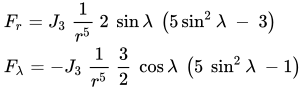
In the article Geopotential model it is shown that these force components caused by the term are

To be able to apply relations derived in the article Orbital perturbation analysis (spacecraft) the force component must be split into two orthogonal components and as illustrated in figure 2

Figure 2: The unit vector orthogonal to in the direction of motion and the orbital pole . The force component is marked as "F"

Let make up a rectangular coordinate system with origin in the center of the Earth (in the center of the Reference ellipsoid) such that points in the direction north and such that are in the equatorial plane of the Earth with pointing towards the ascending node, i.e. towards the blue point of Figure 2.

The components of the unit vectors

making up the local coordinate system (of which are illustrated in figure 2), and expressing their relation with , are as follows:

where is the polar argument of relative the orthogonal unit vectors and in the orbital plane

Firstly

where is the angle between the equator plane and (between the green points of figure 2) and from equation (12) of the article Geopotential model one therefore obtains

Secondly the projection of direction north, , on the plane spanned by is

and this projection is

where is the unit vector orthogonal to the radial direction towards north illustrated in figure 1.

From equation (11) we see that

and therefore:

In the article Orbital perturbation analysis (spacecraft) it is further shown that the secular perturbation of the orbital pole is

Introducing the expression for of (14) in (15) one gets

The fraction is

where

are the components of the eccentricity vector in the coordinate system.

As all integrals of type
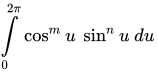
are zero if not both and are even, we see that

and

It follows that

where

and are the base vectors of the rectangular coordinate system in the plane of the reference Kepler orbit with in the equatorial plane towards the ascending node and is the polar argument relative this equatorial coordinate system
is the force component (per unit mass) in the direction of the orbit pole

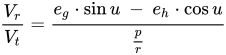
In the article Orbital perturbation analysis (spacecraft) it is shown that the secular perturbation of the eccentricity vector is

where

  • is the usual local coordinate system with unit vector directed away from the Earth
  • - the velocity component in direction
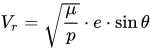
  • - the velocity component in direction
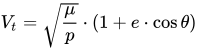
Introducing the expression for of (12) and (13) in (20) one gets

Using that

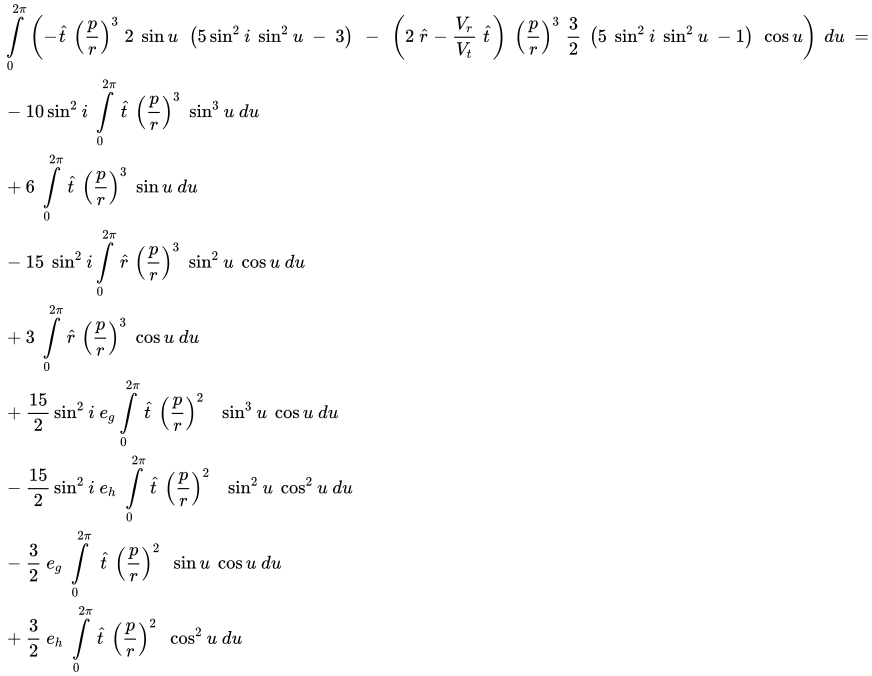
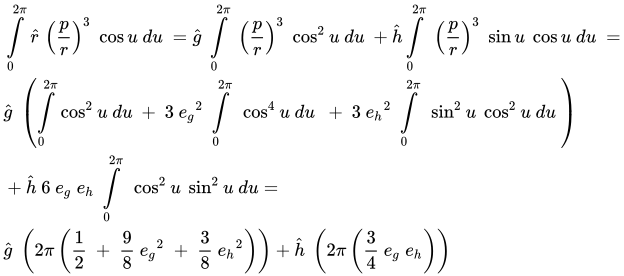
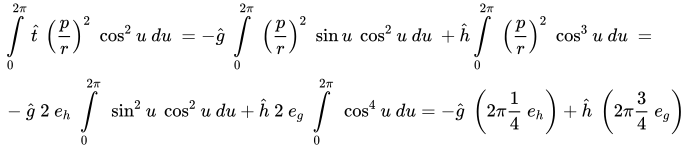
the integral above can be split in 8 terms:

Given that

we obtain

and that all integrals of type

are zero if not both and are even:

Term 1

Term 2

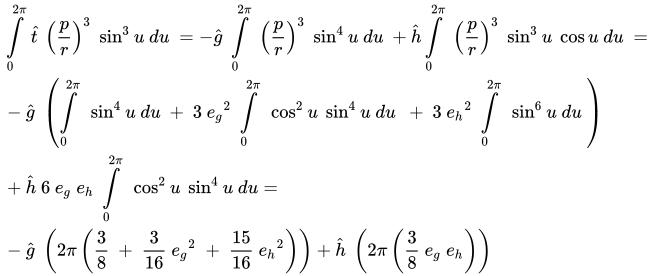
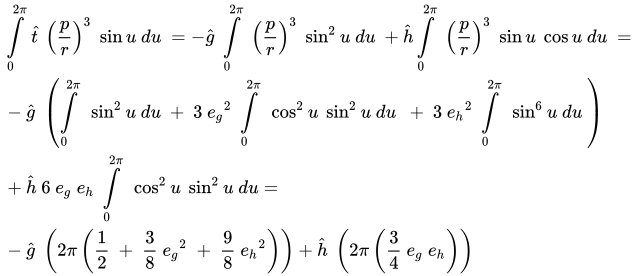
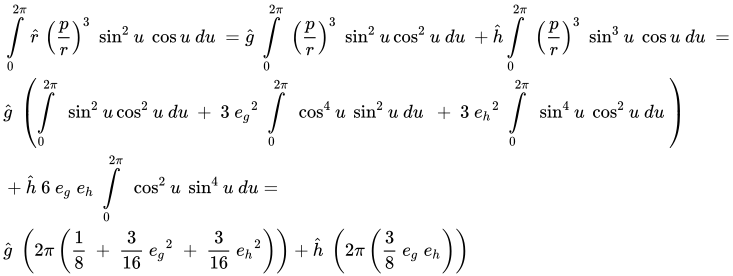
Term 3

Term 4

Term 5

Term 6

Term 7

Term 8

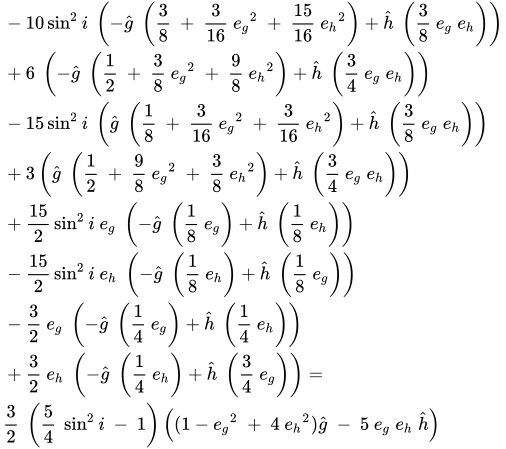
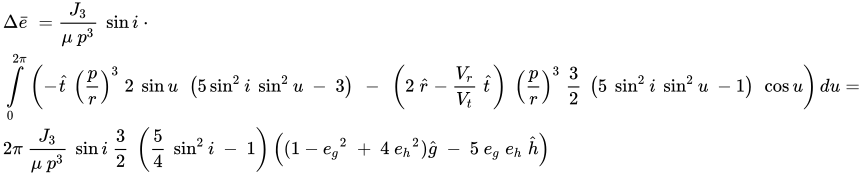
As

It follows that

References

[edit]

Further reading

[edit]
Revisions and contributorsEdit on WikipediaRead on Wikipedia
from Grokipedia
A frozen orbit is a type of orbit designed such that perturbations from the central body's non-spherical are minimized, resulting in nearly constant values for key like eccentricity and argument of perigee over extended periods. This stability is achieved by selecting specific initial conditions for the semimajor axis, inclination, eccentricity, and argument of perigee, which balance secular drifts caused by gravitational harmonics. The concept exploits the averaged effects of zonal harmonics in the , particularly the J2 oblateness term, to create equilibrium points where the time-averaged rates of change for eccentricity (de/dt ≈ 0) and of perigee (dω/dt ≈ 0) vanish. Frozen orbits are typically near-circular (eccentricity e < 0.01) and often sun-synchronous, with inclinations around 98° for Earth orbits to maintain consistent lighting conditions. These orbits can also be adapted for other bodies, such as the Moon, where mascons (mass concentrations) influence stability at specific inclinations like 27°, 50°, 76°, or 86°. Originally proposed for the SEASAT-A ocean-monitoring mission launched in 1978, frozen orbits enable long-duration missions by reducing the need for frequent station-keeping maneuvers and fuel consumption. Notable applications include Earth observation satellites like Landsat-5 and NOAA series for consistent altitude and resolution in imaging, as well as lunar missions for sustained low-altitude operations with minimal perturbations. In modern contexts, they support constellations like Swarm for geomagnetic studies and potential navigation satellites around airless bodies.

Definition and Principles

Core Concept

A frozen orbit is a trajectory for an artificial satellite in which the natural drifting of orbital elements due to perturbations from the central body's oblateness and other gravitational effects is minimized through the careful selection of initial orbital parameters, resulting in near-constant values for the argument of perigee (ω) and eccentricity (e) over extended periods, with inclination (i) selected to achieve desired properties like sun-synchronicity. This design ensures that the orbit maintains a stable shape and orientation relative to the central body, with only short-period oscillations rather than secular drifts that would otherwise require corrective maneuvers. The stability of a frozen orbit arises from balancing the perturbing influences of the central body's non-spherical gravity field, particularly the J2 (zonal harmonic representing equatorial bulge) and J3 (pear-shaped asymmetry) terms, which induce precession in the argument of perigee and variations in eccentricity. In Keplerian orbital theory, which describes unperturbed two-body motion, elements like ω, e, and i remain constant; however, perturbation theory reveals secular effects from these gravitational anomalies that cause long-term changes. Frozen orbits are achieved by selecting parameters such that the rates of change (dω/dt ≈ 0, de/dt ≈ 0) cancel out, often at critical inclinations around 63.4° for J2 dominance or with ω near 90° to nullify J3 effects, thereby reducing the need for frequent station-keeping fuel expenditure. The concept of frozen orbits was first articulated in the late 1970s, with initial applications in 1978 for missions, building on earlier studies of oblateness-induced perturbations dating back to the 18th century but adapted for modern satellite requirements.

Key Orbital Elements

A frozen orbit is characterized by specific orbital elements that minimize secular perturbations from Earth's oblate gravity field, primarily the J₂ zonal harmonic, ensuring long-term stability in key parameters. The primary elements include the inclination ii, eccentricity ee, and argument of perigee ω\omega, with ω\omega typically fixed at 90° for orbits to balance J₂ effects and prevent significant apsidal precession. The semi-major axis aa and right ascension of the ascending node Ω\Omega experience slow drifts due to higher-order perturbations but are not actively frozen. Equilibrium conditions for dω/dt = 0 are achieved at critical inclinations of approximately 63.4° (prograde) and 116.6° (retrograde) due to J2 effects. For sun-synchronous frozen orbits around Earth, an inclination near 98° is selected, with ω fixed at 90° and small e to balance overall perturbations and maintain stability in e and ω. For typical Earth observation missions, frozen orbits are sun-synchronous with i ≈ 98°, ω = 90°, and e ≈ 0.001, where the eccentricity vector is centered at (0, e_f) with e_f ≈ |J3 sin i| / (2 J2) to nullify secular changes from J3. The eccentricity is frozen at a small non-zero value, typically on the order of 0.001, to offset influences from higher harmonics like J₃, which would otherwise cause the perigee to circulate. These values interrelate such that the eccentricity vector (ecosω,esinω)(e \cos \omega, e \sin \omega) centers near (0,ef)(0, e_f), with efe_f determined by the balance of J₂ and J₃ terms. The inclination ii primarily controls nodal precession (dΩ/dtd\Omega/dt), which can be tuned for sun-synchronous behavior in retrograde cases near 98°, matching Earth's orbital motion around the Sun at approximately 0.9856° per day. The argument of perigee ω\omega, fixed at 90°, stabilizes apsidal precession by aligning the orbit such that perturbations from J₂ and odd harmonics cancel, keeping the perigee consistently in the Southern Hemisphere. Eccentricity ee, maintained at a low but non-zero level, ensures the perigee does not cross the equator, thereby avoiding variable atmospheric drag and solar radiation exposure that could degrade mission performance over time. Qualitatively, the stability of these elements manifests in the eccentricity vector tracing a small, closed loop around the frozen point in the (ecosω,esinω)(e \cos \omega, e \sin \omega) plane, with minimal long-term drift; for instance, over years, altitude variations at perigee remain bounded within a few kilometers, as opposed to circulating orbits where ω\omega would sweep 360° annually. This configuration interlinks the elements: deviations in ii alter nodal rates, affecting ground track repeatability, while perturbations in ee or ω\omega could shift the center of the loop, requiring periodic corrections.

Historical Context and Motivations

Origins and Early Concepts

The concept of frozen orbits emerged from foundational studies on the gravitational perturbations affecting artificial satellites, particularly those induced by Earth's oblateness, as explored in the mid-20th century. In the 1950s and 1960s, Dirk Brouwer developed analytical perturbation theories to model secular variations in orbital elements due to the J₂ zonal harmonic, providing the theoretical basis for understanding how Earth's non-spherical gravity field causes long-term drifts in eccentricity, inclination, and argument of perigee. These works, including Brouwer's solution to the artificial satellite problem without atmospheric drag, highlighted the stabilizing effects achievable at specific inclinations, laying the groundwork for orbits where certain elements remain nearly constant over time. By the 1970s, the practical implications of these perturbations were recognized in the design of highly elliptical orbits for high-latitude communications, notably the Molniya orbits developed by Soviet scientists in the 1960s. These orbits, with an inclination of approximately 63.4°—known as the critical inclination—exhibit a frozen argument of perigee, minimizing precession and ensuring stable apogee positioning over the Northern Hemisphere for extended periods. The first Molniya satellite was launched in 1965, demonstrating the utility of this configuration in counteracting secular effects from oblateness, though full theoretical recognition of its "frozen" nature solidified in subsequent analyses during the 1970s. The frozen orbit concept emerged in the late 1970s, with its first application to the SEASAT ocean-monitoring mission launched in 1978. It was further formalized through targeted research for oceanographic missions, extending early theories to low-Earth, near-polar trajectories. A pivotal 1986 analysis by Coffey, Deprit, and Miller examined the critical inclination's role in satellite dynamics, identifying conditions for equilibrium in the eccentricity vector that prevent long-term variations. This work directly informed mission planning for TOPEX/Poseidon, where J.C. Smith Jr. applied Brouwer's perturbation methods alongside higher-degree zonal harmonics to pinpoint frozen orbits with stable eccentricity and perigee, verified through numerical integration for altitudes around 1336 km. Concurrently, extensions to sun-synchronous orbits for remote sensing emerged, as detailed in Murrow's 1986 study, which analyzed frozen eccentricities (e.g., ~0.0012 for Landsat-5 at 98.57° inclination) to maintain consistent ground track lighting and minimize altitude oscillations. These developments bridged classical perturbation theory to practical designs, paving the way for 1990s implementations in Earth observation satellites.

Reasons for Adoption

Frozen orbits are adopted primarily for their fuel efficiency in maintaining orbital parameters over extended periods. By balancing gravitational perturbations, particularly the Earth's oblateness (J2 effect), these orbits minimize the need for frequent station-keeping maneuvers, thereby reducing the total delta-v required compared to conventional low Earth orbits. This leads to substantial propellant savings, freeing up fuel for other mission operations or extending the operational lifetime of satellites in long-duration Earth observation roles. For instance, advanced orbit control techniques in frozen orbits simplify maintenance processes and increase available fuel for on-orbit maneuvering. A key observational advantage stems from the stable ground track repetition inherent in many frozen orbits, especially those designed to be sun-synchronous, which ensures repeatable coverage of specific terrestrial regions without drift over time. The fixed local solar time maintained in such orbits provides consistent lighting conditions, crucial for imaging and remote sensing instruments to achieve uniform data quality across multiple passes. Furthermore, the frozen condition fixes the argument of perigee at approximately 90 degrees, positioning it away from polar regions to reduce variations in atmospheric drag and radiation exposure, thereby stabilizing the orbital environment for sensitive payloads. In perturbed environments like low-altitude Earth orbits, where the J2 perturbation dominates, frozen orbits provide inherent stability by preventing secular growth in eccentricity and variations in the argument of perigee, which could otherwise lead to premature orbital decay. This design is particularly beneficial for missions requiring long-term predictability without intensive corrections. Overall, these attributes enable high-precision applications such as global mapping, radar altimetry, and environmental monitoring, while eliminating the need for compensatory attitude adjustments and yielding significant cost savings in propulsion system requirements.

Applications Around Earth

Characteristics for Earth Orbits

Frozen orbits around Earth are characteristically sun-synchronous, featuring a retrograde inclination of approximately 98 degrees to achieve the required nodal precession rate of about 0.9856 degrees per day, matching Earth's orbital motion around the Sun. This configuration ensures consistent lighting conditions for Earth-observing instruments, with the high inclination enabling near-polar coverage. The argument of perigee is typically fixed at 90 degrees, which positions the apogee over the Southern Hemisphere and the perigee near the Northern Hemisphere, thereby reducing overall atmospheric drag exposure on the higher-altitude portion of the orbit. Eccentricities are maintained at low values, generally between 0.001 and 0.01, to balance the competing influences of gravitational perturbations while keeping the orbit nearly circular. These orbits are confined to low Earth altitudes ranging from 400 to 800 kilometers, corresponding to orbital periods of 90 to 100 minutes. At these heights, the dominant secular perturbations arise from the J2 oblateness term in Earth's geopotential, which induces long-term drifts in eccentricity and the argument of perigee. Frozen conditions are established by tuning the orbital elements to nullify these rates—specifically, setting de/dt ≈ 0 and dω/dt ≈ 0—through the counterbalancing effects of zonal harmonics like J2 and J3, with tesseral harmonics contributing to the stabilization against short-period variations. To sustain these characteristics amid unmodeled perturbations such as solar radiation pressure and higher-order gravity terms, occasional station-keeping maneuvers are performed, typically every few months with delta-V impulses on the order of 0.1 m/s. Such maintenance extends operational lifetimes beyond 10 years for many missions, far exceeding the natural decay timelines in low Earth orbit.

Notable Mission Examples

The concept of frozen orbits was first implemented in the SEASAT-A mission, launched in June 1978 by for oceanographic observations. Operating in a sun-synchronous orbit at 800 km altitude with 98° inclination and low eccentricity, SEASAT demonstrated the stability benefits over its 105-day mission lifetime, despite an early termination due to a power system failure. Landsat-5, launched in March 1984 by and operated until January 2013, utilized a frozen orbit at 705 km altitude, 98.2° inclination, and controlled eccentricity to support long-term Earth imaging with a 16-day repeat cycle. This configuration enabled over 28 years of operations, far exceeding its 3-year design life, with minimal fuel for orbit maintenance. One prominent example of a frozen orbit mission is , launched by the (ESA) in March 2002 and operational until April 2012, which utilized a sun-synchronous frozen eccentricity orbit at an altitude of approximately 800 km, with an inclination of 98.55° and eccentricity around 0.001 to support altimetry and comprehensive Earth observation tasks including radar imaging and atmospheric monitoring. The mission exceeded its planned five-year lifespan by achieving a full decade of operations with minimal fuel expenditure for orbit maintenance, thanks to the frozen orbit strategy that reduced the need for frequent eccentricity corrections. Post-mission reviews highlighted the strategy's efficiency, enabling significant propellant conservation—estimated at up to 8% compared to alternative maintenance approaches—while ensuring stable ground-track repetition every 35 days for consistent data collection. The MetOp series, with MetOp-A (launched 2006 and retired in 2021), MetOp-B (2012), and MetOp-C (2018), represents operational use of frozen orbits for weather monitoring, placed in sun-synchronous paths at 824 km altitude with 98.7° inclination and frozen eccentricity to maintain a 29-day repeat cycle of 412 orbits. MetOp-B and MetOp-C continue to provide polar coverage for global meteorological data with minimal drift in local time and eccentricity, supporting continuous operational services into 2025 and beyond. Minor challenges include occasional eccentricity variations influenced by atmospheric drag, particularly during solar maximum periods, which require periodic adjustments but have not compromised the missions' overall performance. CryoSat-2, launched in April 2010 by ESA, employs a frozen eccentricity orbit at 717 km altitude with 92° inclination and mean eccentricity vector components of approximately (-0.0000013, 0.0013060), argument of perigee near 90°, enabling precise radar altimetry for ice sheet and sea ice mapping. The mission has delivered over 15 years of data by 2025, revealing trends in Arctic and Antarctic ice volume with high accuracy, while the frozen design has minimized fuel use for maintaining the 369-day repeat ground track. The Swarm constellation, launched in November 2013 by ESA, consists of three satellites in a configuration at altitudes of 462 km and 511 km with 87.35° inclination, designed to study Earth's magnetic field variations with along-track separation to avoid collisions. This setup has provided a decade of high-precision geomagnetic data by 2025, including insights into core dynamics and lithospheric anomalies, with mission extensions approved through at least 2025 and potential further prolongation to 2028 pending funding. The frozen parameters have ensured stable eccentricity with only minor drifts, attributed to non-gravitational perturbations like atmospheric effects, allowing efficient fuel allocation for the multi-satellite formation. Looking ahead, ESA's Biomass mission, launched on 29 April 2025, incorporates a sun-synchronous quasi-circular frozen orbit at 666 km altitude with near-polar inclination to map global forest biomass using P-band synthetic aperture radar, building on frozen orbit benefits for repeat-pass interferometry and long-term stability in Earth science applications. These missions collectively illustrate how frozen orbits enable extended operational lifetimes and fuel efficiency, with post-mission analyses across programs like Envisat and MetOp confirming reduced station-keeping demands that preserve resources for science objectives.

Lunar and Other Body Applications

Lunar Frozen Orbit Specifics

Frozen orbits around the Moon exhibit distinct parameters shaped by the body's gravitational field, particularly its lower oblateness compared to . The Moon's J₂ coefficient is approximately 2.03 × 10⁻⁴, significantly smaller than Earth's 1.08 × 10⁻³, which results in four stable prograde inclinations of 27°, 50°, 76°, and 86°, with corresponding retrograde equivalents. These inclinations allow the argument of perigee (ω) to be frozen at 90° or 270°, minimizing secular drifts in eccentricity and perigee location. For low altitudes of 50–100 km, eccentricities are typically low, ranging from 0.001 to 0.01, enabling near-circular paths that maintain stability against J₂-induced perturbations. Unlike Earth orbits, which are limited by atmospheric drag requiring frequent propulsion for maintenance, lunar frozen orbits in low altitudes (below 500 km) can remain stable for extended periods, typically years, without frequent station-keeping maneuvers, as the Moon lacks an atmosphere. This stability arises primarily from the dominance of lunar gravity over third-body perturbations from and the Sun, which are negligible in such low orbits. Higher-order gravity anomalies like mascons introduce minor oscillations, but the frozen conditions effectively bound these effects, allowing orbits to persist for years. For polar regions, where inclinations approach 90°, quasi-frozen orbits (QFOs) provide viable alternatives, with the eccentricity vector frozen at specific points to counteract perigee precession. These QFOs, as demonstrated by the Lunar Reconnaissance Orbiter's commissioning phase, maintain near-stability over extended periods (e.g., 80 days at 30 × 200 km) with minimal fuel expenditure. Recent studies from 2020 to 2025 have explored low lunar frozen orbits for satellite constellations, highlighting their potential to support global navigation systems without ground relays, leveraging the orbits' long-term stability for continuous coverage. For instance, designs using inclinations near 86° enable regional or global communication networks with reduced station-keeping costs compared to non-frozen paths.

Uses in Other Celestial Bodies

Frozen orbits have been proposed for missions to small celestial bodies such as asteroids, where the weak gravitational field, characterized by low values of the J2 oblateness coefficient, necessitates higher orbital eccentricities to achieve stability against perturbations like solar radiation pressure. For instance, in asteroid mapping missions akin to , frozen orbit designs enable consistent global coverage by maintaining near-constant orbital elements, with the spacecraft in Orbital C phase resembling a frozen configuration at higher altitudes for extended observation periods. A 2019 study demonstrated the application of frozen orbit design and maintenance techniques to small body exploration, using Legendre polynomial expansions to derive stable orbits around irregularly shaped asteroids like Vesta, highlighting the need for adaptive control laws to counteract perturbations and ensure long-term stability with minimal fuel expenditure. For Mars and its satellites, frozen orbits offer advantages in polar observation and relay communications, particularly for Phobos and Deimos, where quasi-frozen configurations around Mars can provide persistent coverage despite the planet's non-spherical gravity. Analytical investigations have identified quasi-circular frozen orbits in the Martian gravity field up to the J4 harmonic, suitable for low-altitude polar missions that minimize eccentricity drift and argument of perigee variations, enabling efficient station-keeping for scientific surveys. The irregular gravity fields of these bodies pose significant challenges, requiring numerical optimization techniques to identify viable frozen orbit solutions under combined effects of zonal harmonics and solar radiation pressure, often solved via root-finding algorithms for equilibrium conditions. These approaches yield fuel savings of up to several meters per second per year for long-duration surveys, as maintenance maneuvers are reduced compared to non-frozen orbits. Emerging applications from 2020 to 2025 include proposals for frozen orbits in cislunar navigation supporting Artemis-era missions, such as the CS-3 Commercial Lunar Payload Services task deploying a relay satellite into an elliptical frozen orbit for small body transfer operations adjacent to lunar trajectories. These designs facilitate efficient navigation in the Earth-Moon system while extending to nearby small body intercepts, emphasizing stability in multi-body dynamics.

Theoretical Foundations

Classical Theory Overview

The classical theory of frozen orbits relies on first-order secular perturbation analysis from the J2 oblateness term in the geopotential, as outlined in Brouwer's foundational solution to the artificial satellite problem. This model computes the long-term variations in orbital elements by averaging over one orbital period, focusing on the dominant axisymmetric component of Earth's gravitational field to predict stable configurations where key elements remain nearly constant. The secular rate of change of the argument of perigee, which governs the rotation of the orbital plane relative to the equator, is derived as dωdt=32nJ2(R2a2)252sin2i(1e2)2,\frac{d\omega}{dt} = \frac{3}{2} n J_2 \left( \frac{R^2}{a^2} \right) \frac{2 - \frac{5}{2} \sin^2 i}{(1 - e^2)^2}, where nn is the mean motion, J2J_2 is the second zonal harmonic coefficient, RR is Earth's equatorial radius, aa is the semi-major axis, ee is the eccentricity, and ii is the orbital inclination. Frozen orbits occur when this rate vanishes (dω/dt=0d\omega/dt = 0), yielding the critical inclinations i63.4i \approx 63.4^\circ for prograde orbits and i116.6i \approx 116.6^\circ for retrograde orbits, at which the perigee neither advances nor regresses secularly. To establish full equilibrium, the theory sets the secular rates of eccentricity and inclination to zero (de/dt=0de/dt = 0 and di/dt=0di/dt = 0) through the averaged Lagrange planetary equations, which describe how perturbations alter the Keplerian elements over time. These equations assume an axisymmetric potential, neglecting non-zonal contributions, and yield conditions where the eccentricity vector remains fixed in the orbital plane, minimizing altitude variations at perigee and apogee. Developed primarily in the 1950s through the 1980s for early satellite mission design, this analytical framework enabled rapid parameter selection without extensive computation, influencing initial planning for geostationary and polar missions. Its limitations include omission of J3 and higher zonal terms, as well as tesseral harmonics from Earth's non-uniform rotation, making it accurate for high-eccentricity or near-equatorial regimes but insufficient for stable polar frozen orbits near i=90i = 90^\circ.

Modern Theoretical Advances

In the 1990s, theoretical models extended classical analyses by incorporating the J3 zonal harmonic, which accounts for the Earth's slight triaxial asymmetry and shifts the equilibrium eccentricity of frozen orbits from zero to a small non-zero value, enabling precise placement of the argument of perigee at 90° for critical mission requirements like consistent ground-track patterns. This adjustment breaks the symmetry introduced by even harmonics alone, producing stable equilibria where the perigee remains over the , as derived in averaged perturbation equations for inclinations near 90°. Numerical methods have since advanced to handle higher-order and irregular gravity fields beyond low-degree zonal terms, employing optimization algorithms such as differential evolution—rooted in genetic principles—to iteratively search for orbital parameters that minimize secular drifts in eccentricity and argument of perigee. These approaches facilitate simulations with comprehensive gravity models like EGM96, which includes up to degree and order 360, allowing for accurate propagation of frozen orbit conditions under tesseral and sectoral harmonics that classical theories overlook. Recent developments from 2019 to 2024 have focused on quasi-frozen orbits, which tolerate minor drifts while maintaining near-equilibrium states, particularly for near-polar low lunar orbits targeting polar regions with periselene altitudes as low as 10-20 km. These orbits, identified through high-fidelity averaging and station-keeping analyses, exhibit bounded eccentricity variations over mission durations, supporting persistent observation of lunar south pole sites. Concurrently, constellation designs leveraging frozen orbits have emerged for stable low-altitude networks, optimizing satellite phasing in elliptical frozen configurations to achieve uniform coverage with reduced collision risks and fuel demands. Advancements in predictive modeling now enable assessments of long-term stability exceeding 10 years by integrating full ephemeris data and higher-degree gravity fields, revealing that well-designed frozen orbits maintain perigee altitude variations below 5 km over such periods without intervention. Furthermore, extensions to multi-body dynamics incorporate third-body perturbations from the Sun and Earth into cislunar orbit propagation, enhancing stability forecasts for hybrid Earth-Moon systems and informing trajectory designs for deep-space gateways.

Perturbation Analysis

J2 Perturbation Effects

The J2 perturbation term quantifies the dominant gravitational effect arising from a central body's equatorial bulge due to its oblateness, formally defined as the zonal harmonic coefficient C20=J2C_{20} = -J_2 in the spherical harmonics expansion of the gravitational potential. For Earth, J21.0826×103J_2 \approx 1.0826 \times 10^{-3}, while for the Moon, it is significantly weaker at J22.034×104J_2 \approx 2.034 \times 10^{-4}. This oblateness induces secular precessions in key orbital elements, primarily the right ascension of the ascending node Ω\Omega and the argument of perigee ω\omega. The nodal precession rate due to J2 is given by Ω˙=32nJ2(Ra)2cosi(1e2)2,\dot{\Omega} = -\frac{3}{2} n J_2 \left( \frac{R}{a} \right)^2 \frac{\cos i}{(1 - e^2)^2}, where n=μ/a3n = \sqrt{\mu / a^3}
Add your contribution
Related Hubs
User Avatar
No comments yet.