Hubbry Logo
Functional equationFunctional equationMain
Open search
Functional equation
Community hub
Functional equation
logo
7 pages, 0 posts
0 subscribers
Be the first to start a discussion here.
Functional equation
Functional equation
from Wikipedia

In mathematics, a functional equation [1][2][irrelevant citation] is, in the broadest meaning, an equation in which one or several functions appear as unknowns. So, differential equations and integral equations are functional equations. However, a more restricted meaning is often used, where a functional equation is an equation that relates several values of the same function. For example, the logarithm functions are essentially characterized by the logarithmic functional equation

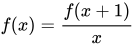
If the domain of the unknown function is supposed to be the natural numbers, the function is generally viewed as a sequence, and, in this case, a functional equation (in the narrower meaning) is called a recurrence relation. Thus the term functional equation is used mainly for real functions and complex functions. Moreover a smoothness condition is often assumed for the solutions, since without such a condition, most functional equations have highly irregular solutions. For example, the gamma function is a function that satisfies the functional equation and the initial value There are many functions that satisfy these conditions, but the gamma function is the unique one that is meromorphic in the whole complex plane, and logarithmically convex for x real and positive (Bohr–Mollerup theorem).

Examples

[edit]
  • Recurrence relations can be seen as functional equations in functions over the integers or natural numbers, in which the differences between terms' indexes can be seen as an application of the shift operator. For example, the recurrence relation defining the Fibonacci numbers, , where and
  • , which characterizes the periodic functions
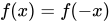
  • , which characterizes the even functions, and likewise , which characterizes the odd functions
  • , which characterizes the functional square roots of the function g
  • (Cauchy's functional equation), satisfied by linear maps. The equation may, contingent on the axiom of choice, also have other pathological nonlinear solutions, whose existence can be proven with a Hamel basis for the real numbers
  • satisfied by all exponential functions. Like Cauchy's additive functional equation, this too may have pathological, discontinuous solutions
  • , satisfied by all logarithmic functions and, over coprime integer arguments, additive functions
  • , satisfied by all power functions and, over coprime integer arguments, multiplicative functions
  • (quadratic equation or parallelogram law)
  • (Jensen's functional equation)
  • (d'Alembert's functional equation)
  • (Abel equation)
  • (Schröder's equation).
  • (Böttcher's equation).
  • (Julia's equation).
  • (Levi-Civita),
  • (sine addition formula and hyperbolic sine addition formula),
  • (cosine addition formula),
  • (hyperbolic cosine addition formula).
  • The commutative and associative laws are functional equations. In its familiar form, the associative law is expressed by writing the binary operation in infix notation, but if we write f(a, b) instead of ab then the associative law looks more like a conventional functional equation,
  • The functional equation is satisfied by the Riemann zeta function[a]. The capital Γ denotes the gamma function.
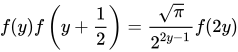
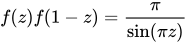
  • The gamma function is the unique solution of the following system of three equations:[citation needed]
    •           (Euler's reflection formula)
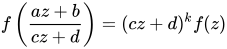
  • The functional equation where a, b, c, d are integers satisfying , i.e. = 1, defines f to be a modular form of order k.

One feature that all of the examples listed above have in common is that, in each case, two or more known functions (sometimes multiplication by a constant, sometimes addition of two variables, sometimes the identity function) are inside the argument of the unknown functions to be solved for.

When it comes to asking for all solutions, it may be the case that conditions from mathematical analysis should be applied; for example, in the case of the Cauchy equation mentioned above, the solutions that are continuous functions are the 'reasonable' ones, while other solutions that are not likely to have practical application can be constructed (by using a Hamel basis for the real numbers as vector space over the rational numbers). The Bohr–Mollerup theorem is another well-known example.

Involutions

[edit]

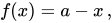
The involutions are characterized by the functional equation . These appear in Babbage's functional equation (1820),[3]


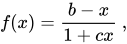
Other involutions, and solutions of the equation, include

  • and

which includes the previous three as special cases or limits.

Solution

[edit]

In dynamic programming a variety of successive approximation methods[4][5] are used to solve Bellman's functional equation, including methods based on fixed point iterations.

See also

[edit]

Notes

[edit]

References

[edit]

Bibliography

[edit]
[edit]
Revisions and contributorsEdit on WikipediaRead on Wikipedia
from Grokipedia
In mathematics, a functional equation is an equation in which one or more functions appear as unknowns to be determined, rather than numerical variables. These equations typically relate the values of the unknown function at different points in its domain, often involving operations such as addition, multiplication, or composition, and they seek to find all functions—such as continuous, differentiable, or otherwise restricted—that satisfy the relation for specified inputs. A classic example is Cauchy's functional equation, f(x+y)=f(x)+f(y)f(x + y) = f(x) + f(y), which, under assumptions like continuity, yields linear functions f(x)=cxf(x) = cx over the real numbers. Functional equations arise across diverse mathematical fields, including analysis, algebra, number theory, and combinatorics, as well as in applications to physics, engineering, and economics, where they model phenomena like exponential growth or symmetry properties. For instance, the equation f(x+y)=f(x)f(y)f(x + y) = f(x)f(y) with f(0)=1f(0) = 1 describes exponential functions, relevant to radioactive decay and population models. Solutions often require techniques such as substitution, assuming differentiability, or exploiting group structures, but no universal method exists, making their study a blend of creativity and rigorous analysis. Historically, functional equations gained prominence in the 19th century through works by mathematicians like Cauchy and d'Alembert, evolving into a rich area of research with connections to modern topics like quantum mechanics.

Definition and Fundamentals

Definition

In mathematics, a functional equation is an equality between two expressions formed from a finite number of superpositions of functions (at least one of which is unknown) and independent variables. This contrasts with ordinary algebraic or differential equations, where the unknowns are typically numerical values or constants rather than entire functions. Functional equations arise in various fields, including analysis, algebra, and applied mathematics, and their study focuses on finding functions that satisfy the given relation across specified domains. A precise formulation of a functional equation is an equation of the form F(x,f(x),f(y),)=0F(x, f(x), f(y), \dots) = 0, where ff is the unknown function to be determined, and x,y,x, y, \dots are variables ranging over appropriate sets. More generally, these equations express relationships such as f(x+y)=g(f(x),f(y))f(x + y) = g(f(x), f(y)) for some known function gg, where the unknowns are functions rather than scalars. The solutions are functions f:ABf: A \to B, with AA denoting the domain (the set of allowable inputs) and BB the codomain (the set containing possible outputs), such that the equation holds for all elements in the relevant domain subsets. The well-posedness of functional equations often depends on prerequisite concepts like the specification of domain and codomain, which define the scope over which the function operates. Additionally, auxiliary assumptions such as continuity or monotonicity are frequently imposed on ff to ensure uniqueness or restrict pathological solutions, particularly in real analysis settings where the axiom of choice might otherwise yield non-measurable functions. These conditions help delineate the class of admissible solutions without altering the core equation.

Basic Properties

Functional equations often exhibit uniqueness of solutions under specific conditions, such as the completeness of the domain equipped with a suitable metric structure. For instance, in Banach spaces, the completeness ensures that iterative methods converge to unique fixed points or solutions for contractive mappings related to the equation. A seminal result by Aczél provides uniqueness for a broad class of equations of the form AF(x,y)=H(F(x),F(y),x,y)A F(x,y) = H(F(x), F(y), x, y) on intervals, where the solution FF is unique up to an additive constant or affine transformation, assuming the functions satisfy regularity conditions like continuity. This theorem highlights how domain properties and the form of HH enforce that any two solutions differ by a prescribed transformation, preventing multiplicity without additional constraints. Stability is a fundamental property indicating that small perturbations in the equation still yield solutions close to the exact ones. The Hyers-Ulam stability, originating from Ulam's problem on approximate homomorphisms and resolved by Hyers, applies to additive functional equations in Banach spaces: if f(x+y)f(x)f(y)ϵ|f(x+y) - f(x) - f(y)| \leq \epsilon for all x,yx, y in a Banach space, then there exists an exact additive solution gg such that f(x)g(x)δ\|f(x) - g(x)\| \leq \delta for some δ\delta depending on ϵ\epsilon. This property extends to various nonlinear equations, ensuring robustness in applications like approximation theory, where approximate solutions in complete spaces remain stable under bounded errors. Symmetry in functional equations manifests as invariance under operations like variable swaps, imposing structural constraints on solutions. For equations symmetric in their arguments, such as those where swapping xx and yy leaves the form unchanged, solutions often inherit this symmetry, leading to even functions or paired behaviors like f(x)=f(y)f(x) = f(y) for interchanged variables. This invariance simplifies solving by reducing the equation to symmetric cases, as seen in bilateral equations where the solution space is restricted to symmetric or antisymmetric functions. The equation f(f(x))=xf(f(x)) = x defines an involution, implying bijectivity of ff on its domain, as ff serves as its own inverse, ensuring both injectivity (distinct inputs map to distinct outputs) and surjectivity (every element is reached). In broader contexts, functional equations implying involutive properties, such as certain iterative equations, force solutions to be one-to-one mappings, which is crucial for invertibility in dynamical systems. Assumptions like additivity or continuity profoundly influence property inheritance in functional equations. For Cauchy's additive equation f(x+y)=f(x)+f(y)f(x + y) = f(x) + f(y) over the reals, continuity or measurability guarantees the unique solution f(x)=cxf(x) = c x, inheriting linearity from the rationals to the full domain via density arguments. Without such axioms, pathological non-linear solutions exist using Hamel bases, but additivity alone propagates vector space properties. In Jensen's midpoint equation f(x+y2)=f(x)+f(y)2f\left( \frac{x+y}{2} \right) = \frac{f(x) + f(y)}{2}, assuming continuity yields quadratic solutions, and the equation underpins Jensen's inequality for convex functions: for convex ff, f(λixi)λif(xi)f\left( \sum \lambda_i x_i \right) \leq \sum \lambda_i f(x_i) with λi=1\sum \lambda_i = 1, λi0\lambda_i \geq 0, linking additivity-like structures to convexity preservation. Pexider equations generalize Cauchy's form as f(x+y)=g(x)+h(y)f(x + y) = g(x) + h(y), preserving affine properties under regularity assumptions like measurability. Solutions are affine: f(x)=cx+af(x) = c x + a, g(x)=cx+bg(x) = c x + b, h(y)=cy+dh(y) = c y + d with constants satisfying compatibility, ensuring the equation's structure inherits translation invariance and linearity from the underlying additive group. This generalization maintains uniqueness in complete normed spaces, where perturbations lead to nearby affine functions via stability extensions.

Historical Development

Early History

The origins of functional equations lie in ancient mathematical traditions where relations between quantities were explored implicitly through geometric and algebraic means. In ancient Greece around 300 BCE, Euclid's Elements examined proportional relationships in geometry, such as those in similar triangles and circles, which implicitly defined dependencies akin to functions between variables like lengths and angles. These constructions provided early insights into how one magnitude determines another, laying groundwork for later explicit formulations. Medieval Islamic scholars further advanced algebraic frameworks that supported functional thinking. Muhammad ibn Musa al-Khwarizmi, in his circa 820 CE treatise Al-Kitab al-mukhtasar fi hisab al-jabr wal-muqabala, systematized solutions to linear and quadratic equations using completion and balancing techniques, addressing practical problems in inheritance and measurement; this algebraic rigor created a context for relating variables in ways that prefigured functional equations. The 17th century saw precursors emerge amid the development of calculus. John Wallis's Arithmetica Infinitorum (1656) utilized interpolation on infinite sequences to compute areas under curves, treating discrete values as approximations to continuous functions and introducing methods for handling variable dependencies without formal notation. Concurrently, Jacob Bernoulli's publications in the 1680s, including studies on infinite series in Acta Eruditorum, analyzed expansions for compound interest and probability distributions, which functioned as early generating forms relating sums to their terms. By the mid-18th century, explicit functional equations appeared in analytical works. In 1747, Jean le Rond d'Alembert's research on vibrating strings in Mémoire sur la propagation des sons employed the cosine addition formula, satisfying the relation f(x+y)+f(xy)=2f(x)f(y)f(x+y) + f(x-y) = 2 f(x) f(y), to model wave propagation as a physical dependency. The following year, Leonhard Euler's Introductio in analysin infinitorum (1748) directly examined equations like f(x+y)=f(x)f(y)f(x+y) = f(x) f(y) for exponential functions, defining functions analytically and emphasizing their role in series and transformations. These early developments were motivated by needs in physics and analysis, such as resolving differential relations in wave motion and integrating series without contemporary symbolic tools, thus connecting geometric intuition to emerging analytical methods.

19th and 20th Century Advances

In the early 19th century, Augustin-Louis Cauchy formalized the study of additive functional equations with his 1821 analysis of the equation f(x+y)=f(x)+f(y)f(x + y) = f(x) + f(y) for functions f:RRf: \mathbb{R} \to \mathbb{R}. He proved that under the assumption of continuity, all solutions are linear, specifically of the form f(x)=kxf(x) = kx for some constant kRk \in \mathbb{R}. This result, now known as Cauchy's theorem on continuous solutions, established a foundational benchmark for regularity conditions in functional equations. Building on this, Niels Henrik Abel advanced the field in 1826 through his investigation of functions of two independent variables satisfying specific addition properties, particularly those emerging from binomial series expansions. His work introduced systematic methods for deriving functional forms related to elliptic integrals and series convergence, influencing subsequent developments in analytic functional equations. During the 1830s, extensions of Cauchy's insights examined bounded solutions to additive equations. It was shown that if an additive function is bounded on some interval, it must be linear throughout the reals, providing a crucial extension beyond mere continuity to local boundedness. This theorem underscored the pathological potential of unbounded solutions without regularity assumptions, shaping later discussions on the scope of functional equations. The late 19th and early 20th centuries revealed the existence of non-linear "pathological" solutions, dramatically altering the landscape. In 1905, Georg Hamel constructed such solutions using a Hamel basis for R\mathbb{R} as a vector space over Q\mathbb{Q}, showing that additive functions need not be linear without additional constraints like continuity or measurability. These wild solutions, which are linear over Q\mathbb{Q} but highly discontinuous, rely on the axiom of choice and illustrate the role of rational vector spaces in generating non-measurable functions. In the mid-1910s, Hugo Steinhaus and Wacław Sierpiński showed that Lebesgue measurable additive functions coincide with the linear ones. The 20th century brought a systematic unification of the field. János Aczél, starting in the 1940s, pioneered a comprehensive theory of functional equations, emphasizing stability and generalization across domains. His seminal 1966 book, Lectures on Functional Equations and Their Applications, synthesized prior advances and introduced tools for solving equations under various regularity conditions, solidifying the modern framework. Complementing this, Palaniappan Kannappan in the 1970s focused on stability theory, proving results for equations like the cosine functional equation f(x+y)+f(xy)=2f(x)f(y)f(x + y) + f(x - y) = 2f(x)f(y), showing that approximate solutions are close to exact ones under Hyers-Ulam conditions. These contributions emphasized the robustness of functional equations in applied contexts, such as approximation theory.

Classification of Functional Equations

By Structure and Linearity

Functional equations are classified by their algebraic structure, with a primary distinction drawn between linear and nonlinear forms. Linear functional equations are characterized by the unknown function appearing linearly, typically expressible as Af(x)+Bg(x)=h(x)Af(x) + Bg(x) = h(x), where AA and BB are linear operators acting on the function space, such as shifts, scalings, or compositions, and hh is a given function. This structure arises naturally in contexts where the equation models additive or proportional behaviors in the function. A seminal treatment of such equations emphasizes their role in preserving vector space properties over suitable domains. In the homogeneous case, h(x)=0h(x) = 0, yielding Af(x)+Bg(x)=0Af(x) + Bg(x) = 0, which often implies that solutions form a vector space themselves, facilitating superposition principles for combining particular solutions. The inhomogeneous case, with nonzero h(x)h(x), requires finding a particular solution to the nonhomogeneous equation and adding the general solution to the associated homogeneous equation. For instance, Cauchy's additive equation f(x+y)=f(x)+f(y)f(x + y) = f(x) + f(y) exemplifies a homogeneous linear form, where the operators involve translation invariance. This classification extends to systems where multiple functions satisfy coupled linear relations. Nonlinear functional equations deviate from this linearity, often involving products, powers, or compositions of the function, leading to more complex solution sets that may not admit superposition. Multiplicative equations, such as f(xy)=f(x)f(y)f(xy) = f(x)f(y), represent a key nonlinear structure, preserving the multiplicative group operation rather than addition; solutions typically include exponential functions under regularity assumptions like continuity. Iterative equations, like f(n)(x)=xf^{(n)}(x) = x for the n-fold composition f(n)f^{(n)}, capture periodic or cyclic behaviors and are inherently nonlinear due to the nested application of the function. These forms highlight structures beyond vector space linearity, often requiring logarithmic or iterative substitutions for analysis. The distinction between additive and multiplicative structures hinges on the underlying group operation: additive equations align with abelian groups under addition, as in Cauchy's form, while multiplicative ones align with multiplication, akin to exponential equations. Criteria for categorization include the presence of sum terms (additive) versus product terms (multiplicative), with Cauchy's additive equation f(x+y)=f(x)+f(y)f(x + y) = f(x) + f(y) contrasting the multiplicative f(xy)=f(x)f(y)f(xy) = f(x)f(y), whose solutions relate via f(x)=eg(lnx)f(x) = e^{g(\ln x)} for an additive gg under appropriate domains. This duality underscores how structure dictates solution techniques, such as taking logarithms to linearize multiplicative cases. Linearity in functional equations is preserved under affine substitutions and transformations, allowing generalizations like Pexiderized forms to maintain structural properties. The Pexiderized variant of Cauchy's equation, f(x+y)=g(x)+h(y)f(x + y) = g(x) + h(y), extends the homogeneous linear case by introducing auxiliary functions, yet solutions often reduce to affine forms f(x)=l(x)+cf(x) = l(x) + c, g(x)=l(x)+dg(x) = l(x) + d, h(x)=l(x)+eh(x) = l(x) + e via substitutions that absorb constants, preserving the additive linearity. Such transformations ensure that the equation's core linear structure endures, facilitating solvability through reduction to standard linear cases.

By Domain and Variables

Functional equations can be categorized based on the domain of the functions they involve, which determines the applicable mathematical tools and the nature of potential solutions. Common domains include the real numbers ℝ, the complex numbers ℂ, discrete sets such as the integers ℤ, and more general structures like Banach spaces. This classification highlights how the underlying space influences properties like continuity, analyticity, or discreteness in the solutions. Over the real numbers ℝ, functional equations frequently specify functions that are continuous, measurable, or monotonic, enabling the application of real analysis techniques such as integration or differentiation to derive solutions. For instance, equations defined for all x,yRx, y \in \mathbb{R} often assume real-valued outputs to exploit order properties and completeness of ℝ. In contrast, equations over the complex domain ℂ typically require holomorphic or analytic solutions, where the complex structure allows for powerful tools like the Cauchy integral formula or residue theorem, but demands careful handling of singularities and branch cuts. The transition from real to complex domains can extend solutions via analytic continuation, though real restrictions may yield non-analytic behaviors not preservable in ℂ. Discrete domains, particularly the integers ℤ or natural numbers ℕ, frame functional equations as recurrence relations, where the function's values are defined iteratively based on prior terms. A prototypical form is f(n+1)=af(n)+bf(n+1) = a f(n) + b for nZn \in \mathbb{Z}, with constant a,ba, b, which models sequences in combinatorics and difference equations; solutions often involve characteristic equations analogous to linear recurrences. Mixed domains, such as mappings from ℤ to ℝ, blend discrete inputs with continuous outputs, useful in number theory or dynamical systems, where integer steps inform real-valued behaviors without full continuity assumptions. The number and variety of variables further refine this classification. Single-variable (unary) functional equations involve one argument, such as compositions like f(x)=g(f(h(x)))f(x) = g(f(h(x))) for xx in the domain, emphasizing iterative or transformational properties within a single dimension. Multi-variable equations, by contrast, incorporate two or more arguments, often exploring symmetries or joint behaviors, as in f(x,y)=f(y,x)f(x,y) = f(y,x) for all x,yx, y in the domain, which enforces invariance under permutation and arises in group theory or invariant theory. These extend unary cases by considering interactions across variables, with solutions potentially factorizable or homogeneous. Vector-valued functional equations generalize scalar cases to functions between normed spaces, particularly Banach spaces, where the codomain is a complete normed vector space. Here, equations like f(x+y)=f(x)+f(y)f(x+y) = f(x) + f(y) hold for x,yx, y in a Banach space XX, with f:XYf: X \to Y and YY another Banach space, leveraging linearity and completeness to ensure additivity or contractivity; such settings are crucial in operator theory and nonlinear analysis, where pathological solutions require additional regularity like measurability.

Solution Techniques

Analytical Approaches

Analytical approaches to solving functional equations rely on assumptions of differentiability, integrability, or analyticity to transform the equations into more tractable forms, such as ordinary differential equations (ODEs), integral equations, or algebraic systems. These methods are particularly effective for equations where the unknown function belongs to a class of sufficiently smooth functions, allowing the application of calculus tools to derive explicit solutions or characterize the solution space.

Differentiation Methods

One primary technique involves assuming the unknown function ff is differentiable and differentiating the functional equation with respect to one or more variables, often reducing it to an ODE. For instance, consider Cauchy's functional equation f(x+y)=f(x)f(y)f(x + y) = f(x) f(y) for x,yRx, y \in \mathbb{R}, assuming ff is differentiable and f0f \neq 0. Differentiating both sides with respect to yy yields f(x+y)=f(x)f(y)f'(x + y) = f(x) f'(y); setting y=0y = 0 gives f(x)=f(x)f(0)f'(x) = f(x) f'(0). This is a separable ODE: f(x)f(x)=f(0)\frac{f'(x)}{f(x)} = f'(0), whose solution is lnf(x)=f(0)x+C\ln |f(x)| = f'(0) x + C, or f(x)=Aekxf(x) = A e^{k x} where k=f(0)k = f'(0) and A=±eCA = \pm e^C, recovering the exponential solutions under the differentiability assumption. More generally, differentiation with respect to a parameter in parameterized functional equations, such as w(x,y)=θ(x,y,a)w(ϕ(x,y,a),ψ(x,y,a))w(x, y) = \theta(x, y, a) w(\phi(x, y, a), \psi(x, y, a)), produces a partial differential equation (PDE) upon setting the parameter to a specific value. Solving the resulting PDE via characteristic methods then yields candidate solutions, which are verified in the original equation. This approach applies to Pexider's equation f(x)+g(y)=h(x+y)f(x) + g(y) = h(x + y), where differentiation with respect to xx and yy leads to h(z)=0h''(z) = 0, implying h(z)=az+bh(z) = a z + b and affine forms for ff and gg.

Integral Transforms

Integral transforms, such as the Laplace or Fourier transform, are useful for convolution-type functional equations, where the equation involves an integral operator. For an equation of the form f(x)=k(t)f(xt)dt+g(x)f(x) = \int_{-\infty}^{\infty} k(t) f(x - t) \, dt + g(x), applying the Fourier transform yields f^(ω)=k^(ω)f^(ω)+g^(ω)\hat{f}(\omega) = \hat{k}(\omega) \hat{f}(\omega) + \hat{g}(\omega), allowing isolation of f^(ω)=g^(ω)1k^(ω)\hat{f}(\omega) = \frac{\hat{g}(\omega)}{1 - \hat{k}(\omega)} provided 1k^(ω)01 - \hat{k}(\omega) \neq 0, such as when k^(ω)<1|\hat{k}(\omega)| < 1. The inverse transform then recovers ff. The Laplace transform similarly handles equations on [0,)[0, \infty), turning convolutions into algebraic multiplications, as in renewal equations f(x)=g(x)+0xf(xt)g(t)dtf(x) = g(x) + \int_0^x f(x - t) g(t) \, dt, yielding f~(s)=g~(s)1g~(s)\tilde{f}(s) = \frac{\tilde{g}(s)}{1 - \tilde{g}(s)}. These transforms reduce the functional equation to an algebraic one in the transformed space, solvable under integrability assumptions, with the original solution obtained via inversion. Such methods are standard for linear equations with kernel functions.

Series Expansions

For analytic functions, assuming a power series representation f(x)=n=0anxnf(x) = \sum_{n=0}^{\infty} a_n x^n and substituting into the functional equation equates coefficients, yielding recurrence relations for the ana_n. Convergence is verified using ratio or root tests, often ensuring solutions within the radius of convergence. For example, in f(x+y)=f(x)+f(y)f(x + y) = f(x) + f(y), substitution leads to relations implying an=0a_n = 0 for n1n \neq 1 and a1a_1 arbitrary, giving linear solutions f(x)=cxf(x) = c x. This method extends to nonlinear cases, transforming the equation into a system of algebraic equations for coefficients.

Fixed-Point Theorems

In complete metric spaces, such as the space of continuous functions on a compact interval with the sup norm, the Banach contraction mapping theorem guarantees unique fixed points for contraction operators, applicable to integral formulations of functional equations. For an equation recast as f=Tff = T f where TT is a contraction (e.g., TfTgkfg\|T f - T g\| \leq k \|f - g\| with k<1k < 1), the theorem ensures a unique solution as the limit of iterates fn+1=Tfnf_{n+1} = T f_n. In dynamic programming contexts, equations like w(x)=λsupy[p(x,y)+q(a(x,y),b(x,y))w(c(x,y))]w(x) = \lambda \sup_{y} [p(x, y) + q(a(x, y), b(x, y)) w(c(x, y))] with 0λ<10 \leq \lambda < 1 and bounded functions satisfy contraction conditions on bounded complete metric spaces, yielding unique solutions with error bounds wnwλn1λw1w0\|w_n - w\| \leq \frac{\lambda^n}{1 - \lambda} \|w_1 - w_0\|.

Iterative and Transform Methods

Iterative methods involve repeated application of the functional equation to generate sequences of functions or values that converge to a solution, particularly useful for non-differentiable cases where local analysis fails. Successive substitution, a basic iterative technique, rewrites the equation in a fixed-point form x=g(x)x = g(x) and iterates xn+1=g(xn)x_{n+1} = g(x_n) starting from an initial guess, often revealing periodic solutions or cycles in equations like f(f(x))=xf(f(x)) = x. For instance, in involution equations where f2(x)=xf^2(x) = x, iteration identifies fixed points and 2-cycles by tracking orbits under repeated composition. This approach extends to higher iterates, such as solving A2n(x)=F(x)A^{2^n}(x) = F(x) using composita to construct solutions via binary exponentiation of iterations. A more advanced iterative framework is provided by Schröder's equation, ψ(f(x))=λψ(x)\psi(f(x)) = \lambda \psi(x), which linearizes the iteration around a fixed point where f(a)=af(a) = a and λ=f(a)0,1\lambda = f'(a) \neq 0,1. Here, the conjugacy ψ\psi transforms the nonlinear iteration fn(x)f^n(x) into multiplication by λn\lambda^n, facilitating computation of fractional or continuous iterates via ft(x)=ψ1(λtψ(x))f^t(x) = \psi^{-1}(\lambda^t \psi(x)). Solutions exist analytically near the fixed point under suitable analyticity assumptions on ff, with ψ\psi constructed as a power series. This linearization applies to equations in one or several variables, provided the derivative at the fixed point has full rank. For recursive functional equations defined on integers, such as f(n+1)=f(n)+f(n1)f(n+1) = f(n) + f(n-1) with initial conditions, ordinary generating functions offer a closed-form solution by transforming the recurrence into an algebraic equation. Define the generating function G(z)=n=0f(n)znG(z) = \sum_{n=0}^\infty f(n) z^n; multiplying the recurrence by zn+1z^{n+1} and summing yields G(z)=f(0)+(f(1)f(0))z1zz2G(z) = \frac{f(0) + (f(1) - f(0))z}{1 - z - z^2}, whose coefficients recover f(n)f(n) via partial fractions or binomial expansions. This method generalizes to linear recurrences with constant coefficients, converting difference equations into rational functions for explicit solutions. Transform methods, particularly integral transforms, address scale-invariant functional equations like f(ax)=bf(x)f(ax) = b f(x) by converting them into simpler algebraic or differential forms. The Mellin transform, Mf(s)=0xs1f(x)dxM_f(s) = \int_0^\infty x^{s-1} f(x) \, dx, applied to such equations yields asMf(s)=bMf(s)a^{-s} M_f(s) = b M_f(s), implying Mf(s)=0M_f(s) = 0 unless s=logb/logas = -\log b / \log a, which identifies power-law solutions f(x)=cxαf(x) = c x^{\alpha} with α=logb/loga\alpha = \log b / \log a. This transform exploits the multiplicative structure, making it ideal for homogeneous equations on positive reals, and inversion recovers ff via the inverse Mellin formula. Similarly, wavelet transforms solve dilation equations in multiresolution analysis, such as ϕ(x)=2khkϕ(2xk)\phi(x) = \sqrt{2} \sum_k h_k \phi(2x - k)
Add your contribution
Related Hubs
User Avatar
No comments yet.