


Community hub
Recent from talks
Contribute something
Nothing was collected or created yet.
Even and odd functions
View on Wikipedia

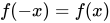
In mathematics, an even function is a real function such that for every in its domain. Similarly, an odd function is a function such that for every in its domain.


They are named for the parity of the powers of the power functions which satisfy each condition: the function is even if n is an even integer, and it is odd if n is an odd integer.

Even functions are those real functions whose graph is self-symmetric with respect to the y-axis, and odd functions are those whose graph is self-symmetric with respect to the origin.
If the domain of a real function is self-symmetric with respect to the origin, then the function can be uniquely decomposed as the sum of an even function and an odd function.
Early history
[edit]The concept of even and odd functions appears to date back to the early 18th century, with Leonard Euler playing a significant role in their formalization. Euler introduced the concepts of even and odd functions (using Latin terms pares and impares) in his work Traiectoriarum Reciprocarum Solutio from 1727. Before Euler, however, Isaac Newton had already developed geometric means of deriving coefficients of power series when writing the Principia (1687), and included algebraic techniques in an early draft of his Quadrature of Curves, though he removed it before publication in 1706. It is also noteworthy that Newton didn't explicitly name or focus on the even-odd decomposition, his work with power series would have involved understanding properties related to even and odd powers.
Definition and examples
[edit]Evenness and oddness are generally considered for real functions, that is real-valued functions of a real variable. However, the concepts may be more generally defined for functions whose domain and codomain both have a notion of additive inverse. This includes abelian groups, all rings, all fields, and all vector spaces. Thus, for example, a real function could be odd or even (or neither), as could a complex-valued function of a vector variable, and so on.
The given examples are real functions, to illustrate the symmetry of their graphs.
Even functions
[edit]

A real function f is even if, for every x in its domain, −x is also in its domain and[1]: p. 11 or equivalently

Geometrically, the graph of an even function is symmetric with respect to the y-axis, meaning that its graph remains unchanged after reflection about the y-axis.
Examples of even functions are:
- The absolute value
- for any even integer
- cosine
- hyperbolic cosine
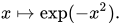
- Gaussian function


Odd functions
[edit]

A real function f is odd if, for every x in its domain, −x is also in its domain and[1]: p. 72 or equivalently

Geometrically, the graph of an odd function has rotational symmetry with respect to the origin, meaning that its graph remains unchanged after rotation of 180 degrees about the origin.
If is in the domain of an odd function , then .


Examples of odd functions are:
- The sign function
- The identity function
- for any odd integer
- for any odd positive integer
- sine
- hyperbolic sine
- The error function


![{\displaystyle x\mapsto {\sqrt[{n}]{x}}}](https://wikimedia.org/api/rest_v1/media/math/render/svg/9f6dc6c72b6adc06584f94fb29f182d65e8ff246)


Basic properties
[edit]Uniqueness
[edit]- If a function is both even and odd, it is equal to 0 everywhere it is defined.
- If a function is odd, the absolute value of that function is an even function.
Addition and subtraction
[edit]- The sum of two even functions is even.
- The sum of two odd functions is odd.
- The difference between two odd functions is odd.
- The difference between two even functions is even.
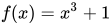
- The sum of an even and odd function is not even or odd, unless one of the functions is equal to zero over the given domain.
Multiplication and division
[edit]- The product and quotient of two even functions is an even function.
- This implies that the product of any number of even functions is also even.
- This implies that the reciprocal of an even function is also even.
- The product and quotient of two odd functions is an even function.
- The product and both quotients of an even function and an odd function is an odd function.
- This implies that the reciprocal of an odd function is odd.
Composition
[edit]- The composition of two even functions is even.
- The composition of two odd functions is odd.
- The composition of an even function and an odd function is even.
- The composition of any function with an even function is even (but not vice versa).
Inverse function
[edit]- If an odd function is invertible, then its inverse is also odd.
Even–odd decomposition
[edit]If a real function has a domain that is self-symmetric with respect to the origin, it may be uniquely decomposed as the sum of an even and an odd function, which are called respectively the even part (or the even component) and the odd part (or the odd component) of the function, and are defined by and
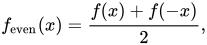
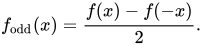
It is straightforward to verify that is even, is odd, and



This decomposition is unique since, if

where g is even and h is odd, then and since



For example, the hyperbolic cosine and the hyperbolic sine may be regarded as the even and odd parts of the exponential function, as the first one is an even function, the second one is odd, and
- .
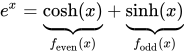
Fourier's sine and cosine transforms also perform even–odd decomposition by representing a function's odd part with sine waves (an odd function) and the function's even part with cosine waves (an even function).
Further algebraic properties
[edit]- Any linear combination of even functions is even, and the even functions form a vector space over the reals. Similarly, any linear combination of odd functions is odd, and the odd functions also form a vector space over the reals. In fact, the vector space of all real functions is the direct sum of the subspaces of even and odd functions. This is a more abstract way of expressing the property in the preceding section.
- The space of functions can be considered a graded algebra over the real numbers by this property, as well as some of those above.
- The even functions form a commutative algebra over the reals. However, the odd functions do not form an algebra over the reals, as they are not closed under multiplication.
Analytic properties
[edit]A function's being odd or even does not imply differentiability, or even continuity. For example, the Dirichlet function is even, but is nowhere continuous.
In the following, properties involving derivatives, Fourier series, Taylor series are considered, and these concepts are thus supposed to be defined for the considered functions.
Basic analytic properties
[edit]- The derivative of an even function is odd.
- The derivative of an odd function is even.
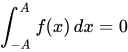
- If an odd function is integrable over a bounded symmetric interval , the integral over that interval is zero; that is[2]
- .
- This implies that the Cauchy principal value of an odd function over the entire real line is zero.
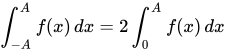
- If an even function is integrable over a bounded symmetric interval , the integral over that interval is twice the integral from 0 to A; that is[3]
- .
- This property is also true for the improper integral when , provided the integral from 0 to converges.
![{\displaystyle [-A,A]}](https://wikimedia.org/api/rest_v1/media/math/render/svg/f30ed42787a0511b07f6cc4622e0f6a812d39add)


Series
[edit]- The Maclaurin series of an even function includes only even powers.
- The Maclaurin series of an odd function includes only odd powers.
- The Fourier series of a periodic even function includes only cosine terms.
- The Fourier series of a periodic odd function includes only sine terms.
- The Fourier transform of a purely real-valued even function is real and even. (see Fourier analysis § Symmetry properties)
- The Fourier transform of a purely real-valued odd function is imaginary and odd. (see Fourier analysis § Symmetry properties)
Harmonics
[edit]In signal processing, harmonic distortion occurs when a sine wave signal is sent through a memory-less nonlinear system, that is, a system whose output at time t only depends on the input at time t and does not depend on the input at any previous times. Such a system is described by a response function . The type of harmonics produced depend on the response function f:[4]

- When the response function is even, the resulting signal will consist of only even harmonics of the input sine wave;
- The fundamental is also an odd harmonic, so will not be present.
- A simple example is a full-wave rectifier.
- The component represents the DC offset, due to the one-sided nature of even-symmetric transfer functions.
- When it is odd, the resulting signal will consist of only odd harmonics of the input sine wave;
- The output signal will be half-wave symmetric.
- A simple example is clipping in a symmetric push-pull amplifier.
- When it is asymmetric, the resulting signal may contain either even or odd harmonics;
- Simple examples are a half-wave rectifier, and clipping in an asymmetrical class-A amplifier.




This does not hold true for more complex waveforms. A sawtooth wave contains both even and odd harmonics, for instance. After even-symmetric full-wave rectification, it becomes a triangle wave, which, other than the DC offset, contains only odd harmonics.
Generalizations
[edit]Multivariate functions
[edit]Even symmetry:
A function is called even symmetric if:


Odd symmetry:
A function is called odd symmetric if:

Complex-valued functions
[edit]The definitions for even and odd symmetry for complex-valued functions of a real argument are similar to the real case. In signal processing, a similar symmetry is sometimes considered, which involves complex conjugation.[5][6]
Conjugate symmetry:
A complex-valued function of a real argument is called conjugate symmetric if


A complex valued function is conjugate symmetric if and only if its real part is an even function and its imaginary part is an odd function.
A typical example of a conjugate symmetric function is the cis function

Conjugate antisymmetry:
A complex-valued function of a real argument is called conjugate antisymmetric if:

A complex valued function is conjugate antisymmetric if and only if its real part is an odd function and its imaginary part is an even function.
Finite length sequences
[edit]The definitions of odd and even symmetry are extended to N-point sequences (i.e. functions of the form ) as follows:[6]: p. 411

Even symmetry:
A N-point sequence is called conjugate symmetric if

Such a sequence is often called a palindromic sequence; see also Palindromic polynomial.
Odd symmetry:
A N-point sequence is called conjugate antisymmetric if

Such a sequence is sometimes called an anti-palindromic sequence; see also Antipalindromic polynomial.
See also
[edit]- Hermitian function for a generalization in complex numbers
- Taylor series
- Fourier series
- Holstein–Herring method
- Parity (physics)
Notes
[edit]- ^ a b Gel'Fand, I. M.; Glagoleva, E. G.; Shnol, E. E. (1990). Functions and Graphs. Birkhäuser. ISBN 0-8176-3532-7.
- ^ W., Weisstein, Eric. "Odd Function". mathworld.wolfram.com.
{{cite web}}: CS1 maint: multiple names: authors list (link) - ^ W., Weisstein, Eric. "Even Function". mathworld.wolfram.com.
{{cite web}}: CS1 maint: multiple names: authors list (link) - ^ Berners, Dave (October 2005). "Ask the Doctors: Tube vs. Solid-State Harmonics". UA WebZine. Universal Audio. Retrieved 2016-09-22.
To summarize, if the function f(x) is odd, a cosine input will produce no even harmonics. If the function f(x) is even, a cosine input will produce no odd harmonics (but may contain a DC component). If the function is neither odd nor even, all harmonics may be present in the output.
- ^ Oppenheim, Alan V.; Schafer, Ronald W.; Buck, John R. (1999). Discrete-time signal processing (2nd ed.). Upper Saddle River, N.J.: Prentice Hall. p. 55. ISBN 0-13-754920-2.
- ^ a b Proakis, John G.; Manolakis, Dimitri G. (1996), Digital Signal Processing: Principles, Algorithms and Applications (3 ed.), Upper Saddle River, NJ: Prentice-Hall International, ISBN 9780133942897, sAcfAQAAIAAJ
References
[edit]- Gelfand, I. M.; Glagoleva, E. G.; Shnol, E. E. (2002) [1969], Functions and Graphs, Mineola, N.Y: Dover Publications
Even and odd functions
View on GrokipediaDefinitions and Examples
Even Functions
An even function is a univariate real-valued function that satisfies the condition for every in its domain.[4] This definition captures the inherent symmetry of the function with respect to input negation.[5] Geometrically, the graph of an even function exhibits mirror symmetry across the y-axis, meaning that the point on the graph has a corresponding point that is its reflection over the y-axis.[4] This property allows the function's behavior to the right of the y-axis to precisely mirror its behavior to the left.[5] Common examples illustrate this symmetry clearly. The quadratic function is even, since , and its graph forms a parabola opening upward, symmetric about the y-axis.[4] The cosine function is also even, as , resulting in a periodic wave that repeats symmetrically on both sides of the y-axis.[6] Additionally, the absolute value function qualifies as even because , producing a V-shaped graph that is perfectly mirrored across the y-axis.[5] Even functions are typically defined on domains symmetric about zero, such as intervals of the form where , to ensure the symmetry condition applies consistently across the entire domain.[7] This symmetry contrasts with that of odd functions, which exhibit antisymmetry about the origin.[4]Odd Functions
An odd function is a function defined on a domain symmetric about zero such that for all in the domain.[8][9] This property implies that the function values at and are negatives of each other, reflecting an antisymmetric behavior with respect to the origin.[2] Geometrically, the graph of an odd function exhibits point symmetry about the origin, meaning that rotating the graph 180 degrees around the origin maps it onto itself.[10][3] This rotational symmetry distinguishes odd functions from even functions, which are symmetric about the y-axis. For the definition to hold, the domain must be symmetric about zero, so that if is in the domain, then is also in the domain.[11] If zero is in the domain of an odd function, then , which implies .[2] Common examples include the identity function , which passes through the origin and satisfies the condition linearly; the sine function , a periodic odd function with antisymmetry in each cycle; and the cubic function , which maintains odd symmetry while curving away from the origin.[12][13][14] Constant functions where satisfy , making them even rather than odd, while the zero function is both even and odd.[1][15]Algebraic Properties
Basic Operations
The basic operations on even and odd functions preserve or alter parity in predictable ways, depending on the parities of the functions involved. For addition and subtraction, the sum or difference of two even functions is even. To see this, let and be even functions, so and . Then, and similarly, [16][12] The sum or difference of two odd functions is odd: if and are odd, then and , so and [16][12] However, the sum or difference of an even function and an odd function is neither even nor odd in general, unless one is the zero function.[16][12] For multiplication, the product of two even functions or two odd functions is even, while the product of an even function and an odd function is odd. Let and be even: then (f \cdot g)(-x) = f(-x) g(-x) = f(x) g(x) = (f \cdot g)(x). $$ If both are odd, (f \cdot g)(-x) = (-f(x)) (-g(x)) = f(x) g(x) = (f \cdot g)(x). $$ For one even and one odd, say even and odd, [16][12][2][11] Division follows analogous rules where defined, but requires the denominator to be non-zero and the domain to be symmetric about the origin to preserve the function's parity classification. The quotient of two even functions or two odd functions is even: for even and with , and similarly for two odd functions. The quotient of an even function by an odd function (or vice versa) is odd.[16]Composition and Inverse
The composition of even and odd functions exhibits specific parity properties that can be determined by examining the behavior under the transformation . Let and be functions defined on appropriate domains such that the composition is well-defined. The parity of is analyzed as follows.[12] If both and are even, then , so is even. For example, the composition of (even) and (even) yields , which is even.[12][17] If is even and is odd, then since is even, so is even. An example is (even) composed with (odd), giving , which is even. In general, any even function composed with any function (even or odd) results in an even function.[12][17] If is odd and is even, then , so is even. For instance, (odd) composed with (even) gives , which is even.[12][17] If both and are odd, then , so is odd. An example is (odd) composed with (odd), yielding , which is odd.[12][17] Even functions are generally not invertible over domains symmetric about the origin, such as , because they fail to be one-to-one: for , implies multiple inputs map to the same output. In contrast, odd functions that are bijective possess inverses that are also odd. To see this, suppose where is odd and invertible. Then , so applying gives . For example, the inverse of (odd) is , which satisfies and is thus odd.[18][19]Even-Odd Decomposition
Uniqueness of Decomposition
In functional analysis, any function defined on a domain symmetric about the origin—such as or —admits a unique decomposition into an even function and an odd function such that .[20] This theorem establishes that every such function can be expressed as the sum of components with distinct parity properties, where even functions satisfy and odd functions satisfy . To outline the proof of existence, the even component is given by and the odd component by Direct substitution confirms that . Furthermore, verifies the evenness of , while confirms the oddness of .[21] The uniqueness follows from the fact that the only function that is both even and odd is the zero function. Suppose , where are even and are odd. Then . The left side is even, while the right side is odd, implying that both sides equal zero (as their sum would otherwise contradict parity). Thus, and .[21] This unique decomposition enables parity-based analysis for arbitrary functions, even without inherent symmetry, which simplifies computations in integration, differentiation, and series expansions by isolating even and odd behaviors.[20]Construction Methods
The even and odd parts of a function defined on a domain symmetric about the origin can be explicitly constructed using the averaging formulas: These expressions yield the even component and the odd component , satisfying .[12] As an illustrative example, consider . Then , so The even part is symmetric about the y-axis, while the odd part exhibits antisymmetry about the origin. This decomposition separates the polynomial into its naturally even and odd terms.[12] The formulas ensure the constructed parts satisfy the required symmetries. For the even part, demonstrating y-axis symmetry. For the odd part, confirming point symmetry about the origin. These verifications follow directly from the definitions and the commutative property of addition.[12] If the domain of is not symmetric about the origin, such as , the formulas require extension of to a symmetric domain via reflection to define values at negative arguments. An even reflection sets for , mirroring the graph over the y-axis, while an odd reflection sets , reflecting through the origin. The choice of extension influences the resulting parts but enables application of the construction on the full symmetric domain.[22] Graphically, this decomposition isolates symmetric and antisymmetric behaviors. The even part appears as the y-axis-symmetric portion of , formed by averaging the original graph with its y-axis reflection, emphasizing mirrored features across the vertical axis. The odd part captures the origin-symmetric component, obtained by averaging the original graph with its 180-degree rotation about the origin, highlighting opposing values at and . This method provides the unique even-odd decomposition, as justified by the uniqueness theorem.[12]Analytic Properties
Differentiation and Integration
If a function is even and differentiable at a point , then its derivative is odd at that point. To see this, consider the definition of the derivative: For , substitute into the limit: Since is even, and , so where . Thus, , confirming that is odd.[23][5] Conversely, if is odd and differentiable at , then is even. The proof follows similarly: substituting the odd condition and into the derivative limit for yields after the substitution . Examples include , which is odd with even derivative . These properties hold under the assumption of differentiability, typically requiring continuity of at the point.[23][24] For integration, the parity of a function affects definite integrals over symmetric intervals where . If is even and continuous on , then This arises from the symmetry: the areas from to 0 and 0 to are equal due to . For instance, with , the integral from to 1 is .[25][5] If is odd and continuous on , then The positive and negative areas cancel due to . An example is , where . More generally, for any integrable where is the even part and the odd part, the integral decomposes as , with the odd part contributing zero. These results extend to Riemann or Lebesgue integrability, assuming the integral exists.[25][24]Series Representations
If an even function has a power series expansion centered at the origin, it contains only even powers of the variable, while if an odd function has such an expansion, it contains only odd powers.[26] For instance, the power series for the cosine function, which is even, is given by valid for all real .[27] Similarly, the sine function, which is odd, has the expansion also valid for all real .[27] The Taylor series expansion of a function at zero, known as the Maclaurin series, directly reflects the parity of the function through its derivatives evaluated at the origin. For an even function , all odd-order derivatives vanish at zero ( for odd ), resulting in a series with only even powers.[26] Conversely, for an odd function , all even-order derivatives (except possibly the zeroth, where ) vanish at zero ( for even ), yielding only odd powers in the series.[26] This property arises because the derivative of an even function is odd, and vice versa, leading to the alternation and vanishing conditions at the symmetric point zero.[26] In Fourier series representations of periodic functions over symmetric intervals like , even functions expand solely in terms of cosine functions, which form an even basis.[28] The series takes the form , where the coefficients are computed via integrals that exploit the orthogonality of cosines.[28] Odd functions, by contrast, expand only in sine terms, an odd basis, yielding , with sine coefficients from corresponding orthogonal integrals.[28] Any sufficiently smooth periodic function can be decomposed into its even and odd parts, and its Fourier series naturally separates these components: the cosine terms capture the even part, while the sine terms represent the odd part.[28] This decomposition leverages the orthogonality of the trigonometric basis, allowing the even and odd contributions to be isolated independently in the expansion.[28]Applications
Harmonic Functions
In the context of physics, even and odd functions play a fundamental role in describing harmonic vibrations. Symmetric vibrations, which exhibit mirror symmetry about the equilibrium position, are modeled using even functions such as cosines, corresponding to even harmonics that maintain the same sign on both sides of the axis. In contrast, antisymmetric vibrations, which invert across the axis, are represented by odd functions like sines, aligning with odd harmonics that produce opposite displacements on either side. This distinction arises naturally from the symmetry properties required to satisfy boundary conditions in wave equations for oscillatory systems.[29] Decomposition of periodic functions into even and odd components in Fourier analysis simplifies the study of harmonic balance in wave phenomena. By separating a function into its even part (yielding only cosine terms) and odd part (yielding only sine terms), the resulting series representation highlights how symmetric and antisymmetric behaviors contribute to the overall signal structure.[29] This approach is particularly useful in harmonic analysis, where the even-odd split reduces computational complexity and reveals underlying symmetries in the frequency domain.[30] For instance, the even component corresponds to basis functions that are cosine-like, aiding in the identification of balanced harmonic contributions without cross-terms from opposite symmetries. A representative example appears in standing waves on a taut string fixed at both ends, where modes are classified by their symmetry about the midpoint. Odd modes are symmetric, with mirror-image displacements across the center and antinodes at the midpoint, such as the first harmonic where the entire string moves in phase without a central node.[31] Even modes, conversely, are antisymmetric, with displacements inverting across the center, as seen in the second harmonic with a node at the midpoint and equal but opposite lobes on either side. These symmetries directly tie to even and odd function properties in the mode shapes, facilitating solutions to the wave equation via separation of variables. The conceptual framework of even and odd functions in harmonics traces back to 18th- and 19th-century developments in solving the wave equation. Jean le Rond d'Alembert's 1747 formulation of the one-dimensional wave equation for vibrating strings incorporated initial conditions that preserved even or odd parity, enabling general solutions via traveling waves.[32] Leonhard Euler extended this work in the 1750s by applying series expansions—precursors to Fourier series—to arbitrary initial displacements, implicitly leveraging even-odd symmetries to match boundary conditions and decompose vibrations.[33] These contributions laid the groundwork for using even and odd functions as basis elements in harmonic solutions to wave problems. In modern applications, such as audio synthesis, the distinction between even and odd harmonics influences tonal qualities. Even harmonics, derived from even function components, generate "warm" tones by adding consonant overtones that blend smoothly with the fundamental, evoking richness in analog-style sounds.[34] Odd harmonics, stemming from odd functions, produce "bright" or edgy timbres through dissonant higher frequencies that enhance clarity and presence, commonly used to sharpen synthesized waveforms.[34] This selective emphasis on even or odd components allows engineers to tailor harmonic content for desired auditory effects in music production.Signal Processing
In signal processing, even signals exhibit symmetry about the time origin, satisfying for all , while odd signals demonstrate antisymmetry, satisfying . These properties are leveraged in filter design and analysis, where separating signals into even and odd components enables efficient processing, such as in symmetric filter impulse responses that reduce computational demands in linear systems.[35] Any arbitrary signal can be uniquely decomposed into even and odd parts using and , allowing independent manipulation that preserves overall signal integrity while simplifying operations like time reversal and scaling.[36] In the discrete Fourier transform (DFT) and its fast implementation (FFT), the spectrum of an even signal is real-valued and even, effectively reducing to a discrete cosine transform, whereas an odd signal's spectrum is purely imaginary and odd, corresponding to a discrete sine transform. This spectral symmetry from even-odd decomposition facilitates signal compression by enabling sparse representations and reduced data storage, as seen in transform-based coding schemes where only real or imaginary components need processing.[36][37] For instance, in electrocardiogram (ECG) analysis, even-odd splitting within lifting-based wavelet transforms decomposes noisy signals into subsampled even and odd subsets, enabling targeted denoising that suppresses artifacts like baseline wander while retaining diagnostic features such as QRS complexes.[38] In image processing, even-symmetric components in phase congruency models, derived from Gabor filter pairs, enhance edge detection by identifying points of maximum phase alignment, improving robustness to noise and illumination variations in applications like synthetic aperture radar imagery.[39] Even-odd properties also streamline convolution, a core operation in filtering: the convolution of two even signals or two odd signals yields an even result, while an even signal convolved with an odd signal produces an odd result, allowing parity to guide efficient kernel designs and output predictions without full recomputation.[40] Software tools support these techniques in practice; MATLAB's Signal Processing Toolbox includes utilities likefft for spectral analysis and custom scripts for even-odd extraction via averaging over time-reversed copies, while Python's SciPy library offers scipy.signal functions for decomposition and symmetry-based filtering in DSP workflows.