
.jpg/250px-D75_9372-1_(cropped).jpg)


.jpg/2000px-D75_9372-1_(cropped).jpg)
Community hub
Recent from talks
Contribute something
Nothing was collected or created yet.
GE Evolution Series
View on Wikipedia
| GE Evolution Series | |||||||||||||||||||||||
|---|---|---|---|---|---|---|---|---|---|---|---|---|---|---|---|---|---|---|---|---|---|---|---|
.jpg) A Norfolk Southern ET44AC No. 3622 with an ES44DC No. 7589. The different sized radiators help distinguish the models. | |||||||||||||||||||||||
| |||||||||||||||||||||||
| |||||||||||||||||||||||
| |||||||||||||||||||||||
| |||||||||||||||||||||||
The Evolution Series is a line of diesel locomotives built by GE Transportation Systems (now owned by Wabtec), initially designed to meet the U.S. EPA's Tier 2 locomotive emissions standards that took effect in 2005. The line is the direct successor to the GE Dash 9 Series. The first pre-production units were built in 2003. Evolution Series locomotives are equipped with either AC or DC traction motors, depending on the customer's preference. All are powered by the GE GEVO engine.[4]
The Evolution Series was named as one of the "10 Locomotives That Changed Railroading" by Trains Magazine and was the only locomotive series introduced after 1972 to be included in that list.[5] The Evolution Series locomotives are some of the best-selling and most successful freight locomotives in United States history.
These locomotives are equipped with Nathan Airchime K5HL horns, with the reversed 2 configuration, making a K5HLR2. The horns are mounted backwards with the 2 bell only facing forward and the 4 bells facing back. These horns have been very popular for the evolution series, and have a very distinct noise, noticeable from great distances. All of the locomotives use these horns, except for the ET23DCM and international locomotives.
Models
[edit]Currently, six different Evolution Series models (seven including rebuilds), have been produced for the North American market. They are all six-axle locomotives and have AAR wheel arrangement C-C (UIC classification Co′Co′), except for the ES44C4 and ET44C4 which uses the AAR A1A-A1A wheel arrangement and the meter-gauge version developed for the Brazilian network ES43BBi which is AAR B-B-B-B.
ES40DC (2004–2008)
[edit].jpg)
The ES40DC (Evolution Series, 4,000 hp, DC traction) replaced the Dash 9-40CW model in the General Electric catalogue and, like the former model, was delivered exclusively to Norfolk Southern Railway. ES44DCs owned by CSX Transportation were also given this designation in 2009 after being de-rated to 4,000 hp (3,000 kW). However, high-horsepower demand on Norfolk Southern made a mandatory repowering of several ES40DC engines into their former ES44DC power.[6]
ES44DC (2005–2010)
[edit]The ES44DC (Evolution Series, 4,400 hp, DC traction) replaced the Dash 9-44CW model in the General Electric catalogue. Primary users are BNSF Railway, CSX Transportation, and Canadian National Railway. Pilbara Iron in Australia ordered a lengthened, international version designated ES44DCi. The extra length is used for a larger radiator to increase cooling capacity in the Australian outback.
ES44AC (2003–present)
[edit].jpg)
The ES44AC (Evolution Series, 4,400 hp, AC traction) replaced the AC4400CW model in the General Electric catalogue. These locomotives have been ordered by every Class I railroad in North America: Union Pacific Railroad (who refers to these locomotives as the C45ACCTE), BNSF Railway, CSX Transportation, Norfolk Southern Railway, Ferromex, CPKC Railway, and Canadian National Railway.
Union Pacific also bought the heavy ballasted variation of this model, the ES44AH, and refers to it as the C45AH. UP also uses this designation to refer to their ET44AH units.
CSX Transportation has bought these locomotives and they were always heavy ballasted, so they called these the ES44AH. The first set was 700-999, which was built from 2007-2011. Beginning 2023, CSX has repainted and renumbered the 3000 series locomotives to heritage units. The first heritage, 1827, was painted into Baltimore & Ohio and renumbered from 3059 on May 11, 2023.
BNSF Railway purchased 25 ES44AC locomotives in 2023, and they are all classified as ES44ACH. They were built between August and September 2023 and were built concurrently with the ET44ACH. The numbers were 3282-3306, which officially ended the production of the ES44C4 in 2020. These units are Tier 4 credit units. In 2024, BNSF has bought 25 more ES44ACH locomotives, which are numbered from 3307-3331. These locomotives weigh 436,320 lbs.
ES44C4 (2009–2020)
[edit]
The ES44C4 (Evolution Series, 4,400 hp, C to denote 3 axles per truck, 4 traction motors) was introduced in 2009. While similar to the ES44AC, the ES44C4 has two traction motors per truck, instead of the conventional three such as on the ES44AC. No ES44C4s with DC traction were built. The center axle of each truck is unpowered, giving an A1A-A1A wheel arrangement. BNSF Railway is the launch customer for this model, ordering an initial batch of 25 units numbered 6600–6624.[7] The ES44C4 was initially only built for BNSF. The units 3250–3281, the 4200s, 5533–5546, 7921-7999, and units 8318–8399 are certified as Tier 4 Credit units, while the others are Tier 2 or Tier 3. On 30 January 2014 Florida East Coast Railway announced that they would buy 24 ES44C4s, to be numbered 800–823, for heavy haul service and intermodal traffic. All were delivered by the end of 2014, in order to beat the EPA's deadline on exhaust-emissions standards for new-built Tier 3 locomotives.
A feature of these units is a variable traction control system in their computer systems. One of the differences between an ES44AC and an ES44C4 is the air cylinders and linkages on the truck sideframes of the ES44C4; these are part of the traction control system. Every time a variation in grade, traction, or wheel slip occurs, the computer adjusts the pressure in these cylinders to maintain sufficient adhesion, by varying the weight on the drive axles.[8][9]
ES44DCi/ES44ACi
[edit]
The ES44DCi (Evolution Series, 4400 horsepower, DC traction, international version) was built for the Rio Tinto railway in Australia. The ES44ACi was built for the Roy Hill and Rio Tinto Group.
The ES44ACi/DCi is essentially an ES44AC/DC in a GE AC6000CW's body, with the radiator at the end protruding out over the rear deck in the same way the AC6000CW does. The locomotive's large radiator allows it to handle the Australian outback's extreme temperatures.
Roy Hill has ordered 21 ES44ACi locomotives, and is currently in possession of all 21 locomotives (numbered 1001 "Ginny"-1021). Rio Tinto ordered 100 ES44DCi locomotives and has all 100 (numbered 8100–8199) and 21 ES44ACi locomotives (numbered 9100–9120) and more are on order. Rio Tinto's units can be remotely driven, meaning nobody has to be in the cab as they can be controlled from a control center.[10]
Ferromex also acquired 50 ES44ACi. As the construction of these locomotives was subsequent to the new environmental laws of the US, GE cataloged them only as ES44ACi, although in the external technical specifications of the locomotives say ES44AC). These locomotives can no longer reenter the US operating.
In Brazil, the Rumo, Suzano and MRS Logística railways purchased 25 units, manufactured at Wabtec of Brazil with broad-gauge trucks.[11]
ET44AC/ET44C4 (2012–present)
[edit]
The ET44AC (Evolution Series Tier 4, 4,400 hp, AC traction) replaces the ES44AC model. These locomotives have been ordered by every US and Canadian Class I railroad, including BNSF Railway, Canadian National Railway, CPKC, CSX Transportation, Norfolk Southern, and Union Pacific. BNSF also ordered similar ET44C4 locomotives, which have a dynamic weight management system instead of a traction motor on the middle axle of each truck. UP and CSX designate their ET44ACs as ET44AH although UP calls these C45AH, and BNSF calling them ET44ACH as their locomotives are ballasted to 436,320 lbs.
ET23DCM (2023–present)
[edit]
The ET23DCM (Evolution Series Tier 4, 2350 hp, DC traction), sometimes called the SD23T4, is a modernized locomotive using EMD's SD40-2 platform and the Wabtec Inline 6-cylinder Tier 4 diesel engine.[12] CSX Transportation ordered 15 of these locomotives, with most being built at their Huntington Heavy Repair Shop. Wabtec also built one locomotive as a demonstrator from ex-NS SD40-2 3259.
TE33A
[edit]The TE33A is an export 1520 mm gauge locomotive in the GE Evolution Series.
3TE25K2M
[edit]The 3TE25K2M is an export 1520mm gauge locomotive in the GE Evolution Series for Russian Railways.
ES40ACi (2008–2010)
[edit]The ES40ACi (Evolution Series , 4,250 hp , AC traction) was the first GEVO locomotive that was made for the Egyptian National Railways featuring a full-width car body and double cabin. The locomotive weighs 140 metric tons (312,000 lbs) and reaches maximum speed of 121 km/h (75 mph). 80 units were produced, and are used in both passenger and freight trains.
ES30ACi (2018–2022)
[edit]The ES30ACi (Evolution Series, 3300-4250hp, AC Traction) A total of 100 units were produced. The locomotive weighs 135 metric tons (301,000lbs) and the maximum speed is 121 km/h (75 mph) [Computer Controlled], 140 km/h (86 mph)
Identifying features
[edit]The Evolution Series locomotives are visually similar to the AC4400CW and GE Dash 9 Series, although small differences are evident. The most noticeable difference is the radiator section at the rear of the locomotive is larger to accommodate the GEVO's air-to-air intercoolers. As with the AC6000CW, the radiators project beyond the end of the hood. On the ES44ACi and ES44DCi models, the radiator extends in the same way as the AC6000CW, protruding out over the rear deck. For the other Evolution Series locomotives, the radiator does not protrude completely over the rear deck, but rather sits nearly flush with the rear of the engine hood. Unlike previous GE locomotives, the grills under the radiator are at two different angles. The increase in radiator size is due to the necessity for greater cooling capacity in the locomotive in order to reduce emissions. The other major difference between the Evolution Series and earlier models is the vents below the radiators, which are larger than those on previous GE locomotives.[13] Also, all Evolution Series units have air conditioners mounted below the cab on the conductor's side.
Operators
[edit]| Railroad | Qty. | Road Numbers | Notes |
|---|---|---|---|
| ES40ACi | |||
| Egyptian National Railways | 80 | 2400-2479 | Built in 2008-2009 |
| ES30ACi | |||
| Egyptian National Railways | 100 | 2550-2649 | Built in 2018-2022 on 2 editions |
| ES40DC | |||
| CSX Transportation | 302 | 5200–5501 | Built as ES44DC units but were downgraded by 2010. 5306, 5411, and 5488 were wrecked and retired. CSXT 5500 lettered "Spirit of Cincinnati" Archived 28 September 2011 at the Wayback Machine. |
| ES44DC | |||
| BNSF | 721 | 7200–7920 | Built between 2005 and 2010. 7650-7743 are painted in Heritage II (H2), except for 7687 and 7701 that are in Heritage III (H3). Few of these are getting repainted into H3. The rest of the ES44DC's are in H3. 7695 is painted in the Golden Swoosh scheme using H3. 7514, 7553, 7673, 7838, and 7847 were wrecked and retired. 7814 and 7907 were repaired after their respective train collisions. |
| Canadian National | 125 | 2220–2344 | 2328 was wrecked and retired. |
| GE Transportation[a] | N/A | 1 | 2011 |
| Norfolk Southern | 219 | 7500–7719 | Unit 7530 wrecked and was retired. Units were uprated from 4,000 to 4,400 HP in 2014. 7500-7514 are preproduction units, renumbered from 9912-9926 due to the C40-9W units. 7508 stored in Erie, Pennsylvania, awaiting possible rebuild as of October 2025. |
| ES44AC | |||
| ArcelorMittal, operated by Cartier Railway | 2 | 301–302 | Built 2010.[14] |
| BNSF | 815 | 5718–5747 | Built between October 2003 and April 2004, these are pre-production units. They are classified AC4400EV. |
| 5748–5837 | Built 2005. | ||
| 5844–6438 | Built between 2005 and 2009, BNSF 5942 was wrecked at Cactus, Texas in October 2006, but was rebuilt in 2009. 5958 was wrecked and retired in December 2013 while 6348 was wrecked and retired in 2019. 5774 was wrecked in Garza County, TX in October 2023 and retired. 5828, 5869, 5872, 6017, 6022, 6075, 6078, 6111, 6163, and 6179 were painted into BNSF's 25th anniversary stickers scheme in 2020 that celebrates 25 years of BNSF Railway as it started in 1995 from two railroads, BN and ATSF. 6026 was given a Northern Pacific sticker on the side of its nose. | ||
| 3282-3381 | Tier 4 credit units.[15] Ballasted to 436,320 lb, and classified ES44ACH.[16] | ||
| Canadian National | 435 | 2750-2796, 2800–2999, 3800–3987 | 2800–2975 were built 2012 through 2015. The first 2015 order (2951–2975) was built to Tier 3 standards but after the Tier 4 cutoff date and therefore are restricted to operation in Canada only. More Tier 4-compliant ET44AC's were on order for 2015 delivery, with the first two, CN 3002 and 3004, entering service on 6 August 2015. 8 additional Tier 4 units (2976–2983) were built in 2016–2017. 2984–2999 and 3800–3805 built in late 2017. 3806–3835 built in 2018 and 3836–3875 built in 2018–2019. 2750-2796 and 3913–3987 are ex-CREX units. 2792-2796, 2976-2999, 3800-3912, and 3970-3987 are Tier 4 Credit units. |
| Canadian Pacific Kansas City | 561 | 8700–8960, 9350–9379
4650–4919 |
4700 was wrecked and retired. 4805 and 9375 are painted in the new CPKC corporate paint scheme. |
| Cerrejón | 4 | 10015–10018 | |
| Citicorp Railmark Inc. (Citirail) CREX[b] | 15 | 1201–1215 | Delivered in December 2012.[17] Some sold to Canadian National. |
| 50 | 1301–1350 | Delivered in late 2013. Some sold to Canadian National. 1331 was wrecked and retired. | |
| 35 | 1401–1435 | Delivered during summer 2014. Some sold to Canadian National. | |
| 25 | 1501—1525 | Delivered in December 2015, units are Tier 4 Credit units. Some sold to Canadian National. | |
| Cemex | 1 | 81[18] | Built in March 2008 as an add-on to a CSXT order. |
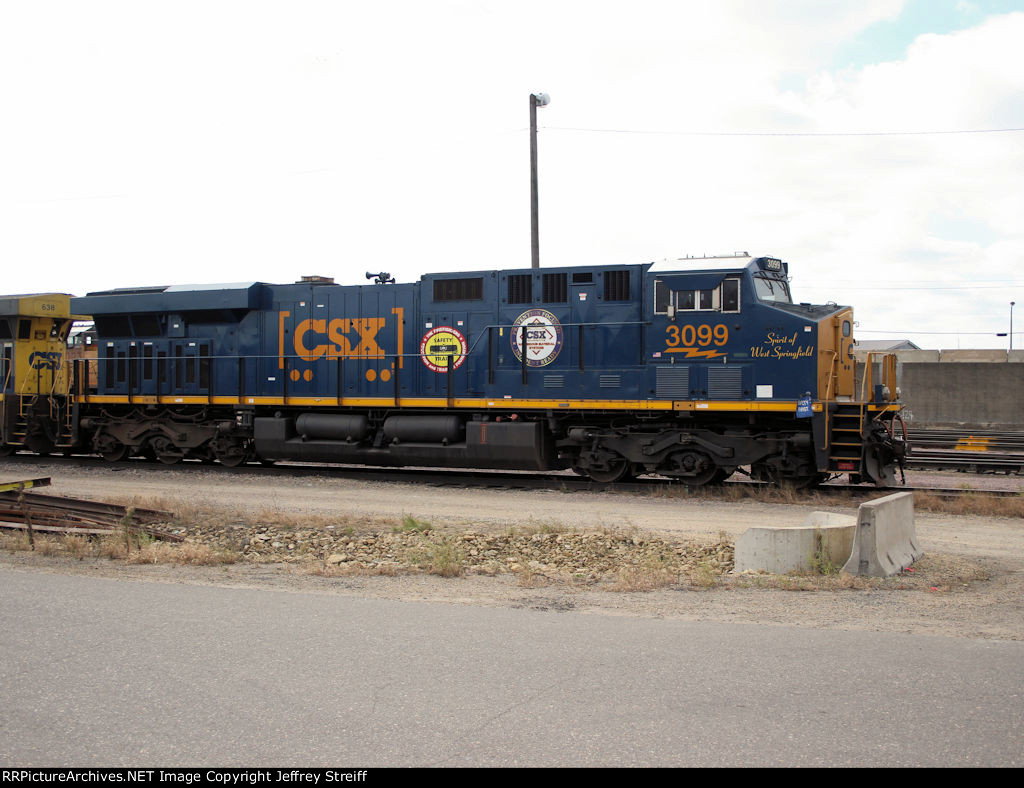
| CSX Transportation | 550 | 700–999, 1776, 1827, 1834, 1836, 1850-1853, 1869, 1871, 1875, 1877, 1897, 1899, 1900, 1902, 1967, 1972, 1973, 1976, 1981, 1982, 3000-3048, 3070–3111, 3113-3249 | These are the ES44AH model equipped with high tractive effort. These were built between 2007 and 2015. 847, 963, 3070, and 3097 have been wrecked and retired. Three units have special names and paint schemes: 911 Spirit of Our First Responders, 3112 renumbered to 1776 Spirit of Our Armed Forces and 3194 Spirit of Our Law Enforcement. CSXT 3099 lettered "Spirit of West Springfield and Safety Train"; was officially destroyed in Chihuahua, Mexico in 2018 & retired. Units 3049-3069 have been renumbered to 1827, 1834, 1836, 1850, 1851, 1852, 1853, 1869, 1871, 1875, 1877, 1897, 1899, 1900, 1902, 1967, 1972, 1973, 1976, 1981, and 1982 respectively and are painted into various heritage paint schemes. 3175-3249 are Tier 4 credit units. |
| Ferromex | 100 | 4600–4699[19] | 4600-4659 built in 2006 at the GE plant in Erie, PA. 4660-4699 built in 2007 at the GE plant in Erie, PA. |
| 50 | 4800–4849 | Delivery started in June 2016. Units numbered 4800–4818 were built at the GE plant in Erie, PA. Units numbered 4819–4849 were built at the GE plant in Fort Worth, Texas. 4815 was wrecked and retired in 2018. 4838 also wrecked and retired. | |
| 30 | 4850–4879 | The first units will be delivered in 2024 | |
| Ferrosur | 23 | 4700–4722 | Painted in Ferromex colors. |
| GE Transportation[a] | 1 | 2012 | Wears the same demonstration scheme as 2011, as well as GECX 2005 and UP 7605 (formerly). |
| 1 | 2010 | This is an ES44AC-H prototype, and was rebuilt in 2007 as a hybrid from GECX ES44AC 2005. | |
| 1 | 3000 | Converted to operate on battery power, the unit was rebuilt from former NextFuel (liquid natural gas/diesel mixture) demonstrator ES44AC 3000. | |
| Iowa Interstate Railroad | 20 | 500–519 | The first set of units, numbered 500-512, were delivered from 2008 to 2009, these are the first new units purchased by this railroad and were originally intended for CSX.
The unit 513 was delivered in early 2010. It is painted in a Chicago, Rock Island and Pacific Railroad heritage scheme in honor of this Iowa Interstate predecessor. The units 514-516 were delivered in 2015. 516 is painted in a Rock Island inspired 30th anniversary paint scheme. The units 517-519 are Tier 4 Credit units. They were set for delivery in late 2019. |
| Norfolk Southern | 166 | 8000–8165 | Units 8025, 8098–8105 and 8114 were painted in schemes of predecessor railroads as part of Norfolk Southern's 30th anniversary. Unit 8099 was wrecked in 2021, and was rebuilt in 2023. |
| 3 | 8166–8168[20] | These are Tier 4 Credit units, built concurrently with ET44AC's 3600–3646. | |
| 16 | 8169–8184 | These are Tier 4 Credit units. Unit 8175 was wrecked in December 2021 and was later retired. | |
| Sava Transportation (Savatran) SVTX | 3 | 1912, 1982, 1986 | Delivered February 2012, these units are numbered for the years that Penn State University won national college football championships.[21] |
| Union Pacific | 5 | 5695–5699 | Built between January and February 2003, these are pre-production units and classified as C45ACCTE by UP. They have since been renumbered to 5348–5352. |
| 938 | 2010, 5248–5347, 5353–5553, 7345–7468, 7470–7529, 7600–8051 | These are classified as C45ACCTE by UP. 5359, 5412, 5482, 7421, 7856, 7894, and 7914 were wrecked and retired. UP 2010, an ES44AC Boy Scouts of America tribute unit, was unveiled on 31 March 2010, in Houston, Texas to commemorate 100 years of Boy Scouts. The unit was renumbered from 7469. However, in early 2022 it was repainted into the Union Pacific lettered scheme after months of sitting in storage. It kept its number of 2010.[22] In September 2010, UP 7400 was unveiled, featuring a pink ribbon on the side as a tribute to Susan G. Komen for the Cure. 7964 was the 5000th GE Evolution Series locomotive to be built at Erie, PA in June 2012. The banner was removed 4 years later in 2016. | |
| 296 | 2520–2569, 2740–2769, 8052–8267 | These are the ES44AH model, classified as C45AH by UP. These units are 432,000 lb (196,000 kg) compared to the ES-series standard 416,000 lb (189,000 kg), and are supplied with all required equipment and computer software to be classified as "AH" heavy units. UP's "AH" types are similar to CSXT's, except for their Hi-Ad trucks, and are designated C45AH's by U.P.[23] 2520–2569 and 2740–2769 are Tier 4 Credit units. 2542 wrecked in Texarkana, TX in 2015 and retired. 8210 and 8245 were wrecked in 2024 and retired. | |
| ES44C4 | |||
| BNSF | 1299 | 3250–3281, 4200–4299, 5533–5546, 6500–7199 | Built 2009–2020. 6943 was wrecked and retired. 4213 was wrecked in 2020 and repaired in 2022. 3250–3281, 4200–4299, and 5533–5546 are Tier 4 credit units. |
| 7921–8291 | Built 2013–2015. 8123 and 8153 were wrecked and retired. 7921–7999 are Tier 4 credit units. 8191 was repaired in 2020 after a train collision in 2016. | ||
| 8318–8399 | Built 2015. They are Tier 4 credit units. | ||
| Florida East Coast | 24 | 800–823 | Built between November and December 2014. All units have since been converted to use a combination of standard diesel fuel/liquid natural gas mixture, supplied from an external tender towed behind the locomotives. 5 units were leased to FXE in 2024. The unit 814 was wrecked in 2024.[24] |
| ES44DCi/ES44ACi | |||
| Rio Tinto Group | 100 | 8100–8118, 8119–8199 | They ordered the locomotives for operation on their privately owned rail line, operated by Pilbara Iron.[25] The ES44DCi uses the AC6000CW's longer frame to allow space for a heavy duty cooling system to cope with the hot desert environment that the locomotives operate in.[26] Units 8100–8118 were delivered in a predominantly grey paint scheme,[27] while units 8119–8199 feature additional red lettering and striping.[28] |
| 49 | 9100–9148 | These units are numbered from 9100 onwards and more are on order. They are the ES44ACi and are painted in the Rio Tinto silver with red stripes and numerals. | |
| Roy Hill | 28 | 1001–1028 | Took delivery of the first 14 out of a total order for 21 ES44ACis in January 2015.[29] |
| ET44AC | |||
| BNSF | 50 | 3625-3674 | Ballasted to 436,320 lb. and classified as ET44ACH. |
| Canadian National | 296 | 3000–3295 | Units 3008, 3023, 3069, and 3115 repainted to commemorative heritage paint schemes. Units 3015 and 3233 painted into unique paint schemes commemorating veterans. Unit 3103 wrecked in 2017 and retired from roster. 3286-3295 were built in early 2023. 3009 wrecked in 2019 and retired. 3121-3132 are former GECX demonstrator units 2029 and 2033–2043, which were rebuilt with new hoods. |
| CSX Transportation | 225 | 3250–3474 | These are the ET44AH model with HTE. 3440 lettered "Spirit of Ravenna" along with L&N and KSHC markings after attending the announcement of Kentucky Steam buying the Ravenna yard property from CSX. Units 3438 and 3374 wrecked in 2020 and retired. 3415 has the Georgia Railroad emblem. |
| Canadian Pacific Kansas City | 203 | 5000–5024, 7430–7437, 7450–7619 | Delivery started in 2018-2019 for KCS. The CPKC units 7430–7437 are former GECX demonstrator units 7001-7008 and acquired in 2024. Those units were originally intended for a cancelled order for Baffinland Iron Mines located in Baffin Island, Canada.[30] 170 more units on order for 2025 and are undergoing delivery.[31] |
| Ferromex | TBA | ||
| GE Transportation | 27 | 2014, 2015, 2023, 2024, 2026, 2027, 2029, 2033-2044, 7001-7008 | These are demonstrator units. 2029, 2033-2043 were sold to CN. 2026 and 2027 were sold to NTEC. 7001-7008 were sold to Baffinland Iron Mines and later to CPKC. They were renumbered from units 2025, 2028, 2030-2032, 2020-2022 respectively. |
| Navajo Transitional Energy Co. | 2 | 2026-2027 | These are former GE demonstrator units of the same numbers with hoods modified to match the standard production units.[32] |
| Norfolk Southern | 47 | 3600–3646[20] | 3633 wrecked in 2019 and retired in 2020. |
| 34 | 3647–3680 | N/A | |
| Union Pacific | 170 | 2570–2739 | These are the ET44AH model, classified as C45AH by UP. |
| ET44C4 | |||
| BNSF | 311 | 3675-3706, 3721–3999 | Built between 2015 and 2020. 3967 was wrecked and retired. 3971 was repaired after damage. Additional units, numbered 3721–3724 were built in late 2019 and therefore restricted to California only. More units, numbered 3675–3706, (built early through mid-2020). |
| ET23DCM | |||
| Wabtec (GECX) | 1 | 1867 | The first ET23DCM built as a demonstrator and engineering test locomotive was constructed by Wabtec in Albia, Iowa and is now used for testing in Erie, Pennsylvania. Former NS 3259. |
| CSX Transportation | 15 | 1713-1727 | The first two CSX locomotives were built by Wabtec in Albia, Iowa and the remaining thirteen were constructed by CSX at their Huntington Heavy Repair Shop in Huntington, West Virginia. All locomotives were sent through RJ Corman in Lexington, Kentucky for final work before entering service. These are classified as SD23T4 by CSX. |
| TE33A | |||
| Kazakhstan Temir Zholy | 310 | TBA | Ordered on the 28 September 2006, they signed an agreement with GE Transportation Systems, ordering the locomotives. The first ten of these were built in GE's Erie, Pennsylvania, plant while the remaining 300 will be assembled at a new plant in Astana, Kazakhstan which was opened by President Nursultan Nazarbayev on 3 July 2009[33] Delivery is expected between 2009 and 2012. The locomotives are built with dual cabs and are among the first diesel-electric locomotives with AC traction motors to operate in the Commonwealth of Independent States and Ukraine[34] (besides the 2TE25A built by Bryansk Engineering Works, Transmashholding, Russia).[35] |
| ES59ACi | |||
| China Railway | 300 | HXN5-0001—HXN5-0650, HXN5-2001-—HXN5-2050 | Ordered October 2005 and delivered between 2008 and 2009. They were ordered from GE Transportation Systems and Qishuyan Locomotive and Rolling Stock Works. Two have been built at Erie, Pennsylvania, the rest will be assembled by Qishuyan at Changzhou.[36] Classed as the China Railways HXN5. |
| ES58ACi | |||
| Carajás Railway | 70 | TBA | The units were built at GE's Erie plant and delivered in 2009. The prime mover is a GEVO-16. They are wide gauge (1,600 mm (5 ft 3 in)). |
| ES40ACi | |||
| Egyptian National Railways | 80 | TBA | Delivered 2009. There are two versions: Painted blue for passenger trains and red/black for freight trains.[37][38][39] |
| ES30ACi | |||
| Egyptian National Railways | 100 | TBA | Ordered 2017, They are valued at $575 million that can be used for both passengers or freight rail.[citation needed] The first 10 units were delivered in November 2019.[40][41] |
| ES43ACi | |||
| Pakistan Railways | 55 | 9001–9055 | They are made for 1,676 mm gauge. Deliveries are expected during 2017.[42] See Locomotives of Pakistan. |
| TransGuinéen | TBA | Deliveries started in May 2025.[43] | |
Licensed production
[edit]Australia
[edit]In 2002, GE and UGL launched the Evolution Series locomotive, and in 2009, continued their partnership for another 10 years for UGL to distribute and sell GE locomotives in Australia.[44]
India
[edit]In November 2015, it was announced Indian Railways and GE would engage in a 11-year joint venture in which GE would hold a majority stake of 74%, to provide a mix of 1,000 diesel locomotives of type ES43ACmi[45] which are 4,500 horsepower and type ES57ACi[46] which are 6,000 horsepower each. Indian Railways designated these 1,676 mm (broad gauge) locomotives as the WDG-4G class and WDG-6G class respectively. General Electric has invested ₹2,052 crore (US$305 million) for its construction. In the $2.6 Billion deal, Indian Railways would purchase 1,000 goods locomotives a year for ten years beginning in 2017; the locomotives would be modified versions of the GE Evolution series.[1] Diesel Locomotive Factory, Marhowrah was built by GE for the manufacture of the locomotives.[2]
South Africa
[edit]
Transnet Engineering in South Africa has a license to manufacture 233 4,200 hp (3,100 kW) 3 ft 6 in (1,067 mm) Cape gauge ES40ACi locomotives for Transnet Freight Rail, with core components including GEVO-12 engines supplied from the United States.[47]
The first six of these Class 44-000 locomotives were built in Erie, Pennsylvania, in April and July 2015. In October 2015, the first of the 227 South African-built locomotives was nearing completion at Transnet Engineering's Koedoespoort shops in Pretoria.[48]
See also
[edit]- EMD SD70 series, a similarly powerful locomotive produced by EMD in response to GE's predecessor of the Evolution Series, the Dash 9 Series.
- Wabtec FLXDrive, a battery-electric locomotive built by Wabtec based on the Evolution Series design.
References
[edit]Notes
[edit]- ^ a b These locomotives are most often used in GE Transportation/Wabtec's small test fleet on a nearly 3-mile-long (4.8 km) test track in Erie, PA, to test new locomotives before delivery.
- ^ Most units have been sold to Canadian National as of 2021. "Canadian National". The Diesel Shop. Retrieved 14 January 2022.
- ^ a b c ES44DC Datasheet Archived 26 June 2012 at the Wayback Machine, The Diesel Shop
- ^ a b c ES44AC Datasheet Archived 24 December 2011 at the Wayback Machine, The Diesel Shop
- ^ a b c ES44C4 Datasheet Archived 16 November 2011 at the Wayback Machine, The Diesel Shop
- ^ "Evolution | GE Transportation". Archived from the original on 7 February 2015. Retrieved 29 January 2014.
- ^ Lustig, David (2010). "10 Locomotives That Changed Railroading". Trains.
- ^ Solomon 2011, p. 64
- ^ "GE unveils ES44C4 locomotive". Railway Gazette International. 27 May 2009. Archived from the original on 12 October 2012. Retrieved 25 January 2012.
- ^ "GE Transportation unveils new Evolution Series locomotive". Archived from the original on 27 September 2011. Retrieved 3 November 2009.
- ^ "Archived copy" (PDF). www.gevirtualrailexpo.com. Archived from the original (PDF) on 31 October 2014. Retrieved 11 January 2022.
{{cite web}}: CS1 maint: archived copy as title (link) - ^ "Rio Tinto train completes first crewless trip | Trains Magazine". Trains. July 2018. Archived from the original on 8 May 2022. Retrieved 4 May 2022.
- ^ "Trilhos brasileiros começam a receber as locomotivas mais sustentáveis do país – Agência iNFRA". 7 April 2022.
- ^ Guss, Chris (1 November 2022). "ET23DCM locomotives explained". Trains. Archived from the original on 30 September 2023. Retrieved 12 January 2023.
- ^ Solomon, Brian (2005). Burlington Northern Santa Fe Railway. MBI. ISBN 978-0-7603-2108-9.
- ^ Smith, Rob (September 2010). "GEVOs head to Cartier". Trains Magazine. Kalmbach Publishing: 17.
- ^ "New Class I locomotive orders trickle in". 29 August 2023.
- ^ "Burlington Northern Santa Fe Roster Summary".
- ^ Diesel Era Magazine, Jan./Feb. 2013, pg. 2.
- ^ ""81"". Archived from the original on 6 September 2018. Retrieved 1 April 2008.
- ^ "Ferrocaril Mexicano (Ferromex)". The Diesel Shop. Archived from the original on 29 September 2010. Retrieved 11 July 2010.
- ^ a b "Norfolk Southern ET44ACs on the way". Trains. 19 May 2016. Archived from the original on 22 May 2016. Retrieved 20 May 2016.(subscription required)
- ^ Diesel Era Magazine, March/April 2012, pg. 8.
- ^ "Union Pacific Railroad Unveils No. 2010 Boy Scouts of America Commemorative Locomotive". Enhanced Online News. 31 March 2010. Archived from the original on 12 March 2012. Retrieved 8 May 2010.
- ^ Diesel Era Magazine, July/August 2013, pg. 2
- ^ "Florida East Coast Railway converts locomotive fleet to LNG". International Rail Journal. 13 November 2017. Archived from the original on 27 October 2020. Retrieved 23 August 2020.
- ^ "Rail". Rio Tinto Iron Ore. Archived from the original on 1 July 2013. Retrieved 31 March 2010.
- ^ "Closeup of the radiator on Rio Tinto 8110". Archived from the original on 11 October 2012. Retrieved 17 April 2011.
- ^ "Rio Tinto 8118 prior to delivery". Archived from the original on 2 November 2012. Retrieved 17 April 2011.
- ^ "Rio Tinto 8120 prior to delivery". Archived from the original on 2 November 2012. Retrieved 17 April 2011.
- ^ Issue 01.02 Archived 10 September 2016 at the Wayback Machine Western Australian Rail January 2015
- ^ Guss, Chris (11 December 2024). "CPKC acquires 'new' power". Trains magazine. Retrieved 3 February 2025.
- ^ Guss, Chris (22 December 2024). "CPKC orders new power from Wabtec". Retrieved 3 February 2025.
- ^ Cotey, Angela (12 June 2017). "New locomotives en route to New Mexico mine railroad NEWSWIRE". Trains. Archived from the original on 20 February 2023. Retrieved 25 April 2024.
- ^ "President opens Astana locomotive plant". Railway Gazette International. 6 July 2009. Archived from the original on 13 September 2009. Retrieved 22 July 2009.
- ^ "Evolution grabs hold in Kazakhstan". Late Breaking Industry News. Railway Age. 28 September 2006. Archived from the original on 22 August 2006. Retrieved 3 October 2006.
- ^ "Photo of the ТЭ33А-0007 in Almaty". Archived from the original on 11 September 2012. Retrieved 4 August 2015.
- ^ "GE ships first CML diesel locomotive to China". Railway Gazette International. 21 August 2008. Archived from the original on 13 September 2009. Retrieved 21 August 2008.
- ^ GE Transportation and Egyptian National Railways Announce the Completion of Commissioning of 80 Evolution Series Locomotives (2009-07-13)
- ^ "Photos of ES40ACi for Egypt at delivery". Archived from the original on 21 September 2015. Retrieved 12 January 2012.
- ^ "Now Arriving: The World's Oldest Trading Empire is Getting New Trains | GE News". Archived from the original on 6 December 2019. Retrieved 6 December 2019.
- ^ "Egypt receives first batch of General Electric locomotives in November". 5 October 2019. Archived from the original on 6 December 2019. Retrieved 6 December 2019.
- ^ "Erie built locomotives arrive in Egypt". 5 December 2019. Archived from the original on 6 December 2019. Retrieved 6 December 2019.
- ^ "First GE Evolution loco for Pakistan completed". Railway Gazette. Archived from the original on 24 August 2017. Retrieved 23 August 2017.
- ^ "TransGuinéen iron ore railway locomotive rolled out". Railway Gazette. 28 May 2025. Retrieved 7 June 2025.
- ^ "GE Transportation and UGL extend rail partnership by 10 years | GE News". www.ge.com. 20 July 2009. Archived from the original on 4 November 2022. Retrieved 4 November 2022.
- ^ "ES43ACmi Locomotive | Wabtec Corporation". www.wabteccorp.com. Retrieved 8 October 2023.
- ^ "ES57ACi Locomotive | Wabtec Corporation". www.wabteccorp.com. Retrieved 8 October 2023.
- ^ "Transnet: 1,064 locomotives, $5 billion". Railway Age. 17 March 2014. Archived from the original on 15 June 2015.
- ^ Railways Africa, 11 Feb 2015: New Transnet Diesel-Electric Locomotives Archived 16 May 2022 at the Wayback Machine (Accessed 22 Nov 2015)
Bibliography
[edit]- Graham-White, Sean (2007). GE Evolution Locomotives. St. Paul, MN, USA: MBI. ISBN 9780760322987.
- Lamb, J. Parker (2007). Evolution of the American Diesel Locomotive. Railroads Past and Present. Bloomington, Indiana: Indiana University Press. ISBN 978-0-253-34863-0.
- McDonnell, Greg (2008). Locomotives: The Modern Diesel and Electric Reference. Erin, Ontario: Boston Mills Press. ISBN 978-1550464931.
- Solomon, Brian (2003). GE Locomotives: 110 Years of General Electric Motive Power. St. Paul, MN, USA: MBI Publishing. ISBN 9780760313619.
- Solomon, Brian (2010). Modern Locomotives: High Horsepower Diesels 1966–2000. New York: Crestline. ISBN 978-0785826811.
- Solomon, Brian (2011). Modern Diesel Power. Minneapolis, MN: Voyageur Press. ISBN 978-0-76-033943-5.
- Solomon, Brian (2012). North American Locomotives: A Railroad-by-Railroad Photohistory. Minneapolis, Minnesota: Voyageur Press. ISBN 978-0-7603-4370-8.
External links
[edit]
- GE Transportation Systems. Evolution Series locomotive.
- NorthEast Rails. GE AC4400-6000 Diesel Railroad Locomotives. Retrieved on 23 February 2005.
- GE Evolution Locomotives. Published by Voyageur Press 2007 "[3]"




GE Evolution Series
View on GrokipediaHistory and Development
Origins and Introduction
The GE Evolution Series locomotives were developed by GE Transportation starting in the late 1990s, primarily to comply with the U.S. Environmental Protection Agency's (EPA) Tier 2 emissions standards, which became effective in January 2005, while aiming to succeed the Dash 9 series with enhanced efficiency and reduced emissions.[5] This initiative involved significant investment, exceeding $200 million over more than six years, focusing on innovative diesel engine technology to balance power output with environmental requirements without sacrificing performance.[5] The series represented a strategic response to tightening regulatory pressures and the railroad industry's demand for sustainable operations, marking a pivotal shift in locomotive design toward cleaner combustion processes. The first prototype of the Evolution Series was unveiled in 2002, introducing the groundbreaking GEVO-12 prime mover—a 12-cylinder, four-stroke diesel engine rated at 4,400 horsepower—designed specifically for the ES44AC model.[6] Initial production began in 2003, with pre-production units delivered to Union Pacific, including five AC-powered variants that served as testbeds for the new platform's reliability and emissions performance. These early units emphasized the series' core goal of maintaining high tractive effort while achieving substantial reductions in nitrogen oxides and particulate matter compared to prior GE models. Key milestones included the first revenue deliveries in 2004, with the ES40DC variant supplied to Norfolk Southern, enabling rapid integration into freight operations across North America.[7] The series gained swift adoption due to fuel efficiency gains of approximately 5 percent over predecessors like the Dash 9, translating to significant operational savings in an industry sensitive to fuel costs.[8] By 2019, under GE's stewardship, more than 7,000 Evolution Series units had been produced, solidifying its position as the best-selling locomotive family in North America and underscoring its enduring market dominance.[2]Transition to Wabtec and Recent Innovations
In February 2019, Wabtec Corporation acquired GE Transportation for approximately $8.1 billion, integrating the Evolution Series into its portfolio while retaining production of the GEVO engine at the Erie, Pennsylvania facility.[9][10] This transition preserved the series' core design under Wabtec's management, enabling continued enhancements to the platform without disrupting ongoing manufacturing.[11] Marking the 20th anniversary of the Evolution Series in 2025, Wabtec introduced the EVO Advantage engine upgrade in August, featuring advanced eTurbo technology and digital controls that improve fuel efficiency by up to 7% and extend maintenance intervals.[12][13] These innovations build on the original GEVO architecture, incorporating load-matching governors and optimized fuel delivery to reduce consumption in both Tier 3 and Tier 4 configurations.[14] The Evolution Series Tier 4 locomotives reached their 10th anniversary in July 2025, with ET44AC units accumulating millions of operational miles and demonstrating refinements in exhaust gas recirculation and fuel injection for sustained emissions compliance.[4][15] Wabtec's investments, exceeding $250 million in Tier 4 technology, have enabled these models to achieve over 70% reductions in nitrogen oxides and particulate matter compared to prior standards.[16] Major orders underscored the series' ongoing relevance in 2024 and 2025. In December 2024, Canadian Pacific Kansas City (CPKC) placed an order for 170 ET44AC locomotives, with the first five units delivered in June 2025 and plans for up to 100 more that year to expand its Tier 4 fleet.[17][18] In September 2025, Kazakhstan Temir Zholy awarded Wabtec a record $4.2 billion contract for 300 Evolution Series locomotives, including locally assembled kits to support regional infrastructure.[19][20] Sustainability efforts advanced with Vale's partnership with Wabtec, announced in October 2025, to test ethanol-diesel blends in locomotives on Brazil's Vitória-Minas Railway, aiming for up to 25% ethanol substitution through 2027 trials.[21][22] Meanwhile, ES44AC production remained active into 2025, incorporating hybrid adaptations for biodiesel compatibility to meet evolving fuel standards.Design and Technology
Prime Mover and Engine Variants
The GEVO-12 serves as the foundational prime mover for the Evolution Series locomotives, featuring a 12-cylinder, 4-stroke diesel engine in a V-configuration designed for enhanced efficiency and emissions compliance.[23] This engine delivers power outputs ranging from 4,000 to 4,500 horsepower, with variations achieved through derating to suit specific model requirements while maintaining reliability under heavy-haul conditions.[24] Its architecture emphasizes modular components for easier servicing, contributing to the series' reputation for low total cost of ownership.[25] Engine variants within the GEVO family adapt the core design to diverse power needs across the Evolution lineup. The GEVO-12 is derated to approximately 3,300 horsepower for medium-weight models like the ES30ACi, optimizing performance for lighter loads and high-temperature environments without requiring a distinct cylinder configuration.[25] For higher-output applications, the 16-cylinder GEVO-16 variant provides up to 6,000 gross horsepower in specialized heavy-haul locomotives such as the ES58ACi.[26] In 2025, Wabtec introduced the EVO Advantage upgrade for existing GEVO engines, incorporating electronic fuel management and eTurbo technology that recovers exhaust energy to power traction motors, yielding 5-7% fuel efficiency improvements over standard setups.[27] Key innovations in the GEVO series focus on durability and environmental performance, including common-rail fuel injection for precise delivery and reduced emissions. For Tier 4 compliance, exhaust gas recirculation (EGR) and two-stage turbocharging integrate to achieve up to 76% NOx reduction and 70% particulate matter decrease compared to prior generations.[24] Fuel consumption averages around 0.002-0.003 gallons per ton-mile at full load for typical heavy-haul operations, reflecting a 6% advantage over legacy 16-cylinder engines like the FDL series.[28] The engines support biodiesel blends up to B20 without modifications, ensuring compatibility with renewable fuels while preserving performance.[29] The modular design of GEVO engines extends maintenance intervals to 20,000-30,000 miles between major overhauls, minimizing downtime through simplified component access and robust construction that supports over 1 million miles of service life before full rebuilds.[23]Traction Systems and Configurations
The GE Evolution Series locomotives provide operator flexibility through dual traction system options, allowing selection between DC and AC propulsion based on cost, performance, and infrastructure preferences. The DC configuration, as in the ES44DC model, utilizes six GE 752 series traction motors powered by rectified DC current from the main alternator, offering a simpler design with lower initial costs and compatibility with legacy DC systems. In comparison, the AC configuration, featured in the ES44AC, employs six GEB13 three-phase AC induction motors driven by inverter technology, which enhances adhesion through precise torque control, enables regenerative braking to recover energy during deceleration, and supports higher overall efficiency in heavy-haul applications. Truck configurations in the series emphasize durability and adaptability, with most models using six-axle C-C arrangements for maximum tractive effort distribution. The ES44C4 variant introduces A1A-A1A trucks with four GE B13B2B AC traction motors, reducing unsprung weight and maintenance demands while improving ride stability on rough track by unpowering the center axles. Propulsion control is managed by microprocessor-based systems, including GE's Locomotive System Integration (LSI), which integrates dynamic braking grids for extended low-speed retardation, wheel-slip detection algorithms to prevent skidding, and automated adjustments for optimal power delivery across varying loads.[30][31] Power transmission begins with the alternator—such as the GMG205 model—converting mechanical energy from the GEVO prime mover into electrical output rated at up to 3,281 kW for traction use, with auxiliary systems drawing additional capacity from a total of around 5,500 kW. In AC models, inverter bridges enable variable-frequency control of motor speeds, delivering 4,400 hp continuously at the rail while minimizing losses. Adhesion is maximized at 35% for AC setups and 29.5% for DC, yielding starting tractive efforts of 183,000 lbf for ES44AC and 142,000 lbf for ES44DC, augmented by automatic sanders for enhanced grip on wet or graded rails and anti-wheel-slide sensors that modulate power in real time.[32] Tier 4-compliant models in the ET series build on these foundations with integrated upgrades, including GE's Remote Monitoring and Diagnostics Services for real-time data transmission, enabling predictive maintenance through analysis of traction performance, fault detection, and operational trends to reduce downtime.Emissions Standards and Performance Metrics
The GE Evolution Series locomotives were designed to comply with evolving U.S. Environmental Protection Agency (EPA) emissions standards, beginning with Tier 2 certification upon their introduction in 2005. Tier 2 standards required a reduction in nitrogen oxides (NOx) to 5.5 g/bhp-hr and particulate matter (PM) to 0.20 g/bhp-hr for line-haul locomotives over 2,000 horsepower, representing approximately a 42% NOx cut from pre-2002 Tier 0 levels of 9.5 g/bhp-hr.[33] These locomotives achieved this through advanced combustion in the GEVO engine family, without relying on exhaust aftertreatment systems.[24] Subsequent models transitioned to Tier 3 standards starting in 2012, maintaining NOx at 5.5 g/bhp-hr but reducing PM to 0.10 g/bhp-hr via refined engine controls and lower-sulfur fuel compatibility.[33] The series reached full Tier 4 compliance in 2015 with models like the ET44AC, which deliver a 76% overall NOx reduction to 1.3 g/bhp-hr (or combined NOx + hydrocarbons at the same level) and a 70% PM cut to 0.03 g/bhp-hr compared to Tier 3 baselines.[33][4] This compliance was enabled by innovations such as exhaust gas recirculation (EGR) and two-stage turbocharging in the GEVO-12 engine, allowing the locomotives to meet standards without selective catalytic reduction (SCR) or diesel particulate filters (DPF).[24][4] Performance metrics for Evolution Series locomotives underscore their efficiency in freight operations. Typical top speeds reach 75 mph, with continuous tractive effort rated at 166,000 lbf for models like the ES44AC and ET44AC.[4][24] Fuel efficiency improved by approximately 3% over predecessors like the Dash 9 series through optimized GEVO engine design, while independent testing showed a 6% advantage over comparable EMD SD70ACe Tier 2 units.[34][28] By 2025, nearly 1,200 Tier 4 units had logged over 500 million miles, achieving high reliability with nearly 10,000 cumulative years of operation and availability rates supporting consistent heavy-haul service.[4] Further innovations in the Tier 4 Evolution Series include variable-speed auxiliaries and advanced digital controls like Trip Optimizer, which enhance fuel economy and reduce greenhouse gas emissions by over 200 tons of CO2 annually per locomotive.[4] In 2025, Wabtec (successor to GE Transportation) initiated testing of diesel-ethanol blends in Evolution Series locomotives with Vale on Brazil's Vitória-Minas Railway, building on existing 25% biodiesel compatibility to evaluate higher substitution rates for decarbonization, targeting a 33% cut in operational emissions by 2030.[22] In heavy-haul applications, Evolution Series locomotives achieve a horsepower-to-ton ratio of 1.2-1.5 in typical consists, outperforming EMD equivalents in long-haul fuel efficiency and emissions performance due to the GEVO platform's integrated design.[28][35]| Tier | Implementation Year (Line-Haul >2,000 hp) | NOx (g/bhp-hr) | PM (g/bhp-hr) | Key Reductions vs. Previous Tier |
|---|---|---|---|---|
| Tier 2 | 2005 | 5.5 | 0.20 | ~42% NOx from Tier 0 |
| Tier 3 | 2012 | 5.5 | 0.10 | 50% PM from Tier 2 |
| Tier 4 | 2015 | 1.3 | 0.03 | 76% NOx, 70% PM from Tier 3 |