
Recent from talks
Gallipoli campaign
Knowledge base stats:
Talk channels stats:
Members stats:
Gallipoli campaign
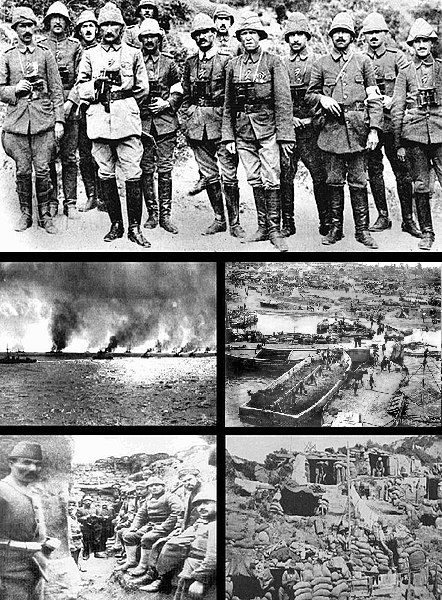
The Gallipoli campaign, the Dardanelles campaign, the Defence of Gallipoli or the Battle of Gallipoli (Turkish: Gelibolu Muharebesi, Çanakkale Muharebeleri or Çanakkale Savaşı) was a military campaign in the First World War on the Gallipoli Peninsula (now Gelibolu) from 19 February 1915 to 9 January 1916. The Entente powers, Britain, France and the Russian Empire, sought to weaken the Ottoman Empire, one of the Central Powers, by taking control of the Turkish straits. This would expose the Ottoman capital at Constantinople to bombardment by Entente battleships and cut it off from the Asian part of the empire. With the Ottoman Empire defeated, the Suez Canal would be safe and the Bosphorus and Dardanelles straits would be open to Entente supplies to the Black Sea and warm-water ports in Russia.
In February 1915 the Entente fleet failed to force a passage through the Dardanelles. An amphibious landing on the Gallipoli peninsula began in April 1915. In January 1916, after eight months' fighting, with approximately 250,000 casualties on each side, the land campaign was abandoned and the invasion force was withdrawn. It was a costly campaign for the Entente powers and the Ottoman Empire as well as for the sponsors of the expedition, especially the First Lord of the Admiralty (1911–1915), Winston Churchill. The campaign was considered a great Ottoman victory. In Turkey, it is regarded as a defining moment in the history of the state, a final surge in the defence of the motherland as the Ottoman Empire retreated.
The campaign became the basis for the Turkish War of Independence and the declaration of the Republic of Turkey in 1923, with Mustafa Kemal Atatürk, who rose to prominence as a commander at Gallipoli, as founder and president. The campaign is considered by some to be the beginning of Australian and New Zealand national consciousness. The anniversary of the landings, 25 April, is known as Anzac Day, the most significant commemoration of military casualties and veterans in the two countries, surpassing Remembrance Day (Armistice Day).
On 29 October 1914, two former German warships, the Ottoman Yavûz Sultân Selîm and Midilli, conducted the Black Sea raid, in which they bombarded the Russian port of Odessa and sank several ships. On 31 October, the Ottomans entered the war and began the Caucasus campaign against Russia. The British briefly bombarded forts in Gallipoli, invaded Mesopotamia and studied the possibility of forcing the Dardanelles.
Before the Dardanelles operation was conceived, the British had planned to conduct an amphibious invasion near Alexandretta on the Mediterranean, an idea originally presented by Boghos Nubar in 1914. This plan was made by the Secretary of State for War, Field Marshal Earl Kitchener, to sever the Ottoman capital from Syria, Palestine and Egypt. Alexandretta was an area with a Christian population and was the strategic centre of the Ottoman railway network; its capture would cut the empire in two. Vice Admiral Sir Richard Peirse, Commander-in-Chief, East Indies, ordered Captain Frank Larkin of HMS Doris to Alexandretta on 13 December 1914. The Russian cruiser Askold and the French cruiser Requin were also present. Kitchener was working on the plan in March 1915, the beginning of the British attempt to incite an Arab Revolt. The Alexandretta landing was abandoned because militarily it would have required more resources than France could allocate and politically France did not want the British operating in their sphere of influence, a position to which Britain had agreed in 1912.
By late 1914, on the Western Front, the Franco–British counter-offensive of the First Battle of the Marne had ended and the Belgians, British and French had suffered many casualties in the First Battle of Ypres in Flanders. The war of manoeuvre had evolved into trench warfare. The German Empire and Austria-Hungary closed the overland trade routes between Britain and France in the west and Russia in the east. The White Sea in the Arctic and the Sea of Okhotsk in the Far East were icebound in winter and distant from the Eastern Front; the Baltic Sea was blockaded by the Kaiserliche Marine (Imperial German Navy) and the entrance to the Black Sea through the Dardanelles was controlled by the Ottoman Empire. While the Ottomans remained neutral, supplies could be sent to Russia through the Dardanelles but prior to the Ottoman entry into the war, the straits had been closed; in November the Ottomans began to mine the waterway.
The French politician, Aristide Briand, proposed in November to attack the Ottoman Empire but this was rejected and an attempt by the British to bribe the Ottomans to join the Entente side also failed. Later that month, Winston Churchill, First Lord of the Admiralty, proposed a naval attack on the Dardanelles, based in part on erroneous reports of Ottoman troop strength. Churchill wanted to use a large number of obsolete battleships, which could not operate against the German High Seas Fleet, in a Dardanelles operation, with a small occupation force provided by the army. It was hoped that an attack on the Ottomans would also draw Bulgaria and Greece into the war on the Entente side. On 2 January 1915, Grand Duke Nicholas of Russia appealed to Britain for assistance against the Ottomans, who were campaigning in the Caucasus. Planning began for a naval demonstration in the Dardanelles, to divert Ottoman troops from Caucasia.
On 17 February 1915, a British seaplane from HMS Ark Royal flew a reconnaissance sortie over the Straits. Two days later, the first attack on the Dardanelles began when an Anglo-French flotilla, including the British dreadnought HMS Queen Elizabeth, began a long-range bombardment of Ottoman coastal artillery batteries. The British had intended to use eight aircraft from Ark Royal to spot for the bombardment but only a Short Type 136, was serviceable. A period of bad weather slowed the attack but by 25 February the outer forts had been reduced and the entrance cleared of mines. Royal Marines were landed to destroy guns at Kum Kale and Seddülbahir, while the naval bombardment shifted to batteries between Kum Kale and Kephez.
Hub AI
Gallipoli campaign AI simulator
(@Gallipoli campaign_simulator)
Gallipoli campaign
The Gallipoli campaign, the Dardanelles campaign, the Defence of Gallipoli or the Battle of Gallipoli (Turkish: Gelibolu Muharebesi, Çanakkale Muharebeleri or Çanakkale Savaşı) was a military campaign in the First World War on the Gallipoli Peninsula (now Gelibolu) from 19 February 1915 to 9 January 1916. The Entente powers, Britain, France and the Russian Empire, sought to weaken the Ottoman Empire, one of the Central Powers, by taking control of the Turkish straits. This would expose the Ottoman capital at Constantinople to bombardment by Entente battleships and cut it off from the Asian part of the empire. With the Ottoman Empire defeated, the Suez Canal would be safe and the Bosphorus and Dardanelles straits would be open to Entente supplies to the Black Sea and warm-water ports in Russia.
In February 1915 the Entente fleet failed to force a passage through the Dardanelles. An amphibious landing on the Gallipoli peninsula began in April 1915. In January 1916, after eight months' fighting, with approximately 250,000 casualties on each side, the land campaign was abandoned and the invasion force was withdrawn. It was a costly campaign for the Entente powers and the Ottoman Empire as well as for the sponsors of the expedition, especially the First Lord of the Admiralty (1911–1915), Winston Churchill. The campaign was considered a great Ottoman victory. In Turkey, it is regarded as a defining moment in the history of the state, a final surge in the defence of the motherland as the Ottoman Empire retreated.
The campaign became the basis for the Turkish War of Independence and the declaration of the Republic of Turkey in 1923, with Mustafa Kemal Atatürk, who rose to prominence as a commander at Gallipoli, as founder and president. The campaign is considered by some to be the beginning of Australian and New Zealand national consciousness. The anniversary of the landings, 25 April, is known as Anzac Day, the most significant commemoration of military casualties and veterans in the two countries, surpassing Remembrance Day (Armistice Day).
On 29 October 1914, two former German warships, the Ottoman Yavûz Sultân Selîm and Midilli, conducted the Black Sea raid, in which they bombarded the Russian port of Odessa and sank several ships. On 31 October, the Ottomans entered the war and began the Caucasus campaign against Russia. The British briefly bombarded forts in Gallipoli, invaded Mesopotamia and studied the possibility of forcing the Dardanelles.
Before the Dardanelles operation was conceived, the British had planned to conduct an amphibious invasion near Alexandretta on the Mediterranean, an idea originally presented by Boghos Nubar in 1914. This plan was made by the Secretary of State for War, Field Marshal Earl Kitchener, to sever the Ottoman capital from Syria, Palestine and Egypt. Alexandretta was an area with a Christian population and was the strategic centre of the Ottoman railway network; its capture would cut the empire in two. Vice Admiral Sir Richard Peirse, Commander-in-Chief, East Indies, ordered Captain Frank Larkin of HMS Doris to Alexandretta on 13 December 1914. The Russian cruiser Askold and the French cruiser Requin were also present. Kitchener was working on the plan in March 1915, the beginning of the British attempt to incite an Arab Revolt. The Alexandretta landing was abandoned because militarily it would have required more resources than France could allocate and politically France did not want the British operating in their sphere of influence, a position to which Britain had agreed in 1912.
By late 1914, on the Western Front, the Franco–British counter-offensive of the First Battle of the Marne had ended and the Belgians, British and French had suffered many casualties in the First Battle of Ypres in Flanders. The war of manoeuvre had evolved into trench warfare. The German Empire and Austria-Hungary closed the overland trade routes between Britain and France in the west and Russia in the east. The White Sea in the Arctic and the Sea of Okhotsk in the Far East were icebound in winter and distant from the Eastern Front; the Baltic Sea was blockaded by the Kaiserliche Marine (Imperial German Navy) and the entrance to the Black Sea through the Dardanelles was controlled by the Ottoman Empire. While the Ottomans remained neutral, supplies could be sent to Russia through the Dardanelles but prior to the Ottoman entry into the war, the straits had been closed; in November the Ottomans began to mine the waterway.
The French politician, Aristide Briand, proposed in November to attack the Ottoman Empire but this was rejected and an attempt by the British to bribe the Ottomans to join the Entente side also failed. Later that month, Winston Churchill, First Lord of the Admiralty, proposed a naval attack on the Dardanelles, based in part on erroneous reports of Ottoman troop strength. Churchill wanted to use a large number of obsolete battleships, which could not operate against the German High Seas Fleet, in a Dardanelles operation, with a small occupation force provided by the army. It was hoped that an attack on the Ottomans would also draw Bulgaria and Greece into the war on the Entente side. On 2 January 1915, Grand Duke Nicholas of Russia appealed to Britain for assistance against the Ottomans, who were campaigning in the Caucasus. Planning began for a naval demonstration in the Dardanelles, to divert Ottoman troops from Caucasia.
On 17 February 1915, a British seaplane from HMS Ark Royal flew a reconnaissance sortie over the Straits. Two days later, the first attack on the Dardanelles began when an Anglo-French flotilla, including the British dreadnought HMS Queen Elizabeth, began a long-range bombardment of Ottoman coastal artillery batteries. The British had intended to use eight aircraft from Ark Royal to spot for the bombardment but only a Short Type 136, was serviceable. A period of bad weather slowed the attack but by 25 February the outer forts had been reduced and the entrance cleared of mines. Royal Marines were landed to destroy guns at Kum Kale and Seddülbahir, while the naval bombardment shifted to batteries between Kum Kale and Kephez.
Recent media