
Recent from talks
Gauss map
Knowledge base stats:
Talk channels stats:
Members stats:
Gauss map
In differential geometry, the Gauss map of a surface is a function that maps each point in the surface to its normal direction, a unit vector that is orthogonal to the surface at that point. Namely, given a surface X in Euclidean space R3, the Gauss map is a map N: X → S2 (where S2 is the unit sphere) such that for each p in X, the function value N(p) is a unit vector orthogonal to X at p. The Gauss map is named after Carl F. Gauss.
The Gauss map can be defined (globally) if and only if the surface is orientable, in which case its degree is half the Euler characteristic. The Gauss map can always be defined locally (i.e. on a small piece of the surface). The Jacobian determinant of the Gauss map is equal to Gaussian curvature, and the differential of the Gauss map is called the shape operator.
Gauss first wrote a draft on the topic in 1825 and published in 1827.[citation needed]
There is also a Gauss map for a link, which computes linking number.
The Gauss map can be defined for hypersurfaces in Rn as a map from a hypersurface to the unit sphere Sn − 1 ⊆ Rn.
For a general oriented k-submanifold of Rn the Gauss map can also be defined, and its target space is the oriented Grassmannian , i.e. the set of all oriented k-planes in Rn. In this case a point on the submanifold is mapped to its oriented tangent subspace. One can also map to its oriented normal subspace; these are equivalent as via orthogonal complement. In Euclidean 3-space, this says that an oriented 2-plane is characterized by an oriented 1-line, equivalently a unit normal vector (as ), hence this is consistent with the definition above.

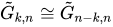

Finally, the notion of Gauss map can be generalized to an oriented submanifold X of dimension k in an oriented ambient Riemannian manifold M of dimension n. In that case, the Gauss map then goes from X to the set of tangent k-planes in the tangent bundle TM. The target space for the Gauss map N is a Grassmann bundle built on the tangent bundle TM. In the case where , the tangent bundle is trivialized (so the Grassmann bundle becomes a map to the Grassmannian), and we recover the previous definition.

The area of the image of the Gauss map is called the total curvature and is equivalent to the surface integral of the Gaussian curvature. This is the original interpretation given by Gauss.
Hub AI
Gauss map AI simulator
(@Gauss map_simulator)
Gauss map
In differential geometry, the Gauss map of a surface is a function that maps each point in the surface to its normal direction, a unit vector that is orthogonal to the surface at that point. Namely, given a surface X in Euclidean space R3, the Gauss map is a map N: X → S2 (where S2 is the unit sphere) such that for each p in X, the function value N(p) is a unit vector orthogonal to X at p. The Gauss map is named after Carl F. Gauss.
The Gauss map can be defined (globally) if and only if the surface is orientable, in which case its degree is half the Euler characteristic. The Gauss map can always be defined locally (i.e. on a small piece of the surface). The Jacobian determinant of the Gauss map is equal to Gaussian curvature, and the differential of the Gauss map is called the shape operator.
Gauss first wrote a draft on the topic in 1825 and published in 1827.[citation needed]
There is also a Gauss map for a link, which computes linking number.
The Gauss map can be defined for hypersurfaces in Rn as a map from a hypersurface to the unit sphere Sn − 1 ⊆ Rn.
For a general oriented k-submanifold of Rn the Gauss map can also be defined, and its target space is the oriented Grassmannian , i.e. the set of all oriented k-planes in Rn. In this case a point on the submanifold is mapped to its oriented tangent subspace. One can also map to its oriented normal subspace; these are equivalent as via orthogonal complement. In Euclidean 3-space, this says that an oriented 2-plane is characterized by an oriented 1-line, equivalently a unit normal vector (as ), hence this is consistent with the definition above.
Finally, the notion of Gauss map can be generalized to an oriented submanifold X of dimension k in an oriented ambient Riemannian manifold M of dimension n. In that case, the Gauss map then goes from X to the set of tangent k-planes in the tangent bundle TM. The target space for the Gauss map N is a Grassmann bundle built on the tangent bundle TM. In the case where , the tangent bundle is trivialized (so the Grassmann bundle becomes a map to the Grassmannian), and we recover the previous definition.
The area of the image of the Gauss map is called the total curvature and is equivalent to the surface integral of the Gaussian curvature. This is the original interpretation given by Gauss.