
Recent from talks
Geology of solar terrestrial planets
Knowledge base stats:
Talk channels stats:
Members stats:
Geology of solar terrestrial planets
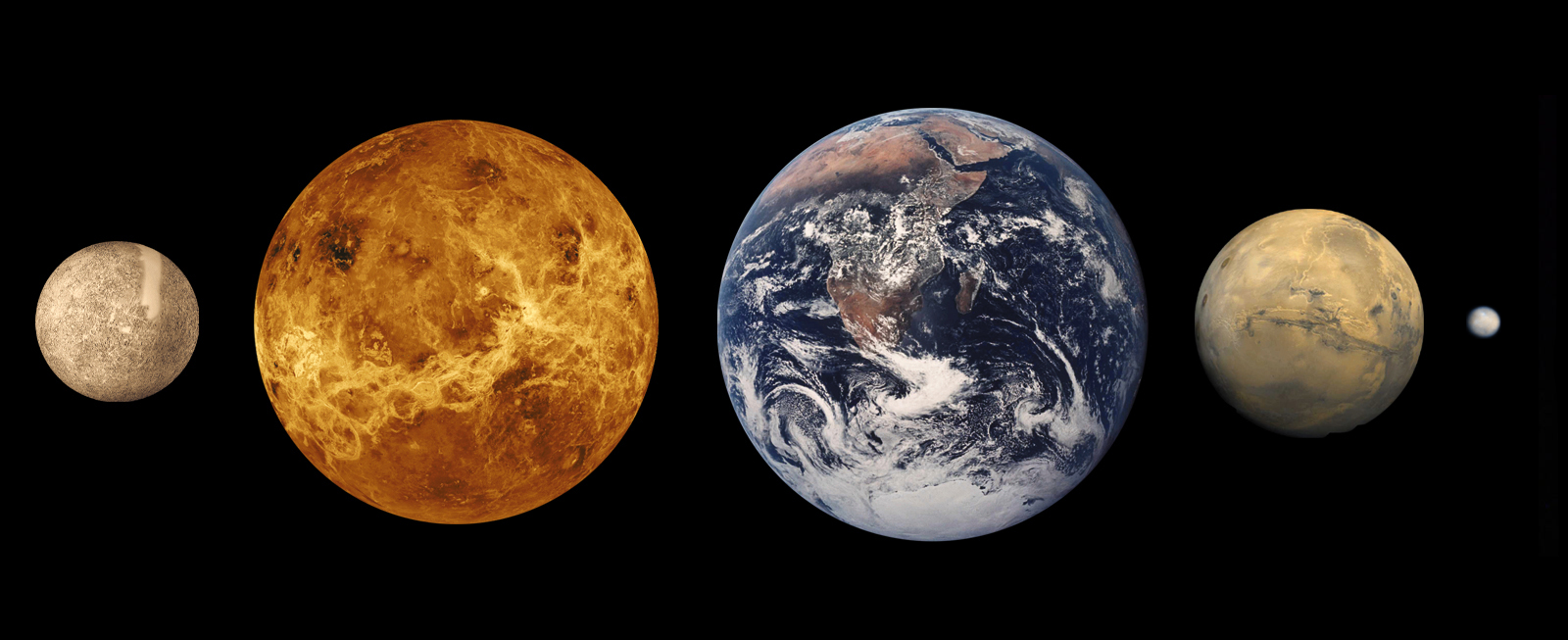
The geology of solar terrestrial planets mainly deals with the geological aspects of the four terrestrial planets of the Solar System – Mercury, Venus, Earth, and Mars – and one terrestrial dwarf planet: Ceres. Earth is the only terrestrial planet known to have an active hydrosphere.
Terrestrial planets are substantially different from the giant planets, which might not have solid surfaces and are composed mostly of some combination of hydrogen, helium, and water existing in various physical states. Terrestrial planets have a compact, rocky surfaces, and Venus, Earth, and Mars each also has an atmosphere. Their size, radius, and density are all similar.
Terrestrial planets have numerous similarities to dwarf planets (objects like Pluto), which also have a solid surface, but are primarily composed of icy materials. During the formation of the Solar System, there were probably many more (planetesimals), but they have all merged with or been destroyed by the four remaining worlds in the solar nebula.
The terrestrial planets all have roughly the same structure: a central metallic core, mostly iron, with a surrounding silicate mantle. The Moon is similar, but lacks a substantial iron core. Three of the four solar terrestrial planets (Venus, Earth, and Mars) have substantial atmospheres; all have impact craters and tectonic surface features such as rift valleys and volcanoes.
The term inner planet should not be confused with inferior planet, which refers to any planet that is closer to the Sun than the observer's planet is, but usually refers to Mercury and Venus.
The Solar System is believed to have formed according to the nebular hypothesis, first proposed in 1755 by Immanuel Kant and independently formulated by Pierre-Simon Laplace. This theory holds that 4.6 billion years ago the Solar System formed from the gravitational collapse of a giant molecular cloud. This initial cloud was likely several light-years across and probably birthed several stars.
The first solid particles were microscopic in size. These particles orbited the Sun in nearly circular orbits right next to each other, as the gas from which they condensed. Gradually, gentle collisions allowed the flakes to stick together and make larger particles which, in turn, attracted more solid particles towards them. This process is known as accretion. The objects formed by accretion are called planetesimals—they act as seeds for planet formation. Initially, planetesimals were closely packed. They coalesced into larger objects, forming clumps up to a few kilometers across in a few million years, a small time in comparison to the age of the Solar System. After the planetesimals grew bigger in sizes, collisions became highly destructive, making further growth more difficult. Only the biggest planetesimals survived the fragmentation process and continued to slowly grow into protoplanets by accretion of planetesimals of similar composition. After the protoplanet formed, accumulation of heat from radioactive decay of short-lived elements melted the planet, allowing materials to differentiate (i.e. to separate according to their density).
In the warmer inner Solar System, planetesimals formed from rocks and metals cooked billions of years ago in the cores of massive stars. These elements constituted only 0.6% of the material in the solar nebula. That is why the terrestrial planets could not grow very large and could not exert a strong pull on hydrogen and helium gas. Also, the faster collisions among particles close to the Sun were more destructive on average. Even if the terrestrial planets had had hydrogen and helium, the Sun would have heated the gases and caused them to escape. Hence, solar terrestrial planets such as Mercury, Venus, Earth, and Mars are dense, small planets composed mostly from 2% of heavier elements contained in the solar nebula.
Hub AI
Geology of solar terrestrial planets AI simulator
(@Geology of solar terrestrial planets_simulator)
Geology of solar terrestrial planets
The geology of solar terrestrial planets mainly deals with the geological aspects of the four terrestrial planets of the Solar System – Mercury, Venus, Earth, and Mars – and one terrestrial dwarf planet: Ceres. Earth is the only terrestrial planet known to have an active hydrosphere.
Terrestrial planets are substantially different from the giant planets, which might not have solid surfaces and are composed mostly of some combination of hydrogen, helium, and water existing in various physical states. Terrestrial planets have a compact, rocky surfaces, and Venus, Earth, and Mars each also has an atmosphere. Their size, radius, and density are all similar.
Terrestrial planets have numerous similarities to dwarf planets (objects like Pluto), which also have a solid surface, but are primarily composed of icy materials. During the formation of the Solar System, there were probably many more (planetesimals), but they have all merged with or been destroyed by the four remaining worlds in the solar nebula.
The terrestrial planets all have roughly the same structure: a central metallic core, mostly iron, with a surrounding silicate mantle. The Moon is similar, but lacks a substantial iron core. Three of the four solar terrestrial planets (Venus, Earth, and Mars) have substantial atmospheres; all have impact craters and tectonic surface features such as rift valleys and volcanoes.
The term inner planet should not be confused with inferior planet, which refers to any planet that is closer to the Sun than the observer's planet is, but usually refers to Mercury and Venus.
The Solar System is believed to have formed according to the nebular hypothesis, first proposed in 1755 by Immanuel Kant and independently formulated by Pierre-Simon Laplace. This theory holds that 4.6 billion years ago the Solar System formed from the gravitational collapse of a giant molecular cloud. This initial cloud was likely several light-years across and probably birthed several stars.
The first solid particles were microscopic in size. These particles orbited the Sun in nearly circular orbits right next to each other, as the gas from which they condensed. Gradually, gentle collisions allowed the flakes to stick together and make larger particles which, in turn, attracted more solid particles towards them. This process is known as accretion. The objects formed by accretion are called planetesimals—they act as seeds for planet formation. Initially, planetesimals were closely packed. They coalesced into larger objects, forming clumps up to a few kilometers across in a few million years, a small time in comparison to the age of the Solar System. After the planetesimals grew bigger in sizes, collisions became highly destructive, making further growth more difficult. Only the biggest planetesimals survived the fragmentation process and continued to slowly grow into protoplanets by accretion of planetesimals of similar composition. After the protoplanet formed, accumulation of heat from radioactive decay of short-lived elements melted the planet, allowing materials to differentiate (i.e. to separate according to their density).
In the warmer inner Solar System, planetesimals formed from rocks and metals cooked billions of years ago in the cores of massive stars. These elements constituted only 0.6% of the material in the solar nebula. That is why the terrestrial planets could not grow very large and could not exert a strong pull on hydrogen and helium gas. Also, the faster collisions among particles close to the Sun were more destructive on average. Even if the terrestrial planets had had hydrogen and helium, the Sun would have heated the gases and caused them to escape. Hence, solar terrestrial planets such as Mercury, Venus, Earth, and Mars are dense, small planets composed mostly from 2% of heavier elements contained in the solar nebula.
Recent media