Hubbry Logo
PlanetesimalPlanetesimalMain
Open search
Planetesimal
Community hub
Planetesimal
logo
8 pages, 0 posts
0 subscribers
Be the first to start a discussion here.
Planetesimal
Planetesimal
from Wikipedia
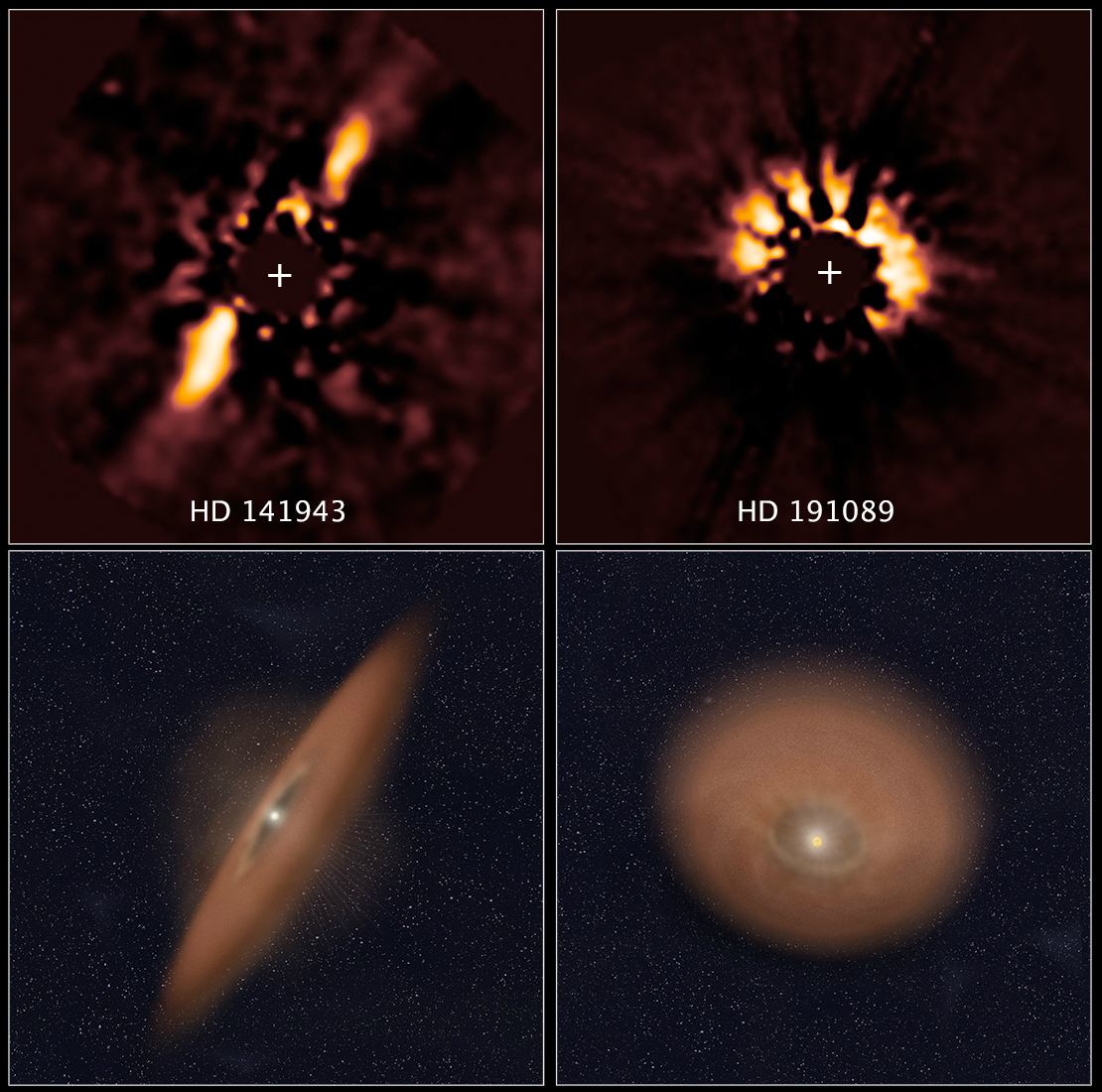
Debris disks detected in HST archival images of young stars, HD 141943 and HD 191089, using improved imaging processes (24 April 2014).[1]
486958 Arrokoth, the first pristine planetesimal visited by a spacecraft.

Planetesimals (/ˌplænɪˈtɛsɪməlz/) are solid objects thought to exist in protoplanetary disks and debris disks. Believed to have formed in the Solar System about 4.6 billion years ago, they aid study of its formation.

Formation

[edit]

A widely accepted theory of planet formation, the planetesimal hypothesis of Viktor Safronov, states that planets form from cosmic dust grains that collide and stick to form ever-larger bodies. Once a body reaches around a kilometer in size, its constituent grains can attract each other directly through mutual gravity, enormously aiding further growth into moon-sized protoplanets. Smaller bodies must instead rely on Brownian motion or turbulence to cause the collisions leading to sticking. The mechanics of collisions and mechanisms of sticking are intricate.[2][3] Alternatively, planetesimals may form in a very dense layer of dust grains that undergoes a collective gravitational instability in the mid-plane of a protoplanetary disk—or via the concentration and gravitational collapse of swarms of larger particles in streaming instabilities.[4] Many planetesimals eventually break apart during violent collisions, as 4 Vesta[5] and 90 Antiope may have,[6] but a few of the largest ones may survive such encounters and grow into protoplanets and, later, planets.

Planetesimals in the Solar System

[edit]

It has been inferred that about 3.8 billion years ago, after a period known as the Late Heavy Bombardment, most of the planetesimals within the Solar System had either been ejected from the Solar System entirely, into distant eccentric orbits such as the Oort cloud, or had collided with larger objects due to the regular gravitational nudges from the giant planets (particularly Jupiter and Neptune). A few planetesimals may have been captured as moons, such as Phoebe (a moon of Saturn) and many other small high-inclination moons of the giant planets.

Planetesimals that have survived to the current day are valuable to science because they contain information about the formation of the Solar System. Although their exteriors are subjected to intense solar radiation that can alter their chemistry, their interiors contain pristine material essentially untouched since the planetesimal was formed. This makes each planetesimal a 'time capsule', and their composition might reveal the conditions in the Solar Nebula from which our planetary system was formed. The most primitive planetesimals visited by spacecraft are the contact binary Arrokoth.[7]

Definition of planetesimal

[edit]

The word planetesimal is derived from the word infinitesimal and means an ultimately small fraction of a planet. [citation needed]

While the name is always applied to small bodies during the process of planet formation, some scientists also use the term planetesimal as a general term to refer to many small Solar System bodies – such as asteroids and comets – which are left over from the formation process. A group of the world's leading planet formation experts decided at a conference in 2006[8] on the following definition of a planetesimal:

A planetesimal is a solid object arising during the accumulation of orbiting bodies whose internal strength is dominated by self-gravity and whose orbital dynamics is not significantly affected by gas drag. This corresponds to objects larger than approximately 1 km in the solar nebula.

Bodies large enough not only to keep together by gravitation but to change the path of approaching rocks over distances of several radii start to grow faster. These bodies, larger than 100 km to 1000 km, are called embryos or protoplanets.[9]

In the current Solar System, these small bodies are usually also classified by dynamics and composition, and may have subsequently evolved[10][11][12] to become comets, Kuiper belt objects or trojan asteroids, for example. In other words, some planetesimals became other types of body once planetary formation had finished, and may be referred to by either or both names.

The above definition is not endorsed by the International Astronomical Union, and other working groups may choose to adopt the same or a different definition. The dividing line between a planetesimal and protoplanet is typically framed in terms of the size and the stages of development that the potential planet has already gone through: planetesimals combine to form a protoplanet, and protoplanets continue to grow (faster than planetesimals).[13][14][15]

See also

[edit]

Notes and references

[edit]

Further reading

[edit]
Revisions and contributorsEdit on WikipediaRead on Wikipedia
from Grokipedia
A planetesimal is a solid celestial body, typically ranging from about 1 kilometer to several hundred kilometers in diameter, formed from the aggregation of dust grains, rocky particles, and in a surrounding a young star. These objects serve as the fundamental building blocks of , asteroids, comets, and other solar system bodies, emerging through processes of collision and sticking in the gaseous and dusty environment of the that forms from the collapse of a . In the context of our Solar System, planetesimals began forming approximately 4.6 billion years ago, shortly after the proto-Sun ignited, as small particles in the solar nebula coalesced into larger clumps. This initial accretion occurred in stages: first, dust particles condensed from the cooling nebula and settled into a thin, gravitationally unstable disk; then, gravitational instabilities, direct collisions, or streaming instabilities led to the formation of kilometer-sized first-generation planetesimals over timescales of hundreds of thousands to about a million years. Over subsequent millions of years, these evolved through cluster formation and further collisions, driven by gas drag and gravitational attraction. Two primary mechanisms explain their origin—core accretion, where dust grains progressively stick and grow, and gravitational instability, where dense disk regions collapse directly into planetesimals—often combining with streaming instability to accelerate the process. Planetesimals play a crucial role in planetary formation by colliding to create planetary embryos, roughly the size of Mars, which then merge into full-sized planets within a few million years as the dissipates. In our Solar System, remnants of these ancient bodies include the asteroids in the main belt and objects, providing key insights into early solar system dynamics and composition. Their study, informed by observations of debris disks around other stars, missions like NASA's Dawn and , reveals how turbulence, gas drag, and orbital resonances influence their growth and survival.

Definition and Properties

Definition

A planetesimal is a solid celestial body formed during the early stages of development, typically ranging from about 1 kilometer to several hundred kilometers in diameter, at which self-gravity dominates over external forces such as gas drag or tidal influences, enabling the object to accrete additional material and grow toward planetary sizes. This scale marks a critical transition where gravitational interactions begin to govern the body's dynamics, distinguishing it as a building block in the accretion process. The term "planetesimal" derives from the combination of "" and "," emphasizing its role as a minuscule yet fundamental planetary precursor, and was coined in by geologist Thomas C. Chamberlin and astronomer Forest Ray Moulton in their planetesimal hypothesis, which posited that planets formed through collisions of such small solid particles ejected from the Sun. The concept traces its roots to the , first articulated by in 1755 and refined by in 1796, which described the solar system's origin from a collapsing gaseous where diffuse material condensed into small solid particles that aggregated into . This idea was formalized in modern accretion theory by Viktor Safronov in 1969, who detailed the gravitational and collisional processes governing planetesimal growth. Planetesimals are differentiated from smaller dust grains, which are sub-meter particles primarily aggregated by non-gravitational mechanisms like van der Waals forces and , and from protoplanets, which are substantially larger bodies exceeding roughly 100–1,000 km in diameter, often featuring internal differentiation into core and mantle structures or retaining significant gaseous envelopes.

Physical and Chemical Properties

Planetesimals are typically defined by a size range of 1 km to 100 km in , exhibiting irregular shapes due to insufficient self-gravity for complete rounding during their formation phase. These dimensions allow them to be self-gravitating aggregates while remaining below the scale of protoplanets, with shapes influenced by initial accretion dynamics and subsequent low-velocity collisions that preserve angular features. Their bulk densities generally fall between 1 and 3 g/cm³, with variations primarily driven by the relative proportions of and rocky components; for instance, primitive carbonaceous chondrite-like materials exhibit densities around 2 g/cm³, reflecting a mix of porous silicates and minor metals. planetesimals in outer disk regions tend toward the lower end of this range due to water incorporation, while inner disk counterparts are denser from higher content. Compositionally, planetesimals consist of a heterogeneous of silicates, metals (such as iron and ), and ices including , , and , with primitive variants closely mirroring solar nebula elemental abundances for , , and oxygen. Recent analyses of samples from asteroids and Ryugu (as of 2025) confirm high carbon abundances (around 4-5 wt%) and the presence of organics and minerals predating Earth's formation, supporting the primitive nature of these planetesimal remnants. These ratios are preserved in undifferentiated bodies, where silicates and metals form the core matrix, interspersed with volatile ices that dominate in colder formation environments, leading to overall mass fractions like approximately 40% ice, 30% rock, and 30% organics in cometary analogs. Surface features on planetesimals include thin layers developed through repeated low-energy impacts, which grind down without significant resurfacing, and low albedos typically ranging from 0.03 to 0.1 for dark, primitive types rich in carbonaceous . Icy planetesimals may exhibit potential cryovolcanic activity, where subsurface volatiles erupt to form smooth plains or vents, altering local topography under internal heating. Rotational periods for planetesimals span from several hours to a few days, with an average around 10 hours, shaped by acquired during accretion and modified by collisions that can either accelerate or stabilize spin. The Yarkovsky-O'Keefe-Radzievskii-Paddack ( further influences rotation by imparting a net from asymmetric thermal re-radiation of , potentially leading to spin-up over time scales of millions of years.

Formation Processes

Initial Dust

The initial represents the foundational stage in planetesimal formation, occurring within the gas-dominated surrounding a young star. These disks consist primarily of molecular and , with a component comprising approximately 1% by , initially in the form of micron-sized grains inherited from the and stellar outflows. Radially, disk temperatures decrease from around 1000 near the central star to about 10 in the outer regions, creating a stratified environment that influences dust dynamics and chemistry. Coagulation begins as these sub-micron particles collide and stick, driven primarily by van der Waals forces and electrostatic interactions that overcome relative velocities on the order of centimeters per second. For particles smaller than 1 cm, —resulting from random collisions with gas molecules—facilitates frequent encounters, with the diffusion coefficient given by
D=kT6πηr,D = \frac{kT}{6\pi \eta r},
where kk is Boltzmann's constant, TT is the temperature, η\eta is the gas viscosity, and rr is the particle radius. This diffusive process dominates early growth, enabling aggregates to form fluffy, fractal-like structures with low densities. Turbulent gas motions in the disk further enhance collision rates by concentrating dust in dense clumps, promoting pairwise sticking without significant fragmentation at these scales.
Growth proceeds efficiently to millimeter and centimeter sizes, but encounters a "bouncing barrier" around 1 cm, where relative velocities exceed 1 m/s, leading to elastic rebounds rather than and potential fragmentation upon impact. experiments confirm this transition, with rebound velocities surpassing sticking thresholds for aggregates at these dimensions. However, at ice lines—radial locations where temperatures drop below the condensation point of volatiles like (around 150-170 )—icy mantles form on dust grains, dramatically increasing surface stickiness and enabling growth beyond the barrier through enhanced energy dissipation during collisions. The entire from micron-sized to centimeter-scale pebbles typically unfolds over timescales of 100 to 1000 years, accelerated by that boosts local densities by factors of 10-100 compared to the mean disk value. This rapid aggregation sets the stage for subsequent concentration mechanisms, with growth rates depending on local turbulence levels and particle , as modeled in numerical simulations of disk .

Growth to Planetesimal Size

The transition from centimeter-sized pebbles to kilometer-sized planetesimals in protoplanetary disks primarily occurs through hydrodynamic and gravitational instabilities that concentrate solids beyond the reach of simple collisional growth. The streaming instability, introduced by Youdin and Goodman (2005), arises from the differential drift between gas and solid particles, leading to aerodynamic interactions that amplify density fluctuations and form dense filaments of pebbles. These filaments can achieve solid-to-gas density ratios exceeding unity, enabling gravitational collapse into planetesimals when the disk's self-gravity overcomes stabilizing forces, as quantified by the Toomre parameter Q=csκπGΣQ = \frac{c_s \kappa}{\pi G \Sigma}, where csc_s is the sound speed, κ\kappa is the epicyclic frequency, GG is the gravitational constant, and Σ\Sigma is the surface density; instability occurs when Q<1Q < 1. This process builds on the initial coagulation of dust into pebbles, allowing gravitational mechanisms to dominate at larger scales. An alternative pathway is secular gravitational instability, particularly in massive disks where dust settling creates a thin layer susceptible to long-timescale perturbations from gas drag and differential rotation. Unlike the rapid streaming instability, secular modes grow over orbital timescales, fostering axisymmetric instabilities that concentrate solids without requiring extreme drift velocities. This mechanism is more relevant in regions with high dust abundance, such as beyond the snow line, where it complements direct gravitational collapse. Once formed, planetesimals reach a critical size threshold of approximately 1 km, beyond which runaway growth accelerates due to gravitational focusing, enhancing collision probabilities. The effective cross-section for collisions becomes σ=πr2(1+2GMrv2)\sigma = \pi r^2 \left(1 + \frac{2 G M}{r v^2}\right), where rr is the planetesimal radius, MM its mass, and vv the relative velocity; the focusing term 2GMrv2\frac{2 G M}{r v^2} (related to the Safronov number) dominates when escape velocity exceeds random motions, leading to exponential mass growth. However, reaching this threshold faces the meter-size barrier, where particles experience rapid radial drift or bouncing upon collision, stalling growth; in outer disks, ice-assisted aggregation allows fluffy icy particles to stick at higher velocities, bypassing fragmentation, while turbulence aids concentration via mechanisms like the streaming instability. Overall, these processes convert 10-50% of the disk's solid mass into on timescales of 1-10 Myr, aligning with observed protoplanetary disk lifetimes and enabling subsequent planetary accretion.

Role in Planetary Accretion

Collisional Evolution

Collisional evolution refers to the dynamic process by which in a protoplanetary disk interact through mutual collisions, resulting in either accretion to larger sizes or fragmentation into smaller debris, thereby shaping the overall mass and size distribution during the early stages of planet formation. This evolution is governed by the interplay of collision frequencies, impact velocities, and material properties, transitioning from net growth in the initial phases to a balance between building and destruction as the disk matures. The process is crucial for determining how efficiently contribute to planetary cores before larger bodies dominate accretion. Collision rates among planetesimals are primarily determined by the dynamics of the protoplanetary disk, where the Safronov number, defined as Θ=12vesc2vrel2\Theta = \frac{1}{2} \frac{v_{\rm esc}^2}{v_{\rm rel}^2}, quantifies the role of gravitational focusing in enhancing encounter probabilities, with vescv_{\rm esc} as the escape velocity from the planetesimal surface and vrelv_{\rm rel} as the relative velocity between colliding bodies. When Θ>1\Theta > 1, gravitational attraction significantly boosts the effective cross-section for impacts, facilitating higher collision rates in denser disk regions. This parameter, introduced in foundational models of planetesimal dynamics, highlights how low relative velocities initially favor frequent encounters, though rates decline as velocities increase due to disk stirring. The outcomes of these collisions depend critically on impact velocity: at low velocities below approximately 1 km/s, mergers dominate, allowing planetesimals to accrete and grow efficiently through sticking or gravitational capture of fragments. In contrast, high-velocity impacts exceeding 5 km/s often lead to or catastrophic disruption, where the target loses a substantial fraction of its —up to 99% in super-catastrophic cases—producing a swarm of smaller fragments rather than net growth. These disruptive events are modeled using hydrodynamic simulations that account for material strength and , revealing thresholds where outweighs accretion for bodies larger than a few kilometers. Such outcomes underscore the shift from constructive to destructive collisions as the disk evolves. Over time, the size distribution of planetesimals and their fragments tends toward a collisional equilibrium described by the Dohnanyi law, where the number of bodies n(D)n(D) scales as n(D)D3.5n(D) \propto D^{-3.5} across diameters from about 1 cm to 100 km, reflecting a steady-state balance between production of small from disruptions and their removal by further collisions. This power-law distribution emerges from analytical solutions to collisional cascade models, assuming equal-sized fragments and in impacts, and has been validated in simulations of disks. However, deviations occur in non-equilibrium phases, such as during rapid growth spurts. Dynamical heating, arising from gravitational among growing planetesimals and emerging protoplanets, progressively increases relative velocities across the disk, typically reaching disruptive levels after about 1 million years and thereby inhibiting further net accretion by favoring fragmentation over mergers. This viscous stirring effect, quantified in N-body simulations, raises the velocity dispersion from initial sub-meter-per-second values to kilometers per second, effectively stalling planetesimal growth and transitioning the system toward oligarchic accretion dominated by larger embryos. The timescale aligns with observed disk lifetimes, emphasizing the finite window for efficient collisional buildup.

Transition to Protoplanets

The transition from a planetesimal disk to protoplanets is dominated by two successive phases of accretion: runaway growth followed by oligarchic growth. In the runaway phase, the largest planetesimals experience enhanced gravitational cross-sections, leading to rapid mass accumulation that outpaces smaller bodies. This phase typically lasts 0.1–1 million years, during which a small number of bodies grow to masses significantly exceeding the average planetesimal size, establishing dynamical dominance over the disk. The subsequent oligarchic phase involves competition among these emerging protoplanets, which grow at comparable rates while maintaining relative isolation due to orbital repulsion. Lasting 1–10 million years, this stage results in a self-regulated system where protoplanets accrete planetesimals more efficiently than they collide with each other. The mass growth during these phases can be characterized by the doubling time tdblMM˙ln2t_{\rm dbl} \approx \frac{M}{\dot{M}} \ln 2, where MM is the protoplanet mass and M˙\dot{M} is the accretion rate, with M˙Σr2/Ω\dot{M} \propto \Sigma r^2 / \Omega (Σ\Sigma is the disk surface density, rr the protoplanet radius, and Ω\Omega the Keplerian frequency). This formulation highlights the exponential nature of early growth, transitioning to more linear accumulation as isolation zones expand. By the end of oligarchic accretion, the disk typically hosts 100–1000 protoplanets, spaced approximately 10 Hill radii apart to minimize mutual perturbations. During this process, planetesimals are largely depleted, comprising less than 1% of the initial disk mass, as most material is incorporated into the protoplanets. The final consolidation into full occurs through giant impacts among these protoplanets, such as the theorized Moon-forming collision between proto-Earth and a Mars-sized body.

Planetesimals in the Modern Solar System

Asteroids and Meteorites

The Main Belt, located between the orbits of Mars and , hosts the primary population of surviving planetesimals in the inner Solar System, consisting of rocky and metallic remnants from the early . These asteroids range predominantly from 1 to 100 km in diameter, though a few larger bodies exist, such as , which measures approximately 525 km across and is notable for its differentiated structure, featuring a crust, mantle, and iron core. The current population includes an estimated 1.1 to 1.9 million asteroids larger than 1 km in diameter, with the total mass of the belt amounting to about 2.1 × 10^{21} kg, equivalent to roughly 0.00035 masses or 3% of the Moon's mass. Asteroids in the Main Belt are classified primarily by their spectral properties and compositions, with C-type (carbonaceous) asteroids comprising over 75% of the population; these dark, primitive bodies are rich in carbon, silicates, and volatiles, reflecting minimally altered planetesimal material from the outer disk regions. S-type (siliceous or stony) asteroids make up about 17%, consisting of and nickel-iron mixtures, and are more prevalent in the inner belt, suggesting origins closer to the Sun where higher temperatures inhibited volatile retention. These compositional distinctions provide direct links to the diverse planetesimal populations that formed during the Solar System's first few million years. Meteorites recovered on serve as invaluable samples of these ancient planetesimals, offering insights into their undifferentiated and differentiated states. , the most primitive meteorites, represent fragments from undifferentiated planetesimals that never underwent significant melting; for example, the Allende CV3 contains calcium-aluminum-rich inclusions (CAIs) dated to approximately 4.567 billion years ago (Ga), marking the oldest known solids condensed from the solar nebula. In contrast, achondrites derive from melted and differentiated parent bodies, where internal heating led to magmatic processes and core-mantle separation, as evidenced by basaltic howardites, eucrites, and diogenites (HED meteorites) linked to Vesta. The dynamical history of the Main Belt reveals extensive depletion and reshaping through giant planet migrations and collisional events. In the Grand Tack model, Jupiter's early inward migration to about 1.5 AU followed by an outward shift scattered and removed much of the original planetesimal population, reducing the belt's mass by orders of magnitude and implanting outer disk material into the inner regions. Subsequent collisions intensified during the around 3.9 Ga, a period of elevated impact flux that heavily cratered asteroid surfaces and contributed to the fragmentation observed today. This evolutionary path underscores the Main Belt's role as a depleted reservoir of primitive planetesimals, preserving compositional gradients from the disk's initial formation.

Trans-Neptunian Objects

Trans-Neptunian objects (TNOs) represent a diverse population of icy planetesimals orbiting beyond , serving as key preserved samples of the early Solar System's building blocks. These bodies, largely unaltered since their formation, offer direct evidence of the processes that shaped the outer , including the accretion of volatiles and the dynamical scattering during giant planet migration. Unlike inner Solar System remnants, TNOs are predominantly composed of water ice, , and other frozen volatiles, reflecting the colder conditions of their natal environment. The , a broad disk extending from about 30 to 50 AU, hosts the majority of known TNOs, with estimates suggesting hundreds of thousands of objects larger than 100 km in . Prominent members include the dwarf planets and Eris, which exemplify the belt's volatile-rich composition. Within the , the cold classical population stands out for its low-eccentricity and low-inclination orbits, which have remained stable and unperturbed by Neptune's gravity, thereby retaining primordial dynamical and physical properties from the era of planetesimal formation. Extending beyond the main , the scattered disk consists of planetesimals dynamically ejected into eccentric orbits by interactions with , reaching distances up to several hundred AU; notable examples include Sedna, whose highly elongated orbit highlights the scattering processes. The forms a more distant, spherical reservoir of such ejected planetesimals, spanning 2,000 to 100,000 AU and acting as a distant shell perturbed by passing stars. The combined mass of the scattered disk and inner populations is estimated at 0.01 to 0.1 masses, underscoring their role as scattered remnants of the giant planets' formation zones. Many TNOs manifest as the nuclei of , with short-period comets (orbital periods under 200 years) sourcing from the through gravitational perturbations, while long-period comets (periods over 200 years) originate from the due to galactic tidal influences. A representative example is , a short-period comet revealed by the ESA mission to be a low-density, porous aggregate of ice and dust grains, with a structure indicative of gentle assembly from smaller planetesimal fragments. Among the most pristine TNOs is Arrokoth (486958, 2014 MU69), a cold classical Kuiper Belt object imaged during the 2019 flyby. This , comprising two similarly sized lobes joined at low relative velocity, demonstrates that planetesimals in this region formed through hierarchical, low-speed accretion of pebbles within the , preserving a snapshot of early growth without violent collisions.

Theoretical Models and Observations

Numerical Simulations

Numerical simulations play a crucial role in modeling the formation and evolution of planetesimals, capturing complex interactions in protoplanetary disks that are intractable analytically. Hydrodynamic simulations, such as those employing the FARGO code, are widely used to study disk instabilities like the streaming instability, which concentrates dust particles into dense filaments capable of gravitational collapse. These simulations solve the equations of gas and dust dynamics on a grid, incorporating aerodynamic drag and pressure gradients to reveal how particle clumping occurs over scales of AU in the disk. For the later stages of accretion, N-body simulations using integrators like MERCURY track the gravitational interactions among thousands to millions of planetesimals, modeling their collisions and orbital evolution to predict planetary embryo growth. Key predictions from these models include thresholds for the onset of streaming instability, where planetesimal formation requires a dust-to-gas ratio Z exceeding approximately 0.01 to overcome particle drift and enable robust clumping, though this value varies with and turbulent strength. These size ranges align with the primordial populations inferred from observations, emphasizing the role of early instabilities in setting the building blocks for planets. Advancements in simulation techniques have incorporated (SPH) methods to resolve high-velocity impacts between planetesimals, capturing material deformation, fragmentation, and heating with Lagrangian particles that adapt to irregular geometries. Additionally, models integrating gas drag effects and , such as those in model framework, use N-body codes to simulate how scattering of planetesimals by migrating giant planets shapes the outer Solar System architecture, including excitation of eccentricities and inclinations. Despite these progresses, limitations persist, particularly in resolving small-scale physics like sub-meter interactions due to computational resolution constraints in hydrodynamic grids. Post-2020 developments, including GPU-accelerated codes like GENGA and updated FARGO variants, have enabled higher-fidelity simulations, allowing for more accurate tracking of particle evolution over extended timescales.

Recent Observational Evidence

Recent observations from advanced telescopes have provided compelling evidence for planetesimal formation mechanisms in protoplanetary disks. The Atacama Large Millimeter/submillimeter Array (ALMA) captured detailed images of the HL Tauri disk in 2014, revealing a series of concentric rings and gaps interpreted as pressure bumps or pebble traps that concentrate dust particles, facilitating their growth into planetesimals through mechanisms like streaming instability. These structures, spanning tens of astronomical units, suggest localized enhancements in dust density that overcome radial drift barriers, aligning with theoretical predictions for efficient planetesimal accretion. Further support comes from radio observations of the TW Hydrae disk, where combined ALMA and Karl G. Jansky () data up to 2023 have mapped substructures such as bright rings with elevated dust-to-gas ratios, ideal conditions for triggering the streaming instability to form planetesimals. These rings exhibit dust trapping at pressure maxima, with pebble-sized grains accumulating to densities sufficient for , as evidenced by resolved millimeter-wavelength emission profiles. The (JWST), operational since 2022, has enhanced our understanding through mid-infrared of debris disks, revealing planetesimal belts in systems like . In 2023, JWST's (MIRI) imaged three nested dust belts extending to 23 billion kilometers, the inner two previously undetected, indicating ongoing collisions among planetesimals sculpted by unseen planets. These belts, with temperatures around 50-100 K, represent remnants of planetesimal populations where dynamical interactions drive dust production. JWST has also detected water in outer regions of protoplanetary and disks, crucial for planetesimal formation beyond the . Observations of the HH 48 NE disk in 2023 resolved spatially varying absorption features, showing water dominating in colder outer zones, which promotes efficient dust coagulation into planetesimals via reduced fragmentation velocities. Similarly, 2025 JWST spectra of the HD 181327 confirmed crystalline water at distances favoring ice-rich planetesimal assembly. Space missions have directly probed planetesimal-like bodies in the Solar System. The mission's 2014 encounter with 67P/Churyumov-Gerasimenko revealed a highly porous nucleus with a of about 0.53 g/cm³, consistent with formation from loosely bound aggregates of millimeter-sized pebbles rather than compact rock. In-situ measurements and imaging confirmed fluffy, hierarchical structures with macroporosity up to 75%, supporting gentle models for early planetesimals. New Horizons' 2019 flyby of Arrokoth (2014 MU69) provided a snapshot of a pristine planetesimal, showing a bilobed, contact-binary structure with low density (~0.5 g/cm³) and minimal craters, indicative of a "fluffball" formed by slow accretion of porous pebbles in the outer Solar System. The object's oblate shape and uniform reddish surface suggest it assembled from locally sourced materials without violent collisions, validating streaming instability simulations for Kuiper Belt planetesimals. The Double Asteroid Redirection Test (DART) mission in 2022 tested collisional dynamics relevant to planetesimal evolution by impacting the rubble-pile asteroid moon Dimorphos. The impact ejected over a million tons of material, altering its orbit by 32 minutes and revealing internal structure as a loosely bound aggregate with ~40% porosity, mirroring planetesimal collision outcomes where momentum transfer is enhanced by fragmentation. Post-impact analysis showed boulder ejections and a persistent tail, demonstrating how low-velocity collisions in early Solar System conditions could reshape planetesimal populations without complete disruption. Recent studies from 2023-2025 have addressed gaps in formation models, such as radial migration effects on planetesimals. High-resolution simulations indicate that pebble clouds collapse into planetesimals with initial masses up to 100 km, influenced by migration-driven density enhancements.

References

Add your contribution
Related Hubs
User Avatar
No comments yet.