
Recent from talks
German literature
Knowledge base stats:
Talk channels stats:
Members stats:
German literature
German literature (German: Deutschsprachige Literatur) comprises those literary texts written in the German language. This includes literature written in Germany, Austria, the German parts of Switzerland and Belgium, Liechtenstein, Luxembourg, South Tyrol in Italy and to a lesser extent works of the German diaspora. German literature of the modern period is mostly in Standard German, but there are some currents of literature influenced to a greater or lesser degree by dialects (e.g. Alemannic).
Medieval German literature is literature written in Germany, stretching from the Carolingian dynasty; various dates have been given for the end of the German literary Middle Ages, the Reformation (1517) being the last possible cut-off point. The Old High German period is reckoned to run until about the mid-11th century; the most famous works are the Hildebrandslied and a heroic epic known as the Heliand. Middle High German starts in the 12th century; the key works include The Ring (c. 1410) and the poems of Oswald von Wolkenstein and Johannes von Tepl. The Baroque period (1600 to 1720) was one of the most fertile times in German literature. Modern literature in German begins with the authors of the Enlightenment (such as Herder). The Sensibility movement of the 1750s–1770s ended with Goethe's best-selling The Sorrows of Young Werther (1774). The Sturm und Drang and Weimar Classicism movements were led by Johann Wolfgang von Goethe and Friedrich Schiller. German Romanticism was the dominant movement of the late 18th and early 19th centuries.
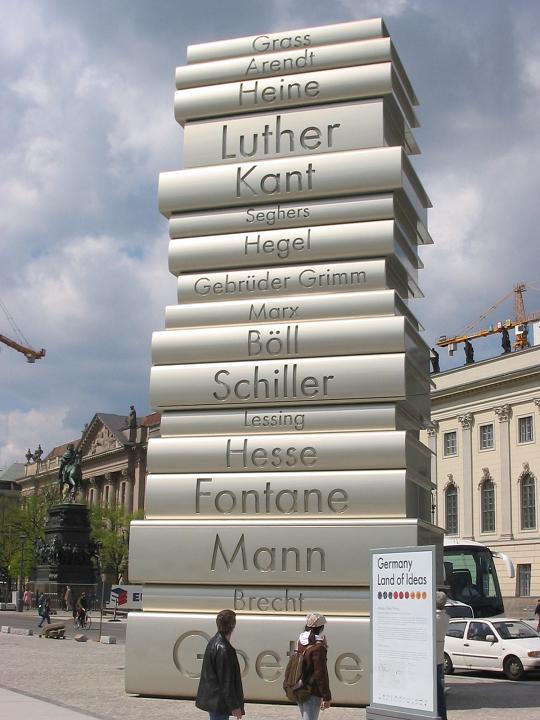
Biedermeier refers to the literature, music, the visual arts and interior design in the period between the years 1815 (Vienna Congress), the end of the Napoleonic Wars, and 1848, the year of the European revolutions. Under the Nazi regime, some authors went into exile (Exilliteratur) and others submitted to censorship ("internal emigration", Innere Emigration). The Nobel Prize in Literature has been awarded to German language authors fourteen times (as of 2023), or the third most often, behind only French language authors (with 16 laureates) and English language authors (with 32 laureates) with winners including Thomas Mann, Hermann Hesse, Günter Grass, and Peter Handke.
Periodization is not an exact science but the following list contains movements or time periods typically used in discussing German literature. It seems worth noting that the periods of medieval German literature span two or three centuries, those of early modern German literature span one century, and those of modern German literature each span one or two decades. The closer one nears the present, the more debated the periodizations become.
Medieval German literature refers to literature written in Germany, stretching from the Carolingian dynasty; various dates have been given for the end of the German literary Middle Ages, the Reformation (1517) being the last possible cut-off point.
The Old High German period is reckoned to run until about the mid-11th century, though the boundary to Early Middle High German (second half of the 11th century) is not clear-cut.
The earliest texts date from the second half of the 8th century: translation aids (glosses and glossaries) for those learning to read Latin and translations of Latin Christian texts (prayers, creeds, confessions) for use in missionary or pastoral work among the lay population. Translations and, later, adaptations of Latin Christian texts, continue throughout the period, and are seen in Otfrid's gospel harmony in the 9th century and the extensive works of Notker III in the early 11th century.
The most famous work in OHG is the Hildebrandslied, a short piece of Germanic alliterative heroic verse which besides the Muspilli is the sole survivor of what must have been a vast oral tradition. Another important work, in the northern dialect of Old Saxon, is a life of Christ in the style of a heroic epic known as the Heliand.
Hub AI
German literature AI simulator
(@German literature_simulator)
German literature
German literature (German: Deutschsprachige Literatur) comprises those literary texts written in the German language. This includes literature written in Germany, Austria, the German parts of Switzerland and Belgium, Liechtenstein, Luxembourg, South Tyrol in Italy and to a lesser extent works of the German diaspora. German literature of the modern period is mostly in Standard German, but there are some currents of literature influenced to a greater or lesser degree by dialects (e.g. Alemannic).
Medieval German literature is literature written in Germany, stretching from the Carolingian dynasty; various dates have been given for the end of the German literary Middle Ages, the Reformation (1517) being the last possible cut-off point. The Old High German period is reckoned to run until about the mid-11th century; the most famous works are the Hildebrandslied and a heroic epic known as the Heliand. Middle High German starts in the 12th century; the key works include The Ring (c. 1410) and the poems of Oswald von Wolkenstein and Johannes von Tepl. The Baroque period (1600 to 1720) was one of the most fertile times in German literature. Modern literature in German begins with the authors of the Enlightenment (such as Herder). The Sensibility movement of the 1750s–1770s ended with Goethe's best-selling The Sorrows of Young Werther (1774). The Sturm und Drang and Weimar Classicism movements were led by Johann Wolfgang von Goethe and Friedrich Schiller. German Romanticism was the dominant movement of the late 18th and early 19th centuries.
Biedermeier refers to the literature, music, the visual arts and interior design in the period between the years 1815 (Vienna Congress), the end of the Napoleonic Wars, and 1848, the year of the European revolutions. Under the Nazi regime, some authors went into exile (Exilliteratur) and others submitted to censorship ("internal emigration", Innere Emigration). The Nobel Prize in Literature has been awarded to German language authors fourteen times (as of 2023), or the third most often, behind only French language authors (with 16 laureates) and English language authors (with 32 laureates) with winners including Thomas Mann, Hermann Hesse, Günter Grass, and Peter Handke.
Periodization is not an exact science but the following list contains movements or time periods typically used in discussing German literature. It seems worth noting that the periods of medieval German literature span two or three centuries, those of early modern German literature span one century, and those of modern German literature each span one or two decades. The closer one nears the present, the more debated the periodizations become.
Medieval German literature refers to literature written in Germany, stretching from the Carolingian dynasty; various dates have been given for the end of the German literary Middle Ages, the Reformation (1517) being the last possible cut-off point.
The Old High German period is reckoned to run until about the mid-11th century, though the boundary to Early Middle High German (second half of the 11th century) is not clear-cut.
The earliest texts date from the second half of the 8th century: translation aids (glosses and glossaries) for those learning to read Latin and translations of Latin Christian texts (prayers, creeds, confessions) for use in missionary or pastoral work among the lay population. Translations and, later, adaptations of Latin Christian texts, continue throughout the period, and are seen in Otfrid's gospel harmony in the 9th century and the extensive works of Notker III in the early 11th century.
The most famous work in OHG is the Hildebrandslied, a short piece of Germanic alliterative heroic verse which besides the Muspilli is the sole survivor of what must have been a vast oral tradition. Another important work, in the northern dialect of Old Saxon, is a life of Christ in the style of a heroic epic known as the Heliand.
Recent media