Hubbry Logo
HeliandHeliandMain
Open search
Heliand
Community hub
Heliand
logo
8 pages, 0 posts
0 subscribers
Be the first to start a discussion here.
Heliand
Heliand
from Wikipedia

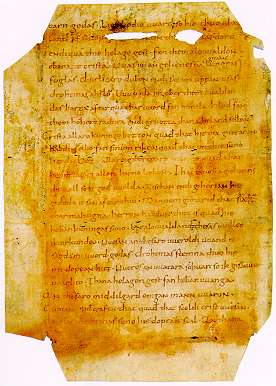
Heliand excerpt from the German Historical Museum

The Heliand (/ˈhɛliənd/) is an epic alliterative verse poem in Old Saxon, written in the first half of the 9th century. The title means "savior" in Old Saxon (cf. German and Dutch Heiland meaning "savior"), and the poem is a Biblical paraphrase that recounts the life of Jesus in the alliterative verse style of a Germanic epic. Heliand is the largest known work of written Old Saxon.

The poem would have been moderately popular since it has survived in only two manuscripts (Cotton MS. & Munich MS.) plus some further fragmentary versions in four other manuscripts.[1] It takes up about 6,000 lines. A praefatio exists, which could have been commissioned by either Louis the Pious (king from 814 to 840) or Louis the German (806–876). This praefatio was first printed by Matthias Flacius in 1562, and while it has no authority in the manuscripts it is generally deemed to be authentic.[2] The first mention of the poem itself in modern times occurred when Franciscus Junius (the younger) transcribed a fragment in 1587.[3] It was not printed until 1705, by the English clergyman George Hickes. The first modern edition of the poem was published in 1830 by Johann Andreas Schmeller.[4]

Historical context

[edit]

The Heliand was probably written at the request of emperor Louis the Pious around AD 830 to combat Saxon ambivalence toward Christianity. The Saxons were forced to convert to Christianity in the late 8th to early 9th century after 33 years of conflict between the Saxons under Widukind and the Franks under Charlemagne.[5] Around the time that the Heliand was written, there was a revolt of the Saxon stelinga, or lower social castes. Murphy depicts the significant influence the Heliand had over the fate of European society; he writes that the author of the Heliand "created a unique cultural synthesis between Christianity and Germanic warrior society – a synthesis that would plant the seed that would one day blossom in the full-blown culture of knighthood and become the foundation of medieval Europe."[5]

Manuscripts

[edit]

The 9th-century poem on the Gospel history, to which its first editor, J. A. Schmeller, gave the name of Heliand (the word used in the text for Savior, answering to the Old English hǣlend and the modern German and Dutch Heiland), is, with the fragments of a poem based on the Book of Genesis, all that remains of the poetical literature of the old Saxons, i.e. the Saxons who continued in their original home.[6] It contained when entire about 6000 lines, and portions of it are preserved in two nearly complete manuscripts and four fragments. The Cotton MS. in the British Library, written probably in the second half of the 10th century, is one of the nearly complete manuscripts, ending in the middle of the story of the journey to Emmaus. It is believed to have an organization closer to the original version because it is divided into fitts, or songs.[5] The Munich MS., formerly at Bamberg, begins at line 85, and has many lacunae, but continues the history down to the last verse of St. Luke's Gospel, ending, however, in the middle of a sentence with the last two fitts missing. This manuscript is now retained in Munich at the Bavarian State Library. Because it was produced on calf skin of high quality, it has been preserved in good condition.[5] Neumes above the text in this version reveal that the Heliand may have been sung. A fragment discovered at Prague in 1881 contains lines 958–1006, and another, in the Vatican Library, discovered by K. Zangemeister in 1894, contains lines 1279–1358.[6] Two additional fragments exist that were discovered most recently. The first was discovered in 1979 at a Jesuit High School in Straubing by B. Bischoff and is currently held in Bayerische Staatsbibliothek. It consists of nearly three leaves and contains 157 poetic lines.[7] The final fragment was found in Leipzig in 2006 by T. Doring and H. U. Schmid. This fragment consists of only one leaf that contains 47 lines of poetry, and it is currently kept at Bibliotheca Albertina.[7]

Authorship and relation to Old Saxon Genesis

[edit]

The poem is based not directly on the New Testament, but on the pseudo-Tatian's Gospel harmony, and it demonstrates the author's acquaintance with the commentaries of Alcuin, Bede, and Rabanus Maurus.[6]

Early scholarship, notably that of Braune, hypothesized that the Heliand was authored by the same hand as the Old Saxon Genesis, but scholarly consensus has shifted away from this view; Sievers had already abandoned the hypothesis when Braune published his study.[8] Large parts of that poem are extant only in an Old English translation, known as Genesis B. The portions that have been preserved in the original language are contained in the same Vatican manuscript that includes the fragment of the Heliand referred to above. In the one language or the other, there are in existence the following three fragments: (I) The passage which appears as lines 235–851 of the Old English verse Genesis in the Caedmon Manuscript (MS Junius 11) (this fragment is known as Genesis B, distinguishing it from the rest of the poem, Genesis A), about the revolt of the angels and the temptation and fall of Adam and Eve. Of this a short part corresponding to lines 790–820 exists also in the original Old Saxon. (2) The story of Cain and Abel, in 124 lines. (3) The account of the destruction of Sodom, in 187 lines. The main source of the Genesis is the Bible, but Eduard Sievers showed that considerable use was made of two Latin poems by Alcimus Avitus, De initio mundi and De peccato originali.[6]

The two poems give evidence of genius and trained skill, though the poet was no doubt hampered by the necessity of not deviating too widely from the sacred.[citation needed] Within the limits imposed by the nature of his task, his treatment of his sources is remarkably free, the details unsuited for poetic handling being passed over, or, in some instances, boldly altered. In many passages his work gives the impression of being not so much an imitation of the ancient Germanic epic, as a genuine example of it, though concerned with the deeds of other heroes than those of Germanic tradition. In the Heliand, the Saviour and His Apostles are presented as a king and his faithful warriors. While some argue that the use of the traditional epic phrases appears to be not, as with Cynewulf or the author of Andreas, a mere following of accepted models but rather the spontaneous mode of expression of one accustomed to sing of heroic themes, others argue that the Heliand was intentionally and methodically composed after careful study of the formula of other German poems. The Genesis fragments have less of the heroic tone, except in the splendid passage describing the rebellion of Satan and his host. It is noteworthy that the poet, like John Milton, sees in Satan no mere personification of evil, but the fallen archangel, whose awful guilt could not obliterate all traces of his native majesty. Somewhat curiously, but very naturally, Enoch the son of Cain is confused with the Enoch who was translated to heaven – an error which the author of the Old English Genesis avoids, though (according to the existing text) he confounds the names of Enoch and Enos.[6]

Such external evidence as exists bearing on the origin of the Heliand and the companion poem is contained in a Latin document printed by Flacius Illyricus in 1562. This is in two parts; the one in prose, entitled (perhaps only by Flacius himself) Praefatio ad librum antiquum in lingua Saxonica conscriptum ; the other in verse, headed Versus de poeta et Interpreta hujus codicis. The Praefatio begins by stating that the emperor Ludwig the Pious, desirous that his subjects should possess the word of God in their own tongue, commanded a certain Saxon, who was esteemed among his countrymen as an eminent poet, to translate poetically into the German language the Old and New Testaments. The poet willingly obeyed, all the more because he had previously received a divine command to undertake the task. He rendered into verse all the most important parts of the Bible with admirable skill, dividing his work into vitteas, a term which, the writer says, may be rendered by lectiones or sententias. The Praefatio goes on to say that it was reported that the poet, till then knowing nothing of the art of poetry, had been admonished in a dream to turn into verse the precepts of the divine law, which he did with so much skill that his work surpasses in beauty all other German poetry (Ut cuncta Theudisca poemata suo vincat decore). The Versus practically reproduce in outline Bede's account of Caedmon's dream, without mentioning the dream, but describing the poet as a herdsman, and adding that his poems, beginning with the creation, relate the history of the five ages of the world down to the coming of Christ.[6]

Controversies

[edit]

Authorship

[edit]

The suspicion of some earlier scholars that the Praefatio and the Versus might be a modern forgery is refuted by the occurrence of the word vitteas, which is the Old Saxon fihtea, corresponding to the Old English fitt, which means a canto of a poem. It is impossible that a scholar of the 16th century could have been acquainted with this word,[citation needed] and internal evidence shows clearly that both the prose and the verse are of early origin. The Versus, considered in themselves, might very well be supposed to relate to Caedmon; but the mention of the five ages of the world in the concluding lines is obviously due to recollection of the opening of the Heliand (lines 46–47). It is therefore certain that the Versus, as well as the Praefatio, attribute to the author of the Heliand a poetic rendering of the Old Testament. Their testimony, if accepted, confirms the ascription to him of the Genesis fragments, which is further supported by the fact that they occur in the same MS. with a portion of the Heliand. As the Praefatio speaks of the emperor Ludwig in the present tense, the former part of it at least was probably written in his reign, i.e. not later than AD 840. The general opinion of scholars is that the latter part, which represents the poet as having received his vocation in a dream, is by a later hand, and that the sentences in the earlier part which refer to the dream are interpolations by this second author. The date of these additions, and of the Versus, is of no importance, as their statements are not credible.[9]

That the author of the Heliand was, so to speak, another Caedmon – an unlearned man who turned into poetry what was read to him from the sacred writings – is impossible according to some scholars, because in many passages the text of the sources is so closely followed that it is clear that the poet wrote with the Latin books before him.[10] Other historians, however, argue that the possibility that the author may have been illiterate should not be dismissed because the translations seem free compared to line-by-line translations that were made from Tatian's Diatessaron in the second quarter of the 9th century into Old High German. Additionally, the poem also shares much of its structure with Old English, Old Norse, and Old High German alliterative poetry which all included forms of heroic poetry that were available only orally and passed from singer to singer.[5] Repetitions of particular words and phrases as well as irregular beginnings of fits (sentences begin at the middle of a line rather than at the beginning of a line to help with alliteration) that occur in the Heliand seem awkward as written text but make sense when considering the Heliand formerly as a song for after-dinner singing in the mead hall or monastery.[5] There is no reason for rejecting the almost contemporary testimony of the first part of the Free folio that the author of the Heliand had won renown as a poet before he undertook his great task at the emperor's command. It is certainly not impossible that a Christian Saxon, sufficiently educated to read Latin easily, may have chosen to follow the calling of a scop or minstrel instead of entering the priesthood or the cloister; and if such a person existed, it would be natural that he should be selected by the emperor to execute his design. As has been said above, the tone of many portions of the Heliand is that of a man who was no mere imitator of the ancient epic, but who had himself been accustomed to sing of heroic themes.[10]

German Christianity

[edit]

Scholars disagree over whether the overall tone of the Heliand lends to the text being an example of a Germanized Christianity or a Christianized Germany. Some historians believe that the German traditions of fighting and enmity are so well pronounced as well as an underlying message of how it is better to be meek than mighty that the text lends more to a Germanized Christianity. Other scholars argue that the message of meekness is so blatant that it renders the text as a stronger representation of a Christianized Germany.[5] This discussion is important because it reveals what culture was more pervasive to the other.

Use by Luther

[edit]

Many historians agree that Martin Luther possessed a copy of the Heliand. Luther referenced the Heliand as an example to encourage translation of Gospels into the vernacular.[5] Additionally, Luther also favored wording presented in the Heliand to other versions of the Gospels. For example, many scholars believe that Luther favored the angel's greeting to Mary in the Heliand – "you are dear to your Lord" – because he disliked the notion of referring to a human as "full of grace."[5]

Extra-canonical origins

[edit]

Contention exists over whether the Heliand is connected to the Gospel of Thomas. The Gospel of Thomas is a Judaic/Christian version of the Gospels found in 1956 that has been attributed the apostle Thomas. Quispel, a Dutch scholar, argues that the Heliand's author used a primitive Diatessaron, the Gospel harmony written in 160-175 by Tatian and thus has connections to the Gospel of Thomas by this association. Other scholars, such as Krogmann assert that the Heliand shares a poetic style of the Diatessaron but that the author may not actually have relied on this source and therefore the Heliand would have no association to the Gospel of Thomas.[5]

Sample passages

[edit]

tho sagda he that her scoldi cumin en wiscuning
mari endi mahtig an thesan middelgard
bezton giburdies; quad that it scoldi wesan barn godes,
quad that he thesero weroldes waldan scoldi
gio te ewandaga, erdun endi himiles.
He quad that an them selbon daga, the ina salingna
an thesan middilgard modar gidrogi
so quad he that ostana en scoldi skinan
huit, sulic so wi her ne habdin er
undartuisc erda endi himil odar huerigin
ne sulic barn ne sulic bocan. (VII, 582-92)

Translation:

Then he spoke and said there would come a wise king,
magnificent and mighty, to this middle realm;
he would be of the best birth; he said that he would be the Son of God,
he said that he would rule this world,
earth and sky, always and forevermore.
he said that on the same day on which the mother gave birth to the Blessed One
in this middle realm, in the East,
he said, there would shine forth a brilliant light in the sky,
one such as we never had before
between heaven and earth nor anywhere else,
never such a baby and never such a beacon.[11]

Editions and translations

[edit]

Editions

[edit]

The first complete edition of the Heliand was published by J. A. Schmeller in 1830; the second volume, containing the glossary and grammar, appeared in 1840. The standard edition is that of Eduard Sievers (1877), in which the texts of the Cotton and Munich manuscripts are printed side by side. It is not provided with a glossary, but contains an elaborate and most valuable analysis of the diction, synonymy and syntactical features of the poem.[10]

Other useful editions are those of Moritz Heyne (3rd ed., 1903), Otto Behaghel (1882) and Paul Piper (1897, containing also the Genesis fragments). The fragments of the Heliand and the Genesis contained in the Vatican MS. were edited in 1894 by Karl Zangemeister and Wilhelm Braune under the title Bruchstücke der altsächsischen Bibeldichtung.[10]

James E. Cathey wrote Heliand: Text and Commentary (2002) (Morgantown: West Virginia University Press, ISBN 0-937058-64-5), which includes an edited version of the text in the original language, commentaries in English and a very useful grammar of Old Saxon along with an appended glossary defining all of the vocabulary found in this version.

Translations

[edit]
  • The Heliand: Translated from the Old Saxon, trans. by Mariana Scott, UNC Studies in the Germanic Languages and Literatures, 52 (Chapel Hill: University of North Carolina Press, 1966), doi:10.5149/9781469658346_Scott
  • The Heliand: The Saxon Gospel, trans. by G. Ronald Murphy (New York: Oxford University Press, 1992)
  • An Annotated English Translation of the Old Saxon Heliand: A Ninth-century Biblical Paraphrase in the Germanic Epic Style, trans. by Tonya Kim Dewey (Edwin Mellen Press, 2010), ISBN 0773414827
  • In 2012, four translations of the Heliand were published (Uitgeverij TwentseWelle, now Uitgeverij Twentse Media) in four modern Saxon dialects: Tweants (tr. Anne van der Meiden and Dr. Harry Morshuis), Achterhoeks (Henk Krosenbrink and Henk Lettink), Gronings (Sies Woltjer) and Münsterlands (Hannes Demming), along with a critical edition of the Old Saxon text by Timothy Sodmann. In 2022 two translations were added, one in Stellingwerfs and one in Sallands.

Studies

[edit]

Luther's Heliand: Resurrection of the Old Saxon Epic in Leipzig (2011) by Timothy Blaine Price is a self-published book detailing results of the author's personal research and travels. Perspectives on the Old Saxon Heliand (2010) edited by Valentine A. Pakis contains critical essays and commentaries. G. Ronald Murphy published The Saxon Saviour: The Germanic Transformation of the Gospel in the Ninth-Century Heliand (1989) (New York: Oxford University Press).

See also

[edit]

References

[edit]

Bibliography

[edit]
[edit]
Revisions and contributorsEdit on WikipediaRead on Wikipedia
from Grokipedia
The Heliand is an anonymous epic poem in Old Saxon, composed in the first half of the ninth century, comprising nearly 6,000 lines of alliterative verse that retell the Gospel narrative of Christ's life, death, and resurrection. Written likely after 822, possibly at the monastery of Fulda, the work adapts biblical events to resonate with the Saxon audience by depicting Jesus as a noble chieftain and his disciples as loyal retainers in a Germanic tribal framework. This cultural transposition aimed to aid the Christianization of the recently conquered Saxon people under Charlemagne's successors. The poem survives in six incomplete manuscripts dating from the mid-ninth to tenth centuries, making it the principal surviving monument of Old Saxon literature.

Origins and Historical Context

Commission and Composition Date

The Heliand was likely composed in the first half of the ninth century, during the reign of Louis the Pious (814–840 CE), following Charlemagne's conquest and forced Christianization of the Saxons in the late eighth century. A prefatory prose text, known as the praefatio, asserts that an unnamed emperor—identified as Louis the Pious by its reference to "Ludouuicus piisimus Augustus"—commissioned the poem to further evangelize the Saxons through a vernacular adaptation of Christian teachings, emphasizing moral instruction over rote Latin liturgy. This praefatio survives not in the primary Heliand manuscripts but was first published in 1562 by the Protestant scholar Matthias Flacius Illyricus from a now-lost source, prompting initial scholarly skepticism about its authenticity due to its absence from extant witnesses and potential sixteenth-century fabrication. However, linguistic analysis aligns its Old Saxon features with the poem's dialect, and its historical context—post-Saxon pacification under Carolingian policy—supports ninth-century origins, leading most scholars to accept it as genuine. Linguistic and paleographic evidence points to composition at the Benedictine monastery of Fulda, a key Carolingian center for Saxon missions, where the poem's dialect reflects East Franconian influences and thematic parallels exist with local biblical commentaries, such as those on Matthew dated after 822 CE. Fulda's scriptorium, under abbots like Hrabanus Maurus, produced works blending classical metrics with vernacular elements, consistent with the Heliand's alliterative style adapted for missionary purposes.

Cultural and Missionary Background

The Saxon Wars, waged by Charlemagne from 772 to 804 CE, culminated in the subjugation of the pagan Saxons through military campaigns that included the destruction of sacred sites like the Irminsul pillar in 772 and mass executions, such as the 782 Verden massacre where approximately 4,500 Saxon rebels were killed for apostasy after prior baptisms. Charlemagne's capitularies, including the 782 Capitulary for Saxony, mandated baptism under penalty of death, tying Christian profession to political submission and prohibiting pagan practices like cremation or oath-swearing on non-Christian symbols, which fostered widespread resentment among Saxons who viewed these impositions as cultural erasure rather than spiritual enlightenment. Under Charlemagne's successor, Louis the Pious (r. 814–840 CE), this coercive framework shifted toward efforts at deeper assimilation, as forced baptisms alone failed to eradicate underlying tribal paganism or secure lasting fealty; adaptive evangelism emerged to recast Christian doctrine in terms resonant with Germanic warrior ethos, aligning concepts of loyalty to a divine drohtin (chieftain-lord) with Saxon hierarchical bonds between lords and retainers. The Heliand, composed circa 830 CE likely at Louis's behest, exemplifies this strategy by harmonizing Gospel narratives into an epic framework that preserved scriptural events—such as Christ's miracles, teachings, and Passion—while framing them through heroic tribal paradigms, portraying Jesus as a steadfast chieftain summoning faithful thegns (disciples) to his hall rather than imposing alien rituals. This approach prioritized causal integration over syncretism, embedding biblical fidelity into Saxon cosmology to foster voluntary adherence; evidence of its efficacy lies in the poem's dissemination across Saxon territories and its role in stabilizing Christian observance post-wars, as subsequent records show declining pagan revolts and the establishment of bishoprics like those in Münster and Paderborn by the mid-ninth century, without doctrinal compromise as confirmed by the Heliand's orthodox alignment with canonical harmonies like Tatian's Diatessaron. By leveraging empirical cultural parallels—equating Christian salvation with heroic wyrd (fate) under a sovereign lord—the work mitigated resentment from Charlemagne's mandates, enabling a transition from coerced nominalism to internalized fealty grounded in unaltered Gospel causality.

Manuscripts and Textual History

Surviving Manuscripts

The Heliand is preserved in six extant manuscripts, all incomplete and dating from the mid-9th to the 10th century, with four consisting of fragments only. The two most extensive copies provide the basis for textual reconstruction, supplemented by collation of variants across witnesses due to the absence of a single complete archetype. The principal manuscripts are designated M (Munich) and C (Cotton). Manuscript M, located in the Bayerische Staatsbibliothek, comprises 75 surviving leaves from an originally larger codex missing at least six folios, and dates to the 9th century. Manuscript C, British Library Cotton Caligula A. vii, originates from the early 10th century and likewise contains lacunae, though it preserves sections absent in M. The fragmentary manuscripts include V (Vatican), held in the Vatican Library and containing portions of the text alongside a Genesis fragment; P (Prague); and S (Straubing). These shorter witnesses, also from the 9th-10th centuries, offer additional textual variants but cover limited passages.
ManuscriptSiglumRepositoryDateCondition
MunichMBayerische Staatsbibliothek9th century75 leaves; lacunae of at least six folios
CottonCBritish Library (Cotton Caligula A. vii)Early 10th centuryLacunae; supplements gaps in M
VaticanVVatican Library9th-10th centuryFragmentary; includes Genesis excerpt
PraguePNational Library, Prague9th-10th centuryFragmentary
StraubingS(Formerly Straubing; now dispersed)9th-10th centuryFragmentary

Fragmentary Witnesses and Recent Discoveries

In addition to the two principal manuscripts, the Heliand survives in four fragmentary witnesses dating from the mid-ninth to late tenth centuries, comprising incomplete leaves that preserve limited verses of the poem. These include a fragment in the British Library's Cotton collection, known since its identification by Franciscus Junius before 1587, which attests to early transmission pathways potentially extending to England by the tenth century, where the text influenced local adaptations and scholarly reception. Other fragments, such as those in Munich and Straubing, consist of single or few folios covering episodes like the baptism of Jesus, with some showing minor glosses or wear indicative of repeated handling, though none substantially alter the reconstructed text. A significant recent discovery occurred in 2006, when a single parchment leaf (MS L) was identified among the archival holdings of Leipzig's St. Thomas' Church, transferred to Leipzig University Library in 1930. This fragment, measuring approximately 20 by 15 cm and containing 20 lines from the poem's account of Christ's baptism (lines 268-287 in standard editions), exhibits ninth-century paleographic features consistent with continental Old Saxon scriptoria, including insular influences and Caroline minuscule precursors. Linguistic analysis reveals archaic phonetic traits, such as retention of older Saxon diphthongs, confirming its authenticity as an early witness predating many known copies, despite its later binding in a sixteenth-century Reformation-era volume near Wittenberg. These fragmentary attestations refine understanding of the Heliand's dissemination, evidencing Ottonian-era copying efforts and possible routes via missionary networks to Anglo-Saxon England, where tenth-century manuscripts suggest active engagement rather than mere preservation. However, they introduce no new textual variants challenging the core narrative or do not shift the consensus dating of the original composition to the first half of the ninth century under Louis the Pious's patronage. The Leipzig find, in particular, underscores the poem's endurance through medieval disruptions, including monastic dispersals, without implying revisions to its philological stemma.

Proposed Authors and Attribution Debates

The authorship of the Heliand remains anonymous, with no direct attribution in the surviving manuscripts or contemporary records. Scholars infer the poet's Saxon origins from the poem's idiomatic Old Saxon dialect and its adaptation of Christian narratives to Germanic heroic ethos, suggesting a native speaker immersed in tribal culture rather than a foreign composer. The work's theological depth, drawing on Latin Gospel harmonies and patristic commentaries such as those of Tatian and Bede, points to an educated individual, likely a missionary figure trained in a monastic center like Fulda, where Saxon converts were integrated into Carolingian learning. This profile favors a cleric or lay noble with clerical training over an unlettered scop, as the synthesis of sources requires literacy in Latin alongside mastery of alliterative metrics. A key source for the poet's profile is the Praefatio ad Heliandum, a Latin preface first published by Matthias Flacius Illyricus in 1562, which, despite lacking manuscript attestation, is widely accepted as authentic due to its stylistic consistency with ninth-century Carolingian prefaces and alignment with the poem's commissioning context under Louis the Pious around 830. The Praefatio portrays the author as a singular "Saxon layman of great renown as a singer," divinely inspired to versify the Gospels in native verse for evangelizing recently Christianized Saxons, evoking the oral-poetic scop tradition akin to the Anglo-Saxon Cædmon. This depiction underscores a causal link between the poet's Germanic heritage—emphasizing singer as a performer of ancestral lays—and the need for culturally resonant missionary tools, though it does not preclude clerical education, as monastic orders often trained lay poets for such tasks. Attribution debates center on clerical versus lay status, with no empirical resolution due to absent biographical data. Proponents of priestly authorship, such as Heinrich Rückert in the nineteenth century, cite the poem's orthodox handling of Christology and reliance on ecclesiastical sources as evidence of seminary-level training unavailable to most laymen. Conversely, advocates like Paul Piper emphasized the Praefatio's lay singer motif and the poet's fluid integration of pagan heroic motifs, arguing for a noble or professional bard augmented by missionary patronage rather than full clerical vows. Linguistic analysis supports the latter indirectly: the poet's command of Old Saxon phonology and avoidance of Frankish loanwords indicate a non-monastic Saxon upbringing, while metrical irregularities suggest adaptation from oral performance to written form by an educated amateur rather than a Latin versifier like Otfrid of Weissenburg. Unsubstantiated claims, such as non-Saxon origins or collective authorship, falter against the unified stylistic voice and dialectal coherence, which preclude multiple hands or external imposition.

Connection to Old Saxon Genesis

The Old Saxon Genesis fragments, consisting of approximately 337 lines preserved in the 9th-century Vatican Library manuscript (Bibliotheca Apostolica Vaticana, Pal. lat. 1447), appear alongside excerpts from the Heliand (lines 790–820), suggesting a close textual and codicological association that points to production within the same scriptorium or cultural milieu. Linguistic analysis reveals shared Old Saxon dialectal features, including phonological patterns such as the retention of Germanic a-mutation and morphological elements like weak verb conjugations, which align both texts to a continental Saxon origin around 830–850 CE rather than Anglo-Saxon influences. These dialectal consistencies, verifiable through comparative lexicography, underscore a unified linguistic environment without implying direct borrowing. Stylistic parallels further link the works, particularly in their adherence to alliterative verse meter, where stressed syllables and alliterative onsets follow Germanic poetic conventions, as seen in comparable half-line structures and formulaic phrasing for divine actions (e.g., overlapping expressions for creation or judgment motifs). Both employ heavy hypermetrical verses—extended lines with extra syllables for emphasis—appearing at rates and positions that suggest a common metrical toolkit, potentially indicating training under the same poetic tradition or authorial hand. Vocabulary overlaps, such as terms for fate (wurd) or lordship (haldend), reinforce this, with phraseological echoes in the Vatican Genesis mirroring Heliand diction in non-narrative elements like invocations. Despite these affinities, distinctions in scope and preservation temper claims of identical authorship: the Genesis survives only fragmentarily, covering Genesis 1–12 with a linear Old Testament focus, whereas the Heliand forms a cohesive Gospel harmony emphasizing Christological narrative. This disparity has prompted scholarly hypotheses of complementary composition—envisioning a bipartite biblical epic bridging Old and New Testaments—but such pairings remain speculative, as no manuscript evidence confirms sequential intent, and metrical variances (e.g., Genesis's denser archaic formulas) allow for distinct yet contemporaneous authorship within a shared workshop. Overall, the evidence favors a 9th-century Saxon poetic circle over isolated creation, with stylistic metrics providing stronger support for workshop affiliation than for singular authorship.

Poetic Structure and Content

Alliterative Form and Linguistic Features

The Heliand employs the traditional Germanic alliterative verse form, comprising 5,983 lines divided into long lines that split into two half-lines (known as the on-verse or a-verse and off-verse or b-verse) separated by a caesura. Each half-line typically features two primary stresses, yielding four stresses per full line, with alliteration binding the two halves: the first stressed syllable of the b-verse alliterates with one or both stressed syllables in the a-verse, often the initial one. This structure echoes the metrics of Old English epics like Beowulf, adapting the Sieversian types (A through E) to Old Saxon phonology while maintaining resolution rules where short stressed syllables followed by short ones count as a single long stress. Linguistically, the poem is rendered in Old Saxon, a West Germanic dialect spoken in the northern German lowlands circa the 9th century, characterized by features such as the preservation of /sk/ in words like skip (ship), monophthongization of diphthongs (e.g., ī from Proto-Germanic ī), and a synthetic inflectional system with case endings akin to Old English but distinct from the High German consonant shift. The lexicon prioritizes native Germanic roots for biblical concepts, substituting Latin-derived terms sparingly; for instance, "God" is gôd, "Christ" or "Savior" is hêland (from haljan, "to heal"), and "disciples" become theninga (retainers or followers), evoking feudal loyalty over abstract devotion. This fusion preserves phonetic authenticity, with alliterative patterns exploiting Old Saxon's initial-stress system and avoidance of unstressed prefixes in key positions to ensure rhythmic flow. The verse exhibits episodic division into staves or fitte (sections of varying length, often 60–70 lines), facilitating oral recitation and mnemonic recall, while deviations like hypermetric lines (with expanded stresses) occur for emphasis, numbering fewer than 100 instances and aligning with formulaic phrasing drawn from common Germanic poetic stock. Such metrics underscore the poem's adaptation of epic conventions to a linear, chronological harmonization of Gospel material, though without rigid stanzaic rhyme or syllable counting typical of later medieval forms.

Narrative Adaptation of the Gospels

The Heliand constructs a unified epic narrative harmonizing the accounts of the four canonical Gospels, recounting Christ's life from the annunciation to Mary and his birth in Bethlehem through his baptism by John, temptation in the wilderness, public ministry of miracles and teachings, Passion, crucifixion, burial, and resurrection on the third day. Key events include the visitation by shepherds and Magi at the Nativity, the calling of the twelve disciples, specific miracles such as turning water into wine at Cana and raising the widow's son at Nain, the Sermon on the Mount, the Last Supper, betrayal by Judas, trial before Pilate, scourging, nailing to the cross at midday with death at the ninth hour amid an earthquake and the tearing of the temple veil, entombment by Joseph of Arimathea, and post-resurrection appearances confirmed by angels to women and the disciples. This adaptation preserves the sequence and causality of Gospel events, drawing primarily from a Latin harmony akin to Tatian's Diatessaron supplemented by the Vulgate, without introducing non-canonical plot elements or altering miraculous causes, such as the direct transformation of water to wine or the resurrection of the dead through Christ's command. The temptation episode, for instance, depicts Christ fasting forty days and resisting Satan's offers in the wilderness, maintaining the scriptural trials of bread, divine protection, and worldly kingdoms as tests of obedience rather than fabricating additional heroic feats. Herod's massacre of the innocents follows Matthew's account, triggered by the Magi's report of the newborn king, leading to flight into Egypt. Germanic cultural reframings integrate these events into a heroic framework without deviating from core plot fidelity: the world is termed middilgard (Midgard), recast as the realm under the Heaven-King's sovereignty, with Bethlehem embedded in this earthly domain; Christ appears as a drohtin (chieftain or lord of the folk), wielding authority like a Germanic ruler who dispenses wisdom and heals as the "All-Wielding" healer. Disciples function as gisiðos or thanes, summoned as loyal retainers pledging fealty—Peter, Andrew, and Matthew, for example, respond to the call like warriors joining a lord's hall—emphasizing oaths of service and communal solidarity over individualistic belief, while Roman guards and Pilate's court evoke imperial thanes under Caesar. Miracles retain their evidentiary role, as in healings demonstrating the lord's power to his followers, and the Passion unfolds as a chieftain's sacrificial stand against foes, with the cross as a site of warrior endurance.

Key Thematic Elements

The Heliand integrates Germanic motifs of fate (wurd or uurd), recasting them as subordinate to , thereby aligning pagan with Christian without doctrinal alteration. Fate is depicted not as an autonomous but as the temporal execution of sovereign will, evident in Christ's foreknowledge of his Passion: "Fate is at hand, so that will go just as in his might has determined it." This subordination transforms potential heroic defeat into voluntary submission, portraying Christ's as a chieftain's compliant victimization for redemptive purposes, promising followers heavenly reward for enduring analogous trials. Loyalty emerges as a central virtue, with the disciples rendered as thegnas (thanes) bound by oath-like fealty to Christ as their drohtin (lord), mirroring comitatus ideals where retainers pledge unwavering service. This motif fosters resonance with Saxon warrior ethos, as seen in exhortations to "suffer with our Commander… die with Him at the moment of his doom," emphasizing endurance in allegiance over resistance. Divine violence, sacralized through God's orchestration of events, underscores causal realism: suffering is not capricious but instrumentally tied to salvation, with Christ's Crucifixion evoked heroically—"Then they set up the gallows on the sandy ground… and God's Bairn was tormented / Thereon, on the cross"—evoking a lord's sacrificial hanging akin to Germanic execution rites, yet framed as fulfillment of predestined will. Eschatological imagery adapts afterlife concepts culturally: heaven as an eternal hall of feasting and fellowship, where "there was winsome conversing… like unto Paradise itself," evokes the mead-hall (medu-hall) as communal reward under the divine lord, while hell signifies "farflung exile" from this order, a banishment for oath-breakers against the heavenly chieftain. Such parallels, drawn from the poem's alliterative structure (e.g., wurd weaving with willio in fateful declarations), bridge empirical Saxon social realities with theological imperatives, maintaining orthodoxy by vesting ultimate causality in God. The exemplifies thematic synthesis, blending with heroic lineage: the hails Mary as "worthy of the Wielder… bearing a man-child, of the Heaven-King," positioning the as fated descent of a royal heir into earthly bonds. These elements cohere in a narrative prioritizing causal submission to divine order, evidenced across the text's 5,983 lines, without extra-canonical deviation.

Theological Analysis and Controversies

Christological Orthodoxy

The Heliand upholds Chalcedonian by depicting Christ as possessing both fully divine and fully natures, united in one without , change, division, or separation, as articulated in the Definition of (451 CE). This alignment counters scholarly charges of heretical leanings, such as —which posits Christ as a mere man elevated to divine sonship at —or , which denies his true humanity. Textual analysis of pivotal episodes reveals the poet's fidelity to Nicene Trinitarianism and the Incarnation formula, emphasizing Christ's eternal divinity alongside genuine human experiences, without reliance on apocryphal sources that might suggest deviation. In the Annunciation (lines 289–319), the angel Gabriel declares to Mary that "the holy spirit [or soul] became the child in her womb" (Uuard the hêlago gêst / that barn an ira bôsma), directly echoing the Nicene Creed's affirmation of the Son's incarnation "of the Holy Spirit and the Virgin Mary." This phrasing underscores pre-existent divinity entering human form, refuting adoptionist interpretations that subordinate Christ's sonship to a post-conception event, while affirming corporeal humanity to rebut docetic denials of physical birth. The poet's expansion avoids ambiguity, aligning with Carolingian exegetes like Hrabanus Maurus, who stressed the hypostatic union. The Temptation in the wilderness (lines 1729–1860) further illustrates dual natures: Satan tempts Christ by misjudging him as either "solely God" (god ênfald) or "solely man" (man ênfald), forcing recognition of both aspects in Christ's resistance through divine authority rooted in Scripture. Miracles here, such as implied angelic sustenance, function as sovereign divine interventions rather than autonomous human feats, countering Arian diminishment of Christ's equality with the Father. Scholarly defenses, including those by Joseph Rathofer, highlight this as deliberate orthodoxy amid potential Lombard Arian residues in Saxon regions, not heretical compromise. The Transfiguration (lines 3154–3200) manifests Christ's divine glory atop the mount, where his face shines and garments whiten, yet he simultaneously foretells human suffering and death (lines 3166b–3168a), integrating glory with vulnerability. This episode affirms hypostatic union by revealing veiled divinity without negating incarnate limitations, opposing monophysite fusions of natures or adoptionist temporality. Unlike critics like G. Ronald Murphy, who infer docetic tendencies from Germanic heroic overlays, analyses by Stephen Pellé demonstrate the poet's precision in preserving Chalcedonian balance, drawing from patristic harmonies rather than heterodox traditions. Overall, the Heliand exhibits no empirical divergence from creedal norms, with miracles portrayed as extensions of God's causal will through the Son, not naturalistic or magical occurrences.

Germanization of Christian Elements

The Heliand adapts core Christian narratives by recasting biblical figures in terms resonant with Saxon tribal , portraying Christ as a drihten (chieftain or ) who rules from a hall and leads a warband of disciples bound by oaths of unwavering , akin to the Germanic comitatus ethic of mutual fidelity between lord and thanes. This inculturation strategy mapped gospel events onto familiar heroic motifs, such as the disciples' pledges mirroring warrior vows, which facilitated evangelism among recently conquered Saxons by rendering abstract Christian duties—love, obedience, sacrifice—concrete and honorable within their cultural framework. Scholars like G. Ronald Murphy highlight this as a deliberate "Germanic transformation" of the gospel harmony, enabling the faith's propagation without wholesale cultural erasure, as evidenced by the poem's composition circa 830 in the Fulda monastic scriptorium amid post-Charlemagne Saxon stabilization. Critics, however, contend that such adaptations risked diluting Christianity's universal ethic of humility and meekness by prioritizing heroic valor and tribal allegiance, potentially subordinating divine grace to human strength in the narrative's emphasis on Christ's "mighty deeds" (wundorworc) as chieftainly prowess. For instance, the poem's depiction of the Last Supper as a lord's feast with oath-swearing elevates camaraderie over sacramental symbolism, which some analyses interpret as accommodating pagan warrior ideals at the expense of doctrinal purity. Yet, textual evidence counters outright dilution: the poet consistently subordinates martial imagery to transcendent faith, portraying warrior loyalty as preparatory for eternal submission to God, not an end in itself, as in lines where disciples' oaths culminate in spiritual uuîtdo (fate ordained by divine will) rather than mere earthly glory. Scholarly reflects this tension, with advocating cultural synthesis as evangelistic ingenuity that bridged pagan and Christian worlds effectively—Saxony's rapid post-804 conquests attests to its pragmatic —while others, like those critiquing 19th-century nationalist readings, emphasize orthodox over accommodation, arguing the Heliand uses Germanic forms to inculcate submission to Christ without compromising core tenets. Empirical outcomes favor the : circulation in monastic centers like and Corvey, alongside Saxon integration by the 9th century's end, indicates the approach prioritized doctrinal transmission via relatable vessels, yielding deeper than coercive impositions alone. This balance underscores the Heliand's in a missionary context where truth was conveyed through, not supplanted by, cultural idiom.

Extra-Canonical Influences and Jewish Portrayals

The Heliand primarily relies on the canonical Gospels, harmonized through Tatian's second-century Diatessaron, which itself draws from the four evangelists with occasional apocryphal interpolations such as expansions on Christ's infancy or miracles not strictly in the New Testament. However, the poet's adaptation shows no systematic dependence on extra-canonical texts like the Infancy Gospel of Thomas or Protoevangelium of James, limiting such elements to faint echoes mediated by Latin commentaries and avoiding doctrinal deviation. Textual comparisons reveal that deviations from familiar Gospel versions—such as added descriptive flourishes—stem more from interpretive traditions of church fathers like Alcuin than from heretical apocrypha, preserving orthodox Christology amid cultural transposition. Exaggerated claims of syncretistic heresy thus lack substantiation, as the narrative core aligns verifiably with patristic exegesis rather than non-biblical invention. The poem's depiction of Jews adheres to New Testament accounts, portraying them collectively as an adversarial force embodying disloyalty and opposition to Christ, evident in scenes of arrest, trial, mockery, and crucifixion where they bind him with iron, torture his body, and voice sinful taunts (e.g., lines 4917–18, 5381–85, 5422, 5470). This negative characterization reflects the evangelists' emphasis on Jewish leaders' role in Jesus' death, extended to the populace as a unified "enemy" group contrasting with Christ’s loyal thegns. Yet positive portrayals distinguish faithful individuals—such as Mary, the disciples, Jesus himself (ethnically Jewish), and Joseph of Arimathea—highlighting virtues like unwavering allegiance that resonate with Saxon warrior ethos. Such differentiation avoids blanket condemnation, mirroring patristic interpretations that critiqued unbelief while affirming righteous remnants. This portrayal draws realism from post-Roman Saxon contexts, where ethnic prejudices framed outsiders as threats akin to recent conquerors, analogizing first-century Jews under Roman dominion to ninth-century Saxons under Frankish overlordship. The Jews' depicted resistance and resulting "exile" from divine favor (lines 2284–90) serve as a theological caution against defying Christian authority, encouraging submission without fabricating anti-Jewish motifs absent from source Gospels. Unlike modern politicized lenses imputing invented prejudice, the Heliand's approach evidences causal continuity with biblical and early medieval realism: collective culpability for deicide as per patristic consensus, repurposed didactically for a conquered audience prone to revolt, not as ethnic vilification detached from scriptural warrant.

Reception and Legacy

Medieval Circulation and Use

The Heliand circulated primarily through monastic scriptoria in the 9th and 10th centuries, with six extant manuscripts—all incomplete and four fragmentary—dating from the mid-9th to the , indicating active for preservation and use within religious communities. These copies, such as the 9th-century manuscript containing 75 leaves, served educational purposes in Saxon monasteries, where the poem's of the Gospels facilitated instruction in Christian amid ongoing efforts to consolidate following the . Its design for suggests beyond strictly scribal means, targeting both monastic novitiates and the lay warrior to bridge pagan traditions with . Transmission extended to England by the mid-9th century, likely via diplomatic exchanges such as a copy sent by to Æthelwulf in 856, with a significant manuscript ( A VII) produced in the second half of the 10th century, containing nearly 6,000 lines and possibly copied at centers like Winchester, Canterbury, or East Anglia. Marginal annotations, including Gospel incipits from Luke 1:5 and Matthew 22:15, in this English copy point to practical roles in preaching and homiletic guidance during Æthelred's reign (978–1016), aligning with councils like the 993 Winchester synod amid Viking pressures. Such features underscore the poem's function in catechesis, reinforcing orthodox belief and edifying audiences through familiar Germanic imagery to foster resilience in Saxon Christian piety. The scarcity of surviving copies reflects the vulnerabilities of early medieval textual traditions, exacerbated by political instability and reliance on oral performance, yet the Heliand's adaptation of scriptural narratives into Old Saxon verse demonstrably advanced vernacular theology by rendering Christian tenets accessible and culturally resonant for newly converted populations. Its influence persisted in monastic and advisory contexts, promoting a piety attuned to heroic ethics while countering residual pagan ambivalence, though direct lay ownership remains unattested.

Reformation-Era Rediscovery

In 1562, the Protestant church historian Matthias Flacius Illyricus published the Latin Praefatio and associated verses linked to the Heliand, representing the first printed to the poem's commissioning under for Saxon in verse. This edition, sourced from an unidentified , described a "non ignobilis " of Saxon origin adapting into alliterative to suit Germanic hearers, thereby spotlighting the Heliand as a ninth-century precedent for scripture rendered in native idiom. Flacius's work, amid his broader efforts in the Magdeburg Centuries to document ecclesiastical history against Catholic narratives, implicitly aligned the poem with Reformation priorities of direct, culturally resonant access to biblical content over Latin mediation. While the Praefatio evoked interest in early Germanic Christian literary adaptation, no evidence indicates direct reliance by Martin Luther or his circle on the Heliand for the 1522–1534 Bible translation, despite shared emphases on vernacular clarity; claims of Luther's authorship remain unsubstantiated rumor without manuscript support. The publication nonetheless contributed to viewing the poem as a historical counterpoint to Vulgate-centric traditions, affirming Protestant critiques of ecclesiastical Latin monopoly by evidencing prior Northern European experiments in Gospel vernacularization. The discovery of the fragment (MS L) in the holdings further illuminates Reformation-era , as paleographic of its and binding points to handling in the - vicinity by the mid-sixteenth century, prior to Luther's 1546 . This proximity—Leipzig lying roughly 100 kilometers southeast of —implies circulation among scholars building the under figures like Georg Fabricius, who fostered humanist ties to regional interests, potentially preserving the fragment as part of a larger Heliand amid searches for native theological . Such handling revived appreciation for the poem's fusion of Carolingian orthodoxy with Saxon heroic ethos, reinforcing Reformation-era assertions of authentic, non-Roman Christian heritage in Germanic lands without supplanting canonical texts.

Modern Interpretations and Cultural Impact

Scholars in the 19th and 20th centuries identified the Heliand as the oldest substantial epic in Germanic literature, predating the Nibelungenlied by roughly four centuries and establishing a foundational model for blending Christian salvation narratives with the heroic warrior traditions of Saxon society. This synthesis portrayed Christ as a noble chieftain (druhtin) leading a loyal comitatus of disciples, thereby enabling the inculturation of Gospel events into a Germanic framework that emphasized loyalty, fate (wurd), and communal honor over abstract theological discourse. Modern interpretations highlight the Heliand's in contextual , where the adapted biblical motifs—such as and the Passion—to resonate with Saxon values, fostering conversion among forcibly Christianized pagans without evident doctrinal deviation. Criticisms positing an over-Germanization that dilutes , such as portraying divine through heroic lenses, have been refuted by examinations confirming to core Christological tenets, including Christ's voluntary submission and . In 21st-century , particularly post-2020 analyses, the poem's as a "fated victim" of divine will has drawn for integrating Germanic notions of inescapable destiny with orthodox submission to God's , promising eschatological reward for compliant . This approach underscores the Heliand's enduring cultural impact as a for religious , influencing contemporary discussions on balancing cultural with theological precision in contexts.

Editions, Translations, and Scholarship

Critical Editions

The principal critical editions of the Heliand reconstruct the text through meticulous of the six surviving manuscripts—primarily the complete (C, ca. 850) and (M, ca. 997), supplemented by fragments including the fragment (L, )—prioritizing earlier witnesses to resolve in , , and meter. Otto Behaghel's edition, initially published in 1898 as part of Heliand und Genesis, established the scholarly baseline by normalizing the alliterative verse and apparatus criticus based on principal manuscripts C and M, with later revisions incorporating additional fragments for completeness; the fourth edition (1930) remains widely referenced for its conservative textual choices favoring manuscript fidelity over conjectural emendation. Burkhard Taeger's ninth edition (1984, Altdeutsche Textbibliothek) updates Behaghel's framework with refined variant collations and paleographic notes, emphasizing stemmatic relationships among codices while maintaining the prioritization of 9th-century sources. James E. Cathey's Hêliand: Text and Commentary () offers a normalized edition derived from Behaghel's base text but augmented with line-by-line philological , including metrical and lexical , to support rigorous reconstruction; it integrates all known fragments, such as L, into the apparatus for holistic without introducing unsubstantiated readings. For the Leipzig fragment specifically, Valentine A. Pakis's edition (2010) provides a diplomatic transcription with critical apparatus, collating it against C and M to assess its independent textual tradition, thereby enhancing completeness in fragment-inclusive reconstructions.

Translations into Modern Languages

The primary English translation of the Heliand is G. Ronald Murphy's prose rendering, published in 1992 as The Heliand: The Saxon Gospel, which prioritizes semantic clarity and narrative flow over metrical replication, rendering the original's alliterative verse into straightforward modern prose to facilitate accessibility for non-specialists. This approach conveys the poem's theological content and Germanic adaptations without the constraints of verse form, though it sacrifices the rhythmic and sonic qualities central to the Old Saxon's oral-poetic tradition. In contrast, Mariana Scott's verse translation, initially published in 1966 and reissued in subsequent editions, attempts to replicate the original's alliterative meter and stanzaic structure, aiming to evoke the poem's epic timbre for readers attuned to poetic form. While this preserves the Heliand's auditory heritage—essential for a work composed in a Germanic heroic idiom—critics have noted occasional trade-offs in literal fidelity to prioritize scansion, potentially obscuring subtleties in the source text's phrasing. Prose versions like Murphy's thus excel in interpretive precision, whereas verse efforts underscore the poem's performative essence, with the latter better suiting scholarly analysis of its stylistic innovations. More recent work includes Perry Neil Harrison's modern English verse translation of the Heliand paired with the Old Saxon Genesis fragments, published via independent scholarly channels, which integrates both texts to highlight shared vernacular biblical poetics while maintaining alliterative patterns for rhythmic authenticity. This dual rendering emphasizes contextual linkages, such as heroic motifs across the corpus, but its verse form demands familiarity with the original's constraints, potentially limiting broad readability compared to prose alternatives. In German, translations often appear alongside critical editions, such as those rendering the text into prose for philological study, with fidelity focused on linguistic proximity given Old Saxon's affinity to early High German dialects; for instance, modernized versions in scholarly compilations prioritize doctrinal accuracy over poetic revival, aiding continental audiences in tracing etymological and cultural continuities. These prose-oriented German efforts complement English counterparts by underscoring the Heliand's role in Germanic literary genesis, though they rarely attempt alliterative verse, favoring exegetical clarity that aligns with the poem's homiletic intent. Overall, verse translations enhance appreciation of the Heliand's form as a bridge between biblical narrative and pagan epic traditions, while prose editions ensure unadorned access to its core message.

Key Studies and Ongoing Research

Early scholarship on the Heliand includes Kuno Francke's socio-historical in Social Forces in German (1899), which interprets the poem's as a Saxon embedding Christian within the social structures of post-conquest Saxon to facilitate . Francke emphasized the work's in reflecting the tensions between Frankish imposition of and indigenous Germanic values, privileging empirical examination of the text's heroic over purely theological readings. Modern studies highlight the poem's synthesis of Christian with Germanic , as explored by G. in The Saxon Savior (), which argues that the Heliand crafted a deliberate fusion to evangelize reluctant by portraying Christ as a druhtin (chieftain) whose followers exhibit akin to comitatus bonds. 's linguistic and underscores the text's to sources while adapting motifs like fate (wurd) to align with pre-Christian Saxon cosmology, supported by close readings of alliterative verse patterns. A significant recent contribution is Ciaran Arthur's 2021 article on the Heliand's transmission to tenth-century England, which uses manuscript evidence and glosses to demonstrate adaptive translations reinforcing orthodox theology amid Anglo-Saxon cultural turbulence. Arthur's philological approach reveals how the poem's Germanic framing influenced vernacular gospel harmonies, challenging assumptions of insular isolation from continental Saxon literature. Ongoing research includes paleographic investigations of the Leipzig fragment (MS L), a 2006 discovery analyzed in a dissertation examining its script, dialectal features, and potential links to Wittenberg provenance, aiming to refine dating and scribal practices through comparative Old Saxon metrics. Defenses of the poem's Christological orthodoxy persist, as in examinations countering heresy charges by verifying alignment with Nicene formulations in episodes like the Annunciation and Temptation, through textual exegesis prioritizing scriptural sources over speculative influences. Scholarship identifies gaps in tracing the Heliand's causal influence on broader European vernacular literature, where its pioneering alliterative biblical epic form remains underexplored relative to later works like the Nibelungenlied, despite empirical evidence of shared heroic paradigms. Future empirical linguistics could quantify lexical borrowings into Old High German and Old English adaptations to address this.

References

Add your contribution
Related Hubs
User Avatar
No comments yet.