Hubbry Logo
Ghost RanchGhost RanchMain
Open search
Ghost Ranch
Community hub
Ghost Ranch
logo
8 pages, 0 posts
0 subscribers
Be the first to start a discussion here.
Ghost Ranch
Ghost Ranch
from Wikipedia

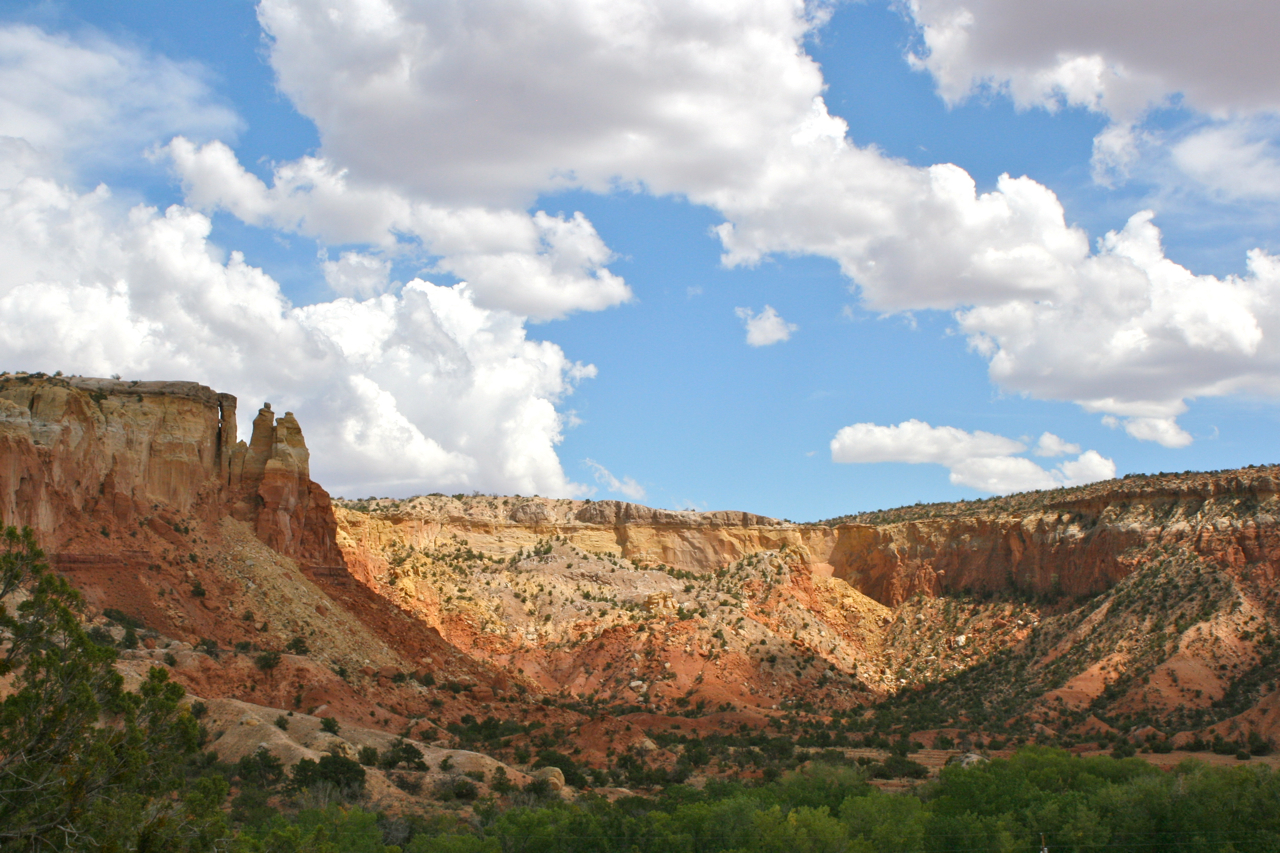
Ghost Ranch redrock cliffs and clouds

Key Information

Ghost Ranch, New Mexico

Ghost Ranch is a 21,000-acre (85 km2)[1] retreat and education center in Rio Arriba County in north central New Mexico, United States. It is about 65 miles northwest of Santa Fe and 14 miles from Abiquiu, the nearest community. In the later 20th century, it was the summer home and studio of artist Georgia O'Keeffe, as well as the subject of many of her paintings. It often serves as a location for movie production. Ghost Ranch is owned by the Presbyterian Church (USA) and leased to and managed by The National Ghost Ranch Foundation, Inc.

Ghost Ranch is known for a remarkable concentration of fossils, most notably that of the theropod dinosaur Coelophysis, of which it has been estimated that nearly a thousand individuals have been preserved in a quarry at Ghost Ranch.[2]

History

[edit]

Ghost Ranch is part of Piedra Lumbre (Spanish, "Shining Rock"), a 1766 land grant to Pedro Martin Serrano from King Charles III of Spain. The Rito del Yeso is a stream that meanders through the canyons and gorge, providing a drought-resistant source of water. In 1976, Ghost Ranch was designated as a National Natural Landmark by the National Park Service.[3]

The canyon was first inhabited in the 1880s by the Archuleta brothers, cattle rustlers who enjoyed the coverage and invisibility that the canyon provided as well as their ability to see for miles down the valley. They created two jacal homes and would move stolen cattle throughout the night to Box Canyon. By transporting the cattle through streams, footprints would be lost and they could not be tracked. Stories of people staying with the Archuleta brothers who had gone missing (and their clothing on the men) circulated around the area. One day one of the brothers made a transaction without the other, and claimed he had buried the gold for safety. The second brother killed him, and kept his wife and daughter hostage until they admitted to knowing where the gold was hidden. Although the mother and daughter feared the rumored spirits of the canyon, they mustered up the courage to sneak away at night through the Chama Valley.[4] The Mother and the daughter informed locals about the remaining brother. A group of local men then came to the ranch, fighting through their fear, and hanged the remaining brother and his gang from a cottonwood tree that still stands next to one of the casitas on the property.[5]: 14  Other visitors who stayed in the casita later on claimed they could hear voices of a man and a woman fighting. A descendant of the Archuletas obtained a deed for the property in 1918. He sold the ranch in 1921 to an area merchant, who sold it in 1928 to a sheep rancher.[5]: 15–16 

Arthur Pack

[edit]

Roy Pfaffle, a guide, outfitter and former park ranger, won the deed to the undeveloped ranch sometime early in 1928 in a poker game, details of which remain shrouded in mystery.[5]: 16  His wife Carol (née Caroline Bishop Stanley), a graduate of the New England Conservatory of Music who had ventured West in 1915, recorded the deed in her name and decided to call the property Ghost Ranch, reflecting legend and lore about evil spirits in the area.[6] Stanley moved there in 1931 after divorcing Pfaffle, who suffered gambling and drinking problems.[5]: 36  Stanley led the construction of guest quarters and created an exclusive dude ranch that was visited by wealthy and creative people of the time. Eventually many of her friends moved to New Mexico for its peaceful atmosphere. One of the most influential to visit Ghost Ranch was Arthur Newton Pack, writer and editor of Nature Magazine. Pack's daughter suffered from bouts of pneumonia, so he and his family moved to an area with a drier climate. Although Stanley's clientele were wealthy, she had difficulty making a profit, and after 1929 the Great Depression severely reduced tourism. Stanley sold the ranch to Arthur Pack in 1935.[5]: 35–36 

As Pack aged, he grew concerned about the future of the ranch. He spoke with the YMCA, the Boy Scouts of America, the Archdiocese of Santa Fe, and the United Brethren Church about acquiring and maintaining the ranch, but none of the organizations was in a position to accept. The Presbyterian Church accepted his offer, and in 1955 Pack donated the ranch to the church for use as an educational center, though the church faced difficulties developing it. The ranch is now used by various organizations and teachers that offer over 300 workshops, classes, outdoor activities and spiritual retreats each year.

Georgia O'Keeffe

[edit]

Georgia O'Keeffe, intrigued by Arthur Pack's statement that the Piedra Lumbre was "the best place in the world",[7] visited the ranch and fell in love with the geography. Soon thereafter, she split her time between New York and New Mexico. She enjoyed having alone time, and was often very demanding of the Packs. Cerro Pedernal was a key geographical feature that could be often found in her paintings. After she moved to New Mexico full time, she spent most of the year at what is now preserved as the Georgia O'Keeffe Home and Studio in Abiquiu, but she lived and worked at a villa and studio in the cooler elevations at Ghost Ranch in summer.

2015 flash flood

[edit]

On July 7, 2015, a flash flood occurred in Ghost Ranch due to severe weather, and destroyed several buildings at the ranch. No injuries or deaths were caused by the flood.

Geology and palaeontology

[edit]

200 million years ago Ghost Ranch and the American Southwest were located close to the equator, and had a warm, monsoon-like climate with heavy seasonal precipitation.[8] Ghost Ranch includes a famous palaeontological site preserving Triassic dinosaurs. Fossil bones were found here as early as 1885.[citation needed] In 1947 the palaeontologist Edwin H. Colbert documented the discovery of over a thousand well-preserved fossilized skeletons of a small Triassic dinosaur called Coelophysis in a quarry here.[9] In 2007, fossil remains of Dromomeron romeri, one of the group of animals recognized as basal dinosauromorphs, were found in the Hayden Quarry.[10] In April 2010, a team of scientists led by Hans-Dieter Sues of the Smithsonian Institution reported the discovery of Daemonosaurus chauliodus, a basal theropod species, at Ghost Ranch.[8] Daemonosaurus lived approximately 205 million years ago, during a transitional period between the oldest known dinosaurs such as Herrerasaurus, which existed during the Late Triassic period in what is now known as Argentina and Brazil, and the more advanced theropod dinosaurs.[8][11]

Effigia, a genus of small Shuvosaurid pseudosuchian, was also uncovered from Ghost Ranch, though it was not recognized for decades following Edwin Colbert's 1947 expedition.[12][13]

Cinematography

[edit]

Ghost Ranch's redrock scenery and 21,000 acres (8,500 hectares) have attracted many filmmakers. Here is a partial list of films and series shot at Ghost Ranch:

See also

[edit]

References

[edit]
[edit]
Revisions and contributorsEdit on WikipediaRead on Wikipedia
from Grokipedia
Ghost Ranch is a 21,000-acre and retreat center located in northern , in traditional territory near the town of Abiquiú, renowned for its striking red rock landscapes in the Piedra Lumbre basin that have inspired artists, scientists, and spiritual seekers for decades. Originally a Spanish dating back centuries, the property evolved through Mexican and Anglo ranching eras before becoming a dude ranch in the early and being donated to the Presbyterian Church (U.S.A.) in 1955 by philanthropists Arthur and Phoebe Pack. Since 2018, it has been managed by the National Ghost Ranch Foundation as a nonprofit hub for workshops, hiking, and programs fostering spiritual growth, environmental stewardship, and cultural exploration. The ranch's geological and paleontological significance stems from its position at the boundary of the and the , featuring rock layers from the Permian period to deposits, with the contributing to the iconic hues. In 1947, paleontologist Edwin Colbert unearthed hundreds of Coelophysis skeletons at the site's dinosaur quarry—a —providing one of the richest bonebeds for this early dinosaur, now New Mexico's state fossil, and highlighting the area's 225-million-year-old fossil record. Archaeological evidence further enriches its heritage, with sites dating back 8,000 to 10,000 years to Paleo-Indian cultures, alongside later Native American traditions of the people. Artist formed a profound connection with Ghost Ranch starting in the 1930s, purchasing a 12-acre summer home there in 1940 after first visiting Ghost Ranch in 1934; she spent over 50 years drawing inspiration from its dramatic vistas for iconic paintings like Chama River, Ghost Ranch, (1937) and Ghost Ranch Landscape (ca. 1936). O'Keeffe's residence at the ranch, which she used seasonally until establishing a permanent home in nearby Abiquiú in 1949, symbolized her modernist embrace of the Southwest's austere beauty, bones, and skies, influencing her abstracted depictions of nature throughout her career. Today, guided tours of the landscapes that inspired her continue to draw visitors, underscoring the site's enduring legacy as a nexus of art, science, and serenity.

Overview

Location and Geography

Ghost Ranch is a 21,000-acre (85 km²) property situated in Rio Arriba County in north-central , approximately 65 miles northwest of Santa Fe and 14 miles from the nearby community of Abiquiú. The ranch lies within the Chama Basin, a broad, shallow basin along the eastern margin of the , where the landscape transitions between the high plateau to the west and the to the east. This setting features dramatic red rock canyons, flat-topped mesas, and expansive high desert expanses, with iconic landmarks such as —a prominent flat-topped mesa rising to about 9,862 feet—dominating the horizon. The Piedra Lumbre area, known as "Shining Stone," encompasses colorful cliffs in shades of red and yellow that frame the basin's rugged terrain. At an elevation of roughly 6,500 feet, the property includes diverse features such as arroyos—seasonal stream channels—and eroded that contribute to its varied topography. These environmental characteristics, marked by vivid rock formations, vast open skies, and relative isolation, have long drawn artists, scientists, and filmmakers seeking inspiration from the stark, otherworldly beauty of the high desert landscape.

Ownership and Management

Ghost Ranch has been owned by the Presbyterian Church (U.S.A.) since its donation in 1955 by philanthropists Arthur and Phoebe Pack, transforming the property into a center for and retreat activities. Since 2018, the ranch's facilities and programs have been leased to and managed by The National Ghost Ranch Foundation, Inc., an independent 501(c)(3) non-profit organization dedicated to sustaining its operations as a retreat and center. This arrangement ensures the continuation of the ranch's mission while allowing for professional management separate from direct church oversight. In 1976, Ghost Ranch was designated as a by the , recognizing its outstanding geological and paleontological features spanning 54 acres within the larger property. As of 2025, the ranch remains an active retreat center on its 21,000 acres, welcoming visitors for spiritual, educational, and environmental programs that emphasize personal growth, creativity, and . Ongoing preservation efforts focus on maintaining the site's natural and , including support for scientific and initiatives. The model of Ghost Ranch integrates its Presbyterian roots with broad public access through a diverse under The National Ghost Ranch Foundation, which includes elected members, representatives from the Presbyterian Mission Agency, and ex officio appointees to balance religious mission with operational needs. This structure facilitates partnerships for paleontological and anthropological research at the on-site museums, as well as activities like guided hikes and trail rides that promote and community engagement open to all visitors regardless of affiliation.

History

Early Settlement

The area encompassing Ghost Ranch has long been part of the ancestral homelands of Native American groups, including the people from nearby pueblos such as Nambé and Ohkay Owingeh, who used the landscape for seasonal habitation, hunting, and resource gathering for millennia. Archaeological evidence from the region reveals human activity dating back at least 8,000 years, with hearths and tools indicating sustained use of the Piedra Lumbre basin's natural resources by . Ghost Ranch forms a portion of the expansive Piedra Lumbre land grant, awarded in 1766 by King Charles III of Spain to Pedro Martín Serrano, encompassing thousands of acres in what is now northern New Mexico and reflecting early Spanish colonial expansion into the territory. This grant, known as the "Valley of the Shining Stone" for its distinctive geological formations, transitioned through Mexican and American rule in the 19th century, facilitating early European settlement and ranching activities amid the rugged Chama River Valley. By the 1880s, the remote canyon at Ghost Ranch attracted the Archuleta brothers, notorious cattle rustlers who occupied the site as a hideout, leveraging its natural cover and isolation to evade authorities while stealing from neighboring ranches. The brothers propagated tales of hauntings—whispers of witches, ghosts, and cursed lands—to deter intruders and rival rustlers, leading locals to dub the property "Rancho de los Brujos" (Ranch of the Witches), which evolved into the modern name "Ghost Ranch" amid persistent eerie legends of unexplained apparitions and buried treasures. Their violent tenure, marked by disputes over stolen goods and rumored murders, cemented the site's reputation as a lawless outpost during New Mexico's turbulent post-Civil War era. In the early , the ranch shifted from its outlaw roots toward commercial viability when Carol Stanley, a Boston-born entrepreneur and musician, acquired the property in 1928 following her ex-husband's poker-game loss of the deed. Stanley transformed it into an exclusive dude ranch, constructing guest casitas, bunkhouses, and riding facilities to attract affluent Eastern tourists seeking the romance of the American Southwest through horseback excursions and scenic stays. This pivot to tourism and recreational ranching not only revitalized the land's economic role but also introduced a layer of accessibility that foreshadowed its later emphasis on education and preservation.

Arthur Pack's Acquisition

In 1935, Arthur Newton Pack, a prominent conservationist, publisher, and environmental advocate, acquired Ghost Ranch from Carol Stanley, transforming the former dude ranch into a dedicated retreat for nature education and appreciation. Born in 1893 in Cleveland, Ohio, Pack graduated from with a business degree, served in , and later collaborated with his father, a timber industry magnate, to establish the American Nature Association in 1923. As editor of Nature Magazine from 1923 to 1956, he promoted public interest in the natural world through influential writings, including the nationally syndicated column "Queer Quirks of Nature," which appeared in outlets like the Arizona Daily Star. Pack's acquisition of the 21,000-acre property reflected his lifelong commitment to conservation, viewing it as an opportunity to create an immersive educational space in the dramatic landscapes of northern . Pack rapidly expanded and developed the ranch to align with his vision of it as a "" showcasing the Southwest's ecological and geological wonders, drawing on his experience co-founding the in 1952 as a model for integrated nature interpretation. He oversaw the construction of additional lodges, guest cottages, and over 20 miles of hiking trails, enhancing accessibility to the site's canyons, badlands, and Piedra Lumbre plateau while minimizing environmental impact. These improvements supported Pack's emphasis on , allowing visitors to engage directly with the region's and landforms. To advance scientific and cultural engagement, Pack launched structured guest programs that hosted writers, artists, and researchers, establishing early artistic residencies and interdisciplinary workshops focused on the interplay of and nature. He actively invited scientists to the ranch, facilitating research initiatives such as geological surveys and the landmark 1947 paleontological excavation of the quarry by the , which uncovered over 1,000 dinosaur specimens and highlighted the site's Triassic-era significance. Complementing these efforts, Pack implemented protective measures for sensitive natural areas, including restrictions on grazing and development to safeguard habitats and beds, thereby preserving Ghost Ranch as a vital conservation asset in the mid-20th century.

Georgia O'Keeffe's Association

Georgia O'Keeffe first visited Ghost Ranch in 1934. The ranch was then operated as a dude ranch by Carol Stanley. Initially disappointed by its commercial nature, she stayed that summer in a small after a guest's illness created an opening, marking the beginning of her annual summer retreats to the isolated site. By 1937, O'Keeffe began renting a modest adobe house from Pack, using it as her primary summer residence and studio amid the ranch's expansive, rugged terrain. In 1940, O'Keeffe purchased the rented house, known as Rancho de los Burros, along with twelve surrounding acres from Pack, securing her preferred seclusion despite initial negotiations where she sought more land for a horse but received only enough space for basic utilities like a sewer. Although she acquired a property in nearby Abiquiú in 1945, which she renovated after Stieglitz's death in 1946 and established as her permanent home in 1949, she continued her summer stays at Ghost Ranch through the 1970s, valuing its remoteness as an escape from urban life in New York. Her interactions with Pack evolved into a cordial relationship, including occasional visits and her gifting him personal items, though she later expressed dismay when he donated the ranch to the Presbyterian Church in 1955 without offering her first refusal. O'Keeffe's daily routine at Ghost Ranch emphasized and immersion in the , often beginning with long walks or horseback rides to nearby features like the Pedernal mesa, where she gathered natural objects such as rocks and bones. She favored the site's isolation, living without running water or telephone service—relying on a generator for —and whitewashing the interior walls of her simple studio to create a serene, light-filled workspace that extended seamlessly into the surrounding desert. Over time, she formed quiet bonds with ranch staff, such as director Jim Hall and his wife Ruth, sharing occasional dinners while maintaining her preference for minimal social engagement with locals. In a interview, she described the ranch as a profound source of "" and personal renewal, underscoring its role as a vital retreat throughout her mid-20th-century life.

Donation and Institutionalization

In 1955, philanthropists Arthur and Phoebe Pack donated their 21,000-acre Ghost Ranch property to the Presbyterian Church (U.S.A.), stipulating that it be used as an educational and retreat center to promote spiritual health, well-being, and appreciation of the natural world, while preserving its wilderness character. The donation transferred ownership to the church with the intent of transforming the ranch into a national study center that integrated conservation principles with learning opportunities, avoiding development into a commercial or luxurious resort. This act fulfilled Pack's vision of the ranch as a place for intellectual and spiritual renewal, building on his earlier efforts to establish it as a retreat site. Arthur Pack died in 1975. Under Presbyterian oversight, the ranch was formalized as the Ghost Ranch Education and Retreat Center, with early institutional changes focusing on expanding programmatic offerings to align with the church's mission. By the late , initiatives like the summer college staff program and the January Term series were launched, providing structured educational experiences in , , and sciences. These developments emphasized the ranch's role as an ecumenical hub, welcoming diverse groups for retreats while incorporating Pack's emphasis on through hands-on learning about the surrounding landscape. During the 1960s and 1970s, the center experienced significant growth in guest capacity, expanding from modest accommodations to facilities supporting over 350 visitors at a time, including rustic lodges and meeting spaces designed to maintain the ranch's remote, non-luxurious ethos. Conference facilities were added to host an increasing number of workshops—over 300 annually by the 1980s—blending spiritual retreats with educational programs in paleontology, art, and writing, which drew participants seeking to connect faith with scientific and creative exploration. The 1972 establishment of the National Ghost Ranch Foundation, a nonprofit entity, marked a key step in formal governance, providing financial and administrative support to the church-owned property and ensuring long-term sustainability. In 2017, operations transferred to the Presbyterian Mission Agency, and since 2018, the National Ghost Ranch Foundation has managed the facilities and programs under a lease from the church. Transition challenges arose in balancing Pack's conservation-oriented vision with the church's religious mission, particularly as demand for programs grew and required infrastructure expansions without compromising the site's natural integrity. By the 1970s, these tensions led to formalized oversight through church boards and strategic planning, prioritizing ecological preservation alongside spiritual and educational goals to prevent overdevelopment. This period solidified the ranch's identity as a multifaceted institution, where stewardship of the land informed all activities.

2015 Flash Flood

On July 7, 2015, a sudden severe monsoon storm struck Ghost Ranch near , around 7:00 p.m., unleashing heavy rainfall that triggered a through the arroyos of Box Canyon. The floodwaters, surging down the Yeso Rito Arroyo, rapidly inundated low-lying areas of the retreat center, destroying several structures including the Pot Hollow arts building, Short House, Pole Barn, equipment shed, Low , and the newly constructed Arts Studio. No fatalities occurred, though approximately 400 guests and staff were present, with staff swiftly evacuating individuals from affected zones, including a sight-impaired guest and her service dog, to higher ground. The immediate impacts were significant but localized, with the flood sparing key cultural sites such as the museums and Georgia O'Keeffe-related facilities while devastating workshop and support infrastructure. estimates ranged from $500,000 to $1 million, encompassing structural losses, cleanup, and trail erosion in Box Canyon. Operations continued with workshops relocated to undamaged buildings, and a special worship service was held the following day to support the community. Recovery efforts began immediately, supported by the Presbyterian Church (U.S.A.), which owns the property, and included insurance claims covering most costs except a $ deductible. A dedicated flood recovery fund launched the day after the event raised nearly $30,000 within two weeks through donations and planned auctions. Officials decided against rebuilding in the vulnerable flood plain, opting instead for relocated and more resilient infrastructure; by 2016, the ranch was undergoing a broader $6 million upgrade that incorporated flood-related repairs and enhancements. In the long term, the event prompted improved flood mitigation measures, including a post-flood hydrology study using drone mapping to assess risks and guide drainage improvements. Restoration initiatives, such as the 2018 Arroyo del Yeso project, replanted native willows and stabilized the flood plain, drawing on support from Presbyterian networks and federal partners like the BioPark. These efforts underscored Ghost Ranch's vulnerability to intensifying monsoon events amid climate change while reinforcing community resilience.

Natural Features

Geology

The geology of Ghost Ranch is characterized by a sequence of sedimentary rocks, primarily the Chinle Group and the Entrada Sandstone, which form the foundation of its dramatic landscape. The Chinle Group, deposited between approximately 228 and 201 million years ago in fluvial environments dominated by ancient river systems, consists of brick-red siltstones, mudstones, and sandstones that reflect episodic flooding and sediment deposition across a vast . Unconformably overlying the Chinle is the Entrada Sandstone, formed around 170 million years ago as eolian dunes in an arid desert setting, creating cross-bedded layers of fine-grained, red to yellow sandstone up to 300 meters thick. These formations, part of the broader stratigraphy, record a transition from wetter conditions to drier climates. Ghost Ranch occupies the eastern margin of the Colorado Plateau, where tectonic activity during the Laramide Orogeny—spanning roughly 80 to 35 million years ago—led to regional uplift and the formation of adjacent basins like the Chama Basin through compressive deformation. This orogeny elevated the plateau as a coherent block, preserving relatively flat-lying strata while initiating long-term incision. Subsequent extension related to the Rio Grande Rift, beginning around 26 million years ago, further influenced local faulting but left the core exposures intact. The colorful of Ghost Ranch result from differential erosion of these layered rocks, exacerbated by the Chama River and intermittent arroyos that carve deep canyons and expose vertical sections of the strata. Iron oxides, primarily , impart the dominant red hues to the through oxidation of iron-rich minerals during deposition and , while variations in iron content and silica cementation produce the banded patterns in the Entrada Sandstone. These erosional processes, ongoing at rates of centimeters per year in the soft Chinle layers, sculpt hoodoos, spires, and cliffs that define the ranch's 1,300-foot . This geological setting not only underpins the ranch's striking visual appeal—drawing artists and geologists alike—but also creates low-oxygen, rapidly buried depositional environments in the Chinle that favored exceptional fossil preservation.

Paleontology

Ghost Ranch, located in northern , is renowned for its rich fossil deposits, primarily from the , which have provided critical insights into the early evolution of dinosaurs and other archosaurs approximately 215–210 million years ago. The site's paleontological significance stems from its exceptional concentration of vertebrate remains, offering a window into Norian-stage in the , following the Carnian-Norian extinction boundary that reshaped terrestrial ecosystems. The most famous discovery occurred at the Coelophysis Quarry (also known as the Whitaker Quarry), where paleontologist Edwin H. Colbert of the (AMNH) unearthed a massive bonebed in 1947. This site yielded over 1,000 skeletons of the small theropod dinosaur Coelophysis bauri, ranging from juveniles to adults, making it one of the largest monospecific dinosaur assemblages known. Designated as the state fossil of in 1981, Coelophysis bauri exemplifies the agile, carnivorous predators that dominated faunas, with its slender build and serrated teeth indicating a lifestyle of hunting small prey. Subsequent excavations at Ghost Ranch have revealed a diverse array of other vertebrates, enhancing understanding of origins and contemporaneous reptiles. In 2007, fossils from the nearby Hayden Quarry led to the description of Dromomeron romeri, an early member of the family and a close relative of the earliest dinosaurs, suggesting a more gradual rise of dinosaurian dominance rather than a sudden replacement of predecessors. The 2011 discovery of chauliodus, a basal theropod with distinctive fang-like teeth, further bridges gaps in theropod evolution, highlighting morphological experimentation in the lineage leading to advanced carnivores like tyrannosaurids. Additionally, in 2006, the crocodylomorph Effigia okeeffeae was identified from quarry remains; named in honor of artist who resided at Ghost Ranch, this theropod-mimicking reptile underscores among archosaurs during the . Paleontological research at Ghost Ranch has been spearheaded by institutions such as the AMNH and the (UNM), with ongoing excavations since the 1940s revealing over 400 fossil quarries across the property. These efforts have illuminated biodiversity, including interactions between early dinosaurs, crocodylomorphs, and other reptiles, and provided evidence for the ecological disruptions associated with mass extinction events at the Carnian-Norian boundary. The exceptional preservation of fossils at Ghost Ranch is attributed to rapid burial in deposits within the Chinle Formation's and layers, which minimized scavenging and . This taphonomic process concentrated carcasses in low-lying areas, preserving articulated skeletons and fine anatomical details that have been instrumental in reconstructing locomotion, growth patterns, and phylogenetic relationships.

Cultural Significance

Artistic Legacy

Ghost Ranch profoundly influenced Georgia O'Keeffe's artistic output, serving as the primary inspiration for numerous paintings she created during her summers there from 1934 until the late 1970s. These works often abstracted the ranch's dramatic landscapes, emphasizing elemental forms and vast spaces that captured her modernist vision. A prominent example is her series, spanning the 1940s to the 1970s, where the flat-topped mountain—affectionately called "my mountain"—appears in varying lights and compositions, such as in Pedernal (1945), highlighting the interplay of color and form against the sky. Recurring themes included bleached animal bones symbolizing life's cycles, expansive blue skies evoking isolation, and the vivid red rocks of the badlands, as seen in pieces like Red Hills and White Flower (1937) and Pelvis Series, Red with Yellow (1945). The ranch functioned as an enduring muse for O'Keeffe's modernist exploration, informing her shift toward large-scale, emotive interpretations of nature and positioning Ghost Ranch at the heart of her contributions to . Following her death in 1986, the site's legacy continued through commemorations such as the Trail, a path tracing her favorite views and maintaining her connection to the landscape. Beyond , Ghost Ranch attracted other prominent artists, notably photographer , who captured its rugged terrain in works like Ghost Ranch Hills, Chama Valley, (1937) and Thunderstorm, Ghost Ranch Hills, Chama (c. 1937), emphasizing dramatic light and geological forms. The ranch's aesthetic continues to inspire contemporary creators through annual art workshops focused on and composition, which draw on its red hills and mesas to foster intuitive techniques akin to O'Keeffe's approach. In American art history, Ghost Ranch symbolizes Southwest , with O'Keeffe's ranch-inspired oeuvre elevating the region's stark beauty into a of 20th-century and environmental portraiture.

Ghost Ranch has served as a filming location for motion pictures and television productions since the 1950s, initially attracting filmmakers seeking authentic Western backdrops amid its pristine red rock landscapes. Early notable productions include Silverado (1985), directed by , which utilized the ranch's expansive vistas for its frontier scenes, and (1990), directed by , featuring shootouts in the rugged terrain. Other classics like (1991), directed by , incorporated the site's diverse , including the construction of Curly's Cabin, now a public attraction. In more recent decades, Ghost Ranch's versatility has extended beyond Westerns to , drama, and historical epics, drawing major Hollywood projects. Indiana Jones and the Kingdom of the Crystal Skull (2008), directed by , filmed chase sequences in the ranch's canyons and mesas to evoke remote American Southwest settings. The remake (2016), directed by , leveraged the dramatic redrock formations for its action-packed gunfights. (2018), directed by Joel and Ethan Coen, captured anthology vignettes against the ranch's stark, colorful badlands. Most prominently, Oppenheimer (2023), directed by , transformed parts of the property into a 1940s-era Los Alamos through constructed sets, highlighting the site's adaptability for period recreations. As of March 2024, guided tours of the Oppenheimer sets are available to visitors, further extending the site's cinematographic legacy. The ranch's appeal lies in its varied redrock scenery, which supports a range of genres from Westerns to contemporary adventures, complemented by on-site facilities like the airplane hangar repurposed for interior sets. Productions such as the commercial (2014) utilized Matrimonial Mesa for sweeping vista shots, while Box Canyon has provided confined, dramatic spaces for action sequences in films like The Missing (2003). These activities generate economic benefits through location permits, licensing fees starting at $250, and requirements for local crew hiring, contributing to the ranch's operations as a production-friendly venue.

Modern Operations

Educational Programs

Ghost Ranch offers a diverse array of educational programs centered on workshops and retreats that foster personal and intellectual growth through immersive experiences in the landscape. Core offerings include programs in , such as and workshops; writing seminars exploring creative expression; spirituality-focused retreats, including discussions and contemplative practices; and , featuring guided hikes and skills training. These programs cater to individuals seeking personal enrichment, groups for team-building or spiritual renewal, and families through accessible summer camps for children and teens. With a year-round seasonal schedule, Ghost Ranch draws over 1,200 participants in recent years and provides options like low-cost youth programs alongside adult-oriented sessions. Philosophically, the programs blend the conservation ethos established by founder Arthur Pack with the Presbyterian Church (U.S.A.)'s emphasis on of creation, promoting holistic development via direct engagement with nature's beauty and sacred elements. This approach encourages participants to nurture the spirit, discover meaning, and commit to environmental care through reflective and . Some programs incorporate online components, such as prerequisite virtual modules for courses. Ghost Ranch also offers scholarships to support for participants from varied socioeconomic backgrounds. Examples of ongoing 2025 programs include the "Color and Composition" art retreat in December and theology seminars like "Authenticity in an Artificial World" in , continuing this tradition of accessible, transformative education.

Museums and Facilities

The Ruth Hall Museum of Paleontology at Ghost Ranch features extensive collections of fossils from the period, approximately 200 million years ago, including specimens of reptiles, amphibians, vertebrates, , and that provide insights into early and dominance. The museum is particularly renowned for its displays related to the Coelophysis quarry on the property, where thousands of the small theropod bauri were discovered in 1947, offering a window into life through preserved skeletal remains and environmental context. Named after amateur paleontologist Ruth Hall, the wife of the ranch's first director, the facility supports ongoing research, such as preparations by resident paleontologist Alex Downs on large fossil blocks from the quarry. The Florence Hawley Ellis Museum of Anthropology showcases artifacts and exhibits centered on Native American arts, culture, and , with a focus on Ancestral Puebloan materials from the Chama Valley region. Collections include items from Paleo-Indian cultures dating back 10,000 years through to historic Puebloan periods, highlighting regional ethnohistory and archaeological findings from nearby sites. Named for pioneering archaeologist Florence Hawley Ellis, who advanced and other analytical methods in Southwestern studies, the museum also hosts temporary exhibits, such as selections from artist residencies featuring works from the Eight Northern Pueblos. Ghost Ranch provides additional facilities including a 24-hour accessible housed in an historic building, containing over 12,000 volumes on Southwest culture, , and to support reading and study. The property features a network of hiking trails through its dramatic red rock landscapes, such as the moderate 2.6-mile Chimney Rock Trail and the easier Matrimonial Point Trail, along with guided horseback riding excursions that explore the ranch's terrain. Accommodations include rustic options like private casitas, shared lodges, dorms, and campsites, all within walking distance of central amenities to accommodate retreats and visitors. Visitor access to the museums and facilities is available via a $10 day pass for adults, which also grants entry to trails and other outdoor areas, with daily guided tours offered to explore paleontological sites and landscapes. The museums facilitate research collaborations with universities, including community-based projects with the , and excavations involving institutions like for fossil analysis at the quarry. In the , Ghost Ranch has advanced efforts, installing solar panels that reduce annual carbon emissions by 340,000 pounds and planning a 2026 solar array expansion to further power the 21,000-acre property.

References

Add your contribution
Related Hubs
User Avatar
No comments yet.