Hubbry Logo
Giga WingGiga WingMain
Open search
Giga Wing
Community hub
Giga Wing
logo
7 pages, 0 posts
0 subscribers
Be the first to start a discussion here.
Giga Wing
Giga Wing
from Wikipedia
Giga Wing
Arcade flyer
DeveloperTakumi Corporation
PublisherCapcom
Dreamcast
DesignerKei Toume
ComposerYasushi Kaminishi
PlatformsArcade, Dreamcast
ReleaseArcade
  • NA: February 1999
  • JP: March 1999
Dreamcast
  • JP: November 11, 1999
  • NA: July 18, 2000
  • EU: October 20, 2000
GenreScrolling shooter
ModesSingle-player, multiplayer
Arcade systemCP System II

Giga Wing[a] is a 1999 vertically scrolling shooter video game developed by Takumi Corporation and published by Capcom for arcades and the Dreamcast. The arcade version is notable for using a horizontally aligned monitor (much like Treasure's Radiant Silvergun), something that is considered rare for a vertical shooter. The Dreamcast version had been scheduled to be released in the U.S. in April 2000,[1] before it was delayed to July 18, 2000.[2] It was later included in Capcom Arcade Stadium.

Gameplay and plot

[edit]
Arcade version screenshot.

Giga Wing takes place during a fictional war within a steampunk setting. The player controls one of four different futuristic aircraft and must destroy enemy aircraft, tanks, ships, and buildings using both guns and missiles mounted on the aircraft and a limited supply of bombs which damage or destroy all enemies on-screen when used. The game is based on the player(s) trying to destroy a medallion which possesses great power. Many of the bosses use the medallion as a weapon. At the end, it shows that an evil man who pilots a ship called the "Stranger" is the real person who is in control of the Medallion, and was responsible for the war, as well as other conflicts in the past including World War II, and the players fight him three times as a mini-boss and as the last boss. He appears to be a friend of Stuck 30 years ago when the players fight him with Stuck.

There are four different characters in the game: Sinnosuke, Ruby, Isha, and Stuck and each of them has their own individual storyline. Players can also do team play mode that has two characters at once, creating a new storyline. In each storyline, there are two endings. In the bad ending, the character the player uses will sacrifice their life in a kamikaze attack that destroys the Medallion. In team up mode, generally one of the character does this, but sometimes both characters survive. In the good endings for either solo or team play, the characters do not sacrifice themselves.

The player chooses one of four different craft and shoots through seven stages. Each level ends with a boss fight and each game begins with three lives. The option to continue is given when all lives are lost, although the seventh stage is only accessible if the player does not use any continues. Each ship in Giga Wing has three attacks: a normal shot (spray of bullets), reflect (reflects enemy bullets and damages enemy ships in the field), and force bomb (nullifies all on-screen bullets). Defeated ships sometimes drop power-ups. Each ship starts out with two bombs and up to seven can be collected. Each bomb left in reserve after any boss fight gives the player a bonus. Players can increase their score multiplier by collecting medals dropped by defeated ships. Player "rank" is determined by score at the end of each level. The game adjusts the difficulty accordingly.

Reception

[edit]

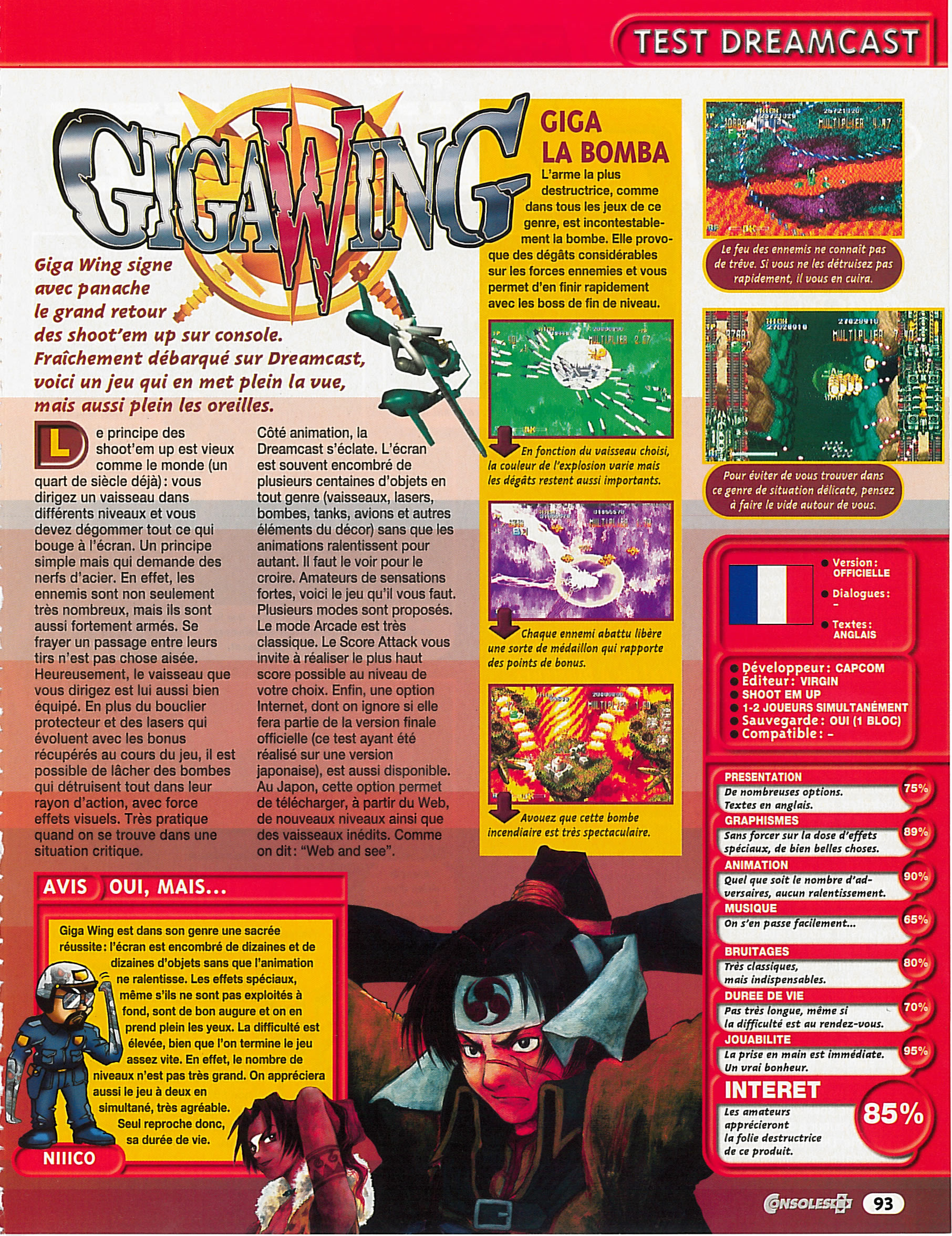
The Dreamcast version received "mixed" reviews according to the review aggregation website GameRankings.[3] Game Informer gave the game a favorable review, and Electronic Gaming Monthly gave it a mixed review, both while the game was still in development.[6][8] Jim Preston of NextGen said that the game "should be packaged with bottles of both Visine and Excedrin."[14] In Japan, Famitsu gave it a score of 28 out of 40.[7]

Also in Japan, Game Machine listed the arcade version in their May 1, 1999 issue as the tenth most-successful arcade game of the month.[15]

Notes

[edit]

References

[edit]
[edit]
Revisions and contributorsEdit on WikipediaRead on Wikipedia
from Grokipedia
Giga Wing is a vertically scrolling video game developed by Takumi Corporation and published by for arcades in 1999. It features four playable characters who pilot unique ships in a futuristic world, battling enemy forces to destroy the Medallion, a massive artifact fueling global conflict in the year 2050. The game's core revolves around aggressive bullet-hell mechanics, where players use a two-button control scheme for primary shots and a Reflect Force ability that temporarily reflects enemy projectiles back at foes for bonus points and scoring opportunities. Bombs provide screen-clearing relief, and the title emphasizes high-score runs across seven stages, with an unlockable EX stage available only on a single credit. In two-player co-op mode, characters can team up, leading to branching story paths and multiple endings based on the pilots selected. Originally released on Capcom's CPS-2 arcade hardware, Giga Wing was ported to the Sega Dreamcast in 2000, retaining the arcade experience with added options like training modes. It later appeared in the 2021 Capcom Arcade Stadium collection for modern platforms including PC, Nintendo Switch, PlayStation 4, and Xbox One, making it accessible via digital download for $1.99 as an add-on. The series inspired sequels, including Giga Wing 2 (2000) and Giga Wing Generations (2001), expanding on its reflective shooting system and scoring depth.

Development and production

Studio background

Takumi Corporation was founded in May 1994 by former employees of , a pioneering Japanese developer that had declared earlier that year, with Tomoaki Fujimoto, Toaplan's ex-sales manager, serving as the company's first president. This formation was part of a broader splintering of Toaplan's talent, which also gave rise to studios like and Eighting, allowing ex-Toaplan staff to continue their work in the genre amid the turbulent arcade industry of the mid-1990s. Building on 's legacy of intricate bullet patterns and high-intensity vertical scrollers, Takumi quickly established its expertise through early titles such as Kyuukyoku Tiger II (1995 arcade release, known internationally as Twin Cobra II), a direct to Toaplan's Tiger Heli series that refined chaotic enemy formations and power-up systems. The studio's small team of around 20-30 developers, many with direct Toaplan experience in programming and design, focused on arcade hardware, producing games that emphasized technical precision and replayability in the space before expanding collaborations. Takumi ceased operations in 2009. For Giga Wing, Takumi entered a development partnership with in late 1998, leveraging the publisher's CPS-2 arcade board to create a title amid the declining Japanese arcade market, where operators sought fresh content to sustain venues. Noritaka Funamizu, Capcom's veteran producer known for fighting games like , oversaw the project, fostering an equal-footing collaboration that blended Takumi's Toaplan-influenced dense elements with Capcom's emphasis on accessible, spectacle-driven mechanics. Challenges included resolving memory constraints on CPS-2 hardware through Capcom's technical support and iterative balancing to merge the studios' stylistic influences without compromising core intensity. This process culminated in Giga Wing's 1999 release, marking Takumi's breakthrough in co-development while honoring their roots.

Key innovations

Giga Wing utilized Capcom's CPS-2 arcade hardware, which was adapted with an increased memory allotment on the (PCB) to accommodate the game's demanding computational needs. This enhancement allowed for more intricate computer-generated (CG) elements and dense bullet patterns, enabling visually complex scenes that pushed the limits of the aging system without requiring a full hardware overhaul. A notable technical choice was the use of a horizontal 4:3 monitor for its vertical , a departure from the standard vertical orientation in most shoot 'em ups of the . This "verizontal" setup, which rotated the display 90 degrees, maximized the visual spectacle by leveraging wider screens for expansive patterns and environmental details, while simplifying cabinet manufacturing compatibility. The game introduced simultaneous two-player cooperative mode, allowing players to team up in real-time while maintaining individual scoring and survival strategies that could blend solo risk-taking with collaborative support. This design encouraged dynamic interplay, such as shared enemy waves and synchronized power-ups, enhancing replayability in arcade settings. Giga Wing's aesthetic was shaped by Kei Toume's character designs, which infused pilots and aircraft with Victorian-futuristic motifs like mechanical prosthetics and ornate machinery, establishing a cohesive alternate-world lore. Complementing this, Yasushi Kaminishi crafted an energetic blending orchestral swells with industrial rhythms, reinforcing the theme's immersive world-building through auditory cues tied to key events and boss encounters.

Release history

Original arcade release

Giga Wing debuted in arcades in in February 1999, with a Japanese release following in March 1999. The game was developed in collaboration with Takumi and published by for their CPS-2 arcade system board, which supported simultaneous play for 1 to 4 players on a horizontal monitor orientation despite the title's vertical scrolling format. This hardware choice allowed for high-resolution graphics and smooth gameplay, contributing to the game's intense bullet patterns and dynamic action. Capcom marketed Giga Wing as their first new shoot 'em up in four years, positioning it to recapture the attention of arcade enthusiasts through its innovative Reflect Force mechanic and potential for massive scoring multipliers. The title quickly found an audience in Japan, where Game Machine magazine ranked it as the 10th most popular arcade game in its May 1999 issue.

Home ports and re-releases

The Sega Dreamcast port of Giga Wing was released in Japan on November 11, 1999, followed by North America on July 18, 2000, and Europe on October 20, 2000. This version adapted the original arcade's 384×224 resolution to the Dreamcast's native 640×480 for improved visual clarity on home hardware, while maintaining the core gameplay structure. In 2019, Giga Wing was included in the Capcom Home Arcade hardware bundle, a dedicated arcade-style console pre-loaded with 16 classic Capcom titles, allowing players to experience the game on authentic-feeling cabinet emulation without additional purchases. The game saw further accessibility through its inclusion as downloadable content in , launched in 2021 across multiple platforms: on February 17 (with Giga Wing DLC available at launch), PC via on May 24, and on October 20. Priced at $1.99, this re-release emulates the original arcade experience with options for both Japanese and English language support. Modern ports, including , feature enhanced co-op functionality tailored to home systems, supporting up to two players locally compared to the arcade's four-player setup, alongside save states and adjustable difficulty for broader accessibility.

Gameplay

Core mechanics

Giga Wing is a vertical scrolling in which players navigate a futuristic through six main stages, each concluding with an intense boss battle against one of the medallion guardians. The game's structure emphasizes relentless forward momentum, with enemies appearing from all directions as the screen auto-scrolls upward, requiring precise maneuvering to avoid collisions and projectiles. An optional seventh EX stage becomes accessible only upon completing the first six without using continues, adding for skilled players. Player controls are straightforward, utilizing an 8-way for movement and two primary s: one for firing standard weapons in a continuous stream when held, and a secondary for deploying special attacks such as screen-clearing bombs. The game begins with three lives per credit, and upon depleting them, players can opt for continues to resume from the current stage, though this impacts certain bonuses and access to the EX stage. This lives system encourages careful play, as death resets power levels and other temporary upgrades. The system revolves around collecting floating item capsules dropped by defeated enemies, which upgrade the ship's capabilities in shots, , and shields. "P" icons incrementally boost weapon to three levels for wider or stronger firing patterns, while excess pickups contribute to other bonuses; "B" icons replenish the , capped at eight, providing clears. Shields, activated through special like the Reflection Laser variant, offer temporary invincibility and protection, enhancing survivability during dense enemy waves. In solo mode, all resources accrue directly to the single player, whereas team modes in multiplayer alter sharing dynamics for collected items and end-stage rewards. Multiplayer supports up to two players in simultaneous , allowing joint progression through the stages with shared screen space and enemy destruction. Players can assist each other by drawing fire or covering flanks, though collisions between ships are possible; alternating play is not supported, emphasizing real-time . This mode fosters resource sharing, such as combined bonuses for stage completion percentages, but demands coordination to avoid friendly interference during deployments.

Reflection Laser and scoring

The Reflection Laser, more commonly referred to as the Reflect Force in the original , is a core defensive and offensive mechanic activated by holding the shot button, creating a temporary barrier around the player's ship that reflects incoming enemy bullets back toward foes, inflicting damage proportional to the number of bullets redirected. This reflection process consumes energy from the dedicated Reflect Gauge at the bottom of the screen, which depletes upon activation and requires a cooldown period of approximately 4-5 seconds to recharge fully before the mechanic can be used again, emphasizing precise timing to manage bullet-heavy encounters without vulnerability. While the Reflect Gauge recharges passively over time, strategic use aligns with power-up items like "P" icons that enhance overall firepower, indirectly supporting sustained reflection plays by clearing paths for safer medal collection. Integrated with the Reflect Force is the game's energy management system, where prolonged barrier deployment drains the gauge faster. The Force Bomb is a separate screen-clearing attack that eliminates all on-screen bullets, grants brief invincibility, and deals area-wide damage to enemies; it is activated by the bomb button when bomb stock (replenished by "B" items dropped by defeated foes, max 8) is available. This dual-layer system promotes risk-reward decisions, as over-relying on reflections can leave players exposed during cooldowns, while conserving energy for bombs provides emergency relief in dense bullet patterns, all while tying into scoring opportunities by preserving multiplier chains. The scoring system in Giga Wing centers on a dynamic multiplier that escalates through the collection of Gold Medals, primarily generated when reflected bullets strike or objects, turning potential threats into point multipliers that can reach values in the trillions for expert play. Base points from destroying (typically 100-500 per foe) are multiplied by this value— for instance, a modest x1,000 multiplier on a 200-point enemy yields 200,000 points—while chaining medals without interruption builds combos that exponentially increase the multiplier, with each medal's value escalating based on the chain length (e.g., +1 for the first, up to +20 or more), allowing multipliers to reach millions and rewarding aggressive reflection tactics over mere survival. Reflected bullets contribute directly by spawning these medals, creating a feedback loop where high-risk barrier use amplifies scores, though death resets the multiplier to x1, underscoring the need for flawless runs to achieve "giga" totals exceeding billions. In Team Mode, which supports simultaneous two-player control of paired characters, reflections operate independently per player but contribute to a shared scoring pool, allowing coordinated medal chains for amplified multipliers, though individual deaths can disrupt and influence ending paths—such as triggering scenarios in bad endings if players fail to clear stages without continues, potentially capping score potential compared to solo good endings. End-of-stage bonuses further enhance totals, awarding points based on destruction percentages and remaining stocks multiplied by the current , reinforcing the strategic depth of balancing reflections with for maximal risk-reward scoring.

Story

Setting and characters

Giga Wing is set in a futuristic world in the year 2050, where nations wage an intense aerial war over the ancient , a divine artifact renowned for granting immense power that has historically sparked conflicts leading to the annihilation of entire civilizations. This setting fuses Victorian-inspired machinery, such as ornate airships and mechanical contraptions, with advanced weaponry and explosive aerial dogfights, creating a backdrop of grandeur and destruction. At the heart of the conflict lies lore: an enigmatic relic capable of both prosperity and devastation, now fueling the most technologically advanced in history as factions seek its dominance. The four playable pilots enter the fray equipped with personal "stones"—mystical artifacts that amplify their ships' abilities and are believed to hold the key to challenging the Medallion's power—each driven by unique motivations tied to this global strife. Sinnosuke, a young pilot descended from a tribe that safeguards a thunder-summoning stone, pilots the Raijin, a balanced craft with wide-ranging shots and average speed, to end the wars ravaging his people. Ruby, a treasure-hunting ex-aerial pirate who now protects an orphanage, commands the swift Carmine, featuring high-power straight shots and superior speed, in her quest to secure a brighter future. Isha, a mystical warrior and trained shaman formerly an ace pilot, flies the slower but homing-missile-equipped Porchka at average power, advocating for peace through her enhanced abilities. Stuck, a grizzled military ace and retired doctor augmented by a transformative magic stone, operates the high-speed, explosive-mine deploying Widerstand with formidable power. The characters' unique ship designs reflect their personalities and stone affinities, contributing to minor variations in weapon flavors during combat. The game's visual style, characterized by extravagant explosions, intricate mechanical details, and dramatic portraits, was crafted by Kei Toume, whose designs infuse the aesthetic with a sense of ornate intensity.

Plot summary

In the year 2050, a devastating rages in a steampunk-inspired future, driven by conflicts over , an ancient divine stone that bestows immense power, prosperity, and destruction upon those who control it, leading civilizations to rise and fall throughout history. Four pilots—Sinnosuke, a descendant of an ancient tribe piloting the to end wars ravaging his people; Isha, a former turned peacemaker in the Porchka; Ruby, an ex-sky pirate in the protecting the innocent; and Stuck, a half-cyborg doctor in the Widerstand seeking to reverse his wife's petrification by a related magical stone—embark on a perilous mission to destroy using powerful reflective stones that amplify their abilities. Their journey unfolds across seven stages of escalating aerial combat amid war-torn landscapes, with the first three stages varying by pilot selection (such as an assault for Sinnosuke or a volcanic for others), progressing to fixed later stages including a transcontinental pursuit and a climactic confrontation with the multi-form in stage six. The narrative branches based on solo or team play: in solo mode, the chosen pilot's individual drives a personal quest, culminating in a bittersweet resolution where they often sacrifice themselves in a desperate dive to shatter if continues are used; however, completing the first six stages on a single credit unlocks stage seven against the enigmatic Stranger, a time-traveling manipulating the artifact, leading to a good ending where the pilot survives and returns home after its destruction. In two-player team mode, a collective storyline emerges, emphasizing camaraderie as the pilots unite their stones' power against overwhelming odds, potentially averting individual tragedies through shared effort. Endings tie directly to these paths and performance: solo good endings allow full personal survival and Medallion eradication without corruption spreading apocalypse; bad endings depict loss and sacrifice amid partial victory; team good endings enable collective triumph with all pilots intact, restoring peace at the cost of the artifact's power; while bad team outcomes involve losses, underscoring the theme of power's perilous toll as the war's apocalyptic stakes hang in the balance.

Reception

Critical response

Upon its 1999 arcade release, Giga Wing received mixed feedback, with praise for its innovative mechanics like the Reflect Force and visual spectacle, though critics noted limitations in graphical polish and high difficulty relative to contemporaries. The game's bullet patterns were praised for their aesthetic variety and predictability, allowing skilled players to navigate dense screens through memorization and precise movement. Reviewers highlighted the Reflect Force as a standout feature, enabling players to deflect enemy projectiles for both survival and amplified scoring via medal collection. However, the steampunk-inspired plot, centered on pilots vying for a powerful medallion, was often viewed as simplistic and secondary to the core action. The 2000 Dreamcast port garnered mixed reception, with an average score around 60% on aggregation sites, lauding its multiplayer and bombastic on-screen chaos while critiquing its steep difficulty curve and repetitive stage design. Critics appreciated the port's faithful recreation of the arcade experience, including enhanced visuals that emphasized explosive effects and intensity, making it a spectacle for up to two players. The Reflection mechanic continued to draw acclaim for adding to dodging and offense, though some found the game's short length—typically under an hour per run—and punishing boss encounters frustrating for newcomers. Co-op mode was frequently highlighted as a redeeming factor, fostering replayability despite the challenges. In modern shmup communities, Giga Wing has earned retrospective praise as an essential title, often included in curated lists of must-play shooters for its addictive Reflection Laser system and high-score potential reaching trillions. Enthusiasts commend the consistent enemy patterns and medal-based scoring for rewarding mastery, positioning it as a gateway to manic-style games. While the narrative remains a minor aspect, the game's enduring appeal lies in its accessible yet demanding , solidifying its status among genre fans.

Sales and rankings

The arcade version of Giga Wing demonstrated strong initial popularity in during its location tests, where it drew large crowds of players who spent extended time engaging with the game, exceeding developer expectations. The port achieved modest commercial performance, selling 8,653 units in according to NPD Group data from 2003. This contributed to Takumi Corporation's portfolio during the console's lifecycle but did not rank among top-selling titles. As part of the collection, Giga Wing was re-released as downloadable content in 2021 for platforms including , , , and PC, priced at $1.99 to enhance accessibility within the community. Overall, while exact global sales figures remain unavailable, Giga Wing is regarded as a mid-tier success amid the declining arcade market of the late 1990s.

Legacy

Sequels

Giga Wing 2, developed by Takumi Corporation in collaboration with , was first released in arcades in January 2000 on Sega's NAOMI hardware. It was later ported to the , launching in on January 18, 2001, and in on May 16, 2001. Development planning began in May 1999, shortly after the original Giga Wing's success, with actual production starting around August or September of that year. The sequel shifted to full 3D graphics, moving away from the original's 2D sprites while retaining the core Reflection mechanic in an enhanced form known as the Reflect Laser, which allows players to absorb enemy bullets and redirect them as powerful beams. A new feature, the Item Volcanon, enables massive explosions when sufficient medals accumulate on screen, amplifying scoring potential to reach into the quintillions—far exceeding the trillions of the first game. The game introduces five new playable characters, each piloting dual ships, set against fresh stages inspired by regions like the fictional Serbenian Republic. A third mainline entry, Giga Wing Generations, developed by Takumi Corporation and published by , was released for arcades in 2004 and ported to the in 2005. No further mainline sequels were produced in the Giga Wing series.

Cultural impact

Giga Wing's Reflect Force mechanic, which enables players to generate a temporary barrier that reflects enemy bullets back toward foes while granting brief invincibility, popularized innovative defensive strategies within the genre by intertwining survival tactics with high-risk scoring opportunities. This approach influenced subsequent titles by emphasizing bullet manipulation as a core element, contributing to the evolution of subgenre dynamics during the late 1990s arcade era. Within the shoot 'em up community, Giga Wing holds enduring status as a staple Dreamcast title, frequently appearing in curated lists of the console's top shooters for its accessible yet intense vertical-scrolling action. Enthusiast discussions and scoring competitions highlight its medal-collection system, which can escalate scores into the trillions through precise reflection timing, fostering ongoing player engagement and high-score chases. The game's development by Takumi Corporation, founded by former Toaplan staff in 1994, underscored a direct lineage from the pioneering 2D arcade era, with Giga Wing serving as their debut collaboration with on the CPS-2 hardware. This partnership helped revitalize 's involvement in shoot 'em ups, bridging classic arcade designs to modern digital collections like the 2021 re-release, which preserved the title's spectacle for new audiences. In retrospective analyses from the 2020s, Giga Wing has garnered praise for its visual and mechanical spectacle, including the satisfying chaos of reflecting dense bullet swarms across chaotic battlefields, even as it acknowledges the title's initial mixed reception for its perceived accessibility. Developers later reflected on its barrier and scoring systems as foundational to the series' appeal, influencing Takumi's brief but impactful output before the studio's closure.

References

Add your contribution
Related Hubs
User Avatar
No comments yet.