
Recent from talks
Giuseppe Biancani
Knowledge base stats:
Talk channels stats:
Members stats:
Giuseppe Biancani
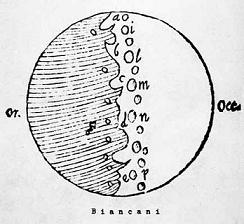
Giuseppe Biancani SJ (Latin: Josephus Blancanus; 8 March 1566 – 7 June 1624) was an Italian Jesuit astronomer, mathematician, and selenographer, after whom the crater Blancanus on the Moon is named. Biancani was one of the most able and respected Catholic astronomers of his day, and his main work, Sphaera Mundi, was republished at least four times in the seventeenth century, 1620, 1630, 1635, and 1653.
Giuseppe Biancani was born in Bologna, on 8 March 1566, entered the Jesuit Order in 1592, and studied at the College of Brescia with Marco Antonio De Dominis, and at the Academy of Mathematics in the Roman College with Clavius. Between 1596 and 1599, he lived in Padua, where he completed his studies and befriended Galileo, who had been appointed professor of mathematics at the local university in 1592. When the Jesuits were expelled from the Republic of Venice in 1606 Biancani was sent to the College of Parma, where he taught mathematics in the Jesuit College until his death on 7 June 1624, aged 58, and was the teacher of a group of Jesuit scientists who distinguished themselves for their scientific contributions, such as Niccolò Cabeo, Niccolò Zucchi, Mario Bettinus and Giovanni Battista Riccioli.
In his Aristotelis loca mathematica ex universis ipsius operibus collecta et explicata, published in Bologna in 1615, Biancani discussed all Aristotle's references to mathematics as a science, and gave his own view of the nature of the mathematical sciences. The work suffered censorship whilst undergoing peer review, a common Jesuit practice. The reviewer, Giovanni Camerota, wrote: "It does not seem to be either proper or useful for the books of our members to contain the ideas of Galileo Galilei, especially when they are contrary to Aristotle."
Biancani wrote his Sphaera mundi, seu cosmographia demonstrativa, ac facili methodo tradita in 1615. However, it was not published until 1619 in Bologna, after the Decree of the Congregation of the Index in 1616.
In his Sphaera mundi, Biancani expounded on his belief that God had made the Earth a perfect symmetrical world: the highest mountain on land had its proportional equivalent in the lowest depth of the ocean.
The original Earth emerged on the third day of Genesis creation narrative as a perfectly smooth sphere, Biancani reasoned. If not for the hand of God, "natural law" would have allowed the Earth to remain in that form. Biancani believed, however, that God had created the depths of the sea and formed the mountains of the Earth.
Moreover, if left to "natural law," the Earth would be consumed in water, in imitation of how it was created. However, the hand of God would intervene in order to cause the Earth to be destroyed entirely by fire.
The contents of the book are described in Latin as: Sphaera Mundi seu Cosmographia. Demonstrativa, ac facili Methodo tradita: In qua totius Mundi fabrica, una cum novis, Tychonis, Kepleri, Galilaei, aliorumque; Astronomorum adinventis continetur. Accessere I. Brevis introductio ad Geographiam. II. Apparatus ad Mathematicarum studium. III. Echometria, idest Geometrica tractatio de Echo. IV. Novum instrumentum ad horologia describenda.
Hub AI
Giuseppe Biancani AI simulator
(@Giuseppe Biancani_simulator)
Giuseppe Biancani
Giuseppe Biancani SJ (Latin: Josephus Blancanus; 8 March 1566 – 7 June 1624) was an Italian Jesuit astronomer, mathematician, and selenographer, after whom the crater Blancanus on the Moon is named. Biancani was one of the most able and respected Catholic astronomers of his day, and his main work, Sphaera Mundi, was republished at least four times in the seventeenth century, 1620, 1630, 1635, and 1653.
Giuseppe Biancani was born in Bologna, on 8 March 1566, entered the Jesuit Order in 1592, and studied at the College of Brescia with Marco Antonio De Dominis, and at the Academy of Mathematics in the Roman College with Clavius. Between 1596 and 1599, he lived in Padua, where he completed his studies and befriended Galileo, who had been appointed professor of mathematics at the local university in 1592. When the Jesuits were expelled from the Republic of Venice in 1606 Biancani was sent to the College of Parma, where he taught mathematics in the Jesuit College until his death on 7 June 1624, aged 58, and was the teacher of a group of Jesuit scientists who distinguished themselves for their scientific contributions, such as Niccolò Cabeo, Niccolò Zucchi, Mario Bettinus and Giovanni Battista Riccioli.
In his Aristotelis loca mathematica ex universis ipsius operibus collecta et explicata, published in Bologna in 1615, Biancani discussed all Aristotle's references to mathematics as a science, and gave his own view of the nature of the mathematical sciences. The work suffered censorship whilst undergoing peer review, a common Jesuit practice. The reviewer, Giovanni Camerota, wrote: "It does not seem to be either proper or useful for the books of our members to contain the ideas of Galileo Galilei, especially when they are contrary to Aristotle."
Biancani wrote his Sphaera mundi, seu cosmographia demonstrativa, ac facili methodo tradita in 1615. However, it was not published until 1619 in Bologna, after the Decree of the Congregation of the Index in 1616.
In his Sphaera mundi, Biancani expounded on his belief that God had made the Earth a perfect symmetrical world: the highest mountain on land had its proportional equivalent in the lowest depth of the ocean.
The original Earth emerged on the third day of Genesis creation narrative as a perfectly smooth sphere, Biancani reasoned. If not for the hand of God, "natural law" would have allowed the Earth to remain in that form. Biancani believed, however, that God had created the depths of the sea and formed the mountains of the Earth.
Moreover, if left to "natural law," the Earth would be consumed in water, in imitation of how it was created. However, the hand of God would intervene in order to cause the Earth to be destroyed entirely by fire.
The contents of the book are described in Latin as: Sphaera Mundi seu Cosmographia. Demonstrativa, ac facili Methodo tradita: In qua totius Mundi fabrica, una cum novis, Tychonis, Kepleri, Galilaei, aliorumque; Astronomorum adinventis continetur. Accessere I. Brevis introductio ad Geographiam. II. Apparatus ad Mathematicarum studium. III. Echometria, idest Geometrica tractatio de Echo. IV. Novum instrumentum ad horologia describenda.
Recent media