
Recent from talks
Glyptodon
Knowledge base stats:
Talk channels stats:
Members stats:
Glyptodon
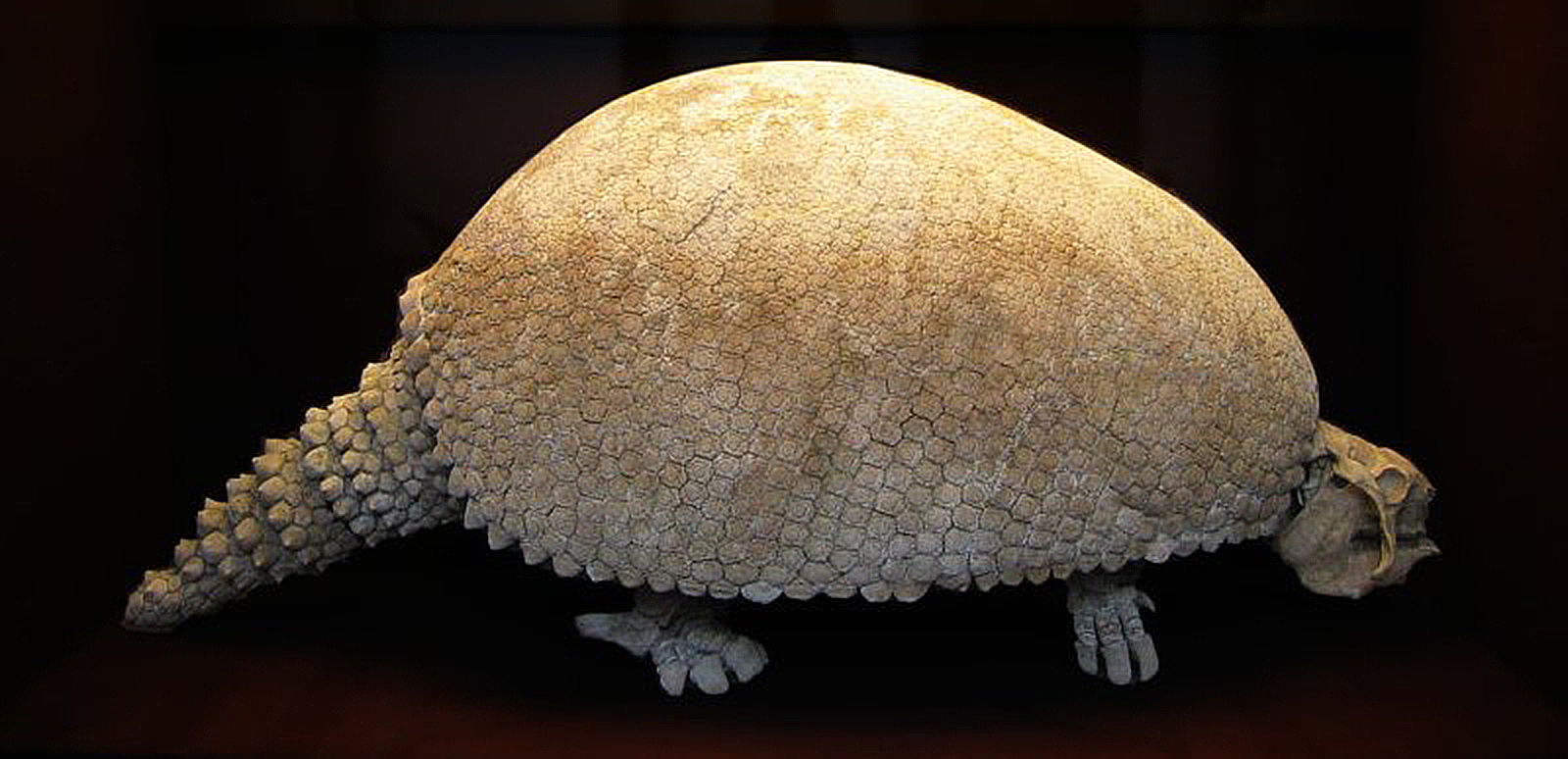
Glyptodon (lit. 'grooved or carved tooth'; from Ancient Greek γλυπτός (gluptós) 'sculptured' and ὀδοντ-, ὀδούς (odont-, odoús) 'tooth') is a genus of glyptodont, an extinct group of large, herbivorous armadillos that lived from the Pliocene, around 3.2 million years ago, to the early Holocene, around 11,000 years ago, in South America. It is one of, if not the, best known genus of glyptodont. Glyptodon has a long and storied past, being the first named extinct cingulate and the type genus of the subfamily Glyptodontinae. Fossils of Glyptodon have been recorded as early as 1814 from Pleistocene aged deposits from Uruguay, though many were incorrectly referred to the ground sloth Megatherium by early paleontologists.
The type species, G. clavipes, was described in 1839 by notable British paleontologist Sir Richard Owen. Later in the 19th century, dozens of complete skeletons were unearthed from localities and described by paleontologists such as Florentino Ameghino and Hermann Burmeister. During this era, many species of Glyptodon were dubbed, some of them based on fragmentary or isolated remains. Fossils from North America were also assigned to Glyptodon, but all of them have since been placed in the closely related genus Glyptotherium. It was not until the later end of the 1900s and 21st century that full review of the genus came about, restricting Glyptodon to just five species under one genus.
Glyptodonts were typically large, quadrupedal (four-legged), herbivorous armadillos with armored carapaces (top shell) that were made of hundreds of interconnected osteoderms (structures in dermis composed of bone). Other pieces of armor covered the tails and skull roofs, the skull being tall with hypsodont (high-crowned) teeth. As for the postcranial anatomy, pelves fused to the carapace, an amalgamate vertebral column, short limbs, and small digits are found in glyptodontines. Glyptodon reached up to 2 meters (6.56 feet) long and 400 kilograms (880 pounds) in weight, making it one of the largest glyptodontines known. Glyptodon is morphologically and phylogenetically most similar to Glyptotherium, however they differ in several ways. Glyptodon is larger on average, with an elongated carapace, a relatively shorter tail, and a robust zygoma, or cheek bone.
Glyptodonts existed for millions of years, though Glyptodon itself was one of its last surviving members. Glyptodon was one of many South American megafauna, with many native groups such as notoungulates and ground sloths reaching immense sizes. Glyptodon had a mixed diet of grasses and other plants, instead living at the edge forests and grasslands where the shrubbery was lower. Glyptodon had a wide muzzle, an adaptation for bulk feeding. The armor could have protected the animal from predators, of which many coexisted with Glyptodon, including the "saber-tooth cat" Smilodon, the large canid Protocyon, and the giant bear Arctotherium.
Glyptodon, along with all other glyptodonts, became extinct at the end of the Late Pleistocene, around 12,000 years ago as part of the Late Pleistocene extinctions, along with most large mammals in the Americas. Evidence of hunting of glyptodonts by recently arrived Paleoindians suggests that humans may have been a causal factor in the extinctions.
The history and taxonomy of Glyptodon is storied and convoluted, as it involved confusion with other genera and dubious species, as well as a lack of detailed data. The first recorded discovery of Glyptodon was as early as 1814 when Uruguayan priest, scientist, soldier, and later politician Dámaso Antonio Larrañaga (1771–1848) wrote about the discovery of several unusual fossils in his Diario de Historia Natural, which included his descriptions of many new species of ants, birds, mammals, and even one of the first figures of the extinct Megatherium, a genus of giant ground sloth that was named in 1796 by French scientist Georges Cuvier (1769–1832). This was the first recorded discovery of a glyptodontine or fossil cingulate. The unusual fossils consisted of a femur, carapace fragments, and a caudal tube (an armored tail covering found in glyptodontines) that he collected from the Pleistocene aged (ca. 2.5-0.011 mya) strata on the banks of the Solís Grande Creek, Uruguay. Larrañaga identified the fossils as those of Dasypus (Megatherium), believing that Megatherium was a subgenus of Dasypus based on the incorrect referral of glyptodontine osteoderms to Megatherium years earlier by Spanish scientist Juan Bautista Bru de Ramón, which misled other scientists to believe that glyptodontine fossils were actually those of armored megatheres.
Larrañaga wrote to French scientist Auguste Saint Hilaire about the discovery, and the letter was reproduced by Cuvier in 1823 in the second volume of his landmark book Recherches sur les ossemens fossiles. Larrañaga also noted that similar fossils had been found in "analogous strata near Lake Merrim, on the frontier of the Portuguese colonies (southern Brazil)." These fossils were also likely those of glyptodontines, possibly the closely related Hoplophorus. The armored Megatherium hypothesis was further supported later in 1827 when portions of a Glyptodon carapace, as well as a partial femur and some caudal armor, were found by a Prussian traveler to Montevideo, Uruguay named Mr. Sellow, who sent the carapace to Berlin where it was described by Professor von Weiss, who referred it to Megatherium. The femur and caudal armor were recovered from the Quegnay in northern Uruguay, while the carapace had been found in the Arapey River. Weiss and other paleontologists noted that the osteoderms closely resembled those of armadillos like Dasypus, but Cuvier's hypothesis was popularized based on the incorrect referral of glyptodontine osteoderms Megatherium.
Another work on the armored Megatherium hypothesis was published in 1833 by Berlin scientist E. D'Alton, who described more of the material sent by Sellow, including portions of the limbs, manus, and shoulder girdle. D'Alton recognized the great similarities of the fossils to Dasypus and speculated that it was a giant armadillo, contrary to the notion that they were from Megatherium. Despite this, D'Alton did not erect a new name for the fossils and instead wrote that additional material was necessary to distinguish it from other armadillos. D'Alton did not mention Megatherium or its osteoderms in the paper, but he implied that all of the "Megatherium armor" was instead from his armadillo. This hypothesis was supported by Laurillard in 1836, who mentioned that a plaster cast of a large armadillo carapace represented a distinct taxon from Megatherium and that the armor referred to the sloth was instead from an armadillo.
Hub AI
Glyptodon AI simulator
(@Glyptodon_simulator)
Glyptodon
Glyptodon (lit. 'grooved or carved tooth'; from Ancient Greek γλυπτός (gluptós) 'sculptured' and ὀδοντ-, ὀδούς (odont-, odoús) 'tooth') is a genus of glyptodont, an extinct group of large, herbivorous armadillos that lived from the Pliocene, around 3.2 million years ago, to the early Holocene, around 11,000 years ago, in South America. It is one of, if not the, best known genus of glyptodont. Glyptodon has a long and storied past, being the first named extinct cingulate and the type genus of the subfamily Glyptodontinae. Fossils of Glyptodon have been recorded as early as 1814 from Pleistocene aged deposits from Uruguay, though many were incorrectly referred to the ground sloth Megatherium by early paleontologists.
The type species, G. clavipes, was described in 1839 by notable British paleontologist Sir Richard Owen. Later in the 19th century, dozens of complete skeletons were unearthed from localities and described by paleontologists such as Florentino Ameghino and Hermann Burmeister. During this era, many species of Glyptodon were dubbed, some of them based on fragmentary or isolated remains. Fossils from North America were also assigned to Glyptodon, but all of them have since been placed in the closely related genus Glyptotherium. It was not until the later end of the 1900s and 21st century that full review of the genus came about, restricting Glyptodon to just five species under one genus.
Glyptodonts were typically large, quadrupedal (four-legged), herbivorous armadillos with armored carapaces (top shell) that were made of hundreds of interconnected osteoderms (structures in dermis composed of bone). Other pieces of armor covered the tails and skull roofs, the skull being tall with hypsodont (high-crowned) teeth. As for the postcranial anatomy, pelves fused to the carapace, an amalgamate vertebral column, short limbs, and small digits are found in glyptodontines. Glyptodon reached up to 2 meters (6.56 feet) long and 400 kilograms (880 pounds) in weight, making it one of the largest glyptodontines known. Glyptodon is morphologically and phylogenetically most similar to Glyptotherium, however they differ in several ways. Glyptodon is larger on average, with an elongated carapace, a relatively shorter tail, and a robust zygoma, or cheek bone.
Glyptodonts existed for millions of years, though Glyptodon itself was one of its last surviving members. Glyptodon was one of many South American megafauna, with many native groups such as notoungulates and ground sloths reaching immense sizes. Glyptodon had a mixed diet of grasses and other plants, instead living at the edge forests and grasslands where the shrubbery was lower. Glyptodon had a wide muzzle, an adaptation for bulk feeding. The armor could have protected the animal from predators, of which many coexisted with Glyptodon, including the "saber-tooth cat" Smilodon, the large canid Protocyon, and the giant bear Arctotherium.
Glyptodon, along with all other glyptodonts, became extinct at the end of the Late Pleistocene, around 12,000 years ago as part of the Late Pleistocene extinctions, along with most large mammals in the Americas. Evidence of hunting of glyptodonts by recently arrived Paleoindians suggests that humans may have been a causal factor in the extinctions.
The history and taxonomy of Glyptodon is storied and convoluted, as it involved confusion with other genera and dubious species, as well as a lack of detailed data. The first recorded discovery of Glyptodon was as early as 1814 when Uruguayan priest, scientist, soldier, and later politician Dámaso Antonio Larrañaga (1771–1848) wrote about the discovery of several unusual fossils in his Diario de Historia Natural, which included his descriptions of many new species of ants, birds, mammals, and even one of the first figures of the extinct Megatherium, a genus of giant ground sloth that was named in 1796 by French scientist Georges Cuvier (1769–1832). This was the first recorded discovery of a glyptodontine or fossil cingulate. The unusual fossils consisted of a femur, carapace fragments, and a caudal tube (an armored tail covering found in glyptodontines) that he collected from the Pleistocene aged (ca. 2.5-0.011 mya) strata on the banks of the Solís Grande Creek, Uruguay. Larrañaga identified the fossils as those of Dasypus (Megatherium), believing that Megatherium was a subgenus of Dasypus based on the incorrect referral of glyptodontine osteoderms to Megatherium years earlier by Spanish scientist Juan Bautista Bru de Ramón, which misled other scientists to believe that glyptodontine fossils were actually those of armored megatheres.
Larrañaga wrote to French scientist Auguste Saint Hilaire about the discovery, and the letter was reproduced by Cuvier in 1823 in the second volume of his landmark book Recherches sur les ossemens fossiles. Larrañaga also noted that similar fossils had been found in "analogous strata near Lake Merrim, on the frontier of the Portuguese colonies (southern Brazil)." These fossils were also likely those of glyptodontines, possibly the closely related Hoplophorus. The armored Megatherium hypothesis was further supported later in 1827 when portions of a Glyptodon carapace, as well as a partial femur and some caudal armor, were found by a Prussian traveler to Montevideo, Uruguay named Mr. Sellow, who sent the carapace to Berlin where it was described by Professor von Weiss, who referred it to Megatherium. The femur and caudal armor were recovered from the Quegnay in northern Uruguay, while the carapace had been found in the Arapey River. Weiss and other paleontologists noted that the osteoderms closely resembled those of armadillos like Dasypus, but Cuvier's hypothesis was popularized based on the incorrect referral of glyptodontine osteoderms Megatherium.
Another work on the armored Megatherium hypothesis was published in 1833 by Berlin scientist E. D'Alton, who described more of the material sent by Sellow, including portions of the limbs, manus, and shoulder girdle. D'Alton recognized the great similarities of the fossils to Dasypus and speculated that it was a giant armadillo, contrary to the notion that they were from Megatherium. Despite this, D'Alton did not erect a new name for the fossils and instead wrote that additional material was necessary to distinguish it from other armadillos. D'Alton did not mention Megatherium or its osteoderms in the paper, but he implied that all of the "Megatherium armor" was instead from his armadillo. This hypothesis was supported by Laurillard in 1836, who mentioned that a plaster cast of a large armadillo carapace represented a distinct taxon from Megatherium and that the armor referred to the sloth was instead from an armadillo.
Recent media