Hubbry Logo
Shield (geology)Shield (geology)Main
Open search
Shield (geology)
Community hub
Shield (geology)
logo
8 pages, 0 posts
0 subscribers
Be the first to start a discussion here.
Shield (geology)
Shield (geology)
from Wikipedia
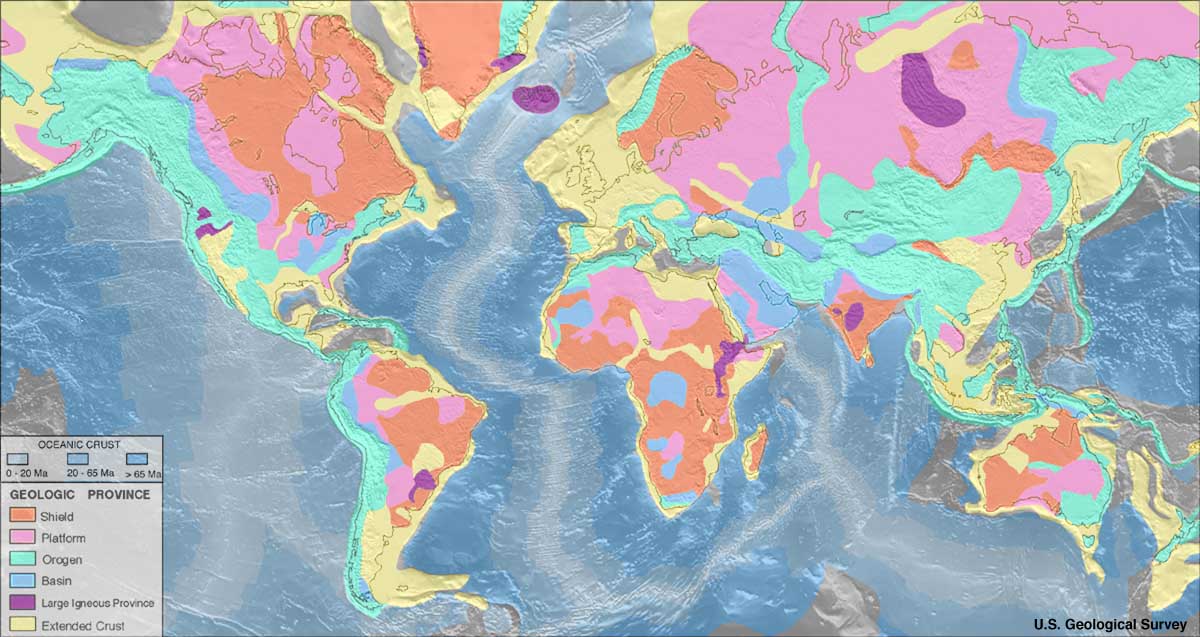
Geologic provinces of the world (USGS)

A shield is a large area of exposed Precambrian crystalline igneous and high-grade metamorphic rocks that form tectonically stable areas.[1] These rocks are older than 570 million years and sometimes date back to around 2 to 3.5 billion years.[citation needed] They have been little affected by tectonic events following the end of the Precambrian, and are relatively flat regions where mountain building, faulting, and other tectonic processes are minor, compared with the activity at their margins and between tectonic plates. Shields occur on all continents.

Terminology

[edit]
Idealized cross-section of Earth's lithosphere, including the relationship between cratons, shields and platforms (Abbreviations: cb=cratonic basin, LIP=large igneous province, MOR=mid-ocean ridge)

The term shield cannot be used interchangeably with the term craton. However, shield can be used interchangeably with the term basement. The difference is that a craton describes a basement overlain by a sedimentary platform while shield only describes the basement.

The term shield, used to describe this type of geographic region, appears in the 1901 English translation of Eduard Suess's Face of Earth by H. B. C. Sollas, and comes from the shape "not unlike a flat shield"[2] of the Canadian Shield which has an outline that "suggests the shape of the shields carried by soldiers in the days of hand-to-hand combat."[3]

Lithology

[edit]

A shield is that part of the continental crust in which these usually Precambrian basement rocks crop out extensively at the surface. Shields can be very complex: they consist of vast areas of granitic or granodioritic gneisses, usually of tonalitic composition, and they also contain belts of sedimentary rocks, often surrounded by low-grade volcano-sedimentary sequences, or greenstone belts. These rocks are frequently metamorphosed greenschist, amphibolite, and granulite facies.[citation needed] It is estimated that over 50% of Earth's shields surface is made up of gneiss.[4]

Erosion and landforms

[edit]

Being relatively stable regions, the relief of shields is rather old, with elements such as peneplains being shaped in Precambrian times. The oldest peneplain identifiable in a shield is called a "primary peneplain";[5] in the case of the Fennoscandian Shield, this is the Sub-Cambrian peneplain.[6]

The landforms and shallow deposits of northern shields that have been subject to Quaternary glaciation and periglaciation are distinct from those found closer to the equator.[5] Shield relief, including peneplains, can be protected from erosion by various means.[5][7] Shield surfaces exposed to sub-tropical and tropical climate for long enough time can end up being silicified, becoming hard and extremely difficult to erode.[7] Erosion of peneplains by glaciers in shield regions is limited.[7][8] In the Fennoscandian Shield, average glacier erosion during the Quaternary has amounted to tens of meters, though this was not evenly distributed.[8] For glacier erosion to be effective in shields, a long "preparation period" of weathering under non-glacial conditions may be a requirement.[7]

In weathered and eroded shields, inselbergs are common sights.[9]

List of shields

[edit]

See also

[edit]

Notes

[edit]
Revisions and contributorsEdit on WikipediaRead on Wikipedia
from Grokipedia
In geology, a shield is a large area of exposed crystalline igneous and high-grade metamorphic rocks that forms the tectonically stable core of a continental . These rocks are typically older than 541 million years, with some dating back 2 to over 4 billion years, and they represent the ancient, eroded remnants of early continental crust. Shields are characterized by low relief due to extensive over billions of years and are often surrounded by younger sedimentary platforms where the craton is buried under later deposits. Shields form through the accretion of continental fragments and the stabilization of the lithosphere during the and eons, creating regions resistant to deformation for billions of years. The underlying cratonic lithosphere is unusually thick, often exceeding 200 kilometers, due to cold, depleted mantle that resists and rifting. This stability allows shields to preserve some of Earth's oldest rock records, providing critical evidence for early planetary processes like initiation and cycles. Prominent examples include the Canadian Shield, which covers much of eastern and central Canada and contains rocks up to 4 billion years old; the Baltic Shield in , exposing gneisses; and the Australian Shield in , featuring formations. Other notable shields are the Ukrainian Shield in and the Kaapvaal Craton in , each contributing to reconstructions of ancient supercontinents like and . These regions often host valuable mineral resources, such as gold, nickel, and , due to their ancient volcanic and metamorphic histories. Shields play a fundamental role in understanding continental evolution, as they anchor stable interiors amid surrounding orogenic belts formed by later tectonic collisions. Their preservation highlights the long-term dynamics of convection and the longevity of cratonic roots, influencing global even today. Ongoing uses seismic imaging and isotopic analysis to probe shield interiors, revealing insights into deep processes.

Definition and Terminology

Core Definition

A shield is a large area of exposed crystalline igneous and high-grade metamorphic rocks forming a stable part of the Earth's , older than 570 million years, with many dating back 2 to over 4 billion years, representing the exposed core of a . These ancient rocks, often dating back to the and eons, have undergone extensive and intrusion, contributing to their enduring stability. Key attributes of shields include low relief landscapes shaped by prolonged exposure and minimal sedimentary cover in central regions, which highlight the underlying crystalline . Their resistance to deformation stems from an unusually thick, cold, and depleted cratonic , often exceeding 200 kilometers in depth, which provides and stability against tectonic forces. Shields represent the exposed portions of , distinguishing them from the full cratonic structure, which incorporates surrounding stable platforms overlain by sedimentary layers. These features typically span millions of square kilometers. In , the term "shield" specifically refers to the exposed, eroded central portion of a , where ancient crystalline rocks are laid bare at the surface due to prolonged . A , by contrast, encompasses the broader stable continental nucleus, incorporating both the exposed shield and surrounding platforms covered by younger sedimentary layers, forming a tectonically rigid core that has remained largely undeformed since the era. Related terms include "massifs," which denote smaller, discrete blocks of exposed rocks within or adjacent to larger shields, often representing high-grade metamorphic or igneous terrains that have been uplifted and eroded independently. Another associated concept is the "," a vast, low-relief surface developed through extended fluvial and subaerial on shields, where the landscape is reduced to near-base level, preserving features of ancient stability. The region now known as the Canadian Shield was mapped in the by Sir William Edmond Logan, director of the Geological Survey of Canada, who described its ancient Laurentian rocks as a dome-like exposure against surrounding younger formations. The broader terminology of "shield" originated in the early , introduced in English by H.B.C. Sollas in his 1901 translation of Eduard Suess's The Face of the Earth, evoking the protective form of these exposures and distinguishing them from adjacent mobile belts. A common misconception arises from conflating geological shields with volcanic shields, the latter being broad, gently sloping topographic features built by effusive basaltic lava flows, as seen in Hawaiian volcanoes, rather than ancient . Geological shields, in contrast, are vast, stable regions of deformed and metamorphosed rocks, not volcanic constructs.

Formation and Geological History

Precambrian Origins

Shields, the ancient stable cores of , originated primarily during the Eon, spanning approximately 4.0 to 2.5 billion years ago, through repeated episodes of crustal accretion, -related magmatism, and vertical growth processes. In the early , initial crustal formation involved the of mantle-derived rocks to produce tonalite-trondhjemite-granodiorite (TTG) suites, which formed the foundational blocks of proto-cratons via plume-driven underplating and localized . By the late (around 3.0 to 2.5 Ga), horizontal accretion became more prominent, with continental collisions assembling these blocks into larger, more rigid structures, including granite-greenstone belts that represent preserved volcanic arcs and sedimentary basins. events (2.5 to 1.8 Ga) further contributed to shield growth through additional and orogenic activity, leading to widespread stabilization by the late to early around 2.5 billion years ago, when the achieved sufficient thickness and buoyancy to resist tectonic disruption. Recent studies also indicate that subaerial during this period facilitated intracrustal melting, aiding the generation of buoyant granitic crust essential for long-term stability. Key formative processes included the development of granite-greenstone belts, which arose from volcanic and intrusive activity in settings, and intrusions that added components to the evolving basement, enhancing overall rigidity. Continental collisions during the facilitated the of disparate terranes, creating the mosaic-like structure characteristic of shields, while supplied the voluminous granitic rocks that dominate their composition. These processes transitioned from predominantly vertical (plume-dominated) in the to more plate-like horizontal motions by the Meso- to , marking a secular in Earth's . Geochronological evidence, particularly from U-Pb dating of crystals, confirms the antiquity of shield crust, with grains as old as 4.0 to 4.4 billion years preserved in sedimentary rocks, indicating that some of Earth's oldest intact continental fragments survived cataclysms. These detrital zircons, often found in cratonic margins like the Yilgarn or Singhbhum, reveal episodes of crustal reworking and juvenile addition, underscoring the intermittent nature of shield assembly. By the , radiometric ages cluster around 2.5 to 1.8 Ga, aligning with final stabilization phases. Shields served as the stable nuclei for early supercontinent cycles, forming the core of Vaalbara (circa 3.6 to 2.8 Ga), which amalgamated cratons like Kaapvaal and through shared magmatic and metamorphic events. Subsequently, fragments of these shields contributed to (circa 2.7 to 2.5 Ga), a assembly incorporating the Superior and Baltic cratons via widespread dyke swarms and orogenic belts, setting the stage for later supercontinents. This role highlights shields as enduring anchors in continental dynamics.

Tectonic Evolution and Stability

Following their formation in the Precambrian, shields have experienced minimal tectonic deformation since the Proterozoic era, primarily due to the development of a thick, cold lithospheric root that resists modern plate tectonic forces. This lithosphere, often exceeding 300 km in thickness beneath major shields like the Superior Craton, provides exceptional buoyancy and rigidity, limiting internal disruption over billions of years. Geophysical models indicate that such roots have remained largely intact, with thickness variations of less than 50 km since the Paleoproterozoic, underscoring their role in preserving ancient continental cores. Tectonic activity on shields has been largely confined to their margins, where minor rifting, faulting, and orogenic events occur without significantly affecting the stable central regions. For instance, the Hudsonian orogeny, part of the broader Trans-Hudson Orogeny around 1.8–1.9 Ga, involved accretion of arc terranes and microcontinents along the margins of the Canadian Shield, deforming peripheral zones like the Reindeer and Foxe areas while the core Slave-Rae and Superior provinces remained undeformed. These marginal processes, including the closure of ancient ocean basins such as the Manikewan, highlight how shields act as rigid backstops during Proterozoic collisions, with central areas exhibiting no substantial metamorphism or structural overprinting since stabilization. Several factors contribute to the long-term stability of shields, including low heat flow, isostatic equilibrium, and the absence of zones in their interiors. Heat flow measurements in shields, such as the Canadian Shield, average 22–50 mW/m² with mantle contributions as low as 15 mW/m², reflecting a cold thermal regime that maintains high and strength in the . Isostatic equilibrium is achieved through the buoyancy of depleted, low-density roots that "float" on the , with isopycnic conditions preventing convective erosion. The lack of intra-shield further preserves these structures by avoiding the recycling mechanisms that destabilize younger continental margins. In contemporary , shields serve as "ghosts" of ancient tectonic regimes, offering intact records of Earth's early plate dynamics through paleomagnetic signatures preserved in their rocks. Paleomagnetic data from shield intrusions, such as those in the Laurentian portion of , enable reconstructions of configurations around 780 Ma, revealing how relative rotations and positions of cratonic blocks shaped global paleogeography. These analyses, drawing on stable remanent magnetizations, provide quantitative evidence for the and of , linking shield stability to broader supercontinental cycles.

Composition and Structure

Rock Types and Lithology

Shields are predominantly composed of metamorphic rocks resulting from multiple episodes of reworking, including granitic gneisses, schists, and amphibolites that form the stable cratonic cores. These gneisses are typically granodioritic to granitic in character, exhibiting medium to high-grade with layered, migmatitic structures. Schists, often biotite-rich and interlayered with gneisses, contribute to the foliated fabric, while amphibolites represent metamorphosed protoliths, imparting the shields' overall resistant . Greenstone belts, embedded within the gneissic terranes, consist primarily of basaltic to andesitic volcanics, including pillowed flows and associated sediments, which underwent to . Intrusive bodies such as gabbros and anorthosites punctuate these sequences, with gabbros forming layered complexes and anorthosites appearing as plagioclase-dominated intrusions that enhance the structural complexity. Key mineral assemblages in granitic gneisses include , (An22-46), , and , reflecting their to intermediate origins. In mafic rocks like amphibolites and basalts, , , , , and accessory dominate, with serving as a critical phase for U-Pb to constrain ages. Schists feature (20-30%), , and sodic , often with in lower-grade variants. Archean shields are distinguished by higher abundances of komatiites—ultramafic volcanics with >18 wt% MgO—within greenstone belts, featuring olivine-rich assemblages altered to , actinolitic , , and under conditions. shields, in contrast, show increased granitic intrusions and more evolved calc-alkaline series, with overall varying from low-grade in greenstones to amphibolite-grade in gneisses due to repeated tectonic events. Petrographic analyses, including point-counting modal studies (500-600 points per sample), reveal polyphase deformation textures such as xenoblastic grains, sutured quartz boundaries, and foliation in these rocks, underscoring their prolonged tectonic history.

Internal Structure and Stratigraphy

Shields exhibit a complex internal architecture resulting from the accretion of numerous terranes, which form collages of ancient microcontinents sutured together during the Precambrian. These terranes, often juvenile arcs or continental fragments, are delineated by extensive shear zones and fault systems that record the collisional boundaries and subsequent stabilization. For instance, in the Arabian Shield, gneiss terranes and island-arc segments are separated by such ductile shear zones, illustrating the mosaic-like assembly. The stratigraphic framework of shields typically features a basement of highly deformed gneisses and granitoids, overlain by supracrustal sequences that include volcanic-sedimentary belts. These supracrustal belts, such as greenstone sequences in shields, consist of interlayered volcanics, clastic sediments, and chemical precipitates, typically 5 to 10 km thick. Unconformities within these sequences mark tectonic events, uplift, or between depositional episodes. Geophysical investigations, particularly seismic reflection and profiles, reveal that shield crust is generally 35–50 km thick, with a upper crust (Vp ≈ 6.0–6.5 km/s) overlying a more lower crust (Vp ≈ 6.5–6.9 km/s) and extending into deep mantle roots for isostatic support. In the Indian , for example, crustal thickness varies from 32 to 65 km across regions, reaching 45–50 km beneath cratons such as the West Dharwar, as imaged by P-wave receiver functions and analysis. anomalies, often positive due to dense intrusions in the lower crust, further highlight these heterogeneities, as seen in the Guayana where thicknesses reach 43–46 km. The deformation history of shields is characterized by polyphase events involving folding, thrusting, and , reflecting multiple orogenic cycles. Early ductile phases produced isoclinal folds and shear fabrics in the , followed by later brittle-ductile thrusting that inverted stratigraphic sequences in supracrustal belts. Unconformities, such as those separating Archean greenstones from cover, delineate these episodes, with evidence from the Canadian Shield showing multiple deformational phases during the .

Geomorphology and Surface Features

Erosion Processes

Shields, as ancient cratonic regions, have experienced prolonged primarily through fluvial and glacial over billions of years, which has progressively reduced their to low-relief peneplains. Fluvial processes involve the gradual incision and transport of by rivers in stable, low-gradient settings, while glacial erosion, particularly during ice ages, has episodically accelerated material removal through abrasion and plucking in areas of ice streaming. These mechanical processes are complemented by chemical , where feldspars in the crystalline rocks decompose into clays via in the presence of water and , contributing to the breakdown of mineral lattices without significant volume loss. Erosion rates in shields are exceptionally low, typically ranging from 1 to 10 meters per million years, attributable to the resistant lithology of igneous and metamorphic rocks and the absence of tectonic activity that would otherwise promote uplift and dissection. This slow denudation reflects a balance where chemical weathering dominates in humid climates, producing regolith that armors the surface against further mechanical erosion, while in arid or cold environments, physical processes prevail but at subdued rates. Episodic acceleration occurs during glacial periods, with rates increasing to 20–35 meters per million years in ice-stream corridors, as seen in the southern Laurentide Ice Sheet over the Canadian Shield, where up to 91 meters of bedrock was removed in such zones during the Quaternary. Throughout the , shields underwent phases of intensified erosion that exposed their cores by stripping overlying sedimentary covers, with thermochronological evidence indicating widespread exhumation in regions like the southern . Post-glacial isostatic rebound has further influenced surface evolution, as the removal of ice loads triggered uplift; for instance, models indicate approximately 100 meters of post-glacial isostatic rebound remaining in the central Fennoscandian Shield. To quantify these long-term rates, geologists employ cosmogenic nuclides such as ¹⁰Be, produced by cosmic rays in minerals at the Earth's surface, which accumulate proportionally to exposure duration and inversely to rate. Analysis of ¹⁰Be concentrations in or fluvial sediments yields average rates integrated over 10⁴ to 10⁶ years, confirming the subdued in shields and helping distinguish steady-state lowering from episodic events like glaciation. This approach has been pivotal in reconstructing exposure ages exceeding 1 million years in stable shield terrains.

Resulting Landforms

Shields exhibit characteristic landforms shaped by prolonged , including rolling peneplains formed through extended periods of and uplift, often preserved as stepped surfaces with low gradients of 3–10 m/km. Rugged uplands feature tors and inselbergs, which are isolated and residual knobs rising 50–500 m above surrounding plains, sculpted by differential along joint patterns and preserved from pre-glacial . Linear ridges arise from faulting, with NW-SE trending zones controlling alignments of valleys and elevated features, such as those in the Kirunavaara area. Depressions host vast lakes and river systems, resulting from glacial scouring and structural weaknesses that capture drainage. Pleistocene glaciations have profoundly modified landscapes, imprinting U-shaped valleys through abrasion of pre-existing V-shaped fluvial channels, alongside depositional forms like drumlins—streamlined hills of aligned parallel to flow—and sinuous eskers composed of sand and gravel deposited in subglacial tunnels. In the Canadian , these processes created thousands of lakes by gouging basins in fractured and depositing debris that blocked outlets, contributing to over 2 million water bodies across the region. Regional variations in landforms reflect differing histories; African shields display more hilly with prominent inselbergs and elongated ridges due to intense tropical and episodic uplift, contrasting with the flatter s of the , where prolonged has produced broad, low-relief surfaces like the sub-Cambrian . Shield surfaces often appear barren with rocky exposures and thin soils, typically shallow sandy or stony layers less than 1 m deep over , supporting sparse vegetation dominated by lichens, mosses, and stunted conifers like and black spruce due to nutrient-poor, acidic conditions and frequent disturbances.

Global Distribution and Examples

Major Shield Regions

The Laurentian Shield, also known as the Canadian Shield, is one of the largest exposed areas of rock on Earth, covering approximately 8 million km² across eastern and , extending into parts of the prairie provinces and the . It features an core composed of ancient blocks assembled during the , surrounded by marginal belts formed through subsequent tectonic accretion and stabilization. This vast region forms the stable heart of the North American , characterized by low-relief terrain shaped by prolonged . The Fennoscandian Shield, located in encompassing parts of , , and northwestern , represents a key crustal fragment with rocks primarily dating from 2.5 to 1.8 Ga. Its geology includes granite-greenstone terranes in the east transitioning to orogenic belts in the southwest, reflecting episodes of continental growth and collision. The shield's surface consists largely of glaciated lowlands and plateaus, where repeated glaciations have smoothed the landscape into subdued hills and broad valleys. In Africa, the Kaapvaal and Congo shields form ancient cratonic nuclei in the southern and central parts of the continent, respectively, with the Kaapvaal Craton underlying much of South Africa and Lesotho, while the Congo Craton spans the Democratic Republic of the Congo, Angola, and surrounding areas. These shields are composed of Archean to Paleoproterozoic basement rocks stabilized by 2.7 Ga, featuring granite-greenstone belts and high-grade metamorphic terrains. Notably, both host diamond-bearing kimberlites emplaced during Mesozoic rifting, which pierced the thick lithospheric roots of these cratons. The Australian Shield, centered in Western Australia, covers a significant portion of the continent's western interior and includes the Yilgarn and Pilbara cratons as its primary Archean components. The Pilbara Craton contains some of the world's oldest preserved crustal fragments, with rocks dating back to approximately 3.6 Ga, including volcanic sequences from the early Earth. The Yilgarn Craton, adjacent to the east, features greenstone belts and granitic domes formed between 3.0 and 2.6 Ga, both cratons amalgamated during the Proterozoic to form a stable shield interior. The Antarctic Shield, predominantly in , preserves the oldest continental fragments on , with zircon crystals in metasedimentary rocks indicating ages up to approximately 4 Ga. This shield forms the bulk of the East Antarctic Craton, a vast Archean-Paleoproterozoic block underlying about 10 million km² of ice-covered terrain, bounded by younger orogenic belts. Its exposed outcrops, such as in the and coastal regions, reveal granulite-facies gneisses and intrusions that record the initial assembly of proto-continental masses.

Economic and Scientific Significance

Shields hold substantial economic importance due to their abundant resources, which have driven significant industries. These ancient cratons are particularly rich in metals such as , , , , and , often formed through prolonged geological processes involving magmatic and hydrothermal activity. For instance, the within the Canadian Shield represents one of the world's largest nickel-copper deposits, along with platinum-group elements, resulting from a that concentrated ores over a vast area. In the early 2000s, in the Sudbury region accounted for approximately half of Ontario's annual $10 billion production, underscoring its role in global supply chains for battery and alloy materials. Similarly, deposits in the Canadian Shield, such as those at , have historically supplied , while diamond mines like Diavik in the exploit pipes embedded in the cratonic basement. However, extraction faces challenges from remote locations, thin soils, and glaciated terrains that complicate infrastructure development and increase costs. Scientifically, shields provide unparalleled insights into Earth's early history, preserving the oldest continental crust and records of primordial life. The Australian Shield hosts the earliest known evidence of terrestrial life, with 3.48-billion-year-old fossilized microbial structures in hot spring deposits from the , pushing back the timeline for life's emergence by over 580 million years and revealing how ancient hydrothermal systems supported primitive ecosystems. These formations also serve as analogs for ancient planetary crusts, such as those on Mars, where similar Precambrian-like terrains exhibit shield volcanism and stable lithospheric remnants that mirror cratonic stability without . Additionally, glacial features across shields, including striations and moraines from Pleistocene ice sheets, encode millennial-scale climate variability, offering a 1.5-million-year proxy record of and ice volume fluctuations that informs models of past glaciations. Beyond the major examples, other shields contribute to global geological diversity. The Guyana Shield, spanning about 1.7 million km² in northeastern , dates primarily to the (ca. 2.2–1.8 Ga) with cores up to 3.6 Ga, hosting greenstone belts rich in and . The Siberian Shield, part of the vast Siberian Craton covering roughly 2.5 million km², features to basement (3.6–1.8 Ga), including the Anabar Shield with remnants as old as 3.62 Ga, and supports and mining. The Indian Shield, encompassing approximately 2 million km² of peninsular , comprises a mosaic of ranging from early (3.5 Ga) to late (1.0 Ga), with granulite terrains that reveal continental assembly processes. The Ukrainian Shield, covering about 200,000 km² in eastern Ukraine, consists of and rocks up to 3.5 Ga, forming the core of the and rich in and deposits. Modern research on shields increasingly addresses climate change impacts and sustainable uses. In northern regions like the Canadian and Siberian Shields, permafrost thaw driven by warming accelerates ground and releases stored carbon, potentially amplifying effects through and altering aquatic ecosystems via metal mobilization. initiatives, such as the UNESCO Global in on the Canadian Shield, promote education on geology while fostering economic diversification through guided tours of ancient rock exposures and glacial landforms. Since the 2010s, advances in isotopic analyses—such as Lu-Hf and Re-Os systems—have refined models of shield resource formation, linking ore genesis to mantle processes, and enhanced planetary comparisons by tracing crustal evolution akin to early solar system bodies.

References

Add your contribution
Related Hubs
User Avatar
No comments yet.