Hubbry Logo
Golden EarringGolden EarringMain
Open search
Golden Earring
Community hub
Golden Earring
logo
8 pages, 0 posts
0 subscribers
Be the first to start a discussion here.
Golden Earring
Golden Earring
from Wikipedia

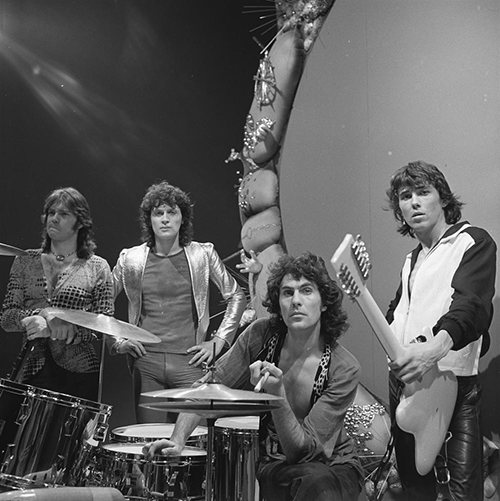
Golden Earring are a Dutch rock band, founded in 1961 in The Hague as the Tornados. They achieved worldwide fame with their international hit songs "Radar Love" in 1973, which went to number one on the Dutch chart, reached the top ten in the United Kingdom, and went to number thirteen on the United States chart,[3][4] "Twilight Zone" in 1982, and "When the Lady Smiles" in 1984.[3] During their career they had nearly 30 top-ten singles on the Dutch charts and released 25 studio albums.

Key Information

The band went through a number of early personnel changes until settling on a stable lineup in 1970, consisting of Rinus Gerritsen (bass and keyboards), George Kooymans (vocals and guitar), Barry Hay (vocals, guitar, flute and saxophone), and Cesar Zuiderwijk (drums and percussion), which remained unchanged until the band broke up in 2021 when Kooymans was diagnosed with ALS. A number of other musicians also appeared in short stints with the band over its history. As of Kooymans' death in 2025, Gerritsen is the only remaining original member left.

The band is scheduled to play a series of five farewell concerts at the Rotterdam Ahoy in 2026.

History

[edit]

Early years (1961–1969)

[edit]

What became Golden Earring was formed in 1961 in The Hague by 13-year-old George Kooymans and his 15-year-old neighbor, Rinus Gerritsen.[5] Originally called "the Tornados", the name was changed to the Golden Earrings[6] when they discovered that the name the Tornados was already in use by another group. The name "the Golden Earrings" was taken from an instrumental called "Golden Earrings" performed by the British group the Hunters, for whom they served as opening and closing act.[7] Initially a pop-rock band with Frans Krassenburg on lead vocals and Jaap Eggermont on drums, the Golden Earrings had a hit with their debut single "Please Go", recorded in 1965.[3][6] Dissatisfied with Dutch recording studios, the band's manager and co-discoverer Fred Haayen arranged for the next single to be recorded at the Pye Records studios in London. The record cut at Pye, "That Day", reached number two on the Dutch charts.[citation needed] The definite article was dropped from the name in 1967, and the plural "s" was dropped in 1969.[3]

In 1968, Barry Hay joined the band, replacing Krassenburg as frontman. Two years later, the band earned their first number one hit in the Netherlands with the song "Dong Dong Diki Digi Dong".[8] In the United States, ground work for entering the US market was being laid by East Coast FM radio disc jockey and music critic Neil Kempfer-Stocker, who is credited as the first radio DJ to play the band in the US. This single was followed by a successful psychedelic album Eight Miles High,[6] which featured a 19-minute version of the title track, a cover of the 1966 hit song by the Byrds. The song, played throughout their US tour, became the core performance of their live shows, and their experience in the US led them to make their studio albums resemble their live shows, rather than the other way around.[9] The band's American records during this period were issued by the Perception Records label in New York, and the band's Golden Earring LP, known as Wall of Dolls, and single "Back Home" performed poorly in the US but became a number 1 hit in the Netherlands.[10]

International fame (1970s and 1980s)

[edit]
Lead singer Barry Hay in 1974
Lead guitarist George Kooymans in 1974

In 1969, drummer Cesar Zuiderwijk joined the band,[6] completing what has become Golden Earring's classic line-up. The band enjoyed brief international fame in the 1970s when the single version of "Radar Love" (1973),[6] from the gold-certified album Moontan, became a hit in both Europe and the US.[3] Golden Earring embarked on their first major US tour in 1969–1970. Owing to American influences, their music evolved towards hard rock,[6] and they performed along with Jimi Hendrix, Led Zeppelin, Procol Harum, and Eric Clapton. Between 1969 and 1984, Golden Earring completed 13 US tours. During this period, they performed as the opening act for Santana, King Crimson, the Doobie Brothers, Rush and .38 Special. During 1973–74, when "Radar Love" was a hit, they had Kiss and Aerosmith as their opening acts.

Golden Earring released the Live album in 1977.[6] The album was recorded at London's Rainbow Theater.

Golden Earring enjoyed a brief period of US stardom, but were unable to secure further chart success until 1982's "Twilight Zone".[6] The music video of the song, directed by Dick Maas, was played on the recently launched MTV, and helped the song to become a US hit, spending 27 weeks on the Billboard chart.[11]

"When the Lady Smiles" became an international hit in 1984, reaching No. 3 in Canada and becoming the band's fifth number one hit in their native country, but was not successful in the United States, reaching no higher than No. 76 on the US Singles Chart. The video was banned from MTV because of its "unholy desires about a nun and a lobotomy";[12] this was Dick Maas's second video for the band, and helped launch his career as a film director.[11] While touring the US in 1984, the band played at the Great Arena Six Flags Great Adventure in New Jersey on May 11 and were in the midst of their performance when a fire broke out at the Haunted Castle on the opposite side of the theme park, killing eight teenagers. Following this tour, Golden Earring turned their focus toward Europe where they continued to attract standing-room-only crowds. The group paused briefly after the release of The Hole in 1986 to focus on other projects, with Hay and Kooymans both releasing solo albums (Victory of Bad Taste and Solo, respectively) the following year. The group then reconvened to record their final album of the 1980s, releasing Keeper of the Flame in 1989.[6]

Later years (1990s–2021)

[edit]

In 1991, Golden Earring had another hit in the Netherlands with "Going to the Run", a rock-ballad about a Hells Angels motorcycle gang member who was a friend of the band and died in a crash. The Russian rock band Aria made a successful cover of "Going to the Run" as "Беспечный ангел" ("Careless Angel"). Between 1992 and 2004, the band released three acoustic live unplugged albums, which became quick successes. The first, The Naked Truth, sold 450,000 copies within the first few years[13] and became the third-best selling album of 1993 in the Netherlands.[14]

Golden Earring celebrated their 50th anniversary in 2011, which the Dutch postal service honored with a stamp that contained a music link: when a smartphone with a special app is held up to the music stamp, Golden Earring's "Radar Love" plays.[15]

On 11 May 2012, the band released what was to prove to be their final studio album, Tits 'n Ass.[7]

On 5 February 2021, the band's manager announced to the Dutch press that the band's active career was over due to George Kooymans' serious ALS illness.[16][17]

Reunion and death of George Kooymans (2025–present)

[edit]

In January 2025, the band announced that they would play one final concert, titled "Golden Earring: One Last Night", at the Rotterdam Ahoy on 30 January 2026. Due to his ALS diagnosis, Kooymans was not scheduled to play, but several famous Dutch artists were to perform with the band, and five euros from each ticket sold went to ALS research.[18][19] Because of extra demand, four more shows from 26 to 29 January were added, which also all sold out immediately.[20]

Kooymans died on 22 July 2025 at the age of 77.[21]

Band members

[edit]

Current members

[edit]
  • Rinus Gerritsen – bass, keyboards, guitar, harmonica (1961–2021, 2025–present)
  • Barry Hay – vocals, guitar, flute, saxophone (1967–2021, 2025–present)
  • Cesar Zuiderwijk – drums, percussion (1970–2021, 2025–present)

Former members

[edit]
  • George Kooymans – guitar, vocals (1961–2021; died 2025)
  • Fred van der Hilst – drums, percussion (1962–1965)
  • Hans van Herwerden – guitar (1962–1963)
  • Peter de Ronde – guitar (1963–1966)
  • Frans Krassenburg – vocals (1964–1967)
  • Jaap Eggermont – drums, percussion (1965–1969)
  • Sieb Warner – drums, percussion (1969–1970)
  • Robert Jan Stips – keyboards, synthesizers (1974–1976; 1977–1978, 1980, 1982, 1986 as a session musician)
  • Eelco Gelling – guitar (1976–1978; 1973-1975 as a session musician)

Session musicians

[edit]
  • Bertus Borgers – saxophone (1973–1976)
  • John Lagrand – harmonica (1979)

Lineups

[edit]
1961–1962 1962–1963 1963–1964 1964–1965
  • Rinus Gerritsen – bass, keyboards, guitar, harmonica
  • George Kooymans – guitar, vocals
  • Hans van Herwerden – guitar
  • Fred van der Hilst – drums, percussion
  • Rinus Gerritsen – bass, keyboards, guitar, harmonica
  • George Kooymans – guitar, vocals
  • Fred van der Hilst – drums, percussion
  • Peter de Ronde – guitar
  • Rinus Gerritsen – bass, keyboards, guitar, harmonica
  • George Kooymans – guitar, vocals
  • Fred van der Hilst – drums, percussion
  • Peter de Ronde – guitar
  • Frans Krassenburg – vocals
1965–1966 1966–1967 1967–1969 1969–1970
  • Rinus Gerritsen – bass, keyboards, guitar, harmonica
  • George Kooymans – guitar, vocals
  • Peter de Ronde – guitar
  • Frans Krassenburg – vocals
  • Jaap Eggermont – drums, percussion
  • Rinus Gerritsen – bass, keyboards, guitar, harmonica
  • George Kooymans – guitar, vocals
  • Frans Krassenburg – vocals
  • Jaap Eggermont – drums, percussion
  • Rinus Gerritsen – bass, keyboards, guitar, harmonica
  • George Kooymans – guitar, vocals
  • Jaap Eggermont – drums, percussion
  • Barry Hay – vocals, guitar, flute, saxophone
  • Rinus Gerritsen – bass, keyboards, guitar, harmonica
  • George Kooymans – guitar, vocals
  • Barry Hay – vocals, guitar, flute, saxophone
  • Sieb Warner – drums, percussion
1970–1974 1974–1975 1975–1978 1978–2021
  • Rinus Gerritsen – bass, keyboards, guitar, harmonica
  • George Kooymans – guitar, vocals
  • Barry Hay – vocals, guitar, flute, saxophone
  • Cesar Zuiderwijk – drums, percussion
  • Rinus Gerritsen – bass, keyboards, guitar, harmonica
  • George Kooymans – guitar, vocals
  • Barry Hay – vocals, guitar, flute, saxophone
  • Cesar Zuiderwijk – drums, percussion
  • Robert Jan Stips – keyboards, synthesizers
  • Rinus Gerritsen – bass, keyboards, guitar, harmonica
  • George Kooymans – guitar, vocals
  • Barry Hay – vocals, guitar, flute, saxophone
  • Cesar Zuiderwijk – drums, percussion
  • Eelco Gelling – guitar
  • Rinus Gerritsen – bass, keyboards, guitar, harmonica
  • George Kooymans – guitar, vocals
  • Barry Hay – vocals, guitar, flute, saxophone
  • Cesar Zuiderwijk – drums, percussion

Timeline

[edit]

Discography

[edit]

References

[edit]

Sources

[edit]
  • Biography by Golden Earring founder and bass player Rinus Gerritsen published on the band's website.
  • Biographical books on the Golden Earring: Haagsche Bluf by Pieter Franssen, 1993, and Rock die niet roest by prof. Maarten Steenmeyer, 2005. Both titles are in Dutch.
  • The Story of Golden Earring by Karin and Mechteld Beks, Picture publishers, an authorized biography published on the occasion of the band's 45th anniversary. Text in Dutch. (2005)
  • Interviews with the band over the years, many of which can be traced back through the Golden Earring Museum website.
[edit]
Revisions and contributorsEdit on WikipediaRead on Wikipedia
from Grokipedia
Golden Earring was a Dutch rock band formed in 1961 in by teenagers (guitar and vocals) and (bass), initially under the name the Golden Earrings. The group evolved through the beat and rock scenes of the 1960s, achieving international fame with anthems like "" from their 1973 album and "Twilight Zone" from the 1982 album Cut, while releasing 25 studio albums over a six-decade career that established them as the longest-running rock band in the . The band retired from ongoing activities in February 2021 after Kooymans was diagnosed with (ALS), though the surviving members announced a final for January 2026 after his death, ending a tenure marked by nearly 30 top-ten singles on the Dutch charts. Kooymans, the band's primary songwriter, died on July 23, 2025, at age 77. In January 2025, the surviving members announced a one-off , "Golden Earring: One Last Night," scheduled for , 2026, at , featuring guest artists and with €5 per ticket donated to ALS research. The classic lineup solidified in the early 1970s with the addition of vocalist and guitarist Barry Hay in 1967 and drummer Cesar Zuiderwijk in 1970, alongside the enduring rhythm section of Kooymans and Gerritsen. Early success in the Netherlands came with pop-oriented hits like "Dong Dong Diki Diki Dong" (1968), but the band shifted toward heavier rock sounds, gaining global traction when "Radar Love"—a driving track about longing and connection—reached No. 13 on the US Billboard Hot 100, No. 7 on the UK Singles Chart, and topped the Dutch charts. Their 1982 single "Twilight Zone," inspired by the horror anthology series and featuring a distinctive guitar riff, became their biggest US hit at No. 10 on the Billboard Hot 100 and No. 1 on the Mainstream Rock chart, revitalizing their career during the MTV era. Golden Earring's enduring legacy lies in their blend of blues-rock, , and progressive elements, influencing generations while maintaining a strong presence in and through relentless touring and consistent output. Despite lineup changes in their formative years, quartet's chemistry produced timeless tracks that captured themes of isolation, , and intrigue, cementing the band's status as a cornerstone of Dutch .

History

Formation and early career (1961–1969)

Golden Earring was founded in 1961 in , , by teenagers on guitar and vocals and his neighbor on bass, who initially named the group The Tornadoes after the British instrumental band. The pair quickly recruited rhythm guitarist Hans van Herwerden and drummer Fred van der Hilst to complete the lineup, drawing inspiration from the burgeoning British beat scene and performing covers of songs by acts like and in local venues. In 1963, van Herwerden and van der Hilst departed the band, prompting the addition of guitarist Peter de Ronde and Jaap Eggermont, which solidified their formation. To avoid confusion with the existing The Tornadoes, the group changed their name to The Golden Earrings that same year, inspired by the instrumental track "Golden Earrings" by the Dutch-British group The Hunters, for whom they occasionally served as a backing band. Signed to , they released their debut single "Please Go" in 1965, which marked their entry into the Dutch charts and was followed by their first , Just , later that year, featuring a mix of original beat-pop tracks and covers that captured the era's youthful energy. The band's early momentum built through relentless local tours across the , including clubs and youth centers in and , where they honed their live sound and gained a dedicated following in the Dutch beat scene. Their first major television exposure came in on the popular Dutch program Muziek Expres, performing the single "That Day," which peaked at number 2 on the Dutch charts and boosted their profile. By 1967, follow-up singles like "Sound of a Screaming Day" achieved further chart success, reaching number 4, while their style began transitioning from straightforward to incorporating psychedelic elements, evident in experimental covers and songwriting that foreshadowed heavier rock explorations. This evolution culminated in their 1969 album , a sprawling cover of the Byrds' track that highlighted their growing affinity for .

Breakthrough and international success (1970–1984)

In the early 1970s, Golden Earring underwent key lineup changes that solidified its core configuration, with co-founders on guitar and vocals and on bass and keyboards remaining, alongside who joined as lead vocalist and guitarist in 1967, and drummer Cesar Zuiderwijk replacing Sieb Warner in 1970. This quartet would define the band's sound for decades, shifting toward while building on their beat roots. The band's international breakthrough arrived with the 1973 album , released on , which featured the driving single "." Written by Kooymans, the track's narrative of a long-distance driver yearning for his partner propelled it to No. 9 on the chart, No. 10 on Cash Box, and No. 13 on the in the , while also reaching the top 10 in the , , , and several European countries. itself achieved gold status in the and marked Golden Earring's first significant global exposure, blending progressive elements with accessible rock hooks. Building on this momentum, Golden Earring signed with MCA Records for US distribution in 1974, enabling wider international reach through Polydor's global network. The 1970 self-titled album Golden Earring (also known as Wall of Dolls) included the hit single "Back Home," which topped the Dutch charts for five weeks and signaled their evolving hard rock style. Later releases like the 1978 album Grab It for a Second on Polydor showcased tracks such as "Roxanne" and "Leather," maintaining their touring-oriented energy, while the non-album single "Weekend Love" in 1979 became another Dutch top-10 entry, emphasizing catchy, riff-driven rock. Extensive touring bolstered their rising profile, with 13 US tours between 1969 and 1984, including opening slots for Led Zeppelin in 1969, The Who, , and in the 1970s across Europe and . These performances honed their live reputation for high-energy sets, often exceeding two hours, and helped cultivate a dedicated international fanbase. A major milestone came in 1979 when Golden Earring received the Conamus Export Prize, recognizing them as the best-selling Dutch band abroad that year, an honor reflecting sales of over 250,000 units internationally from and subsequent efforts. The 1982 album Cut on 21 Records further cemented their US presence with "Twilight Zone," which topped the Billboard Mainstream Rock Tracks chart and reached No. 10 on the Hot 100, driven by its tense, atmospheric riff and music video exposure on . This era positioned Golden Earring as a enduring force in rock, bridging European origins with American commercial success.

Sustained activity and challenges (1985–2021)

Following the international breakthroughs of the and early , Golden Earring sustained a productive career through consistent album releases and touring, anchored by the stable lineup of , , , and Cesar Zuiderwijk that had been intact since 1970. The band navigated a period of stylistic evolution, incorporating harder rock edges alongside pop sensibilities in their compositions, which helped maintain relevance in despite challenges in recapturing U.S. chart momentum after the success of "Twilight Zone" in 1982. Their enduring appeal in the , where they remained one of the country's most beloved acts, was evident in frequent domestic performances and strong album sales. In 1990, Golden Earring released The Devil Made Me Do It, an album that blended their roots with contemporary production, highlighted by the single "Get Away," which received airplay in . The group continued this trajectory with Face It in 1999, featuring singles like "Going to the Run," which charted modestly but reinforced their presence on Dutch radio. Throughout the and , they undertook regular European tours, including stops in , , and the , often headlining festivals such as the in the , where their high-energy sets drew large crowds and solidified their status as national icons. By the 2000s and , the band focused primarily on continental dates, with over 100 concerts annually in the region, emphasizing their classic hits from the as a key draw for multigenerational fans. A significant milestone came in with celebrations marking the band's 50th anniversary, including the release of 50 Years Live, a capturing their extensive live history and underscoring their longevity. The group maintained this momentum with The Naked Truth in , a live recording that showcased acoustic renditions of their catalog, reflecting a reflective phase in their career. Internal stability persisted until the band's retirement in due to Kooymans' diagnosis, allowing the core members to maintain focus on European engagements without major disruptions in the preceding decades. Despite the shift away from U.S. prominence—where subsequent albums failed to replicate earlier peaks—Golden Earring's commitment to touring and recording ensured a dedicated following across .

Health issues, retirement, and aftermath (2022–present)

In the years following their 2021 retirement, Golden Earring remained inactive as co-founder ' health deteriorated due to (), a progressive he was diagnosed with in late 2020 and publicly announced in February 2021. The band's final live performance had occurred on November 16, 2019, at , with no further concerts or tours taking place amid the and Kooymans' condition, including the cancellation of a planned 50th anniversary tour. An audio recording of the 2019 show was later released as the live album You Know We Love You! – Live Ahoy 2019 in March 2022, serving as a posthumous capstone to their touring legacy. Kooymans' ALS progressed without further band activity, leading to his death on July 22, 2025, at the age of 77 from related complications, as confirmed by his family and surviving bandmates. The announcement, made public the following day, highlighted his enduring contributions to , including co-writing hits like "" and "Twilight Zone." In a joint statement, Kooymans' family and Golden Earring members , , and Cesar Zuiderwijk expressed profound loss, stating, "We say goodbye to a unique talent and a dear friend," while emphasizing the band's commitment to honoring his legacy without plans for a traditional reunion. Following Kooymans' passing, tributes poured in from the music community and fans worldwide, with extensive media coverage in outlets like Ultimate Classic Rock and Consequence recounting his six-decade career and influence on . Iron Maiden's Steve Harris, a longtime admirer, shared a personal noting Kooymans' impact on his playing style. Fan memorials emerged online and at concert venues, including a large-scale performance of "" by over 1,000 musicians at in September 2024, predating but amplified by his death. Potential archival releases, such as additional live recordings, have been discussed but not confirmed. As of late 2025, Golden Earring is considered disbanded since 2021, with no ongoing group projects beyond a one-off farewell event scheduled for January 26–30, 2026, at . Titled Golden Earring: One Last Night, the shows will feature Hay, Gerritsen, and Zuiderwijk alongside guest artists like and , explicitly as a to Kooymans rather than a band revival. The surviving members have pursued individual endeavors, including Hay's solo performances and Zuiderwijk's drumming clinics, while maintaining the band's official website to preserve its history.

Musical style and influences

Evolution of sound

Golden Earring's musical journey began in the early 1960s amid the rise of , a Dutch variant of the wave influenced by the . Formed as The Golden Earrings in , the band initially focused on covers of songs by acts like and , capturing the energetic, rhythm-driven sound of the era with simple guitar riffs and harmonious vocals. By the late 1960s, the group transitioned into , embracing extended improvisational jams and experimental textures that reflected the era's countercultural shifts. Their 1969 album exemplified this evolution, featuring heavy psychedelic production with swirling guitars and atmospheric soundscapes that extended beyond conventional song structures. Entering the 1970s, Golden Earring solidified a foundation infused with progressive elements, characterized by powerful, riff-driven compositions that merged bluesy undertones with accessible pop hooks. Tracks like "" from the 1973 album highlighted this blend, with its driving rhythm and narrative lyrics propelling the band to international prominence. In the and , the band's sound incorporated synthesizers and leaned into aesthetics, favoring concise verse-chorus formats and punchy production over the jam-oriented prog of the prior decade. The 1982 single "Twilight Zone," from the album Cut, showcased this refined approach, with its hypnotic synth layers and anthemic energy aiding a resurgence in chart success. Throughout their later career, Golden Earring maintained a commitment to raw, guitar-centric rock in live settings, resisting mainstream trends and emphasizing their foundational roots in performances that prioritized instrumental intensity.

Key influences and innovations

Golden Earring's early musical style drew significant inspiration from the , particularly and , which shaped their initial pop-rock sound rooted in melodic harmonies and beat-driven rhythms. Exposure to international acts during their 1969–1970 U.S. tour, including shared bills with , profoundly impacted guitarist ' techniques, introducing bolder, more improvisational guitar work influenced by Hendrix's innovative phrasing and effects. The band's shift toward in the early 1970s reflected the heaviness of contemporaries like , emphasizing powerful riffs and dynamic intensity without adopting full progressive complexity. Within the Dutch rock scene, Golden Earring forged connections with fellow acts like Focus, both contributing to the vibrant 1970s Nederrock landscape through shared influences from global and progressive elements. Their riff-heavy style also paralleled ZZ Top's boogie-infused approach, creating driving, blues-tinged grooves that prioritized rhythmic propulsion. A key innovation in "Radar Love" was the use of fluid slide guitar techniques by Eelco Gelling in the chorus, lending the song a seamless, emotive glide that enhanced its hypnotic drive. Lyrically, Golden Earring excelled in thematic , often exploring travel and as metaphors for and urgency, as seen in "," where a nocturnal journey symbolizes desperate reconnection. The band innovated through genre blending, merging R&B foundations from their beat-group origins, psychedelic experimentation in the late , and hard rock's edge—approaching heavy metal's aggression but retaining pop accessibility. Golden Earring's international breakthroughs elevated Nederrock's global profile, inspiring subsequent Dutch bands with their enduring success and commitment to a protracted career spanning over six decades.

Band members

Final lineup

The final lineup of Golden Earring, which remained stable from 1970 until the band's retirement in 2021, consisted of four core members who defined the group's sound during its most successful decades. served as the band's founder, lead guitarist, and co-lead vocalist from its inception in 1961 until 2021, when health issues prompted his retirement; he passed away on July 23, 2025, at age 77 due to complications from . contributed as lead vocalist, guitarist, and flautist from 1968 to 2021, renowned for his charismatic stage presence that energized live performances and captivated audiences worldwide. , a co-founder, handled bass and keyboards from 1961 to 2021, providing the rhythmic foundation and serving as a key songwriter who co-authored many of the band's early hits alongside Kooymans. Cesar Zuiderwijk played drums from 1970 to 2021, delivering the powerful propulsion that anchored the band's style through their retirement. The surviving members announced a reunion for a final concert, titled "One Last Night," scheduled for January 26, 2026, in Rotterdam. This enduring configuration evolved from earlier iterations with various members, solidifying Golden Earring's identity as a tight-knit unit.

Former members

Golden Earring's early years featured several transient members who shaped the band's initial sound before the lineup stabilized in 1970. Co-founder Hans van Herwerden served as rhythm guitarist from 1961 to 1963, contributing to the group's formation as the Tornados and its transition to the Golden Earrings name in 1963. Fred van der Hilst played drums from 1962 to 1965, as part of the original in the band's formative years. Peter de Ronde served as from 1963 to 1966, appearing on early albums like (1965). Jaap Eggermont joined as in 1964, playing until 1969 and providing the rhythmic foundation for the band's beat-era , including (1965) and Winter-Harvest (1966); he left to pursue a career as a , later achieving success with projects like Stars on 45. Frans Krassenburg acted as lead vocalist and frontman from 1964 to 1967, delivering the vocals on early hits such as "Please Go" and "That Day," which helped establish the band's presence in the Dutch pop scene. Sieb Warner served as from 1969 to 1970, appearing on the album (1969). Robert Jan Stips joined as keyboardist from 1974 to 1976, contributing to albums Switch (1975) and To the Hilt (1976). Eelco Gelling, a renowned Dutch guitarist known for his work with , joined Golden Earring from 1976 to 1978, adding and contributing to albums such as (1976) and (1978), which showcased the band's evolving style before he departed for solo pursuits.

Timeline of changes

Golden Earring's lineup evolved significantly during its early years before achieving stability with its classic quartet from 1970 onward. The band formed in , , initially as The Tornadoes, and underwent several personnel shifts as it transitioned from a local group to an international act. 1961–1963: Formation and Tornadoes era
The band was founded in 1961 by on guitar and on bass, joined by Hans van Herwerden on guitar and Fred van der Hilst on drums, under the name The Tornadoes. In 1963, the group renamed itself The Golden Earrings after discovering another band used the original name.
1964: Eggermont joins on drums
By the end of 1964, Jaap Eggermont replaced Fred van der Hilst on , solidifying the rhythm section alongside the addition of Peter de Ronde on guitar replacing van Herwerden; Frans Krassenburg also joined as lead vocalist around this period.
1967–1968: Vocalist swaps
In 1967, lead singer Frans Krassenburg departed, and joined as the new frontman in 1968, marking a shift toward a more international sound that influenced albums like .
1970: Zuiderwijk replaces Eggermont
Jaap Eggermont left in 1969 and was briefly succeeded by Sieb Warner, but Cesar Zuiderwijk joined on drums in 1970, completing the enduring core lineup of Kooymans, Gerritsen, Hay, and Zuiderwijk.
1976–1979: Gelling's temporary addition
During a period of experimentation, Eelco Gelling joined as a second in 1976 following a brief stint by keyboardist Robert Jan Stips (1974–1976), contributing to albums like Face It before departing in 1978 (with Stips having left in 1976).
1980s–2021: Core four stable
The classic quartet of , , , and Cesar Zuiderwijk remained intact from 1970 through the and beyond, supporting hits like "" and "Twilight Zone," until the band's retirement in 2021 due to concerns.

Discography

Studio albums

Golden Earring released 25 studio albums between 1965 and 2012, primarily through in their native , with international distribution via MCA and other labels. Their studio output began with beat and R&B-influenced records in the , evolved into psychedelic and in the early 1970s, and later incorporated and pop elements, achieving consistent success on the Dutch charts and occasional breakthroughs abroad. Key releases like (1973) and Cut (1982) drove international recognition, with the former certified gold in the by the RIAA for 500,000 units sold. The band's debut, (1965, Polydor), was a beat-focused effort reflecting the British Invasion's impact, featuring covers and original tracks that helped establish their early popularity in the . By Winter-Harvest (1967, Polydor), the sound began incorporating more original material and psychedelic touches, though commercial success remained modest outside the . The late 1960s albums (1968, Polydor) and On the Double (1969, Polydor, peaking at #2 on the Dutch charts) marked a shift toward longer compositions and experimental elements, with the latter earning critical praise for its ambitious arrangements. (1969, Polydor, #5 Dutch charts) further explored , covering ' hit and adding original psych-pop tracks. The 1970 self-titled Golden Earring (Polydor, #12 Dutch charts), also known as Wall of Dolls, represented a mature progressive phase with complex instrumentation. Seven Tears (1971, Polydor, #7 Dutch charts) and Together (1972, Polydor, #13 Dutch charts) built on this momentum, blending hard rock with melodic hooks and yielding hits like "She Flies on Strange Wings." The breakthrough Moontan (1973, Polydor/Track/MCA, #1 Dutch charts, #12 US Billboard 200) featured the iconic single "Radar Love," which sold over 1 million copies worldwide and propelled the album to gold status in the US. Subsequent 1970s releases included Switch (1975, Polydor/MCA, #1 Dutch charts, #108 US Billboard 200), known for its raw energy and tracks like "Kill Me (Ce Soir)"; To the Hilt (1976, Polydor, #4 Dutch charts) and Contraband (1976, Polydor, #3 Dutch charts), emphasizing guitar-driven rock; and Grab It for a Second (1978, Polydor, #15 Dutch charts, #178 US Billboard 200), which experimented with reggae influences. No Promises... No Debts (1979, Polydor, #2 Dutch charts) and Prisoner of the Night (1980, Polydor, #19 Dutch charts) maintained their hard rock core amid shifting musical trends. In the 1980s, Cut (1982, Polydor, #1 Dutch charts, #24 US Billboard 200) stood out with the MTV-fueled hit "Twilight Zone," boosting their visibility. N.E.W.S. (1984, Polydor, #24 Dutch charts) and The Hole (1986, Polydor, #29 Dutch charts) leaned into pop-metal sounds, while Keeper of the Flame (1989, Polydor, #28 Dutch charts) delivered punchy anthems with bluesy undertones. In the 1990s, Bloody Buccaneers (1991, Polydor, #57 Dutch charts) closed the decade with hard rock edge, followed by Face It (1994, Polydor, #73 Dutch charts) and Love Sweat (1995, Polydor, #85 Dutch charts), blending classic riffs with modern production. The 2000s saw Paradise in Distress (1999, Polydor, #71 Dutch charts) and Millbrook U.S.A. (2003, Universal, #72 Dutch charts), maintaining their sound amid reduced activity. The band's final studio effort, Tits 'n Ass (2012, Eight Miles High Records), revisited their hard rock roots.
AlbumYearLabel(s)Chart Performance
1965Polydor-
Winter-Harvest1967Polydor-
1968Polydor-
On the Double1969Polydor#2 NL
1969Polydor#5 NL
Golden Earring1970Polydor#12 NL
1971Polydor#7 NL
Together1972Polydor#13 NL
1973Polydor/Track/MCA#1 NL, #12 US
Switch1975Polydor/MCA#1 NL, #108 US
To the Hilt1976Polydor#4 NL
Contraband1976Polydor#3 NL
1978Polydor#15 NL, #178 US
No Promises... No Debts1979Polydor#2 NL
Prisoner of the Night1980Polydor#19 NL
Cut1982Polydor#1 NL, #24 US
N.E.W.S.1984Polydor#24 NL
The Hole1986Polydor#29 NL
Keeper of the Flame1989Polydor#28 NL
Bloody Buccaneers1991Polydor#57 NL
Face It1994Polydor#73 NL
Love Sweat1995Polydor#85 NL
Paradise in Distress1999Polydor#71 NL
Millbrook U.S.A.2003Universal#72 NL
2012Eight Miles High-
(Note: Chart positions sourced from Dutch national charts (Album Top 100); US positions from Billboard 200 where applicable. Not all albums charted internationally.)

Live albums and compilations

Golden Earring's live albums and compilations reflect their enduring touring legacy, capturing the raw energy of their performances across decades of international shows and serving as accessible entry points to their catalog for fans. The band, one of the longest-running rock acts from the , frequently documented their stage shows to complement their studio output, with live releases emphasizing extended jams and crowd interaction that defined their sound. Compilations, meanwhile, often topped the Dutch album charts, underscoring their domestic popularity and providing curated selections of hits like "" and "Twilight Zone." The band's inaugural live recording, Live, arrived in 1977 via Polydor as a drawn from their European tour. Captured at London's on March 25, 1977, it features ten tracks with elongated renditions of staples such as "" (clocking in at over 11 minutes) and "Candy's ," drawn primarily from (1973) and other early 1970s material, showcasing the group's tight musicianship and improvisational flair during a peak period of international exposure. In 1978, the compilation Golden Earrings' Greatest Hits was issued, compiling early singles and tracks from their beat and pop eras, including "That Day" and "Daddy Buy Me a ," to highlight their evolution from roots. This release, part of Polydor's efforts to repackage their catalog, reached the , reinforcing their foundational success at home. The 1985 compilation The Collection gathered key tracks across their career up to that point, with Polydor packaging it as a double set in later editions, though the initial vinyl version focused on hits from onward; it served as a amid their resurgence. By 1996, Radar Love: The Very Best of Golden Earring emerged as a definitive hits package, leading with the band's signature 1973 track and including "Twilight Zone" and "," achieving strong sales in Europe and peaking at number 1 on the Dutch compilation charts. Marking their half-century milestone, 50 Years Live was released in 2011 as part of the anniversary celebrations, a multi-disc set blending live performances from various eras with archival material to chronicle their longevity; it included recordings from tours spanning 1961 to 2011 and was honored with a special featuring an audio link to their music. A notable later live effort, The Naked Truth, originally from 1992 but reissued and expanded in subsequent years including digital updates around 2017, presented an acoustic rendition of their repertoire recorded in an intimate theater setting. This unplugged approach stripped back their edge for a raw, folk-infused delivery of classics like "Another 45 Miles" and "Going to the Run," earning praise for revealing the band's versatility and topping the Dutch album charts upon re-release.

References

Add your contribution
Related Hubs
User Avatar
No comments yet.