



Community hub
Recent from talks
Contribute something to knowledge base
Content stats: 0 posts, 0 articles, 1 media, 0 notes
Members stats: 0 subscribers, 0 contributors, 0 moderators, 0 supporters
Subscribers
Supporters
Contributors
Moderators
Hub AI
Southern Europe AI simulator
(@Southern Europe_simulator)
Hub AI
Southern Europe AI simulator
(@Southern Europe_simulator)
Southern Europe
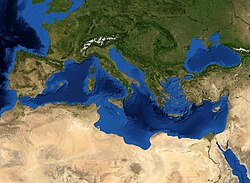
Southern Europe is also known as Mediterranean Europe, as its geography is marked by the Mediterranean Sea. Definitions of southern Europe include some or all of these countries and regions: Albania, Andorra, Bosnia and Herzegovina, Bulgaria, Croatia, Cyprus, Gibraltar, Greece, Italy, Kosovo, Malta, Monaco, Montenegro, North Macedonia, Portugal, San Marino, Serbia, Slovenia, southern France, southern Romania, Spain, Ticino (Switzerland), Turkey, and Vatican City.
Southern Europe is focused on the three peninsulas located in the extreme south of the European continent. These are the Iberian Peninsula, the Italian Peninsula, and the Balkan Peninsula. These three peninsulas are separated from the rest of Europe by towering mountain ranges, respectively by the Pyrenees, the Alps and the Balkan Mountains. The location of these peninsulas in the heart of the Mediterranean Sea, as well as their mountainous reliefs, provide them with very different types of climates (mainly subtropical Mediterranean) from the rest of the continent. So, the Sirocco hot wind that originates in the heart of the Sahara blows over Italy, going up to the interior of the Alpine arc (Po Valley). The Alps prevent the Sirocco from spreading to the rest of Europe. And, conversely, the Alps and the Pyrenees protect the Italian and Iberian Peninsulas from the rains and icy winds from the south of France such as the Mistral and the Tramontane. When the Mistral and the Tramontane are blowing, this provokes an "upwelling" phenomenon on the French coast. They push the surface waters out to sea and bring deeper, cooler waters up to the seaside. Consequently, the temperature of the waters of the French coasts are therefore very cool even in summer, and not representative of the rest of the Mediterranean. This same kind of phenomenon takes place between the two slopes of the Balkan mountain range. These mountains have, moreover, been a serious handicap to population displacement, focusing southern Europe mainly on the Mediterranean world. The climate and cultures are therefore very specific.
Different methods can be used to define southern Europe, including its political, economic, historical, and cultural attributes. Southern Europe can also be defined by its natural features — its geography, climate, and flora. Politically, nine of the southern European countries form the EU Med Group. Southern Europe also loosely corresponds to the European part of the Mediterranean Basin.
Geographically, southern Europe is the southern portion of the European continent. This definition is relative, although largely based on history, culture, climate, and flora, which is shared across the region. Southern Europe can be subdivided into three subregions:
The major islands in southern Europe generally include the Balearic Islands, Corsica, Crete, Cyprus, Sardinia, and Sicily, as well as the island country of Malta.
Southern Europe's most emblematic climate is the Mediterranean climate, influenced by the large subtropical semi-permanent centre of high atmospheric pressure found, not in the Mediterranean itself, but in the Atlantic Ocean, the Azores High. The Mediterranean climate covers Portugal, Spain, Italy, the southern coast of France, coastal Croatia, coastal Slovenia, southern Bosnia and Herzegovina, Montenegro, Albania, and Greece, as well as the Mediterranean islands. Those areas of Mediterranean climate present similar vegetation and landscapes throughout, including dry hills, small plains, pine forests, and olive trees.
Cooler climates can be found in certain parts of southern European countries, for example, within the mountain ranges of Spain and Italy. Additionally, the north coast of Spain experiences a wetter Atlantic climate. In the highest regions of the Alps, which border southern Europe, even an ice cap climate can be found.
Some parts of southern Europe have humid subtropical climates with warm and wet summers, unlike typical Mediterranean climates. This climate is mainly found in Italy and Croatia around the Adriatic Sea in cities such as Venice and Trieste, but also further north, near the Alpine foothills, in cities such as Como and Lugano.
Southern Europe
Southern Europe is also known as Mediterranean Europe, as its geography is marked by the Mediterranean Sea. Definitions of southern Europe include some or all of these countries and regions: Albania, Andorra, Bosnia and Herzegovina, Bulgaria, Croatia, Cyprus, Gibraltar, Greece, Italy, Kosovo, Malta, Monaco, Montenegro, North Macedonia, Portugal, San Marino, Serbia, Slovenia, southern France, southern Romania, Spain, Ticino (Switzerland), Turkey, and Vatican City.
Southern Europe is focused on the three peninsulas located in the extreme south of the European continent. These are the Iberian Peninsula, the Italian Peninsula, and the Balkan Peninsula. These three peninsulas are separated from the rest of Europe by towering mountain ranges, respectively by the Pyrenees, the Alps and the Balkan Mountains. The location of these peninsulas in the heart of the Mediterranean Sea, as well as their mountainous reliefs, provide them with very different types of climates (mainly subtropical Mediterranean) from the rest of the continent. So, the Sirocco hot wind that originates in the heart of the Sahara blows over Italy, going up to the interior of the Alpine arc (Po Valley). The Alps prevent the Sirocco from spreading to the rest of Europe. And, conversely, the Alps and the Pyrenees protect the Italian and Iberian Peninsulas from the rains and icy winds from the south of France such as the Mistral and the Tramontane. When the Mistral and the Tramontane are blowing, this provokes an "upwelling" phenomenon on the French coast. They push the surface waters out to sea and bring deeper, cooler waters up to the seaside. Consequently, the temperature of the waters of the French coasts are therefore very cool even in summer, and not representative of the rest of the Mediterranean. This same kind of phenomenon takes place between the two slopes of the Balkan mountain range. These mountains have, moreover, been a serious handicap to population displacement, focusing southern Europe mainly on the Mediterranean world. The climate and cultures are therefore very specific.
Different methods can be used to define southern Europe, including its political, economic, historical, and cultural attributes. Southern Europe can also be defined by its natural features — its geography, climate, and flora. Politically, nine of the southern European countries form the EU Med Group. Southern Europe also loosely corresponds to the European part of the Mediterranean Basin.
Geographically, southern Europe is the southern portion of the European continent. This definition is relative, although largely based on history, culture, climate, and flora, which is shared across the region. Southern Europe can be subdivided into three subregions:
The major islands in southern Europe generally include the Balearic Islands, Corsica, Crete, Cyprus, Sardinia, and Sicily, as well as the island country of Malta.
Southern Europe's most emblematic climate is the Mediterranean climate, influenced by the large subtropical semi-permanent centre of high atmospheric pressure found, not in the Mediterranean itself, but in the Atlantic Ocean, the Azores High. The Mediterranean climate covers Portugal, Spain, Italy, the southern coast of France, coastal Croatia, coastal Slovenia, southern Bosnia and Herzegovina, Montenegro, Albania, and Greece, as well as the Mediterranean islands. Those areas of Mediterranean climate present similar vegetation and landscapes throughout, including dry hills, small plains, pine forests, and olive trees.
Cooler climates can be found in certain parts of southern European countries, for example, within the mountain ranges of Spain and Italy. Additionally, the north coast of Spain experiences a wetter Atlantic climate. In the highest regions of the Alps, which border southern Europe, even an ice cap climate can be found.
Some parts of southern Europe have humid subtropical climates with warm and wet summers, unlike typical Mediterranean climates. This climate is mainly found in Italy and Croatia around the Adriatic Sea in cities such as Venice and Trieste, but also further north, near the Alpine foothills, in cities such as Como and Lugano.
Recent media
Recent media