


Community hub
Recent from talks
Contribute something
Nothing was collected or created yet.
Graham Roberts
View on Wikipedia
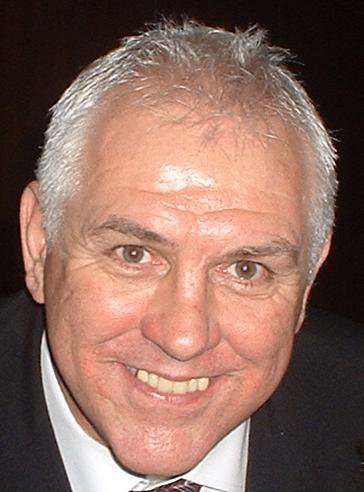
Graham Paul Roberts (born 3 July 1959) is an English retired footballer and manager who played as a defender for numerous clubs including Tottenham Hotspur (where he won the FA Cup and the UEFA Cup), Rangers (where he won the Scottish League and Scottish League Cup), Chelsea (where he won the Second Division) and West Bromwich Albion. He was also capped six times by England. He subsequently served as the head coach of the Pakistan national team and Nepal national team.
Key Information


Playing career
[edit].jpg)
Early career
[edit]Roberts was born in Southampton, and joined his local club, Southampton F.C, as an associate schoolboy in October 1973, but failed to make the grade and was released, joining Portsmouth in March 1977.[2] He was sold to Dorchester Town where he impressed before joining local rivals Weymouth. From there he was sold to Tottenham Hotspur in May 1980 for £35,000.
Tottenham Hotspur
[edit]Roberts was a member of the successful Tottenham Hotspur side of the early 1980s, winning the FA Cup in 1981 and 1982. With Steve Perryman suspended, Roberts captained the side as Tottenham won the 1984 UEFA Cup, scoring in the second leg of the final against Anderlecht.
Rangers
[edit]He moved to Rangers in 1986 for £450,000 and won the Scottish Premier Division in his first season and the Scottish League Cup a year later. Whilst at Rangers he was involved in a controversial Old Firm derby at Ibrox Park on 17 October 1987. During a very bad-tempered match three players were sent off and in the aftermath Roberts, his team-mates Terry Butcher and Chris Woods and Celtic player Frank McAvennie were all charged with conduct likely to provoke a breach of the peace. McAvennie was found not guilty, while Roberts was found not proven, although Butcher and Woods were both convicted and fined.[3] During the match Roberts, who had taken over as goalkeeper after Woods was sent off, was involved in a second controversy when he "conducted" Rangers supporters in a rendition of "The Sash", although Roberts would subsequently claim that he did not realise they were singing that song, a traditional Ulster loyalist anthem, when he made the gesture.[4]
Chelsea
[edit]He joined Chelsea in August 1988 for £475,000 and helped the side emphatically win the Second Division championship in 1988–89.
West Bromwich Albion
[edit]He later moved to West Bromwich Albion, where he played out the remainder of his professional career.
International career
[edit]Coaching career
[edit]Roberts was manager of Enfield from 1992 until 1994, and went on to manage Yeovil Town between 1995 and 1998. He was later manager of Chesham United during the 1998–99 season.[6] He was appointed manager to Hertford Town in 2000, but left in February 2001 when he became manager of Isthmian League club Boreham Wood.[7] Despite leading the club to Division One title, he resigned from the post in July.[8] He was then appointed manager of Carshalton Athletic, who he guided to the Isthmian League Division One South title in 2002–03 before leaving the club.[9] Roberts briefly managed Braintree Town at the end of the 2003–04 season.[10]
In June 2005, Roberts was appointed manager of Clyde. He only had three players under contract, and held open trials in an attempt to get new players. Roberts gave the supporters their greatest day in years, when his Clyde side defeated Celtic in the Scottish Cup in January 2006.[11] Earlier in the season, Clyde took Rangers to extra time at Ibrox Stadium in the Scottish League Cup. Roberts was sacked by Clyde in August 2006 after allegations he made racist remarks.[11] An employment tribunal found that the allegations were "either highly exaggerated or possibly not true" and awarded Roberts £32,000 compensation for unfair dismissal.[11]
In September 2010, he was hired as a consultant to the Pakistan national football team to assist the coaching staff for the 2010 Asian Games. Roberts was appointed as a coaching consultant under head coach Akhtar Mohiuddin. Eventually Roberts parted ways and Akhtar was fired by the Pakistan Football Federation.[12]
He then joined the Nepal national football team in January 2011. In March 2012, he stepped down as coach after a 3–0 defeat to Turkmenistan in the 2012 AFC Challenge Cup.[13]
Honours
[edit]References
[edit]- ^ Dunk, Peter, ed. (1987). Rothmans Football Yearbook 1987–88. London: Queen Anne Press. p. 368. ISBN 978-0-356-14354-5.
- ^ Holley, Duncan; Chalk, Gary (2003). In That Number – A post-war chronicle of Southampton FC. Hagiology Publishing. p. 614. ISBN 0-9534474-3-X.
- ^ "From the archive: the Old Firm shame game of 1987 (From Herald Scotland)". Heraldscotland.com. 17 October 1987. Retrieved 28 December 2015.
- ^ "When Saturday Comes - Hard As Nails". Wsc.co.uk. 9 July 2012. Retrieved 28 December 2015.
- ^ "Graham Roberts". Englandstats.com. Retrieved 26 August 2010.
- ^ Chesham United Archived 8 January 2018 at the Wayback Machine Non-League Club Directory
- ^ Hard man Robbos the spur for Wood Watford Observer, 7 February 2001
- ^ Borehamwood Boss In Quit Shock Archived 12 December 2017 at the Wayback Machine Tewkesbury Admag, 26 July 2001
- ^ History[permanent dead link] Carshalton Athletic
- ^ Manager search is not untried territory for Braintree Town's Board Braintree and Witham Times, 16 May 2016
- ^ a b c "Ex-Clyde boss wins dismissal case". BBC News. 29 June 2007. Retrieved 8 October 2010.
- ^ Ahsan, Ali (5 January 2018). "The decade-long decline of Pakistani football after a rare high". These Football Times. Retrieved 13 August 2024.
- ^ "Roberts steps down as Nepal coach". Archived from the original on 4 February 2013. Retrieved 12 March 2012.
- ^ "1981/82 Charity Shield". footballsite.co.uk. Retrieved 4 November 2019.
- ^ Lynch. The Official P.F.A. Footballers Heroes. p. 147.

| International | |
|---|---|
| National | |
Graham Roberts
View on GrokipediaEarly life
Childhood and introduction to football
Graham Paul Roberts was born on 3 July 1959 in Graham Road, Southampton, England.[8] Growing up in the city's working-class districts during the 1960s and 1970s, he was immersed in a regional football culture dominated by Southampton FC and local non-league teams, where physicality and direct play were hallmarks of the era's grassroots game.[2] Roberts' introduction to organized football came through schoolboy trials, leading to a brief stint as an associate schoolboy with his hometown club, Southampton FC, beginning in October 1973.[9] Despite showing early promise in local youth setups, he was released after failing to secure a professional pathway, prompting a shift to non-league football with sides like Dorchester Town and later Weymouth.[2] His development reflected the toughness required in southern England's amateur scene, where matches emphasized resilience amid limited resources and high competition from port-city rivals.[6]Club career
Early professional beginnings
Roberts began his senior playing career in non-league football after being released from the youth setups of Southampton, where he trained from 1973 to 1977, and Portsmouth from 1977 to 1978.[10][6] He signed with Dorchester Town in the Southern League for the 1978-79 season, securing his first senior appearances in a competitive environment that demanded physical robustness and tactical adaptability.[11][12] Transferring to nearby Weymouth FC in 1979, Roberts featured more extensively in the same Southern League division during the 1979-80 campaign, recording 29 league appearances and 6 goals as a defender.[13][14] His consistent performances over a six-month stint highlighted his tenacity and reliability, prompting praise from Weymouth coach Stuart Morgan, who noted Roberts' potential for top-level play.[15] These non-league experiences, involving twice-weekly training and high-contact fixtures, sharpened Roberts' no-nonsense defending style and leadership qualities amid limited resources.[15] Scouts from Football League clubs, including Tottenham Hotspur, observed his progress, culminating in his transfer to Tottenham in May 1980 for £35,000 after impressing in trial-like settings.[2][15]Tottenham Hotspur
Graham Roberts joined Tottenham Hotspur from non-league Weymouth in May 1980 for a transfer fee of £35,000, marking a record sum for a player from that level at the time.[2][16] He rapidly progressed from squad player to regular starter, featuring in over 270 matches across all competitions during his tenure and scoring 34 goals, often deployed as a tough-tackling central defender or midfielder.[17] Under manager Keith Burkinshaw, Roberts contributed to a revival period for the club, providing physicality and leadership in a squad blending tenacity with technical skill from teammates like Steve Perryman and Glenn Hoddle.[18] Roberts played a pivotal role in Tottenham's consecutive FA Cup triumphs in 1981 and 1982, appearing in all nine cup ties during the 1980-81 campaign, including the replayed final against Manchester City on May 9, 1981, where Spurs secured a 3-2 victory after extra time.[2] His aggressive marking and set-piece defending helped maintain defensive resilience, with Tottenham conceding just 11 goals across those FA Cup runs combined, underscoring the team's organized backline rather than reliance on individual feats.[19] In the 1984 UEFA Cup campaign, Roberts captained the side in the second leg of the final against Anderlecht on May 23, 1984, at White Hart Lane—standing in for the suspended Perryman—and scored to force penalties, which Tottenham won 4-3 to claim the trophy after a 2-2 aggregate draw.[20][21] Roberts' hard-edged style, characterized by robust challenges suited to the era's physical demands, drew occasional scrutiny for its intensity but proved effective in bolstering Tottenham's competitive edge without derailing team cohesion.[2] These successes stemmed from collective synergy under Burkinshaw, who guided Spurs from mid-table struggles to silverware through balanced recruitment and tactical discipline, with Roberts' contributions enhancing rather than dominating the group's dynamics.[18][22]Rangers
Roberts joined Rangers on 22 December 1986, transferring from Tottenham Hotspur for a fee of £450,000 amid Graeme Souness's efforts to rebuild the squad with English talent.[23] His combative defending and leadership proved well-suited to the physical intensity of Scottish football and the fervent Ibrox crowd, helping Rangers end Celtic's nine-year hold on the Scottish Premier Division by clinching the 1986–87 title after Roberts's mid-season arrival strengthened the backline.[24][25] In the 1987–88 season, Roberts contributed to Rangers winning the Scottish League Cup, though the club finished third in the league.[3] Over his stint until July 1988, he made 55 appearances and scored three goals, often anchoring a defense that emphasized solidity during Souness's overhaul.[26] A notable moment came in the 17 October 1987 Old Firm derby at Ibrox, which Rangers drew 2–2 despite playing with nine men after red cards to goalkeeper Chris Woods and Celtic's Frank McAvennie for an early altercation; Roberts, intervening in the ensuing melee, was cautioned for grabbing McAvennie by the throat, an incident emblematic of the fixture's unyielding physical confrontations rather than personal indiscipline.[27] With Woods dismissed, Roberts briefly assumed goalkeeping duties, underscoring his versatility in high-stakes rivalry matches.[28]Chelsea
Roberts transferred to Chelsea from Rangers on 12 August 1988 for a fee of £475,000, becoming the club's captain upon arrival.[29][30] In his debut season, he anchored the defense while contributing offensively, scoring 15 goals—12 from penalties—in 46 appearances across all competitions, aiding Chelsea's emphatic Second Division title win with a record 99 points and promotion to the First Division.[14][31] His tenure highlighted the physical demands of his combative style, with consistent high-tackle involvement reflecting an unyielding but increasingly raw approach as he entered his early 30s.[29][32] In the 1989–90 First Division, pace limitations exposed defensive frailties, notably during a December run where Chelsea conceded 14 goals in three matches, though Roberts still offered experienced leadership in roughly 20 additional appearances amid a mid-table finish.[30] No major trophies followed promotion, underscoring a transitional phase marked by his grit rather than peak athleticism.[33]West Bromwich Albion
Roberts transferred to West Bromwich Albion from Chelsea in November 1990 for a fee of £200,000.[30] At age 31, he joined a Second Division side struggling with consistency, bringing defensive experience from top-flight and European competitions earlier in his career.[10] Over two seasons from 1990 to 1992, Roberts made 39 league appearances for West Brom, scoring 6 goals, primarily from set pieces or penalties reflective of his combative central defender role.[13] His contributions were curtailed by the cumulative physical demands of a decade-plus in high-contact professional football, where recovery relied on basic methods absent advanced sports medicine prevalent today; data from prior clubs show recurrent knocks leading to missed matches, though specific West Brom injury records indicate no prolonged absences beyond typical wear.[2] As a seasoned player in a mid-table lower-tier squad, Roberts served in a stabilizing veteran capacity, mentoring younger defenders amid West Brom's push for promotion contention that ultimately yielded no major honours. His departure in June 1992 signalled the close of his Football League tenure, with limited starts underscoring the era's toll on players without modern protective protocols or regenerative therapies.[10]International career
England national team
Graham Roberts won six caps for England between May 1983 and June 1984, all as a starting central defender under manager Bobby Robson, with no goals scored.[8] His selections followed strong club form at Tottenham Hotspur, where his combative defending and leadership in major domestic and European successes highlighted his value in filling robust defensive roles amid England's need for tenacity in midfield and backline transitions.[34] The appearances consisted of British Home Championship matches and friendlies, contributing to England's 1982–83 Home Championship victory but yielding mixed results overall, including draws and losses against stronger opponents.[8] Roberts featured in both legs of the 1983 Home Championship (a 0–0 draw at Northern Ireland on 28 May and a 2–0 win over Scotland on 1 June at Wembley) before playing the full 1984 slate: a 2–0 friendly loss to France on 29 February in Paris, a 1–0 Home Championship win over Northern Ireland on 4 April at Wembley, a 1–1 draw with Scotland on 26 May at Hampden Park, and a 2–0 friendly defeat to the USSR on 2 June at Wembley.[8][34]| Date | Opponent | Result | Venue | Competition |
|---|---|---|---|---|
| 28 May 1983 | Northern Ireland | 0–0 | Windsor Park, Belfast | British Home Championship |
| 1 June 1983 | Scotland | 0–2 | Wembley Stadium | British Home Championship |
| 29 Feb 1984 | France | 2–0 | Parc des Princes | Friendly |
| 4 Apr 1984 | Northern Ireland | 0–1 | Wembley Stadium | British Home Championship |
| 26 May 1984 | Scotland | 1–1 | Hampden Park | British Home Championship |
| 2 Jun 1984 | USSR | 2–0 | Wembley Stadium | Friendly |