


Community hub
Recent from talks
Contribute something
Nothing was collected or created yet.
Graham cracker
View on Wikipedia
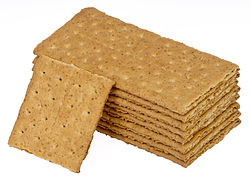
 Modern mass-produced graham crackers | |
| Alternative names | Graham wafer |
|---|---|
| Type | Cracker |
| Place of origin | United States |
| Main ingredients | Graham flour |


A graham cracker (pronounced /ˈɡreɪ.əm/ GRAY-əm or /ˈɡræm/ GRAM in America) is a sweet flavored cracker made with graham flour[1] that originated in the United States in the mid-19th century, with commercial development from about 1880. It is eaten as a snack food, usually honey- or cinnamon-flavored, and is used as an ingredient in some foods, e.g., in the graham cracker crust for cheesecakes and pies.[2]
History
[edit]The graham cracker was inspired by the preaching of Sylvester Graham, who was part of the 19th-century temperance movement. He believed that a vegetarian diet anchored by bread made from wheat coarsely ground at home, was how God intended people to live, and that following this natural law would keep people healthy. Towards that end, Graham introduced the world's first graham wafer product. It was a dull, unsifted flour biscuit baked by Graham himself.[3]
The sugarless wafers were a key component of the eponymous diet.[3] His preaching was taken up widely in the midst of the 1826–1837 cholera pandemic.[4][5][6][7] His followers were called Grahamites and formed one of the first vegetarian movements in America; graham flour, graham crackers, and graham bread were created for them. Graham neither invented nor profited from these products.[8][6] Herman Melville has an early reference to the crackers in Book XXII, Chapter I, of his 1852 novel Pierre; or The Ambiguities:
For all the long wards, corridors, and multitudinous chambers of the Apostles' were scattered with the stems of apples, the stones of prunes, and the shells of peanuts. They went about huskily muttering the Kantian Categories through teeth and lips dry and dusty as any miller's, with crumbs of Graham crackers.
Production
[edit]The main ingredients in its earlier preparations were graham flour, oil, shortening or lard, molasses and salt.[9] Graham crackers have been a mass-produced food product in the United States since 1898, with the National Biscuit Company being the first to mass-produce it at that time.[10] The Loose-Wiles Biscuit Company also began mass-producing the product beginning sometime in the early 1910s.[11][12] The product continues to be mass-produced in the U.S. and Canada today.[2]
In earlier times, mass-produced graham crackers were typically prepared using yeast-leavened dough, which added flavor to the food via the process of fermentation, whereas contemporary mass-production of the product typically omits this process.[13][14] The dough is sometimes chilled before being rolled out, which prevents blistering and breakage from occurring when the product is baked.[14]
Uses
[edit]Graham cracker crumbs are used to create graham cracker crusts for fruit pies and moon pies, and as a base, layer or topping for cheesecake.[2][15][16] Graham cracker pie crusts are mass-produced in the United States, and consumer versions of the product typically consist of a graham cracker crumb mixture pressed into an aluminum pie pan.[17] The graham cracker is a main ingredient in the preparation of the s'more.[18] Graham crackers are commonly used in place of broas in the traditional Filipino icebox cake mango float.[19][20]
Gallery
[edit]-
 A box of National Biscuit Company food crackers, c. 1915, which was priced at ten cents
 -
 A s'more
 -
 A homemade graham cracker crust
 -
 A Mango float, an icebox cake dessert from the Philippines using graham crackers, cream, and ripe Philippine mango

.jpg)

.jpg)
See also
[edit]
References
[edit]- ^ "Homemade Graham Crackers". Retrieved March 21, 2019.
- ^ a b c Krapp, Kristine (1997). How Products are Made. Gale. pp. 181–182. ISBN 9780787615475. Retrieved September 12, 2018.
Over time, it became known the graham cracker. Due to its popularity and innovation, other bakeries copied his recipe and eventually developed methods for its mass production. Since then, graham crackers have been a popular snack food. They have also become an important ingredient in pie crust recipes.
- ^ a b Lachance Shandrow, Kim (December 17, 2015). "The Seriously Unsexy Origins of the Graham Cracker". Entrepreneur. Retrieved January 18, 2023.
- ^ Iacobbo, Karen & Iacobbo, Michael (2004). Vegetarian America: A History. Westport, Connecticut: Praeger. pp. 15–26. ISBN 978-0-275-97519-7.
- ^ Smith, Andrew F. (2009). Eating History: 30 Turning Points in the Making of American Cuisine. New York: Columbia University Press. pp. 29–35. ISBN 978-0-231-14092-8.
- ^ a b Tompkins, K. W. (2009). "Sylvester Graham's Imperial Dietetics". Gastronomica. 9 (1): 50–60. doi:10.1525/gfc.2009.9.1.50. JSTOR 10.1525/gfc.2009.9.1.50.
- ^ Money, J. (1982). "Sex, Diet, and Debility in Jacksonian America: Sylvester Graham and Health Reform". The Journal of Sex Research. 18 (2): 181–182. JSTOR 3812085.
- ^ Iacobbo & Iacobbo (2004), p. 29.
- ^ Gill, J.T. (1881). The Complete Bread, Cake and Cracker Baker. J. Thompson Gill, manager Confectioner and Baker Publishing Company. p. 98. Retrieved September 12, 2018.
- ^ Smith, A.F. (2013). Food and Drink in American History: A "Full Course" Encyclopedia [3 Volumes]: A "Full Course" Encyclopedia. EBSCO ebook academic collection. ABC-CLIO. p. 409. ISBN 978-1-61069-233-5. Retrieved September 12, 2018.
- ^ Armstrong, D.; Armstrong, E.M. (1991). The Great American Medicine Show: Being an Illustrated History of Hucksters, Healers, Health Evangelists, and Heroes from Plymouth Rock to the Present. Prentice Hall. p. 59. ISBN 978-0-13-364027-4. Retrieved September 12, 2018.
- ^ Report of the State Entomologist of Connecticut for the Year ... Bulletin. Connecticut Agricultural Experiment Station. 1915. p. 230. Retrieved September 12, 2018.
- ^ Matz, S.A. (1992). Cookie and cracker technology. AVI book. Van Nostrand Reinhold. pp. 124–125. ISBN 978-0-442-30892-6. Retrieved September 12, 2018.
- ^ a b The Cracker Baker. Vol. 9. American Trade Publishing Company. 1920. p. 6-PA42. Retrieved September 12, 2018.
- ^ Cole, Edith Walters (1967). "Sylvester P. Graham, 'Father of the Graham Cracker'". The Southern Speech Journal. 32 (3). Informa UK Limited: 206–214. doi:10.1080/10417946709371875. ISSN 0038-4585.
- ^ Chilton's Food Engineering. Vol. 70. Chilton Company. 1998. p. 69. Retrieved September 12, 2018.
- ^ Savoie, Lauren (April 10, 2017). "Tasting Ready-Made Graham Cracker Crusts". Cook's Illustrated. Retrieved September 12, 2018.
- ^ Miller, Jeffrey (July 25, 2018). "S'mores: How this American campfire snack came from the Industrial Revolution". The Independent. London. Retrieved September 12, 2018.
- ^ Maryanne (June 15, 2017). "Mango Royale (Mango Icebox Cake)". The Little Epicurean. Retrieved August 31, 2020.
- ^ "Mango Float". Food Network. Retrieved August 31, 2020.
Further reading
[edit]- "Almanac: Graham crackers". CBS News. July 5, 2015. Retrieved September 12, 2018.
External links
[edit]- The Origin of Graham Crackers. Snopes.com.
- 7 Things You Probably Didn't Know About Graham Crackers. Food Republic.
- "A Hell of a Cracker" at JSTOR Daily
Graham cracker
View on GrokipediaThe Graham cracker is a mildly sweet, rectangular flatbread made from graham flour—a coarsely ground whole-wheat flour lacking the separation of bran, germ, and endosperm typically found in refined flours—and originally formulated in the 1829s by Presbyterian minister Sylvester Graham to embody his dietary principles of temperance and self-control.[1][2] Graham, a health reformer influenced by his observations of digestive ailments and moral decay, promoted the cracker as part of a regimen emphasizing unbolted flour products over stimulating foods like meat, spices, and white bread, which he believed exacerbated lustful impulses and indigestion.[3][4] Unlike contemporary sweetened versions produced by companies such as Nabisco, the original Graham cracker was deliberately bland and hard to encourage thorough mastication and discourage overindulgence.[5] Today, Graham crackers are widely used in desserts including s'mores and pie crusts, reflecting a commercialization that diverges from Graham's austere vision.[6]
History
Sylvester Graham and the Graham Diet
Sylvester Graham (July 5, 1794 – September 11, 1851) was an American Presbyterian minister who transitioned into a prominent dietary reformer during the early 19th century. Born in West Suffield, Connecticut, Graham initially pursued theological studies and served in various ministerial roles before focusing on health reform amid the Second Great Awakening's push for moral and physical perfectionism. By the 1820s and 1830s, he integrated temperance advocacy with nutritional principles, positing that improper diet caused physiological imbalances leading to irritability, disease, and unchecked "animal passions" such as lust and self-abuse.[7][8][9] The Graham Diet emphasized coarsely milled whole grains, fresh produce, and water while excluding meat, alcohol, tobacco, coffee, tea, and pungent spices, which Graham viewed as irritants that inflamed the digestive system and thereby exacerbated moral failings. He argued from firsthand observations of patients and congregants that refined white flour, often bleached with chemicals like alum and copperas for aesthetic appeal, produced indigestion and nervous excitability, fostering intemperance and sexual excess; in contrast, unadulterated whole-wheat products promoted calm temperament and self-control. This framework drew on causal links between mastication, digestion, and behavioral stability, rejecting overly processed foods as unnatural deviations from primitive human sustenance.[10][9][7] Graham propagated his regimen through extensive lecture circuits, often under temperance societies, where he detailed hygiene, ventilation, and dietary moderation's role in curbing vice. Adherents, dubbed Grahamites, operated boardinghouses enforcing the diet—featuring hard mattresses, cold baths, and bland meals—to embody these ideals, though such establishments faced riots from opponents in cities like Boston in 1847. His 1837 Treatise on Bread and Bread-Making formalized critiques of commercial baking, advocating stone-ground whole-wheat flour free of additives to retain bran and germ for superior nutrition and moral hygiene, while tracing bread's historical evolution from ancient grinding practices.[8][11][9]Invention and Early Promotion
The graham cracker originated around 1829 as a simple, coarse biscuit crafted from graham flour, an unsifted whole-wheat product Graham developed to enhance digestibility and align with his dietary principles emphasizing moral self-control through bland, fiber-rich foods devoid of stimulants or refinements that he believed provoked vice.[7][11] Graham promoted the cracker through public lectures on physiology and nutrition, where he demonstrated its preparation and urged audiences to bake it at home or in communal settings, positioning it as a practical antidote to the era's processed white breads, which he argued caused indigestion and moral laxity by fermenting in the gut.[12][13] In the 1830s and 1840s, the cracker gained traction among temperance advocates, vegetarians, and health reformers who adopted Graham's recipes from his publications, such as the 1837 Treatise on Bread and Bread-Making, which detailed methods for producing the unsweetened staple to support ascetic living and bodily purity.[12] However, its promotion encountered fierce opposition from commercial bakers and butchers, who viewed the push for unrefined grains as a direct economic threat; this culminated in disruptions during Graham's 1837 Boston lectures, where angry tradesmen pelted him with missiles and nearly incited a full riot, highlighting the clash between reformist ideals and entrenched food industries.[11] Following Graham's death in 1851, the cracker endured as a niche product within lingering health reform circles, where adherents maintained its original form—unleavened, sugar-free, and coarsely textured—to uphold anti-vice doctrines by minimizing digestive "fermentation" purportedly linked to sensual excesses, though its appeal waned without Graham's charismatic advocacy.[4][3]Commercialization and Evolution
In the late 19th century, baking companies such as the National Biscuit Company began mass-producing graham crackers using graham flour, but quickly deviated from Sylvester Graham's austere principles by incorporating sweeteners to appeal to broader consumer tastes.[14][15] By the 1880s, these commercial versions included added sugars, transforming the originally bland, unleavened product into a more palatable snack despite Graham's opposition to refined or stimulating ingredients.[15] Nabisco's introduction of the Honey Maid brand in 1925 marked a pivotal shift, popularizing honey-sweetened graham crackers on a national scale and further emphasizing flavor enhancements over unadulterated whole-grain purity.[16] This commercialization prioritized market appeal, with production scaling through mechanized baking that often involved partial refining of flour to improve texture and shelf life.[17] Following World War II, standardized processing techniques incorporated additional additives and refined components, widening the gap from Graham's ideal of coarsely ground, unsifted whole wheat without preservatives or sweeteners.[18] Marketing campaigns positioned these products as wholesome family snacks, contributing to sustained popularity evidenced by category sales exceeding $8 billion annually by the early 2020s.[19] In recent decades, manufacturers have expanded into flavored variants such as cinnamon and chocolate-coated options, alongside organic lines claiming higher whole-grain content.[20][21] However, ingredient analyses of major brands reveal blends of graham flour with refined wheat flour, yielding only 8-10 grams of whole grains per serving—far short of fully unrefined profiles—and substantial added sugars that contradict the original health-focused intent.[22][21][23]Ingredients and Production
Graham Flour and Core Components
Graham flour consists of coarsely ground whole wheat that includes the intact bran, germ, and endosperm, distinguishing it from refined white flour by avoiding sifting, or bolting, which removes nutrient-rich outer layers.[24][25] This milling approach, advocated by Sylvester Graham in the 1830s, preserved fiber and minerals that bolted flour discarded, countering the era's commercial practices of adding adulterants like chalk to overly processed grains.[26][11] The core components of early graham crackers centered on this flour mixed with water, occasionally incorporating minimal salt for flavor, eschewing fats, leavening, or sweeteners to align with Graham's emphasis on simple, digestion-neutral foods that avoided stimulating perceived moral and physical excesses.[27][11] Such formulations reflected first-principles reasoning on milling: retaining the wheat kernel's full structure ensured slower digestion, promoting satiety and reducing gut irritation compared to refined flours, which 19th-century reformers like Graham observed hastened nutrient loss and contributed to irritability and indigestion.[26][3] This fiber retention provided empirical advantages in bowel regularity and sustained energy, as noted in Graham's dietary lectures linking whole-grain consumption to overall physiological stability.[28]Modern Variations and Additives
Contemporary commercial graham crackers typically incorporate a partial blend of graham flour with refined enriched wheat flour to achieve a lighter texture and extended shelf life, diverging from the undivided whole grain base of early formulations. For instance, Honey Maid graham crackers include graham flour (defined as whole grain wheat flour) as the primary ingredient, but follow it with unbleached enriched flour (wheat flour fortified with niacin, reduced iron, thiamine mononitrate, riboflavin, and folic acid), alongside sugar, soybean and/or canola oil, honey, and leavening agents such as sodium bicarbonate and monocalcium phosphate.[29] These additives enhance crispness and stability but reduce the proportion of intact bran and germ components inherent to pure graham flour.[30] Sugar content in standard servings reaches up to 8 grams per 31-gram portion (approximately eight crackers), often derived from added sucrose or honey, which boosts palatability at the expense of the original austere profile intended to minimize physiological stimulation.[31] This inclusion of refined sweeteners and flours facilitates quicker glycemic responses, countering the foundational aim of graham-based foods to promote digestive moderation without excitatory effects.[32] Market-driven variations since the mid-20th century include honey-coated iterations like Honey Maid Honey Grahams, which emphasize sweetened exteriors for broader appeal, and chocolate-dipped products such as Schär's gluten-free chocolate honeygrams, coated in dark chocolate with real honey.[33] Gluten-free adaptations, utilizing rice flour or other substitutes, cater to dietary restrictions and have proliferated in recent decades, as seen in offerings from Pamela's Products featuring chocolate-covered gluten-free grahams.[34] These modifications prioritize consumer taste preferences and inclusivity over fidelity to unadulterated whole wheat composition. Claims of "whole grain" or organic status on packaging frequently mislead, as refined flours constitute a substantial share of the mix despite branding; multiple 2021 class action lawsuits targeted this discrepancy, including actions against Stop & Shop for underrepresenting whole wheat in cinnamon grahams and Dollar General for inflating whole grain and honey levels in Clover Valley products.[35][36] Similar suits against Trader Joe's and Whole Foods underscored non-compliance with expectations of predominant graham flour standards, revealing formulations where enriched white flour precedes or equals whole grain elements on labels.[37][38]Manufacturing Process
The manufacturing of graham crackers involves a series of automated industrial steps designed for high-volume output, beginning with dough compounding in vertical spindle or high-speed horizontal mixers where initial ingredients are blended into a cream-like base before incorporating the remainder, followed by a resting period of 2-3 hours to facilitate leavening.[39] The dough is then sheeted to uniform thickness using gauging rolls on conveyor systems, often with laminating for layered texture, and cut into shapes via rotary cutters or stampers, with scrap dough recycled to minimize waste.[39] Baking occurs in extended tunnel ovens, typically 100-300 feet long, progressing through zones for dough development, moisture reduction, and surface coloring at temperatures ranging from 350–400°F to achieve the desired crispness, with graham crackers requiring slightly longer exposure than similar products like animal crackers, which bake in about 4 minutes; conveyor speeds precisely control residence time for consistency.[39] [40] Post-baking, crackers are cooled on conveyors—often flipped for even air circulation—and packaged in stacked or bagged formats under controlled conditions to preserve shelf life.[39] This automated sequence, scaled up commercially since the late 19th century with pioneers like Nabisco enabling mass production, contrasts sharply with Sylvester Graham's 1830s artisanal methods, which relied on manual hand-kneading and stone-grinding of whole wheat to produce coarse, unrefined flour without machinery for sheeting or cutting.[2] Modern high-speed roller milling and extrusion-like sheeting processes yield finer particle sizes, reducing bran integrity and resulting in smoother textures verifiable through instrumental analysis showing decreased coarseness compared to stone-ground originals, while eliminating labor-intensive steps for greater efficiency but at the cost of nuanced flavor development inherent in slower, localized grinding.[41] [42] Quality controls emphasize uniformity and low moisture content below 3% to ensure crunch and prevent sogginess, achieved via inline monitoring of dough consistency, oven zoning, and final sensory evaluations alongside instrumental tests for dimensions, color, and breakage resistance; however, these protocols prioritize scalable consistency over the variable artisanal qualities of Graham's era, sometimes incorporating processing aids like emulsifiers during mixing to stabilize high-speed operations in certain formulations.[39] [43] [44]Nutritional Profile
Composition and Macronutrients
A standard serving of graham crackers, defined as two full sheets or approximately eight individual crackers weighing 31 grams, provides 120–130 kilocalories, primarily from carbohydrates. This equates to 20–25 grams of total carbohydrates, of which 5–8 grams are sugars, alongside 3–4 grams of total fat and 2 grams of protein.[31][45][46]| Macronutrient | Amount per 31 g serving |
|---|---|
| Calories | 120–130 kcal |
| Carbohydrates | 20–25 g (5–8 g sugars) |
| Total fat | 3–4 g |
| Protein | 2 g |
| Dietary fiber | 1–2 g |
Micronutrients and Additives
Commercial graham crackers typically contain trace amounts of micronutrients, primarily from the enrichment of refined wheat flour components and the partial retention in graham flour. A standard serving of 31 grams (about 8 crackers) provides approximately 1-1.5 mg of iron, mainly as reduced iron added during fortification, equating to 6-8% of the recommended daily value for adults.[48] B vitamins are similarly supplemented, with thiamin (vitamin B1) at around 0.1-0.15 mg, riboflavin (B2) at 0.1 mg, niacin at 1-1.5 mg, and folic acid at 20-30 mcg per serving, restoring levels lost in milling but in synthetic forms whose bioavailability approximates natural counterparts in controlled assays.[30] The graham flour contributes modest natural magnesium (about 20-30 mg per serving) and zinc (0.5-1 mg), though processing heat and phytate content in the bran reduce their absorption compared to dephytinized sources, with studies showing mineral bioavailability in whole wheat flours at 20-40% lower than in refined, low-phytate enriched alternatives due to chelation effects.[51] Sodium levels range from 150-200 mg per 31-gram serving, derived chiefly from leavening agents like sodium bicarbonate and, in some formulations, sodium carbonates, elevating the processed food's electrolyte profile without corresponding potassium or other balancing minerals to mitigate potential hypertensive risks in high-consumption diets.[31] [48] Other trace elements include manganese (around 0.3 mg) and selenium (2-3 mcg) from the whole grain fraction, offering negligible daily contributions (10-15% and 4-6%, respectively) in bioavailability-adjusted terms.[47] Additives vary by brand but often include emulsifiers like lecithin and preservatives such as sodium sulfite (E221) in select variants, which can trigger sensitivities in susceptible individuals at doses exceeding 10 mg per serving, though levels in graham crackers remain below regulatory thresholds.[52] Artificial or natural flavors appear in honey or chocolate subtypes, contributing no nutritional value and potentially masking the subdued taste of minimally processed bases, while fortification overall compensates for milling-induced nutrient depletion—evident in comparative analyses where unenriched whole graham flour assays show 20-50% higher intrinsic B-vitamin and mineral densities before phytate interference—yet synthetic additions do not fully replicate the synergistic bioavailability of unrefined matrices.[51] These elements underscore the crackers' shift from Sylvester Graham's unadulterated ideal to a fortified yet additive-laden product with limited net micronutrient efficacy per caloric intake.Original Intent vs. Contemporary Reality
Sylvester Graham developed the graham cracker in 1829 as a bland, unsweetened staple of his eponymous diet, which emphasized coarsely ground whole wheat flour to foster temperance, digestive health, and moral vitality by purportedly suppressing excessive sexual urges through reduced stimulation from flavorful or refined foods.[53] Graham's rationale linked dietary simplicity to curbing vice, asserting that whole grains promoted physiological restraint without empirical validation, as contemporary analyses find no causal evidence supporting such anti-libido effects from whole-wheat consumption.[12] In contrast, commercial graham crackers today deviate substantially, incorporating added sugars—typically 6–8 grams per serving alongside refined wheat elements—which elevate glycemic load and contribute to blood sugar fluctuations rather than the original austerity.[32] Epidemiological data underscore the divergence: habitual intake of processed snacks like sweetened graham crackers correlates with heightened insulin resistance and type 2 diabetes risk, as ultra-processed foods comprising over 10% of dietary proportion independently predict elevated incidence in cohort studies tracking over 100,000 participants.[54][55] While Graham's crackers lacked these additives, modern variants undermine any residual "health halo" by supplying disproportionate added sugars relative to their modest whole-grain base; the American Heart Association advises capping intake at under 25 grams daily for women and 36 grams for men to mitigate metabolic harms, a threshold readily exceeded by multiple servings.[56] From a causal standpoint, graham crackers warrant treatment as an occasional indulgence rather than a virtuous mainstay, given their caloric density—around 130 calories per eight-cracker serving—and propensity for overconsumption amid refined carbohydrate-driven appetite dysregulation, absent the unproven moral benefits Graham envisioned.[57] Portion moderation aligns with evidence-based metabolic realities, prioritizing whole-food alternatives over processed approximations of historical intent.[58]Culinary Uses
Traditional Snack Applications
In the 1830s, graham crackers emerged from Sylvester Graham's dietary principles, which emphasized plain, coarsely milled whole-wheat products consumed without sweeteners or fats to curb excessive appetites and promote moral restraint.[12] These early versions were eaten standalone or softened in water as a basic sustenance in Grahamite regimens, aligning with his advocacy for simple vegetarian meals twice daily to avoid stimulation of digestive or sexual urges.[59] In mid-19th-century boardinghouses operated by Graham's followers, the crackers functioned as a vice-preventing staple, substituting for richer breads and meats in efforts to foster health and temperance among residents.[60] The inherent properties of baking graham crackers—low moisture content and dense texture—conferred high resistance to spoilage, rendering them ideal for portable consumption by temperance travelers who required durable, non-indulgent provisions during journeys.[2] This perishability suited Graham's era of moral reform movements, where adherents sought foods that supported prolonged abstinence from alcohol and overstimulation without rapid deterioration.[3] By the early 20th century, following mass production starting with the National Biscuit Company's offerings around 1898, graham crackers had evolved into a commonplace lunchbox essential for schoolchildren, prized for their convenience and nutritional simplicity without need for refrigeration or preparation.[61] Prior to the 1927 introduction of s'mores, they also served as a fundamental camping snack, leveraging their shelf stability for outdoor sustenance in an age before widespread access to fresh perishables.[62]