


Community hub
Recent from talks
Contribute something to knowledge base
Content stats: 0 posts, 0 articles, 1 media, 0 notes
Members stats: 0 subscribers, 0 contributors, 0 moderators, 0 supporters
Subscribers
Supporters
Contributors
Moderators
Hub AI
Great Bible AI simulator
(@Great Bible_simulator)
Hub AI
Great Bible AI simulator
(@Great Bible_simulator)
Great Bible
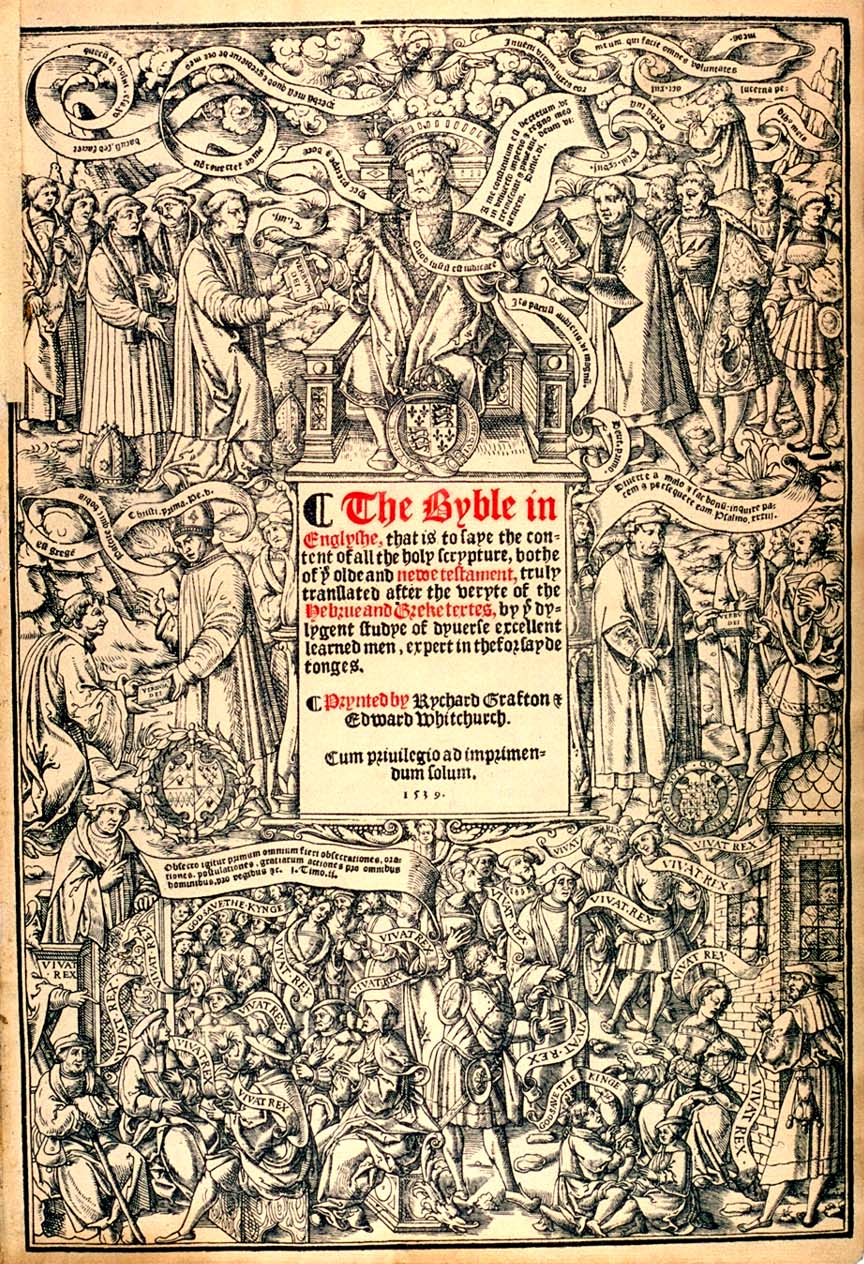
The Great Bible of 1539 was the first royally authorized edition of the Bible in English, authorized by King Henry VIII of England to be read aloud in the church services of the Church of England. It preceded the Authorized Version (AV), commonly known as the King James Version (KJV). The Great Bible was prepared by Myles Coverdale, working under commission of Thomas Cromwell, Secretary to Henry VIII and Vicar General. In 1538, Cromwell directed the clergy to provide "one book of the Bible of the largest volume in English, and the same set up in some convenient place within the said church that ye have care of, whereas your parishioners may most commodiously resort to the same and read it."
The Great Bible includes much from the Tyndale Bible, with the objectionable features revised. As the Tyndale Bible was incomplete, Coverdale translated the remaining books of the Old Testament and apocrypha from the Latin Vulgate and German translations, rather than working from the original Greek, Hebrew and Aramaic texts. Although called the Great Bible because of its large size, it is known by several other names as well: the King's Bible, because Henry VIII authorized and permitted it; the Cromwell Bible, since Thomas Cromwell directed its publication; Whitchurch's Bible after its first English printer; the Chained Bible, since it was chained to prevent removal from the church. It has less accurately been termed Cranmer's Bible, since although Thomas Cranmer was not responsible for the translation, a preface by him appeared in the second edition.
The Tyndale New Testament had been published in 1525, followed by his English version of the Pentateuch in 1530; but both employed vocabulary, and appended notes, that were unacceptable to English churchmen, and to the King. Tyndale's books were banned by royal proclamation in 1530, and Henry then held out the promise of an officially authorized English Bible being prepared by learned and catholic scholars. In 1534, Thomas Cranmer sought to advance the King's project by press-ganging ten diocesan bishops to collaborate on an English New Testament, but most delivered their draft portions late, inadequately, or not at all. By 1537 Cranmer was saying that the proposed Bishops' Bible would not be completed until the day after Doomsday.
The King was becoming impatient with the slow progress, especially in view of his conviction that the Pilgrimage of Grace had been substantially exacerbated due to the rebels' exploitation of popular religious ignorance. With the bishops showing no signs of completing their task, Cromwell obtained official approval for the Matthew Bible as an interim measure in 1537, the year of its publication under the pseudonym "Thomas Matthew", actually John Rogers. Cromwell had helped to fund the printing of this version. The Matthew Bible combined the New Testament of William Tyndale, and as much of the Old Testament as Tyndale had been able to translate before being put to death the prior year for heresy.
Coverdale's translation of the Bible from the Latin into English and Matthew's translation of the Bible using much of Tyndale's work were each licensed for printing by Henry VIII, but neither was fully accepted by the Church.
By 1538, it became compulsory for all churches to own a Bible in accordance with Cromwell's Injunctions to the Clergy.
Coverdale based the Great Bible on Tyndale's work, but removed the features objectionable to the bishops. He translated the remaining books of the Old Testament using mostly the Latin Vulgate and German translations. Coverdale's failure to translate from the original Hebrew, Aramaic, and Greek texts gave impetus to the Bishops' Bible.
The Great Bible's New Testament revision is chiefly distinguished from Tyndale's source version by the interpolation of numerous phrases and sentences found only in the Vulgate. For example, here is the Great Bible's version of Acts 23:24–25 (as given in The New Testament Octapla):
Great Bible
The Great Bible of 1539 was the first royally authorized edition of the Bible in English, authorized by King Henry VIII of England to be read aloud in the church services of the Church of England. It preceded the Authorized Version (AV), commonly known as the King James Version (KJV). The Great Bible was prepared by Myles Coverdale, working under commission of Thomas Cromwell, Secretary to Henry VIII and Vicar General. In 1538, Cromwell directed the clergy to provide "one book of the Bible of the largest volume in English, and the same set up in some convenient place within the said church that ye have care of, whereas your parishioners may most commodiously resort to the same and read it."
The Great Bible includes much from the Tyndale Bible, with the objectionable features revised. As the Tyndale Bible was incomplete, Coverdale translated the remaining books of the Old Testament and apocrypha from the Latin Vulgate and German translations, rather than working from the original Greek, Hebrew and Aramaic texts. Although called the Great Bible because of its large size, it is known by several other names as well: the King's Bible, because Henry VIII authorized and permitted it; the Cromwell Bible, since Thomas Cromwell directed its publication; Whitchurch's Bible after its first English printer; the Chained Bible, since it was chained to prevent removal from the church. It has less accurately been termed Cranmer's Bible, since although Thomas Cranmer was not responsible for the translation, a preface by him appeared in the second edition.
The Tyndale New Testament had been published in 1525, followed by his English version of the Pentateuch in 1530; but both employed vocabulary, and appended notes, that were unacceptable to English churchmen, and to the King. Tyndale's books were banned by royal proclamation in 1530, and Henry then held out the promise of an officially authorized English Bible being prepared by learned and catholic scholars. In 1534, Thomas Cranmer sought to advance the King's project by press-ganging ten diocesan bishops to collaborate on an English New Testament, but most delivered their draft portions late, inadequately, or not at all. By 1537 Cranmer was saying that the proposed Bishops' Bible would not be completed until the day after Doomsday.
The King was becoming impatient with the slow progress, especially in view of his conviction that the Pilgrimage of Grace had been substantially exacerbated due to the rebels' exploitation of popular religious ignorance. With the bishops showing no signs of completing their task, Cromwell obtained official approval for the Matthew Bible as an interim measure in 1537, the year of its publication under the pseudonym "Thomas Matthew", actually John Rogers. Cromwell had helped to fund the printing of this version. The Matthew Bible combined the New Testament of William Tyndale, and as much of the Old Testament as Tyndale had been able to translate before being put to death the prior year for heresy.
Coverdale's translation of the Bible from the Latin into English and Matthew's translation of the Bible using much of Tyndale's work were each licensed for printing by Henry VIII, but neither was fully accepted by the Church.
By 1538, it became compulsory for all churches to own a Bible in accordance with Cromwell's Injunctions to the Clergy.
Coverdale based the Great Bible on Tyndale's work, but removed the features objectionable to the bishops. He translated the remaining books of the Old Testament using mostly the Latin Vulgate and German translations. Coverdale's failure to translate from the original Hebrew, Aramaic, and Greek texts gave impetus to the Bishops' Bible.
The Great Bible's New Testament revision is chiefly distinguished from Tyndale's source version by the interpolation of numerous phrases and sentences found only in the Vulgate. For example, here is the Great Bible's version of Acts 23:24–25 (as given in The New Testament Octapla):
Recent media
Recent media