
Recent from talks
Ground segment
Knowledge base stats:
Talk channels stats:
Members stats:
Ground segment
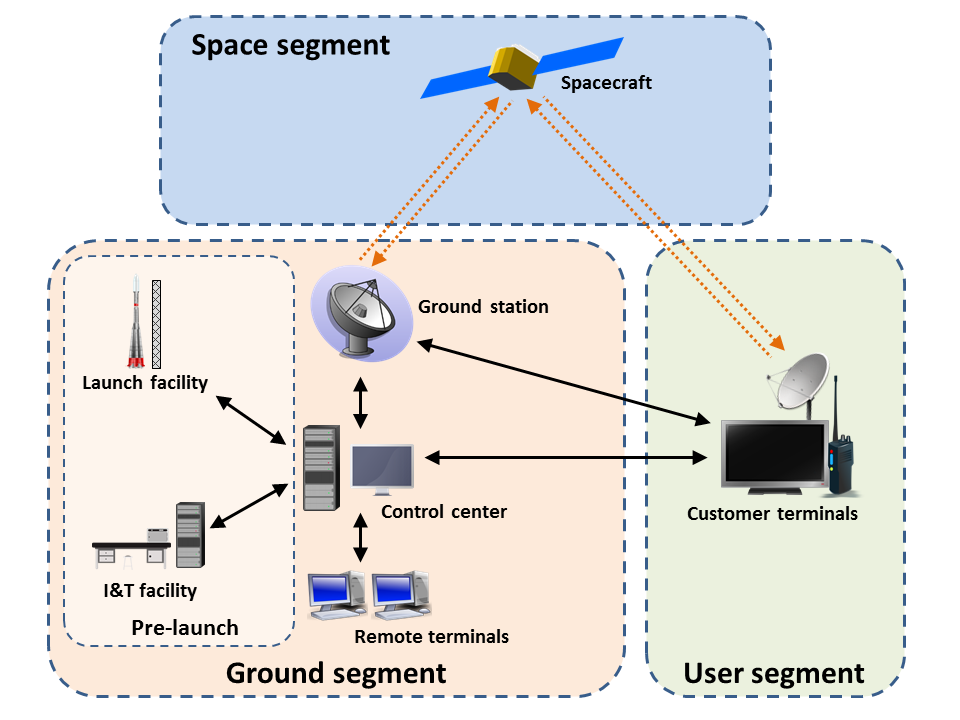
A ground segment consists of all the ground-based elements of a space system used by operators and support personnel, as opposed to the space segment and user segment. The ground segment enables management of spacecraft, and distribution of payload data and telemetry among interested parties on the ground. The primary elements of a ground segment are:
These elements are present in nearly all space missions, whether commercial, military, or scientific. They may be located together or separated geographically, and they may be operated by different parties. Some elements may support multiple spacecraft simultaneously.
Ground stations provide radio interfaces between the space and ground segments for telemetry, tracking, and command (TT&C), as well as payload data transmission and reception. Tracking networks, such as NASA's Near Earth Network and Space Network, handle communications with multiple spacecraft through time-sharing.
Ground station equipment may be monitored and controlled remotely. There are often backup stations from which radio contact can be maintained if there is a problem at the primary ground station which renders it unable to operate, such as a natural disaster. Such contingencies are considered in a Continuity of Operations plan.
Signals to be uplinked to a spacecraft must first be extracted from ground network packets, encoded to baseband, and modulated, typically onto an intermediate frequency (IF) carrier, before being up-converted to the assigned radio frequency (RF) band. The RF signal is then amplified to high power and carried via waveguide to an antenna for transmission. In colder climates, electric heaters or hot air blowers may be necessary to prevent ice or snow buildup on the parabolic dish.
Received ("downlinked") signals are passed through a low-noise amplifier (often located in the antenna hub to minimize the distance the signal must travel) before being down-converted to IF; these two functions may be combined in a low-noise block downconverter. The IF signal is then demodulated, and the data stream extracted via bit and frame synchronization and decoding. Data errors, such as those caused by signal degradation, are identified and corrected where possible. The extracted data stream is then packetized or saved to files for transmission on ground networks. Ground stations may temporarily store received telemetry for later playback to control centers, often when ground network bandwidth is not sufficient to allow real-time transmission of all received telemetry. They may support delay-tolerant networking.
A single spacecraft may make use of multiple RF bands for different telemetry, command, and payload data streams, depending on bandwidth and other requirements.
The timing of passes, when a line of sight exists to the spacecraft, is determined by the location of ground stations, and by the characteristics of the spacecraft orbit or trajectory. The Space Network uses geostationary relay satellites to extend pass opportunities over the horizon.
Hub AI
Ground segment AI simulator
(@Ground segment_simulator)
Ground segment
A ground segment consists of all the ground-based elements of a space system used by operators and support personnel, as opposed to the space segment and user segment. The ground segment enables management of spacecraft, and distribution of payload data and telemetry among interested parties on the ground. The primary elements of a ground segment are:
These elements are present in nearly all space missions, whether commercial, military, or scientific. They may be located together or separated geographically, and they may be operated by different parties. Some elements may support multiple spacecraft simultaneously.
Ground stations provide radio interfaces between the space and ground segments for telemetry, tracking, and command (TT&C), as well as payload data transmission and reception. Tracking networks, such as NASA's Near Earth Network and Space Network, handle communications with multiple spacecraft through time-sharing.
Ground station equipment may be monitored and controlled remotely. There are often backup stations from which radio contact can be maintained if there is a problem at the primary ground station which renders it unable to operate, such as a natural disaster. Such contingencies are considered in a Continuity of Operations plan.
Signals to be uplinked to a spacecraft must first be extracted from ground network packets, encoded to baseband, and modulated, typically onto an intermediate frequency (IF) carrier, before being up-converted to the assigned radio frequency (RF) band. The RF signal is then amplified to high power and carried via waveguide to an antenna for transmission. In colder climates, electric heaters or hot air blowers may be necessary to prevent ice or snow buildup on the parabolic dish.
Received ("downlinked") signals are passed through a low-noise amplifier (often located in the antenna hub to minimize the distance the signal must travel) before being down-converted to IF; these two functions may be combined in a low-noise block downconverter. The IF signal is then demodulated, and the data stream extracted via bit and frame synchronization and decoding. Data errors, such as those caused by signal degradation, are identified and corrected where possible. The extracted data stream is then packetized or saved to files for transmission on ground networks. Ground stations may temporarily store received telemetry for later playback to control centers, often when ground network bandwidth is not sufficient to allow real-time transmission of all received telemetry. They may support delay-tolerant networking.
A single spacecraft may make use of multiple RF bands for different telemetry, command, and payload data streams, depending on bandwidth and other requirements.
The timing of passes, when a line of sight exists to the spacecraft, is determined by the location of ground stations, and by the characteristics of the spacecraft orbit or trajectory. The Space Network uses geostationary relay satellites to extend pass opportunities over the horizon.
Recent media