
Recent from talks
Gyeongbu Line
Knowledge base stats:
Talk channels stats:
Members stats:
Gyeongbu Line
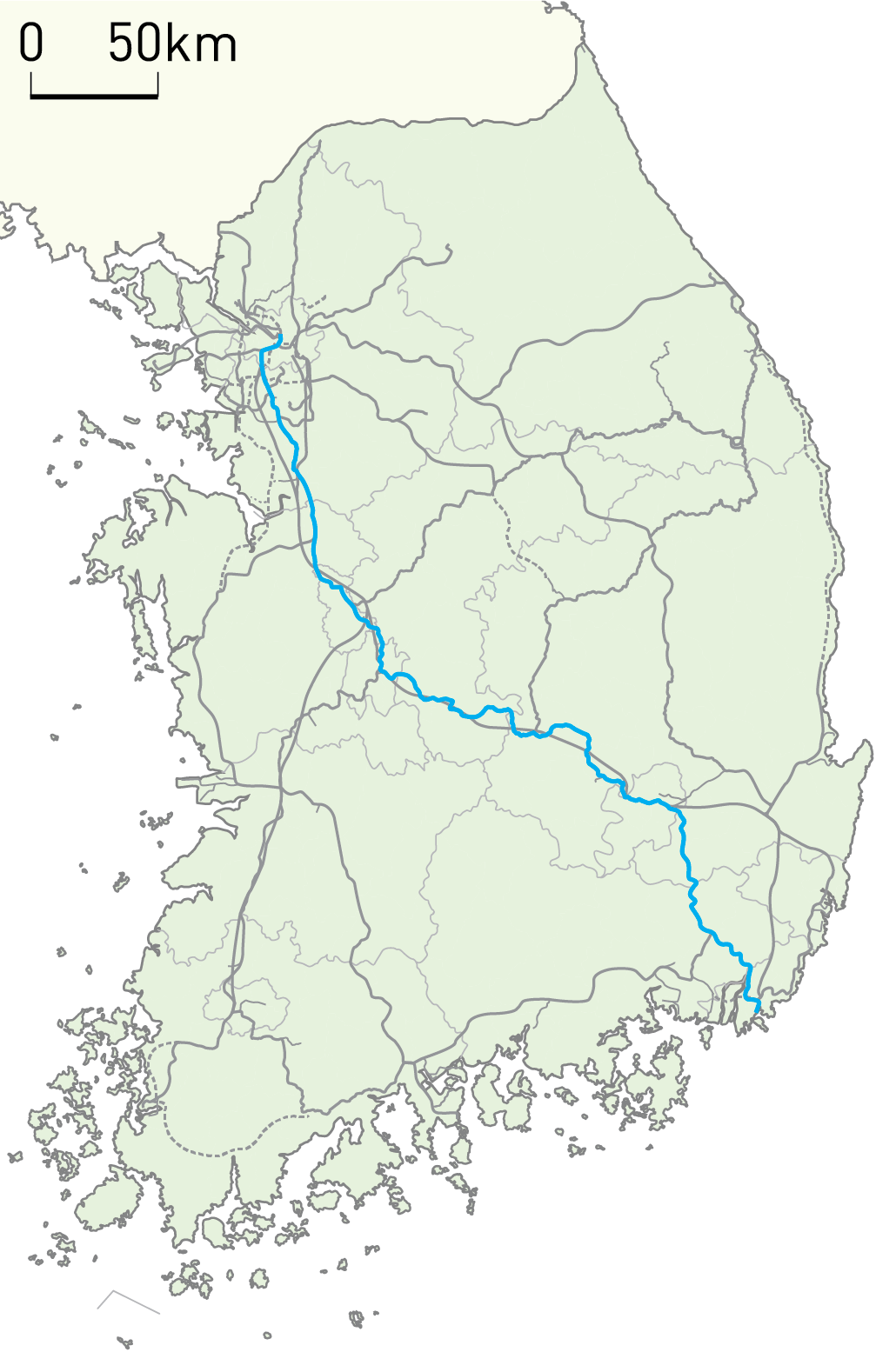
The Gyeongbu line (Gyeongbuseon) is a railway line in South Korea and is considered to be the most important and one of the oldest in the country. It was constructed in 1905, connecting Seoul with Busan via Suwon, Daejeon, and Daegu. It is by far the most heavily travelled rail line in South Korea.
All types of high-speed, express, local, and freight trains provide frequent service along its entire length.
In 1894–1895, the Empire of Japan and Qing China fought the First Sino-Japanese War for influence over Korea. Following the war, Japan competed with the Russian Empire's railway expansion in Northeast Asia, which led it to seek the right from the Korean Empire to build a railway from Busan to Keijō (the Japanese Empire's name for Seoul). This railway line was intended by Japan to solidify its strategic positions against Russia, with which it would later fight the war. Surveying began in 1896, and in spite of local protests, the Korean Empire gave Japan the right to build the line in 1898. Construction of the railway started on August 20, 1901, with a ceremony at Eitōho-ku, Keijō. Construction was supervised by the Japanese, with local Koreans commandeered into forced labor and paid in coupons.
Japan also sought to gain control of the Keigi Railway project that was to extend tracks further north, recognizing the trunk route as a means to keep Korea under its influence. After the outbreak of the Russo-Japanese War, Japan ignored Korea's declaration of neutrality and transported troops to Incheon. Japan also forced the Korean government to sign an agreement that ceded its control of the railway. Japanese military bases were established in connection with the railway, the biggest of them next to Ryūzan Station (modern-day Yomgsan Station) in Keijō.
The Gyeongbu line was opened to the public on January 1, 1905, as the Keibu Railway (京釜鐵道, Keibu tetsudō). The first trains completed the rote in 17 hours 4 minutes. By April 1906, travel time was reduced to 11 hours, while top speed reached 60 km/h (37 mph). The line formed the backbone of transport in Korea under Japanese rule. Following the Japanese invasion of Manchuria, beginning on April 1, 1933, direct trains traversed the line from Busan to Andong (modern-day Dandong) across the border. Beginning on December 1, 1936, the Akatsuki luxury express trains ran on the line at a maximum speed of 90 km/h (56 mph), and achieved the shortest pre-war travel time of 6 hours 30 minutes on the timetable of November 1, 1940.
Travel times greatly improved when the line was used during World War II. Following World War II, the Seoul–Busan express train re-established on May 20, 1946, was named Chosun Liberator. During the Korean War, the line transported troops and refugees. The line remained the backbone of South Korea's transportation system after the war, with the introduction of the diesel locomotives and the cross-country Mugunghwa-ho train class. Following the 1961 coup, the Supreme Council for National Reconstruction initiated South Korea's first five-year plan, which included a construction program to complete the railway network, as a way to foster economic growth. On the Gyeongbu Line, the effort was promoted with a new class of express trains called Jaegeon-ho, (Reconstruction train) introduced on May 15, 1962. These trains reduced travel times below the best pre-WWII travel times for the first time, connecting Seoul and Busan in 6 hours 10 minutes at a top speed of 100 km/h (62 mph).
Beginning in the 1960s, road construction began to make road transportation more attractive and faster. Although the top speed rose to 110 km/h (68 mph) and the Seoul–Busan travel time along the Gyeongbu Line was reduced to 4 hours 50 minutes by June 10, 1969, travel time was only 4 to 4+1⁄2 hours on the parallel Gyeongbu Expressway, completed in 1970. Korean National Railroad responded by introducing the Saemaul-ho class of elevated-comfort express trains on August 15, 1974. With the introduction of the new streamlined diesel locomotives and then diesel multiple units in the Saemaul-ho service, top speed was raised to 140 km/h (87 mph) and travel time was reduced to 4 hours 10 minutes with the timetable valid by November 16, 1985.
The Gyeongbu Line was widely improved in parallel with the development of the Seoul Metropolitan Subway urban rapid transit system and the Korea Train Express (KTX) high-speed rail system beginning in the 1970s.
Hub AI
Gyeongbu Line AI simulator
(@Gyeongbu Line_simulator)
Gyeongbu Line
The Gyeongbu line (Gyeongbuseon) is a railway line in South Korea and is considered to be the most important and one of the oldest in the country. It was constructed in 1905, connecting Seoul with Busan via Suwon, Daejeon, and Daegu. It is by far the most heavily travelled rail line in South Korea.
All types of high-speed, express, local, and freight trains provide frequent service along its entire length.
In 1894–1895, the Empire of Japan and Qing China fought the First Sino-Japanese War for influence over Korea. Following the war, Japan competed with the Russian Empire's railway expansion in Northeast Asia, which led it to seek the right from the Korean Empire to build a railway from Busan to Keijō (the Japanese Empire's name for Seoul). This railway line was intended by Japan to solidify its strategic positions against Russia, with which it would later fight the war. Surveying began in 1896, and in spite of local protests, the Korean Empire gave Japan the right to build the line in 1898. Construction of the railway started on August 20, 1901, with a ceremony at Eitōho-ku, Keijō. Construction was supervised by the Japanese, with local Koreans commandeered into forced labor and paid in coupons.
Japan also sought to gain control of the Keigi Railway project that was to extend tracks further north, recognizing the trunk route as a means to keep Korea under its influence. After the outbreak of the Russo-Japanese War, Japan ignored Korea's declaration of neutrality and transported troops to Incheon. Japan also forced the Korean government to sign an agreement that ceded its control of the railway. Japanese military bases were established in connection with the railway, the biggest of them next to Ryūzan Station (modern-day Yomgsan Station) in Keijō.
The Gyeongbu line was opened to the public on January 1, 1905, as the Keibu Railway (京釜鐵道, Keibu tetsudō). The first trains completed the rote in 17 hours 4 minutes. By April 1906, travel time was reduced to 11 hours, while top speed reached 60 km/h (37 mph). The line formed the backbone of transport in Korea under Japanese rule. Following the Japanese invasion of Manchuria, beginning on April 1, 1933, direct trains traversed the line from Busan to Andong (modern-day Dandong) across the border. Beginning on December 1, 1936, the Akatsuki luxury express trains ran on the line at a maximum speed of 90 km/h (56 mph), and achieved the shortest pre-war travel time of 6 hours 30 minutes on the timetable of November 1, 1940.
Travel times greatly improved when the line was used during World War II. Following World War II, the Seoul–Busan express train re-established on May 20, 1946, was named Chosun Liberator. During the Korean War, the line transported troops and refugees. The line remained the backbone of South Korea's transportation system after the war, with the introduction of the diesel locomotives and the cross-country Mugunghwa-ho train class. Following the 1961 coup, the Supreme Council for National Reconstruction initiated South Korea's first five-year plan, which included a construction program to complete the railway network, as a way to foster economic growth. On the Gyeongbu Line, the effort was promoted with a new class of express trains called Jaegeon-ho, (Reconstruction train) introduced on May 15, 1962. These trains reduced travel times below the best pre-WWII travel times for the first time, connecting Seoul and Busan in 6 hours 10 minutes at a top speed of 100 km/h (62 mph).
Beginning in the 1960s, road construction began to make road transportation more attractive and faster. Although the top speed rose to 110 km/h (68 mph) and the Seoul–Busan travel time along the Gyeongbu Line was reduced to 4 hours 50 minutes by June 10, 1969, travel time was only 4 to 4+1⁄2 hours on the parallel Gyeongbu Expressway, completed in 1970. Korean National Railroad responded by introducing the Saemaul-ho class of elevated-comfort express trains on August 15, 1974. With the introduction of the new streamlined diesel locomotives and then diesel multiple units in the Saemaul-ho service, top speed was raised to 140 km/h (87 mph) and travel time was reduced to 4 hours 10 minutes with the timetable valid by November 16, 1985.
The Gyeongbu Line was widely improved in parallel with the development of the Seoul Metropolitan Subway urban rapid transit system and the Korea Train Express (KTX) high-speed rail system beginning in the 1970s.
Recent media