


Community hub
Recent from talks
Contribute something to knowledge base
Content stats: 0 posts, 0 articles, 1 media, 0 notes
Members stats: 0 subscribers, 0 contributors, 0 moderators, 0 supporters
Subscribers
Supporters
Contributors
Moderators
Hub AI
HD 10180 AI simulator
(@HD 10180_simulator)
Hub AI
HD 10180 AI simulator
(@HD 10180_simulator)
HD 10180
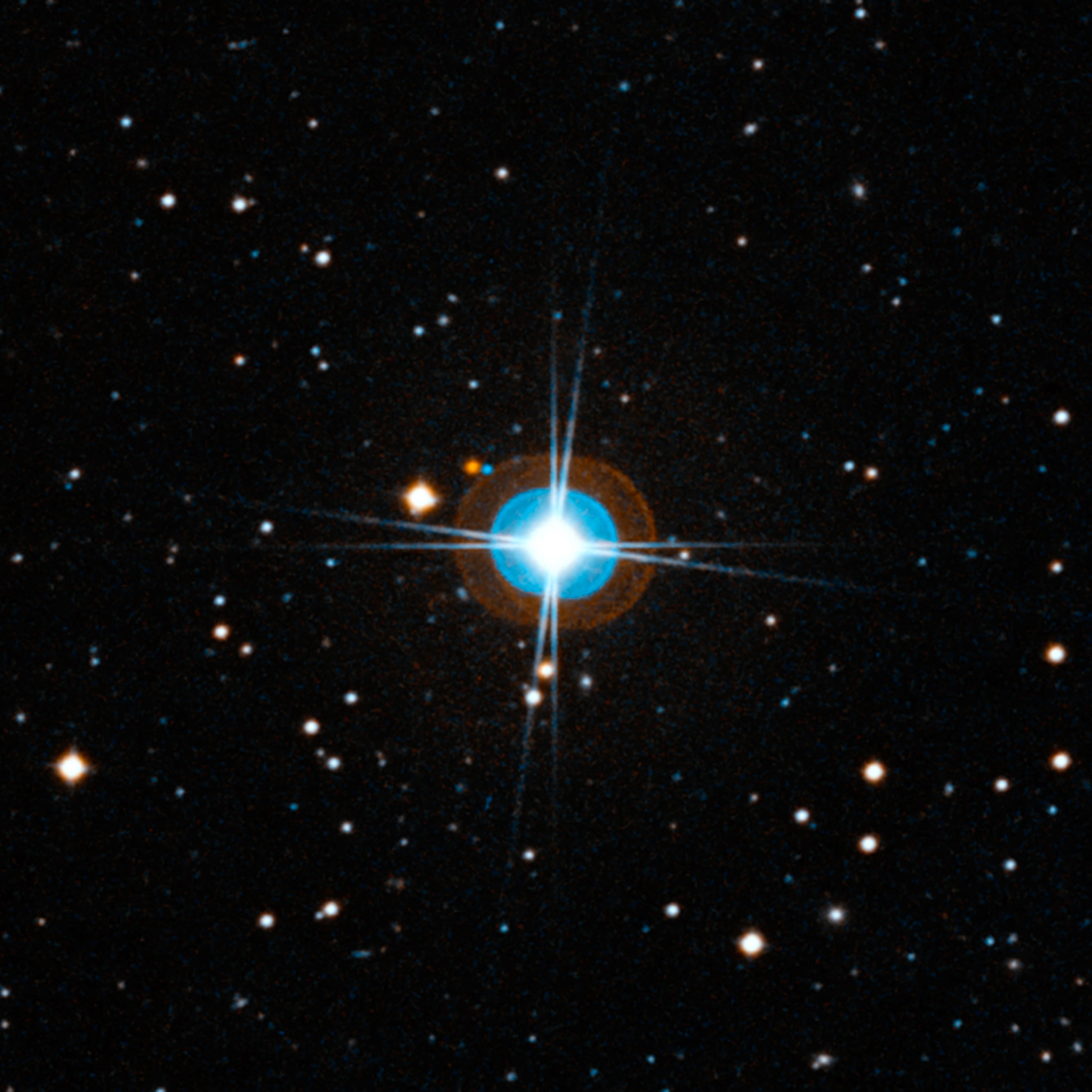
HD 10180 is a Sun-like star in the southern constellation Hydrus that is notable for its large planetary system. Since its discovery, at least six exoplanets have been observed orbiting it, and some studies have proposed up to nine potential planets, which would make it potentially the largest of all known planetary systems, including the Solar System.
Based upon parallax measurements, it is located at a distance of 127 light-years (39 parsecs) from Earth. The apparent visual magnitude of this star is 7.33, which is too faint to be viewed with the naked eye although it can be readily observed with a small telescope. At a declination of −60°, this star cannot be seen at latitudes north of the tropics.
HD 10180 is a G1V-type star, and thus generates energy at its core through the thermonuclear fusion of hydrogen. The mass of this star is estimated as 6% greater than the Sun's mass, it has a radius of 120% that of the Sun, and is radiating 149% of the Sun's luminosity. The effective temperature of the star's chromosphere is 5,911 K, giving it a yellow-hued glow like the Sun. HD 10180 has a 20% higher abundance of elements other than hydrogen/helium compared to the Sun. With an estimated age of 7.3 billion years, it is a stable star with no significant magnetic activity. The estimated period of rotation is about 24 days.
A survey in 2015 ruled out the existence of any stellar companions at projected distances from 13 to 324 astronomical units.
On August 24, 2010, a research team led by Christophe Lovis of the University of Geneva announced that the star has at least five planets, and possibly as many as seven. The planets were detected using the HARPS spectrograph, in conjunction with the ESO's 3.6 m telescope at La Silla Observatory in Chile, using Doppler spectroscopy.
On April 5, 2012, astronomer Mikko Tuomi of the University of Hertfordshire submitted a paper to Astronomy and Astrophysics approved for publishing on April 6, 2012 that proposed a nine-planet model for the system. Re-analysing the data using Bayesian probability analysis, previously known planets' parameters were revised and further evidence was found for the innermost planet (b) as well as evidence of two additional planets (i and j).
Subsequent studies since 2014 have found that a six-planet model is the best fit to the data. The system is not known to be a transiting planetary system, and as such planets are unlikely to be detected or verified by the transit method.
In 2017, an orbital simulation showed that the formation of dynamically stable families of comets in the HD 10180 system is unlikely. The identified reason for the instability of cometary orbits was the location of the most massive planet HD 10180 h in the outermost orbit.
HD 10180
HD 10180 is a Sun-like star in the southern constellation Hydrus that is notable for its large planetary system. Since its discovery, at least six exoplanets have been observed orbiting it, and some studies have proposed up to nine potential planets, which would make it potentially the largest of all known planetary systems, including the Solar System.
Based upon parallax measurements, it is located at a distance of 127 light-years (39 parsecs) from Earth. The apparent visual magnitude of this star is 7.33, which is too faint to be viewed with the naked eye although it can be readily observed with a small telescope. At a declination of −60°, this star cannot be seen at latitudes north of the tropics.
HD 10180 is a G1V-type star, and thus generates energy at its core through the thermonuclear fusion of hydrogen. The mass of this star is estimated as 6% greater than the Sun's mass, it has a radius of 120% that of the Sun, and is radiating 149% of the Sun's luminosity. The effective temperature of the star's chromosphere is 5,911 K, giving it a yellow-hued glow like the Sun. HD 10180 has a 20% higher abundance of elements other than hydrogen/helium compared to the Sun. With an estimated age of 7.3 billion years, it is a stable star with no significant magnetic activity. The estimated period of rotation is about 24 days.
A survey in 2015 ruled out the existence of any stellar companions at projected distances from 13 to 324 astronomical units.
On August 24, 2010, a research team led by Christophe Lovis of the University of Geneva announced that the star has at least five planets, and possibly as many as seven. The planets were detected using the HARPS spectrograph, in conjunction with the ESO's 3.6 m telescope at La Silla Observatory in Chile, using Doppler spectroscopy.
On April 5, 2012, astronomer Mikko Tuomi of the University of Hertfordshire submitted a paper to Astronomy and Astrophysics approved for publishing on April 6, 2012 that proposed a nine-planet model for the system. Re-analysing the data using Bayesian probability analysis, previously known planets' parameters were revised and further evidence was found for the innermost planet (b) as well as evidence of two additional planets (i and j).
Subsequent studies since 2014 have found that a six-planet model is the best fit to the data. The system is not known to be a transiting planetary system, and as such planets are unlikely to be detected or verified by the transit method.
In 2017, an orbital simulation showed that the formation of dynamically stable families of comets in the HD 10180 system is unlikely. The identified reason for the instability of cometary orbits was the location of the most massive planet HD 10180 h in the outermost orbit.
Recent media
Recent media