Hubbry Logo
search
logo
2112933

HMCS Sackville

logo
Community Hub0 Subscribers
Read side by side
from Wikipedia

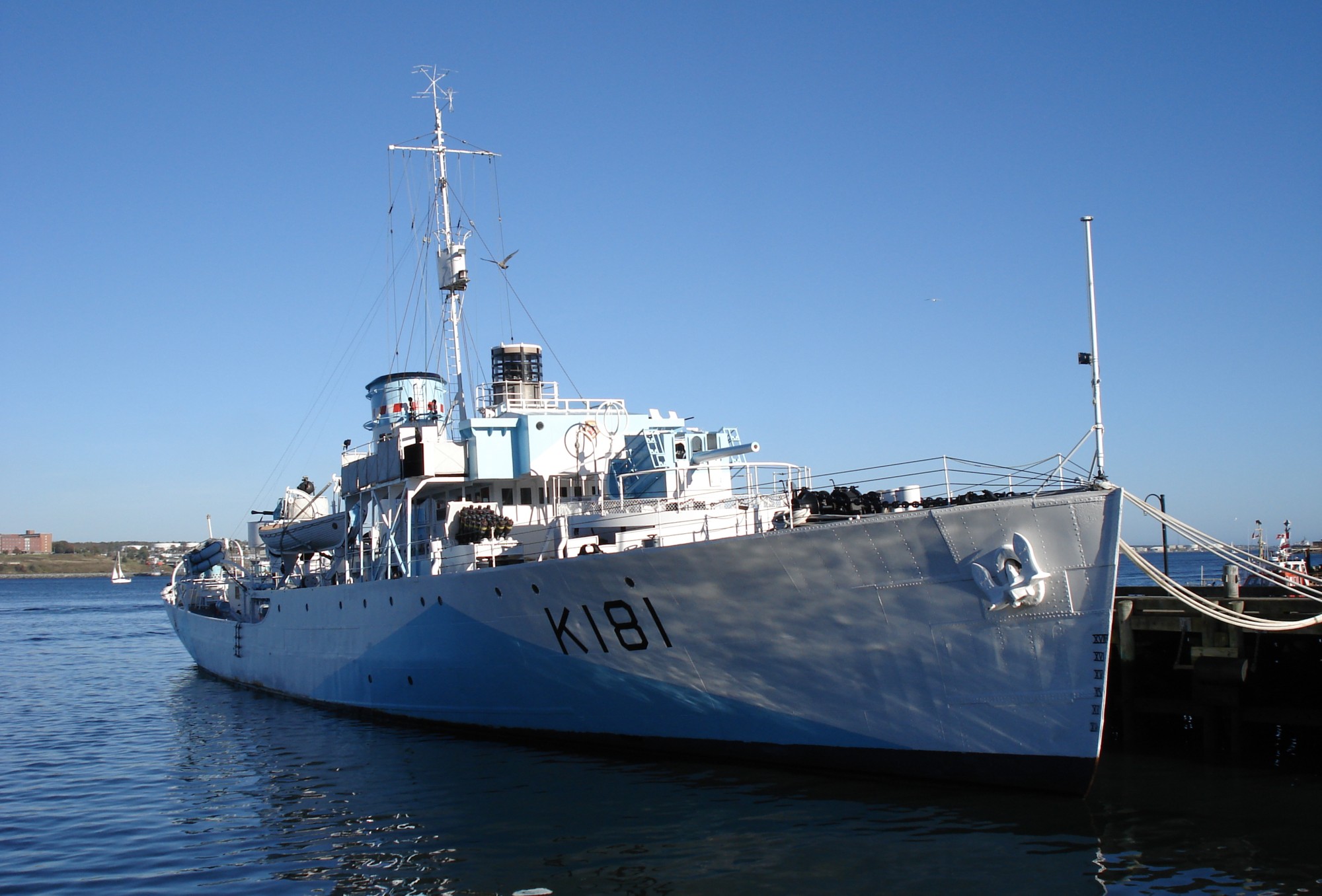
HMCS Sackville in October 2006, moored behind the Maritime Museum of the Atlantic in Halifax, Nova Scotia, and restored to her 1944 condition.
History
Canada
NameSackville
NamesakeSackville, New Brunswick
BuilderSaint John Dry Dock and Shipbuilding Company Ltd.
Laid down28 May 1940
Launched15 May 1941
Commissioned30 December 1941
Decommissioned8 April 1946
Recommissioned15 May 2026
Refit
IdentificationPennant number: K181
Honors and
awards
Atlantic 1942-44
StatusIn ceremonial commission as a museum ship in Halifax
General characteristics
Class & typeFlower-class corvette
Displacement950 tons
Length62.5 m (205 ft 1 in)
Beam10 m (32 ft 10 in)
Draught3.5 m (11 ft 6 in)
PropulsionSingle shaft, 2 fire tube Scotch boilers, 1 4-cyl. triple expansion steam engine, 2,750 hp (2,050 kW)
Speed16 knots (30 km/h; 18 mph)
Complement85
Armament
Official nameHMCS Sackville National Historic Site of Canada
Designated1988

HMCS Sackville is a Flower-class corvette that served in the Royal Canadian Navy and later served as a civilian research vessel. She is now a museum ship located in Halifax, Nova Scotia, and the last surviving Flower-class corvette. On 15 May 2026, Sackville was recommissioned into the Royal Canadian Navy on a symbolic and ceremonial basis.

Wartime service

[edit]

Sackville's keel was laid down as Patrol Vessel 2 at the Saint John Shipbuilding and Drydock Company of Saint John, New Brunswick in early 1940, the second of the Flower-class corvettes ordered by the Royal Canadian Navy. She was launched on 15 May 1941 by Mrs. J. E. W. Oland, wife of the captain of the port, with the Mayor and entire town council of her namesake town in attendance.[1] Sackville was commissioned into the Royal Canadian Navy on 30 December 1941 by Captain J. E. W. Oland, husband of the ship's sponsor.[2] Her first commanding officer, Lieutenant W. R. Kirkland, RCNR was appointed on 30 December[3] but did not join Sackville until 2 January.[2] Kirkland was discharged in March 1942 as "unsuitable" after a poor working-up trip to Newfoundland in late February. The first lieutenant reported that Kirkland had been unable to discharge his duties and had been abusive to his officers. After rescuing the survivors from the sunken Greek ship Lily, Sackville was unable to re-locate her convoy, ON 68.[4] The first lieutenant then took the step of relieving Kirkland and assuming command. The original crew was reposted to other RCN ships and the already trained crew of HMCS Baddeck under Lieutenant-Commander Alan H. Easton, RCNR was drafted onto the ship on 6 April 1942. Also in April Sackville received Canadian-built SW1C radar and worked up at Halifax and St. Margarets Bay.[5]

The ship was finally assigned to Escort Group C-3 of the Mid-Ocean Escort Force along with two others (Galt and Wetaskiwin) on 15 May 1942 to replace corvettes going for refit.[6] In August 1942 Sackville fought a series of fierce actions escorting Convoy ON 115. Deprived of air cover by heavy fog, the convoy was attacked by two successive U-boat "wolfpacks" off the coast of Newfoundland. On 3 August, Sackville caught the German submarine U-43 on the surface and, as the submarine dived, made a series of depth charge attacks which badly damaged the submarine. U-43 survived but had to retreat to France for repairs with serious damage to its engines, compressors, a leaking hatch and a crewman with internal injuries.[7] The next day Sackville attacked U-704 as it dived, causing the submarine to break off its attack leaving Sackville to rescue two survivors from an abandoned but still floating merchant ship. Only a few hours later, Sackville detected U-552 on the surface with radar and landed a four-inch shell on the submarine's conning tower followed by a depth charge. U-552 nearly sank but managed to regain control and creep back to Germany heavily damaged. Sackville's attacks had played a key role in allowing the 41 ship convoy to escape with the loss of only two ships.[8][9]

Sackville continued in her escort role until starting an extensive refit at Thompson Bros. Machinery Co. Ltd. in Liverpool, Nova Scotia in January 1943. She returned to service in April and was assigned to Escort Group C-1 where she remained until reassigned to a new group Escort Group 9 in July. The group was disbanded following the loss of three of its ships on 20–22 September and the ship assigned to group C-2, where the ship remained on Atlantic escort work until going for refit in Galveston, Texas in February 1944.

Returning to Halifax in May 1944 the vessel worked up in Bermuda and was then assigned to Escort Group C-2 which left for Derry escorting convoy HX 297 on 29 June 1944.

At Derry the boilers were cleaned, which revealed a serious leak in one of them. Repairs were unsuccessful and the ship was no longer considered suitable for convoy escort work. Since the ship had only recently been modernized she was reassigned for training at HMCS King on 29 August 1944.

However, almost immediately afterwards the decision was made to convert her to a loop layer, laying anti-submarine indicator loops across harbour entrances, her damaged boiler removed to provide storage for the cable and the 4-inch gun replaced with a pair of cranes. She remained in this role until paid off in April 1946 and laid up in reserve.

Trans-Atlantic convoys escorted

[edit]
Convoy Escort group Dates Notes
HX 175 13-15 Feb 1942[10] 27 ships escorted without loss from Newfoundland to Iceland
SC 72 28 Feb-5 March 1942[11] 19 ships escorted without loss from Newfoundland to Iceland
ON 70 11–15 March 1942[12] 30 ships escorted without loss from Iceland to Newfoundland
HX 191 MOEF group C3 28 May-5 June 1942[10] 24 ships escorted without loss from Newfoundland to Northern Ireland
ON 104 MOEF group C3 17–27 June 1942[12] 36 ships escorted without loss from Northern Ireland to Newfoundland
SC 90 MOEF group C3 6–15 July 1942[11] 32 ships escorted without loss from Newfoundland to Northern Ireland
ON 115 MOEF group C3 25 July-4 Aug 1942[12] Northern Ireland to Newfoundland; 3 ships torpedoed (2 sank)
HX 202 MOEF group C3 12-17 Aug 1942[10] 43 ships escorted without loss from Newfoundland to Iceland
ON 121 MOEF group C3 17-20 Aug 1942[12] 34 ships escorted without loss from Iceland to Newfoundland
SC 98 MOEF group C3 2-11 Sep 1942[11] 69 ships escorted without loss from Newfoundland to Northern Ireland
ON 131 MOEF group C3 19-28 Sep 1942[12] 54 ships escorted without loss from Northern Ireland to Newfoundland
HX 210 MOEF group C3 7-14 Oct 1942[10] 36 ships escorted without loss from Newfoundland to Northern Ireland
ON 141 MOEF group C3 26 Oct-3 Nov 1942[12] 59 ships escorted without loss from Northern Ireland to Newfoundland
SC 109 MOEF group C3 15-27 Nov 1942[11] Newfoundland to Northern Ireland; 2 ships torpedoed (1 sank)
ON 152 MOEF group C3 10-19 Dec 1942[12] 15 ships escorted without loss from Northern Ireland to Newfoundland
ON 184 MOEF group C1 16–25 May 1943[12] 39 ships escorted without loss from Northern Ireland to Newfoundland
HX 242 MOEF group C1 6–14 June 1943[10] 61 ships escorted without loss from Newfoundland to Northern Ireland
ON 190 MOEF group C1 25 June-3 July 1943[12] 87 ships escorted without loss from Northern Ireland to Newfoundland
HX 247 Escort Group 9 14–19 July 1943[10] 71 ships escorted without loss from Newfoundland to Northern Ireland
ON 195 Escort Group 9 1-8 Aug 1943[12] 51 ships escorted without loss from Northern Ireland to Newfoundland
HX 252 Escort Group 9 20-27 Aug 1943[10] 52 ships escorted without loss from Newfoundland to Northern Ireland
Convoys ONS 18/ON 202 Escort Group 9 19-25 Sep 1943[12] Northern Ireland to Newfoundland; 7 ships torpedoed (6 sank)
SC 143 MOEF group C2 2-11 Oct 1943[11] Newfoundland to Northern Ireland; 1 ship torpedoed & sunk
ONS 21 MOEF group C2 23 Oct-2 Nov 1943[12] 33 ships escorted without loss from Northern Ireland to Newfoundland
HX 265 MOEF group C2 11-20 Nov 1943[10] 51 ships escorted without loss from Newfoundland to Northern Ireland
ONS 24 MOEF group C2 1-13 Dec 1943[12] 29 ships escorted without loss from Northern Ireland to Newfoundland
HX 271 MOEF group C2 22-29 Dec 1943[10] 53 ships escorted without loss from Newfoundland to Northern Ireland
ONS 27 MOEF group C2 14-18 Jan 1944[12] 32 ships escorted without loss from Northern Ireland to Newfoundland
ON 220 MOEF group C2 18-19 Jan 1944[12] 54 ships escorted without loss from Northern Ireland to Newfoundland
HX 297 MOEF group C2 30 June-10 July 1944[10] 116 ships escorted without loss from Newfoundland to Northern Ireland

Civilian service

[edit]

Most Flower-class corvettes were scrapped shortly after the war, however Sackville was laid up in reserve. She was reactivated in 1952 and converted to a research vessel for the Department of Marine and Fisheries. The armament was removed, the hull repainted black in place of the original dazzle camouflage and the new pennant number 532 painted on the hull (changed to 113 in the late 1950s). A laboratory was built on the aft superstructure in 1964 and the bridge enclosed in 1968. She remained in service until December 1982, with her last cruise in July 1982.

Museum ship

[edit]

The original intention had been to acquire HMCS Louisburg, which had been sold to the Dominican Republic and renamed Juan Alejandro Acosta but this vessel was wrecked (along with another Flower-class corvette - Cristobal Colon, the former HMCS Lachute)[13] by Hurricane David in 1979. This left Sackville as the sole remaining Flower-class corvette.[14]

The ship was transferred to the Canadian Naval Corvette Trust (now the Canadian Naval Memorial Trust) on 28 October 1983 and restored to her 1944 appearance (apart from minor details in her camouflage and the presence of the "barber pole" red and white pattern around her funnel which had been removed before 1944). It had originally been planned to restore the ship to her 1942 appearance but this proved too expensive.[14]

HMCS Sackville's summer location to the right, behind the Maritime Museum of the Atlantic at the foot of Sackville Street.

She currently serves the summer months as a museum ship moored beside the Maritime Museum of the Atlantic in Halifax, Nova Scotia, while spending her winters securely in the naval dockyard at CFB Halifax under the care of Maritime Forces Atlantic, the Atlantic fleet of Royal Canadian Navy. Sackville's presence in Halifax is considered appropriate, as the port was an important North American convoy assembly port during the war.

In September 2003, Sackville broke loose during Hurricane Juan and struck the schooner Larinda, a yacht inspired by the 1767 Boston schooner HMS Sultana, moored beside her. The schooner's owners sued the Naval Memorial Trust in 2009[15] but the Nova Scotia Supreme Court ruled in Sackville's favour on 4 August 2011, concluding that the Trust had taken all necessary and appropriate precautions to secure Sackville.[16]

Sackville makes her first appearance each spring when she is towed by a naval tugboat from HMC Dockyard to a location off Point Pleasant Park on the first Sunday in May to participate in the Commemoration of the Battle of the Atlantic ceremonies held at a memorial in the park overlooking the entrance to Halifax Harbour. Sackville typically hosts several dozen Royal Canadian Navy veterans on this day and has also participated in several burials at sea for dispersing the ashes of Royal Canadian Navy veterans of the Battle of the Atlantic at this location. In 2018, the ship underwent CAN$3.5 million in repairs at CFB Halifax.[17]

Recognition

[edit]

In 1988, Sackville was designated a National Historic Site of Canada, due to her status as the last Flower-class corvette known to exist.[18]

On 4 November 1998, Canada Post issued a 45¢ stamp featuring HMCS Sackville as part of the Naval Vessels series. The stamps were designed by Dennis George Page, based on an illustration by Todd Hawkins and on photographs by Canadian Naval Memorial Trust.[19]

Greyhound

[edit]

HMCS Sackville was used as the model for the corvette, HMCS Dodge, call sign Dicky, in the 2020 film, Greyhound.[20] The producers of the movie took numerous 3D scans of the ship's exterior to create the CGI version for the movie.

[edit]

See also

[edit]

References

[edit]

Bibliography

[edit]
[edit]
Revisions and contributorsEdit on WikipediaRead on Wikipedia
from Grokipedia
HMCS Sackville is a Flower-class corvette that served in the Royal Canadian Navy (RCN) during the Second World War as a convoy escort in the Battle of the Atlantic, and is now preserved as Canada's Naval Memorial and the last surviving example of its class.[1][2] Built by Saint John Dry Dock and Shipbuilding Co. Ltd. in Saint John, New Brunswick, she was laid down on 28 May 1940, launched on 15 May 1941, and commissioned on 30 December 1941.[1][2] During her wartime service, Sackville operated primarily with the Newfoundland Escort Force and later Escort Groups C-1 and C-2, protecting transatlantic convoys from German U-boat attacks.[1] A notable engagement occurred on 3–4 August 1942, when she engaged three U-boats, damaging two, while escorting Convoy ON 115, earning her commanding officer, Lieutenant Alan Easton, the Distinguished Service Cross.[2] She underwent refits in Liverpool, Nova Scotia (January–May 1943) and Galveston, Texas (February–May 1944), and continued escort duties until the end of the war in Europe.[1] Sackville was paid off on 8 April 1946 but recommissioned on 4 August 1950 as a depot and training ship, later conducting oceanographic surveys in the Gulf of St. Lawrence from 1953 onward.[1][3] Decommissioned from active RCN service in 1982, Sackville was transferred to the Canadian Naval Memorial Trust on 28 October 1983 and restored to her 1944 wartime configuration.[1][3] Designated Canada's Naval Memorial in 1985, she honors the more than 2,000 Canadian sailors lost at sea during the Second World War and serves as a symbol of the RCN's contributions to the Allied victory.[3] In 1988, she was recognized as a National Historic Site of Canada for her role in the Battle of the Atlantic and as the sole remaining Flower-class corvette.[2] Today, Sackville operates as a museum ship berthed at the Maritime Museum of the Atlantic in Halifax, Nova Scotia, where she is open to visitors during the summer months and hosts naval and community events; she winters at HMC Dockyard.[1][3] In 2010, Queen Elizabeth II visited the vessel during her tour of Canada.[3]

Design and Construction

Class and Specifications

HMCS Sackville was a Flower-class corvette, a type of small, mass-produced anti-submarine warfare vessel designed by the British Admiralty and constructed in large numbers for the Royal Navy and its allies, including the Royal Canadian Navy, during the Second World War.[2] These ships were patterned after civilian whale catchers to enable rapid production in modest shipyards, emphasizing convoy escort duties with a focus on detecting and engaging submerged U-boats.[2] The class totaled over 290 vessels, providing critical ocean protection despite their modest size and capabilities.[4] Key specifications for Sackville and her sister ships included a standard displacement of 925 long tons (940 tonnes) and a full load displacement of 1,170 long tons (1,190 tonnes), with dimensions of 205 feet (62.5 meters) in length, 33 feet (10.1 meters) in beam, and 11 feet (3.5 meters) in draft.[4] Propulsion consisted of a single four-cylinder triple-expansion reciprocating steam engine rated at 2,750 indicated horsepower (2,050 kW), driving one shaft via two fire-tube boilers, which provided a top speed of 16 knots (30 km/h) and a range of 3,500 nautical miles (6,500 km) at 12 knots (22 km/h). The crew typically numbered 85 officers and ratings, reflecting the compact design suited for extended patrols.[1] Initial armament featured a single 4-inch (102 mm) QF Mk IV naval gun forward for surface and anti-aircraft fire, a 2-pounder (40 mm) "pom-pom" Mk VIII anti-aircraft gun aft, up to 40 depth charges launched from racks and throwers, and one Hedgehog Mk III forward-throwing anti-submarine mortar to extend attack range while maintaining sonar contact.[2] Mid-war refits added two twin 20 mm Oerlikon anti-aircraft guns for enhanced defense against aircraft, along with increased depth charge capacity.[1] In 1944, Sackville underwent a major refit in Galveston, Texas, extending her forecastle for improved seaworthiness and incorporating degaussing equipment as part of an incomplete conversion to a loop-laying vessel for mine countermeasures.[1] Anti-submarine and sensor equipment centered on ASDIC (sonar) systems, initially Type 123A or 127DV hydrophones for submerged target detection, upgraded to the more effective Type 144 sonar by mid-war for better accuracy in rough seas.[5] Surface search capabilities were provided by Type 271 centimetric radar, mounted in a lantern housing aft of the bridge, aiding in low-visibility conditions and U-boat periscope spotting.[2] These features, combined with high-frequency direction-finding (HF/DF) gear for intercepting U-boat signals, underscored the corvettes' role in the Battle of the Atlantic.[6]

Building and Commissioning

HMCS Sackville was built as the second Flower-class corvette ordered by the Royal Canadian Navy in the spring of 1940, as part of the initial expansion of Canada's naval construction program amid rising tensions in Europe.[7] Constructed by Saint John Dry Dock and Shipbuilding Co. Ltd. at their yard in Saint John, New Brunswick, her keel was laid down on 28 May 1940.[1] The ship was launched on 15 May 1941 during a public ceremony attended by the mayor and town council of Sackville, New Brunswick, along with a large crowd of local residents.[7][1] Following launch, Sackville underwent fitting out and sea trials through late 1941, which confirmed key design specifications of the Flower-class, including a top speed of 16 knots and handling capabilities suited to the rough conditions of the North Atlantic.[1] She was completed on 30 December 1941 and commissioned into Royal Canadian Navy service the same day at the builder's yard in Saint John, under the command of Lieutenant W. Kirkland, RCN.[8] Assigned pennant number K181, the vessel was named after the town of Sackville, New Brunswick, to recognize its local heritage and ongoing support for the war effort—the only RCN ship to carry this name.[1][9] After commissioning, Sackville conducted her initial shakedown cruise in Canadian waters to test systems and crew readiness.[1] She then sailed to Halifax, Nova Scotia, arriving on 12 January 1942, where she prepared for operational duties.[1]

Military Service

World War II Operations

HMCS Sackville entered active service with the Royal Canadian Navy in early 1942, joining the Newfoundland Escort Force on 13 February to provide mid-ocean protection for transatlantic convoys during the Battle of the Atlantic.[10] Assigned primarily to escort groups such as C.1, C.2, and C.3, the corvette operated out of St. John's, Newfoundland, and Derry (Londonderry), Northern Ireland, safeguarding vital supply lines against German U-boat threats.[10] Over the course of the war, Sackville participated in more than 30 convoy operations, escorting over 1,200 merchant vessels across the North Atlantic, with routes typically spanning from St. John's to Derry or Liverpool.[10] Notable assignments included Convoy ON 115 in August 1942, where the ship faced intense wolfpack attacks in the "Black Pit" mid-ocean gap, and Convoy HX 297 in May 1944, a fast eastbound convoy that arrived in Derry without losses despite heightened U-boat activity.[8][11] In anti-submarine warfare, Sackville's crew conducted several aggressive engagements, leveraging depth charges and later advanced weaponry to counter U-boat incursions. During Convoy ON 115 on 3 August 1942, the corvette detected U-43 on the surface via radar and launched a series of depth charge attacks as the submarine crash-dived, inflicting severe damage including to its engines and compressors, forcing it to retreat to France for repairs; this action earned shared credit for the U-boat's eventual sinking later that month by other Allied forces.[10][12] The same convoy saw Sackville break off an attack by U-704 with depth charges and gunfire, damaging the submarine and preventing further strikes on the convoy.[10] The ship also participated in broader wolfpack hunts in the North Atlantic, using improved tactics and coordination with escort groups to disrupt German submarine operations.[10] Sackville underwent significant refits to enhance its combat effectiveness amid evolving threats. In January 1943, at Liverpool, Nova Scotia, the corvette received structural reinforcements, improved radar (Type 271), and enhanced sonar systems, allowing better detection in poor weather conditions typical of the North Atlantic.[10][13] A second major refit occurred in February 1944 at Galveston, Texas, where it was converted for additional roles, including installation of degaussing loops for magnetic mine countermeasures, alongside boiler repairs and further electronic upgrades.[8][13] These modifications enabled continued operations in the North Atlantic, including escorting convoy ONS.348 from Londonderry in August 1944.[1] Throughout its wartime service, HMCS Sackville sustained no casualties among its crew, a testament to effective damage control and the corvette's robust design amid harsh conditions.[10] The ship earned the battle honour Atlantic 1942–1944, recognizing its role in convoy protection.[1]

Decommissioning and Immediate Post-War

As the Second World War drew to a close, HMCS Sackville's active combat role transitioned to support duties. In October 1945, while based at Halifax, the corvette underwent a refit and reconstruction to serve as a loop-laying vessel for minefield operations, with work still underway by Victory in Europe Day on 8 May 1945.[1] Following the refit, Sackville assisted in the dismantling of controlled-loop minefields in Atlantic waters, marking the conclusion of its wartime responsibilities by early April 1946.[8] This period of service came after years of intense convoy escort operations that had contributed to structural fatigue on the aging vessel.[1] On 8 April 1946, HMCS Sackville was paid off at Sorel, Quebec, and placed in reserve as part of the Royal Canadian Navy's rapid demobilization following VE Day.[1] During the late-war refit to a support role, the ship was stripped of its armaments, including its forward gun and armor plating, which were removed to facilitate conversion for non-combat duties, while its hull remained largely intact with no significant battle damage reported.[14] The Flower-class corvettes, including Sackville, were phased out due to their obsolescence in the post-war era, as their short range, limited speed, and basic design proved inadequate for modern naval requirements amid the RCN's shift to a peacetime fleet.[15] From 1946 to 1952, Sackville lay in unmaintained reserve at Sorel, with only a minimal crew assigned for basic upkeep to prevent deterioration.[16] This storage period reflected the broader RCN demobilization, which saw the fleet reduced from over 400 warships in 1945 to a core of about 50 active vessels by 1947, prioritizing the disposal or idling of wartime assets like the corvettes.[17]

Post-Military Career

Research Vessel Service

Following a period of inactivity after its post-war recommissioning as a depot ship in 1950, Sackville was refitted and converted for hydrographic and oceanographic research. It entered service as CNAV Sackville in 1953 under the Fisheries Research Board of Canada, the predecessor to the Department of Fisheries and Oceans.[18][1] The vessel was demilitarized by removing its depth charges, guns, and other wartime armaments, while new survey equipment was installed, including echo sounders for depth measurement, oceanographic winches for sampling, and onboard laboratories for data analysis.[18] These modifications transformed the corvette from a combatant into a platform for scientific inquiry, adapting its original military design—such as its robust hull and propulsion—for peaceful hydrographic and oceanographic tasks.[2] Based primarily in Halifax, Nova Scotia, with occasional operations from St. Andrews, New Brunswick, CNAV Sackville conducted extensive fisheries research, seabed mapping, and pollution studies across Atlantic Canada waters from 1953 through the 1970s.[18] Notable surveys included those in the Gulf of St. Lawrence and on the Scotian Shelf, where the ship gathered data on marine topography and resource distribution to support navigational safety and resource management.[18] The crew, reduced to 25-30 civilian personnel including scientists and technicians, operated the vessel year-round, focusing on systematic data collection rather than the high-intensity patrols of its naval past.[18] Key projects during this era encompassed cod stock assessments, which helped monitor declining fish populations in the northwest Atlantic, and early marine environmental monitoring efforts that tracked pollution impacts on coastal ecosystems.[18] These initiatives contributed to foundational Canadian oceanographic knowledge, aiding policy decisions on sustainable fisheries and habitat protection.[2] By the late 1970s, operations shifted toward coastal hydrography, with final voyages emphasizing detailed charting of nearshore areas. CNAV Sackville was decommissioned in December 1982 after nearly 30 years of research service.[16]

Lay-Up and Transfer

Following its decommissioning as a research vessel in December 1982, HMCS Sackville was laid up in Halifax Harbour, where basic measures were taken to prevent further deterioration from environmental exposure.[19] The vessel remained inactive during this period, with no operational use, as it awaited decisions on its future amid concerns over its potential scrapping.[19] In late 1982 and early 1983, advocacy efforts intensified among naval veterans, historians, and the Naval Officers Association of Canada to preserve Sackville as the last surviving Flower-class corvette.[20] These groups highlighted its historical value in representing Canada's contributions to the Battle of the Atlantic, successfully lobbying against disposal and leading to the formation of the Canadian Naval Corvette Trust in December 1982 to spearhead preservation initiatives.[21] On 28 October 1983, the Government of Canada donated Sackville to the Canadian Naval Corvette Trust (later renamed the Canadian Naval Memorial Trust), formalizing the transfer with official approval to transition the ship from federal service to a heritage asset.[1] At the time of handover, the ship's hull remained structurally sound despite years of civilian service wear, though its interiors had significantly decayed from prolonged use and neglect.[19] This transfer marked a pivotal shift for Sackville, transforming it from an obsolete research platform into a symbol of national naval heritage and a dedicated memorial to Canadian sailors.[16]

Preservation and Museum Role

Acquisition and Initial Restoration

In 1983, the Naval Officers Association of Canada spearheaded efforts to preserve HMCS Sackville as a memorial to Canadian naval personnel, leading to the formation of the volunteer Canadian Naval Memorial Trust (CNMT) to acquire, restore, and manage the vessel.[3] The ship, decommissioned by the Royal Canadian Navy in December 1982, was formally transferred to the CNMT—then known as the Canadian Naval Corvette Trust—on 28 October 1983, marking the beginning of its transition from active service to a floating museum dedicated to the Battle of the Atlantic.[1] Restoration work commenced in June 1983 at Halifax Shipyard to return Sackville to her 1944 wartime configuration as a Flower-class corvette, a process that continued through 1985 and involved removing post-war modifications such as radio and navigation equipment while reinstalling period-appropriate fittings.[22] Key efforts included the reinstallation of a 4-inch Mark 9 gun sourced from the Amherstburg Legion in Ontario, a 2-pounder pom-pom anti-aircraft gun from LaHave, Nova Scotia, depth charge throwers, and a Carley float rack, alongside the relocation of the main switchboard and conversion from DC to AC power systems.[22] The hull was thoroughly cleaned and coated with coal tar epoxy, fitted with 70 zinc anodes for corrosion protection, and reinforced with steel plates; these tasks were supported by donations, including hull coating materials from International Paints (Canada) Ltd. and funds from Maritime Command totaling $24,751.81, as well as public and municipal contributions.[22] Early challenges included a dry-docking at Halifax Industries Ltd.'s Scotiadock in 1983 for hull repairs, conducted at a reduced cost of approximately $128,627, to address deterioration from years of service.[22] Volunteers played a central role, stripping the ship of non-period elements and receiving specialized training, such as offers from radio enthusiasts to install and operate 1940s-era equipment, ensuring the vessel's authenticity and operational readiness for public display.[22] Following completion of the initial restoration, Sackville was permanently moored at the Maritime Museum of the Atlantic on the Halifax waterfront starting in 1985, where she opened to the public as Canada's Naval Memorial.[1] The first tours emphasized her role in the Battle of the Atlantic, honoring the over 2,000 Canadian sailors lost at sea during the war, with the Government of Canada designating her as such on 4 May 1985.[1]

Ongoing Maintenance and Public Operations

Since its designation as Canada's Naval Memorial in 1985, HMCS Sackville has followed a seasonal operational pattern, mooring at the Halifax waterfront from mid-May to early November for public access and tours, before returning to HMC Dockyard at CFB Halifax for winter maintenance.[23][16] This routine, established shortly after its museum conversion, allows for intensive preservation work during the off-season while maximizing visitor engagement in summer.[24] Ongoing maintenance emphasizes structural integrity and seaworthiness, with major efforts including a 2018 refit funded by up to CAD $3.5 million from the Government of Canada, which addressed hull and deck preservation at the Fleet Maintenance Facility Cape Scott in HMC Dockyard Halifax.[25] In 2024, the ship underwent a three-month dry-docking in the submarine shed at HMC Dockyard starting February 11, involving hull cleaning, sandblasting, sonic testing for integrity, repairs to engine and boiler rooms affected by humidity, and potential replacement of steel sections to combat corrosion.[26] These interventions build on earlier restorations to extend the vessel's life, with a planned maintenance program implemented by mid-2024 targeting comprehensive hull assessments.[21] Public operations center on educational outreach, attracting over 20,000 visitors annually in the pre-COVID era through self-guided tours highlighting the ship's World War II role in the Battle of the Atlantic.[27] A volunteer "ship's company" of retired naval personnel and enthusiasts staffs the vessel, providing demonstrations of wartime equipment and daily operations to immerse visitors in Canadian naval history.[28] Admission fees—CAD $10 for adults and $6 for youth—support operations, with free entry for children under six and family rates available during the summer season.[29] In September 2025, HMCS Sackville featured prominently in the inaugural Maritime Heritage Festival on the Halifax waterfront, offering free tours and interactive displays from September 13 to 14 as part of broader naval history programming organized by the Maritime Museum of the Atlantic and the Canadian Naval Memorial Trust.[30] The ship remained docked at the waterfront throughout the month for ongoing public access, aligning with its seasonal schedule. Preparations are underway for a re-commissioning ceremony on May 15, 2026, marking a milestone in its preservation as a living memorial.[31] Funding for these activities relies heavily on private donations, memberships, and corporate sponsorships managed by the Canadian Naval Memorial Trust, with a 2023-2026 strategic plan targeting CAD $4 million in fundraising by December 2025 to cover operational costs and long-term preservation.[21] Challenges include rising inflation and supply chain disruptions impacting repair expenses, alongside the need for a full hull replacement estimated at CAD $15 million by 2033 to address ongoing steel corrosion from marine exposure.[21][26]

Legacy and Recognition

Historic Designations and Honors

HMCS Sackville was designated a National Historic Site of Canada on 24 June 1988 by the Historic Sites and Monuments Board of Canada, recognizing its status as the last surviving Flower-class corvette and its significant contributions to the Battle of the Atlantic during the Second World War.[2] This designation underscores the ship's representative design features and operational role in convoy escort duties across the North Atlantic.[2] In 1998, Canada Post issued a 45-cent stamp featuring HMCS Sackville on 4 November as part of the Naval Vessels series, commemorating the 75th anniversary of the Royal Canadian Naval Reserve.[32] The stamp highlights the corvette's wartime service and enduring legacy as a symbol of Canadian naval efforts.[9] The ship earned the official Royal Canadian Navy battle honour for Atlantic 1942–1944, reflecting its participation in transatlantic convoy protection.[1] On 4 May 1985, the Government of Canada named HMCS Sackville the official Naval Memorial, dedicated to the more than 2,000 Canadian sailors lost at sea during the Battle of the Atlantic.[3] The Canadian Naval Memorial Trust's 2023–2026 strategic plan positions HMCS Sackville as a central symbol of Canada's naval heritage, emphasizing its role in preserving WWII history and connecting past service with contemporary remembrance efforts.[21] As of 2025, no additional formal designations have been awarded beyond the 1998 stamp issuance.[33]

Depictions in Media and Commemoration

HMCS Sackville served as the basis for a full-scale digital model of the fictional Flower-class corvette HMCS Dodge in the 2020 war film Greyhound, directed by Aaron Schneider and starring Tom Hanks as Commander Ernest Krause. Producers conducted 3D scans of the ship while it was docked in Halifax in late 2017 to ensure historical accuracy in depicting a Canadian escort vessel during the Battle of the Atlantic.[34][35] The ship has been featured in naval literature examining the Flower-class corvettes, such as The Flower Class Corvette Agassiz by John McKay and John Harland (1993), which details the design and service of the class, including vessels like Sackville. In documentaries, Sackville appeared in the 1993 Canadian production Lifeline to Victory, a film about convoy escorts in the Atlantic, where the actual ship was used for at-sea scenes to portray wartime operations.[36] It has also been highlighted in CBC programming on Canadian naval history during the 1990s, including segments on the Royal Canadian Navy's role in World War II. As Canada's Naval Memorial, Sackville plays a central role in annual Battle of the Atlantic commemorations, serving as a focal point for ceremonies honoring the over 2,000 Canadian sailors lost during the campaign. In 2025, the ship participated in events marking the 80th anniversary, including tie-ins with the new Maritime Heritage Festival in Halifax, where it hosted tours and exhibits alongside other historic vessels.[37][30] In broader cultural legacy, Sackville symbolizes the citizen sailors of the Royal Canadian Navy and is frequently referenced in World War II naval histories as the last surviving Flower-class corvette, underscoring the class's vital contribution to Allied victory.[8] It serves as a key asset in naval education programs, such as the Royal Canadian Navy's Naval Experience Program, where participants engage with the ship to learn about maritime heritage and leadership.[23] No significant new media depictions have emerged since the Greyhound film as of 2025.

References

User Avatar
No comments yet.