
Recent from talks
HMS Aldenham
Knowledge base stats:
Talk channels stats:
Members stats:
HMS Aldenham
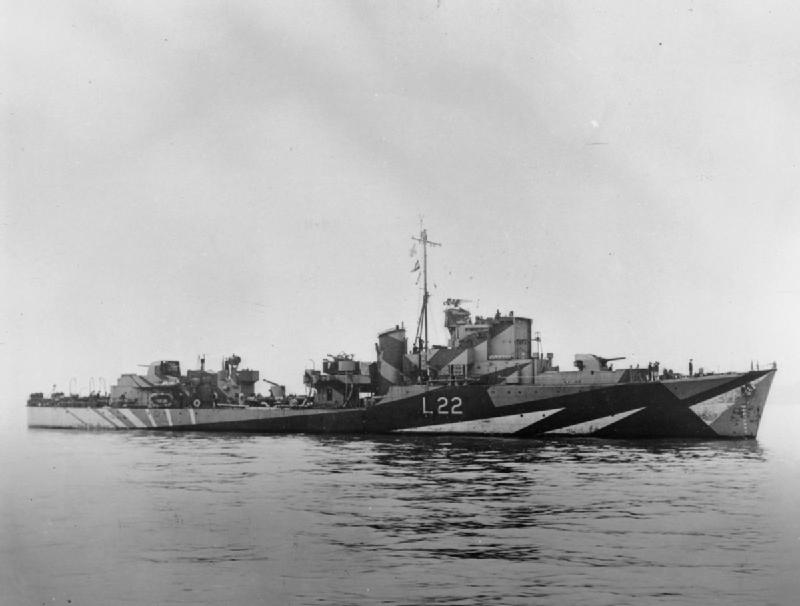
HMS Aldenham (pennant number L22) was an escort destroyer of the Type III Hunt class. The Royal Navy ordered its construction in July 1940. Upon completion in February 1942, she was deployed to convoy escort duty. Aldenham is one of the ships credited with the sinking of the U-587 on 27 March 1942. After circumnavigating Africa, she joined the Mediterranean Fleet, escorting convoys between Alexandria, Malta and Tobruk. She took part in the Allied invasion of Sicily, landings at Salerno and Anzio, the Dodecanese campaign and Operation Dragoon before being assigned to the Adriatic campaign.
On 14 December 1944, Aldenham was sunk by a naval mine in the Adriatic Sea off Pag Island after she led a Royal Navy force in a bombardment mission against targets on the island of Pag and near the town of Karlobag in support of the Yugoslav Partisans. Although the rest of the force came to pick up survivors, cold weather and severe damage to Aldenham permitted the rescue of only 63 of her crew. Her wreck, broken in two by the explosion, was first discovered by specialists of Yugoslav Navy in 1974, and documentary about search and discovery was made by TV Beograd. The wreck has been declared a war grave, where 126 crew members and three partisans aboard Aldenham at the time of the mining died. She was the last Royal Navy destroyer lost in World War II.
Aldenham was a Royal Navy Type III Hunt-class destroyer. She had an overall length of 85.34 metres (280 feet 0 inches), a beam of 9.45 metres (31 feet 0 inches) and a maximum draught of three metres (9 feet 10 inches). Aldenham had a standard displacement of 1,050 long tons (1,070 tonnes), and a full load of 1,435 long tons (1,458 tonnes). Her two Parsons geared steam turbines drove two propeller shaft. Steam was supplied by two Admiralty three-drum water-tube boilers. The turbines were rated at 13,970 kilowatts (18,730 shp) and gave Aldenham a speed of 28.3 knots (52.4 km/h; 32.6 mph) during sea trials, but she achieved up to 27 knots (50 kilometres per hour; 31 miles per hour) on deployments.
Aldenham was armed with four quick-firing four-inch (102 mm) Mk XVI naval guns on twin mounts, four anti-aircraft 40-millimetre (1.6 in) QF 2-pounder naval guns and three Oerlikon 20 mm cannons. She also had two 21-inch (533 mm) torpedo tubes, and 70–100 depth charges deployed by four throwers and two chutes.
The ship was ordered on 4 July 1940. She was laid down by Cammell Laird shipyard in Birkenhead on 22 August 1940 as construction project J 3766. Aldenham was launched on 27 August 1941 and completed on 5 February 1942.
Aldenham (Lieutenant Alex Stuart-Menteth) and its crew of 170 completed brief training at Scapa Flow before deploying for the first time on 21 March 1942, as a part of an Escort Group assigned to the convoy WS 17 sailing to the Cape of Good Hope. On 27 March, Aldenham, together with the Leamington, Grove and Volunteer, sank U-587 in the North Atlantic, due west of Ushant, France.
Circumnavigating Africa and transiting the Suez Canal accompanied by Grove, Aldenham joined the 5th Destroyer Flotilla in the Battle of the Mediterranean. She escorted 14 convoys there, protecting shipping between Alexandria, Malta and Tobruk. On 29 August 1942, she was assigned coastal bombardment duties, including the area of El Daba. Sources disagree which ships took part in the bombardment of El Daba itself. According to Jürgen Rohwer, Aldenham and Eridge were the only ships involved, while Paul Kemp places Eridge at the scene supported by fellow destroyers Croome and Hursley. Aldenham towed Eridge back to Alexandria after the latter ship was disabled by an Italian MTSM motor torpedo boat during the bombardment.
Aldenham was a part of an Allied blockade off Cap Bon in May 1943 and escorted landing craft during the Allied invasion of Sicily in July and the Salerno landings in September that year. She assisted Eskimo removing wounded when Eskimo was attacked and hit by the Luftwaffe on 15 July. Aldenham also took part in failed Dodecanese Campaign of 1944, when she sustained minor damage in an aircraft attack. After repairs in Alexandria, Aldenham saw action in Operation Shingle off Anzio, Italy, and escorted convoys between Oran, Algeria and Naples. She was based in Taranto in May, and transferred to Bari in June, before supporting Operation Dragoon, protecting landing craft off southern France. Afterwards, she sailed again to the Adriatic Sea, joining a Royal Navy flotilla fighting the Adriatic Campaign.
Hub AI
HMS Aldenham AI simulator
(@HMS Aldenham_simulator)
HMS Aldenham
HMS Aldenham (pennant number L22) was an escort destroyer of the Type III Hunt class. The Royal Navy ordered its construction in July 1940. Upon completion in February 1942, she was deployed to convoy escort duty. Aldenham is one of the ships credited with the sinking of the U-587 on 27 March 1942. After circumnavigating Africa, she joined the Mediterranean Fleet, escorting convoys between Alexandria, Malta and Tobruk. She took part in the Allied invasion of Sicily, landings at Salerno and Anzio, the Dodecanese campaign and Operation Dragoon before being assigned to the Adriatic campaign.
On 14 December 1944, Aldenham was sunk by a naval mine in the Adriatic Sea off Pag Island after she led a Royal Navy force in a bombardment mission against targets on the island of Pag and near the town of Karlobag in support of the Yugoslav Partisans. Although the rest of the force came to pick up survivors, cold weather and severe damage to Aldenham permitted the rescue of only 63 of her crew. Her wreck, broken in two by the explosion, was first discovered by specialists of Yugoslav Navy in 1974, and documentary about search and discovery was made by TV Beograd. The wreck has been declared a war grave, where 126 crew members and three partisans aboard Aldenham at the time of the mining died. She was the last Royal Navy destroyer lost in World War II.
Aldenham was a Royal Navy Type III Hunt-class destroyer. She had an overall length of 85.34 metres (280 feet 0 inches), a beam of 9.45 metres (31 feet 0 inches) and a maximum draught of three metres (9 feet 10 inches). Aldenham had a standard displacement of 1,050 long tons (1,070 tonnes), and a full load of 1,435 long tons (1,458 tonnes). Her two Parsons geared steam turbines drove two propeller shaft. Steam was supplied by two Admiralty three-drum water-tube boilers. The turbines were rated at 13,970 kilowatts (18,730 shp) and gave Aldenham a speed of 28.3 knots (52.4 km/h; 32.6 mph) during sea trials, but she achieved up to 27 knots (50 kilometres per hour; 31 miles per hour) on deployments.
Aldenham was armed with four quick-firing four-inch (102 mm) Mk XVI naval guns on twin mounts, four anti-aircraft 40-millimetre (1.6 in) QF 2-pounder naval guns and three Oerlikon 20 mm cannons. She also had two 21-inch (533 mm) torpedo tubes, and 70–100 depth charges deployed by four throwers and two chutes.
The ship was ordered on 4 July 1940. She was laid down by Cammell Laird shipyard in Birkenhead on 22 August 1940 as construction project J 3766. Aldenham was launched on 27 August 1941 and completed on 5 February 1942.
Aldenham (Lieutenant Alex Stuart-Menteth) and its crew of 170 completed brief training at Scapa Flow before deploying for the first time on 21 March 1942, as a part of an Escort Group assigned to the convoy WS 17 sailing to the Cape of Good Hope. On 27 March, Aldenham, together with the Leamington, Grove and Volunteer, sank U-587 in the North Atlantic, due west of Ushant, France.
Circumnavigating Africa and transiting the Suez Canal accompanied by Grove, Aldenham joined the 5th Destroyer Flotilla in the Battle of the Mediterranean. She escorted 14 convoys there, protecting shipping between Alexandria, Malta and Tobruk. On 29 August 1942, she was assigned coastal bombardment duties, including the area of El Daba. Sources disagree which ships took part in the bombardment of El Daba itself. According to Jürgen Rohwer, Aldenham and Eridge were the only ships involved, while Paul Kemp places Eridge at the scene supported by fellow destroyers Croome and Hursley. Aldenham towed Eridge back to Alexandria after the latter ship was disabled by an Italian MTSM motor torpedo boat during the bombardment.
Aldenham was a part of an Allied blockade off Cap Bon in May 1943 and escorted landing craft during the Allied invasion of Sicily in July and the Salerno landings in September that year. She assisted Eskimo removing wounded when Eskimo was attacked and hit by the Luftwaffe on 15 July. Aldenham also took part in failed Dodecanese Campaign of 1944, when she sustained minor damage in an aircraft attack. After repairs in Alexandria, Aldenham saw action in Operation Shingle off Anzio, Italy, and escorted convoys between Oran, Algeria and Naples. She was based in Taranto in May, and transferred to Bari in June, before supporting Operation Dragoon, protecting landing craft off southern France. Afterwards, she sailed again to the Adriatic Sea, joining a Royal Navy flotilla fighting the Adriatic Campaign.
Recent media