Hubbry Logo
MV Gay VikingMV Gay VikingMain
Open search
MV Gay Viking
Community hub
MV Gay Viking
logo
8 pages, 0 posts
0 subscribers
Be the first to start a discussion here.
MV Gay Viking
MV Gay Viking
from Wikipedia

History
Red EnsignUnited Kingdom
NameMV Gay Viking
BuilderCamper & Nicholson
Fate
  • Sunk in a collision on 5 February 1945
  • May have been re-floated and used as civilian vessel until 1973
General characteristics
Class & typeMGB 502 Motor gunboat
Displacement95 long tons (97 t)
Length117 ft (36 m)
Beam20 ft 3 in (6.17 m)
Draught4 ft 1 in (1.24 m)
Propulsion
  • 3 × Paxman VEE RB engines
  • 3 × 800 hp = 2400 hp
Speed
  • 28 knots (52 km/h) (max.)
  • 25 knots (46 km/h) (cruising)
Range2,000 nautical miles (3,700 km) at 11 kn (20 km/h)
Complement21
Armament

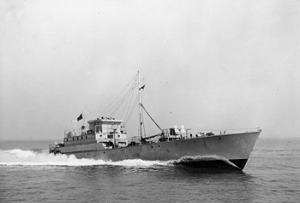
Gay Viking was a blockade runner of the British Merchant Navy. Originally under construction as a Motor Gun Boat, Gay Viking was one of eight vessels that were ordered by the Turkish Navy, but were requisitioned by the Royal Navy to serve with Coastal Forces during the Second World War. Originally intended to be HMMGB 506, the vessel was instead completed as a blockade runner for the Merchant Navy and named Gay Viking. She operated out of Hull on two separate operations to the Scandinavian countries. She was one of the more successful of her group, but was lost in a collision while returning from one of these operations. Reports indicate that she may have been salvaged after this and gone on to sail for a considerable number of years as a civilian vessel.

Construction

[edit]

Gay Viking was built by Camper and Nicholson as part of an order of eight Motor Gun Boats placed by the Turkish Navy.[1] The outbreak of the Second World War led to the Royal Navy taking over the eight vessels giving them numbers (502–509). The Navy then completed 504, 505, 506, 507 and 508 as merchant vessels to take part in Operation Bridford.[2]

The objective of Operation Bridford was to bring back to Britain quantities of ball bearings manufactured by Sweden's SKF. To do this, the vessels would have to reach Sweden by evading the German blockade of the Skagerrak. Once there, the vessels would load the ball bearings and return to Britain. British engineering plants needed the ball bearings, and other specialist equipment manufactured in Sweden and while some supplies were being flown in, the volumes were not sufficient to meet the demand.[1]

The Navy modified five of the boats from Camper and Nicholson to accommodate cargo: most of the armament were removed, and the bridge moved aft, to make way for an internal cargo bay amidships. The need to conform to Sweden's neutrality meant that the Navy also had to implement a number of other measures. First, it gave the boats names: 504 became Hopewell, 505 became Nonsuch, 506 became Gay Viking, 507 became Gay Corsair and 508 became Master Standfast. Second, they sailed under the red ensign of the merchant marine. Third, their crews consisted of civilian sailors drawn from Hull trawlermen and officers from Ellerman Lines.[1] The operation was organised and led by a civilian steel expert and former Arctic explorer, Sir George Binney, who was given the rank of Commander in the Royal Naval Volunteer Reserve to give him the required legal status in case he were captured.[3]

Their mission required the vessels to pass between German-occupied territories in waters habitually patrolled by German aircraft and surface vessels. To minimise the risk of detection, the Navy timed the voyages to pass areas of greatest danger during the hours of darkness.[1] This meant that the vessels could only make their journeys during the winter months when the duration of darkness was sufficient to give the ships the time they needed to traverse the patrolled areas.[1]

Operations

[edit]

The five boats, including Gay Viking, were first deployed in September 1943. The plan was that having arrived at the Swedish port of Lysekil they would load their cargoes, before sailing back to the Humber. Each leg of the journey would take two days.[1]

The first attempt was planned for 23 September, but had to be postponed after problems developed with the boats' engines. It instead took place on 26 October, but was plagued with mechanical problems and bad weather. Gay Viking was the only vessel to make a successful round trip, returning to Britain on 30 October carrying 40 tons of cargo.[1] Further attempts were made, many of them successfully, despite the loss of Master Standfast to the Germans on 2 November, and Nonsuch being rendered inoperable by continuing engine problems that limited her to making only one successful round trip.[1]

Gay Viking eventually made three trips, despite damaging her port engine crankshaft on 17 March 1944.[1] The operation was considered a success, but the trips were brought to an end with the return of the shorter nights in 1944. The voyages were resumed in September 1944 under the name of Operation Moonshine, and involved carrying supplies and munitions to elements of the Danish resistance.[1] Many of these attempts had to be canceled due to poor weather, or recurring difficulties with the Paxman diesel engines.[1] The operation was administered by Captain James Woodeson RA from the Special Operations Executive.[4]

Hopewell, Nonsuch and Gay Corsair all dropped their civilian names and returned to their official designation in 1944. By 1945 the Navy had advanced their numbers to the new numbering scheme and they became No. 2004, 2005 and 2007 respectively. For some reason, Gay Viking apparently continued to sail under that name.

Loss

[edit]

Three of the vessels, Hopewell (No. 2004), Nonsuch (No. 2005) and Gay Viking were deployed on one Moonshine run in early 1945. While making the return voyage on 5 February 1945, Gay Viking and Hopewell collided. The seamen of the Gay Viking were taken off and she subsequently sank.[1][5] However she appears to have subsequently been re-floated and returned to service as a civilian vessel. She was sailed under a variety of names and eventually purchased for conversion as a pleasure craft for operation in The Bahamas, under the name Bahama Viking, although the vessel remained in Denmark as late as 1973.[6] The vessel subsequently sank at wharf in Copenhagen, and was broken up for salvage in the 1990s.[7]

See also

[edit]

Notes

[edit]

References

[edit]
Revisions and contributorsEdit on WikipediaRead on Wikipedia
from Grokipedia
MV Gay Viking was a British motor vessel of the Gay Viking class that served as a during the Second , primarily tasked with transporting essential ball bearings from neutral to the by navigating the heavily patrolled strait under German control. Originally ordered as one of eight motor gunboats for the Turkish Navy by the shipyard and designated MGB 506, the vessel was requisitioned by the Royal Navy upon the outbreak of war in 1939 and completed in 1943 with modifications for merchant service, including enhanced cargo capacity of around 40–45 tons and operation under the by Ellerman Wilson Lines from bases on the estuary. Measuring 117 feet in length with a beam of 20 feet 3 inches and a displacement of 95 tons, Gay Viking was powered by three Paxman VRB diesel engines providing 3,000 brake horsepower, enabling a maximum speed of 23 knots and a range of 1,200 nautical miles at 17 knots, which, combined with nocturnal operations, allowed it to evade U-boats and E-boats. In Operation Bridford from October 1943 to March 1944, it completed three successful round trips—beginning with its first arrival at , , on 28 October 1943 and return to with 40 tons of cargo by 31 October—delivering a total of approximately 120 tons of ball bearings critical to Allied and production, despite the high risks that sank or damaged most sister ships. Later, during Operation in late 1944 and early 1945, Gay Viking shifted to supplying weapons and agents to the Danish resistance, crewed by personnel and local fishermen. The vessel met its wartime end on 5 February 1945 when it collided with the Hopewell off the Danish coast during a mission, sinking with no loss of life but requiring salvage; it was subsequently refloated, refitted, and repurposed as the pleasure craft Bahamas Viking, which remained in service in the as late as 1970.

Design and Construction

Origins as Turkish Gunboat

The MV Gay Viking was originally laid down in 1939 as part of an order for eight diesel-powered motor gun boats placed by the Turkish Navy with British shipyards to bolster coastal defense capabilities. These vessels were designed for high-speed operations in littoral waters, emphasizing agility and firepower to counter potential threats in the Aegean and Black Sea regions. The order reflected Turkey's efforts to modernize its navy amid rising tensions in Europe, procuring advanced designs from established UK builders to ensure rapid deployment. Construction of hull number 506, later to become Gay Viking, took place at Ltd. in , , one of several yards involved in fulfilling the Turkish contract. The yard, known for its expertise in fast naval craft, began work shortly after the order, utilizing all-welded steel construction for durability and reduced weight. Progress was steady through 1939, with the vessel intended for swift commissioning into Turkish service, but the outbreak of in September 1939 prompted British authorities to halt completion and requisition the incomplete hulls for national defense needs. Key technical specifications for the class, including hull 506, included a length of 117 feet (35.7 meters), a beam of approximately 20 feet (6.1 meters), and a displacement of 95 tons. Propulsion was provided by three Paxman 16-cylinder VRB diesel engines, each delivering 1,000 brake horsepower at 1,750 revolutions per minute, for a total output of 3,000 bhp driving three shafts. This configuration enabled a maximum speed of 28 knots and a continuous speed of 25 knots, with an endurance of around 2,000 nautical miles at economical speeds, making the boats suitable for extended patrols. The shallow draught of about 4 feet (1.2 meters) further supported operations in coastal and inshore environments. As motor gun boats, the vessels were planned to mount a combination of light and anti-aircraft weapons for engaging surface and aerial , including quick-firing guns such as 6-pounder or 2-pounder pieces, Oerlikon 20 mm cannons, and machine guns, alongside provisions for torpedoes to enhance offensive capability against larger warships. These armaments were selected to provide versatile firepower while maintaining the boats' emphasis on speed and maneuverability over heavy armor. The design prioritized simplicity and reliability, drawing on British interwar experience with to meet the Turkish Navy's requirements for defending against potential aggressors.

Royal Navy Seizure and Initial Commissioning

At the outbreak of the Second World War in , the requisitioned several motor gun boats under construction for the Turkish Navy, including the vessel that would become the MV Gay Viking, to prevent their delivery to a neutral power and to bolster British coastal defenses amid rising tensions in the Mediterranean as per the Anglo-Turkish alliance signed in October 1939. The requisition was part of a broader effort to secure naval assets during the early war period, with the Admiralty taking control of eight such hulls built by Camper & Nicholson in . The ship was completed in 1943 with modifications for merchant blockade running under the by Ellerman Wilson Lines. The crew comprised personnel and local Humber fishermen, with the vessel equipped with early sets for and detection.

World War II Conversion and Role

Adaptation for Blockade Running

In 1943, the MV Gay Viking, originally under construction as a for the Turkish Navy and seized by the Royal Navy, underwent significant modifications at Amos & Smith's yard in Hull to transform it into a for the . These refits, part of Operation Bridford, involved gutting the hull to install cargo holds capable of carrying up to 45 tons of deadweight, though typical loads were around 40 tons, and adding a new merchant-style bridge aft equipped with crew accommodation, a , and a radio room. Armament was substantially reduced to minimal defensive levels, including four 20 mm Oerlikon cannons in twin mounts and several .303-inch machine guns, shifting the vessel's role from combat to covert mercantile operations. The Gay Viking retained its original propulsion system of three Paxman VRB 16-cylinder diesel engines, each producing 1,000 at 1,750 rpm for a total output of 3,000 , allowing a maximum speed of 23 knots and a cruising speed of 20 knots. While the engines preserved the vessel's potential for high-speed evasion, operational speeds were often lowered to around 17 knots to extend range to approximately 1,200-1,350 miles and enhance stealth during transits. A lightweight mast and were added to support cargo handling, further emphasizing its merchant disguise while maintaining maneuverability in contested waters. To evade German patrols in the , the ship was given a low silhouette and configured with a merchant appearance under the , minimizing its naval profile for nocturnal runs. These features, combined with the vessel's shallow draft and agile design, facilitated its role in smuggling essential Swedish imports like ball bearings critical to Allied war production. The Gay Viking was crewed by a mix of civilian personnel, including officers from the Ellerman Wilson Line and experienced Hull trawlermen who provided expertise in navigating the challenging routes, under overall oversight. This manning strategy leveraged local seafaring knowledge while operating from the area, ensuring the vessel's sister ships—Hopewell, Nonsuch, Gay Corsair, and Master Standfast—could conduct synchronized blockade runs. The conversions of these vessels, three handled by Camper & Nicholson and two by Amos & Smith, were completed by late 1943, enabling the fleet's deployment in October of that year.

Strategic Importance of Ball Bearings

The German invasion and occupation of in April 1940, as part of , established a formidable across the strait, severing direct maritime access between the and the , including routes to neutral . This strategic barrier, enforced by German naval and air forces, critically disrupted Allied supply lines for essential war materials, compelling Britain to seek alternative means to procure vital commodities from Sweden. Swedish s, primarily produced by the factory in , were indispensable for British aircraft and tank manufacturing, with direct wartime imports from accounting for approximately 15 percent of Britain's total ball bearing needs, supplemented by SKF's domestic production in the UK. These precision components enabled the smooth operation of engines, turrets, and in key Allied equipment, such as Spitfire fighters and Churchill tanks, where domestic substitutes often fell short in quality and volume. Without sustained access, production bottlenecks could have severely impaired up to a third of Britain's wartime machinery output, underscoring the cargo's role in maintaining industrial momentum amid resource strains. To circumvent the blockade, the British Admiralty authorized Operation Bridford in 1943, a series of covert naval missions employing fast, low-profile vessels given a merchant appearance to evade German patrols and threats. These operations, spanning nine successful round trips from October 1943 to March 1944, successfully transported hundreds of tons of ball bearings and other specialist materials, with each delivery mitigating potential halts in aircraft assembly lines that relied heavily on Swedish precision engineering. The MV Gay Viking served as the lead vessel in a class of five purpose-built blockade runners—Hopewell, Nonsuch, Gay Viking, Gay Corsair, and Master Standfast—converted from motor gunboat hulls to carry up to 40 tons of cargo at speeds exceeding 20 knots. Collectively, these ships delivered over 347 tons of critical components under Admiralty direction, bolstering Allied war production despite the perilous gauntlet of German escorts and minefields in the North Sea.

Operational History

Initial Runs to Sweden

The initial blockade-breaking voyages of the MV Gay Viking commenced as part of Operation Bridford in late October 1943, when five converted motor gunboats—Gay Viking, Gay Corsair, Hopewell, Nonsuch, and Master Standfast—attempted to penetrate the German-controlled to secure vital war materials from neutral . Departing from the estuary near under cover of darkness on 26 October 1943, the flotilla aimed for the Swedish port of , but only Gay Viking completed the round trip successfully, as the others were forced to turn back due to severe weather and mechanical failures. Under the command of Captain H. Whitfield, Gay Viking transited the hazardous at night to minimize detection by German naval patrols, leveraging her shallow draft—derived from her original design—to navigate safer coastal routes and avoid deeper minefields sown by the enemy. The crew, comprising officers from the Ellerman Wilson Line and experienced Hull trawlermen, maintained strict and operated under the to present as a civilian merchant vessel, enhancing the element of bluff in their high-risk passage. Arriving at in the early morning of 28 October, the ship loaded approximately 40 tons of critical cargo, primarily ball bearings along with rare metals essential for British and machinery production, before departing on the return leg. The Gay Viking returned undetected to the Humber estuary on 31 , marking the pioneering success of the blockade-running effort and delivering the first substantial shipment of these materials via sea since the operation's inception. While outbound cargoes in these early voyages were minimal or absent to prioritize speed and secrecy, the focus remained on importing ball bearings and other strategic materials from . The crew reported tense sightings of German aircraft during the transit but avoided direct combat, underscoring the perilous yet calculated nature of these breakthroughs in sustaining Britain's wartime industrial needs.

Subsequent Missions and Challenges

Following the initial successful voyage in October 1943, MV Gay Viking undertook additional runs to as part of Operation Bridford, enabling the vessel to complete three successful round trips by March 1944, accumulating approximately 120 tons of critical cargo including ball bearings essential for Allied aircraft and machinery production—though the third trip suffered port engine crankshaft failure on 17 March 1944. As the operations progressed into 1944, the risks escalated significantly due to heightened German defenses; MV Gay Viking encountered reconnaissance aircraft during transits, faced near-misses with patrols in the , and battled severe weather conditions that threatened structural integrity and navigation. To mitigate these threats, the crew implemented strict operational adaptations, including night-only sailings to evade aerial detection, complete to avoid interception, and close coordination with Swedish agents on the ground for secure loading and offloading at neutral ports. In the broader fleet context, sister vessels such as Nonsuch and Hopewell also achieved successes, with Nonsuch completing at least one full round trip and contributing to the overall haul of 347.5 tons across the by March 1944, though MV Gay Viking remained a key performer in sustaining the supply line despite the mounting hazards.

Loss and Legacy

Collision and Sinking

On 5 February 1945, during the return leg of Operation Moonshine—a supply run from Hull to —MV Gay Viking collided with her Hopewell in the off the Danish coast. The vessels were part of a trio, including Nonsuch, conducting -running missions to deliver vital cargoes amid the closing stages of in . The collision occurred as the ships navigated challenging wartime conditions on their homeward journey, leading to severe damage aboard Gay Viking. She was holed and rapidly took on water, forcing the crew to abandon ship; the vessel sank shortly thereafter. No fatalities were reported, with the crew rescued by accompanying vessels. The sinking was initially deemed a , marking the end of her wartime service despite successful prior runs that had evaded German interception.

Postwar Salvage and Civilian Service

Following its sinking in a collision with the vessel Hopewell on 5 during Operation Moonshine, MV Gay Viking was refloated postwar. Postwar, the ship underwent repairs and was converted for use as a pleasure craft, marking its transition from military service to private ownership. By 1970, it had been renamed Bahamas Viking and was operating in , continuing in this capacity without reported major incidents and exemplifying the repurposing of wartime vessels for peacetime maritime activities.
Add your contribution
Related Hubs
User Avatar
No comments yet.