
Recent from talks
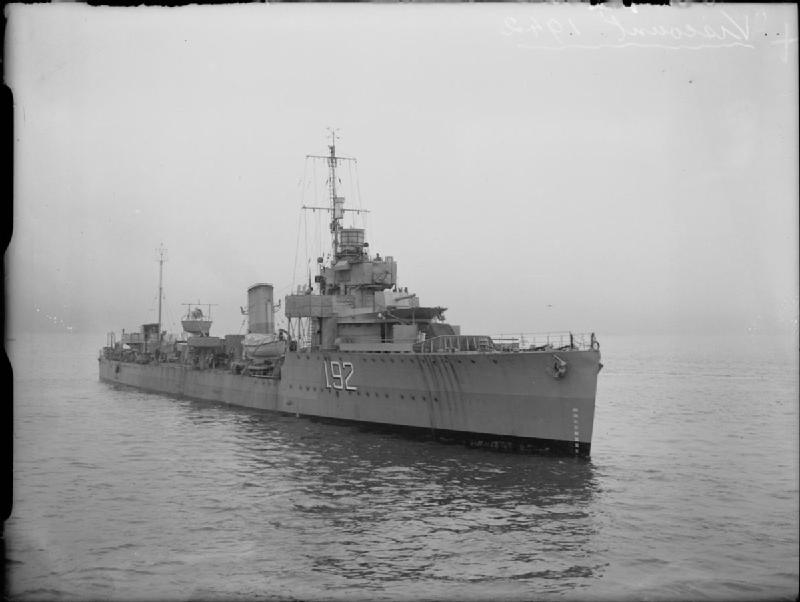
HMS Viscount (D92)
Knowledge base stats:
Talk channels stats:
Members stats:
HMS Viscount (D92)
HMS Viscount was a V-class destroyer (Thornycroft V and W class) of the British Royal Navy that saw service in the final months of World War I and in World War II.
Viscount, the first Royal Navy ship of the name, was ordered either on 30 June 1916 or in July 1916 (sources differ) as part of the 9th Order of the 1916–1917 Naval Programme and was laid down by John I. Thornycroft & Company at Woolston, Hampshire, England, on 20 December 1916. Although broadly similar, Viscount was one of only two V-Class destroyers built by Thornycrofts. HMS Viscount differed in a number of ways to other V-Class destroyers and was notably faster. Launched on 29 December 1917, she was completed on 4 March 1918 and commissioned the same day. Her original pennant number, F99, was changed first to G06 and then in April 1918 to G24; it was changed to D92 during the interwar period.
Upon completion, Viscount was assigned to the Grand Fleet, based at Scapa Flow in the Orkney Islands, in which she served for the rest of World War I. Viscount rapidly gained a reputation as an exceptionally fast ship and successfully attacked and sank at least one German U-boat which was caught on the surface. HMS Viscount was signalled to attack at full speed. The U-boat spoilt the aim of Viscount's forward battery by submerging full-speed astern. Viscount steamed over the U-boat and destroyed it by depth charges. HMS Viscount also participated in several cruises/escorts to Murmansk and Archangel during this period. Other actions included the interception and seizing of Bolshevik-controlled Russian warships in support of White Russian forces.
After the conclusion of World War I, Viscount served in the Atlantic Fleet. In 1921 she joined the light cruisers Caledon, Castor, Cordelia, and Curacoa and the destroyers Vanquisher, Vectis, Venetia, Viceroy, Violent, Winchelsea, and Wolfhound in a Baltic Sea cruise, departing the United Kingdom on 31 August 1921. The ships crossed the North Sea and transited the Kaiser Wilhelm Canal to enter the Baltic, where they called at Danzig in the Free City of Danzig; Memel in the Klaipėda Region; Liepāja, Latvia; Riga, Latvia; Tallinn, Estonia; Helsinki, Finland; Stockholm, Sweden; Copenhagen, Denmark; Gothenburg, Sweden; and Kristiania, Norway, before crossing the North Sea and ending the voyage at Port Edgar, Scotland, on 15 October 1921.
Viscount later served in the Mediterranean Fleet before being assigned to duties in home waters. She was attached to the 1st Submarine Flotilla in 1938.
When the United Kingdom entered World War II on 3 September 1939, Viscount was deployed with the 19th Destroyer Flotilla, based at Plymouth, for convoy escort and patrol duty in the English Channel and Southwestern Approaches. In January 1940, she was reassigned to the Western Approaches Command but continued her escort and patrol operations from Plymouth. On 7 January 1940, she and the destroyer Vanoc relieved two French warships as escort for Convoy HG 13 during the final leg of its voyage from Gibraltar to the United Kingdom; the destroyers Venetia and Volunteer and the trawler Arctic Ranger joined the escort on 8 January 1940, and Viscount detached from it on 10 January. On 18 February 1940, Viscount and Vanquisher relieved a French warship as the escort for Convoy HG 18 during the final portion of its voyage from Gibraltar to Liverpool, detaching to return to Plymouth when it arrived at Liverpool on 19 February 1940. On 8 April 1940, Viscount, the destroyers Vimy and Witch, and the Shoreham-class sloop Rochester relieved a French warship as the escort of Convoy HG 25F for the last leg of its voyage from Gibraltar to Liverpool; although Vimy and Witch detached the next day, Viscount and Rochester stayed with the convoy until arrived at Liverpool on 11 April 1940. In April, Western Approaches Command moved its headquarters to Liverpool, and as a result Viscount's base was changed from Plymouth to Liverpool.
In May 1940, Viscount's pennant number was changed to I92. That month, she was assigned to operations related to the Norwegian Campaign in the aftermath of the April 1940 German invasion of Norway and Denmark. On 17 May 1940, she joined the destroyers Diana and Veteran in escorting the aircraft carrier HMS Glorious from the River Clyde in Scotland to the Norwegian coast. On 7 June 1940, Viscount, the destroyers Antelope, Witherington and Wolverine, and the escort destroyer Atherstone departed the United Kingdom to meet a convoy of troopships that had been delayed by fog. Later that day, the destroyers rendezvoused with the troopships – carrying Allied personnel evacuated from Norway as the campaign there ended in the German conquest of the country – and the repair ship Vindictive and took them under escort to the Clyde. The convoy came under attack by German aircraft on 8 June 1940, but the escorts drove the German planes off.
Viscount returned to her North Atlantic convoy escort duty in July 1940. In September 1940 she detached from it to join Witherington and the destroyers Vansittart and Whitehall in escorting the auxiliary minelayers Menestheus, Port Napier, Port Quebec, and Southern Prince while they laid mines in the Northern Barrage in Operation SN42.
Hub AI
HMS Viscount (D92) AI simulator
(@HMS Viscount (D92)_simulator)
HMS Viscount (D92)
HMS Viscount was a V-class destroyer (Thornycroft V and W class) of the British Royal Navy that saw service in the final months of World War I and in World War II.
Viscount, the first Royal Navy ship of the name, was ordered either on 30 June 1916 or in July 1916 (sources differ) as part of the 9th Order of the 1916–1917 Naval Programme and was laid down by John I. Thornycroft & Company at Woolston, Hampshire, England, on 20 December 1916. Although broadly similar, Viscount was one of only two V-Class destroyers built by Thornycrofts. HMS Viscount differed in a number of ways to other V-Class destroyers and was notably faster. Launched on 29 December 1917, she was completed on 4 March 1918 and commissioned the same day. Her original pennant number, F99, was changed first to G06 and then in April 1918 to G24; it was changed to D92 during the interwar period.
Upon completion, Viscount was assigned to the Grand Fleet, based at Scapa Flow in the Orkney Islands, in which she served for the rest of World War I. Viscount rapidly gained a reputation as an exceptionally fast ship and successfully attacked and sank at least one German U-boat which was caught on the surface. HMS Viscount was signalled to attack at full speed. The U-boat spoilt the aim of Viscount's forward battery by submerging full-speed astern. Viscount steamed over the U-boat and destroyed it by depth charges. HMS Viscount also participated in several cruises/escorts to Murmansk and Archangel during this period. Other actions included the interception and seizing of Bolshevik-controlled Russian warships in support of White Russian forces.
After the conclusion of World War I, Viscount served in the Atlantic Fleet. In 1921 she joined the light cruisers Caledon, Castor, Cordelia, and Curacoa and the destroyers Vanquisher, Vectis, Venetia, Viceroy, Violent, Winchelsea, and Wolfhound in a Baltic Sea cruise, departing the United Kingdom on 31 August 1921. The ships crossed the North Sea and transited the Kaiser Wilhelm Canal to enter the Baltic, where they called at Danzig in the Free City of Danzig; Memel in the Klaipėda Region; Liepāja, Latvia; Riga, Latvia; Tallinn, Estonia; Helsinki, Finland; Stockholm, Sweden; Copenhagen, Denmark; Gothenburg, Sweden; and Kristiania, Norway, before crossing the North Sea and ending the voyage at Port Edgar, Scotland, on 15 October 1921.
Viscount later served in the Mediterranean Fleet before being assigned to duties in home waters. She was attached to the 1st Submarine Flotilla in 1938.
When the United Kingdom entered World War II on 3 September 1939, Viscount was deployed with the 19th Destroyer Flotilla, based at Plymouth, for convoy escort and patrol duty in the English Channel and Southwestern Approaches. In January 1940, she was reassigned to the Western Approaches Command but continued her escort and patrol operations from Plymouth. On 7 January 1940, she and the destroyer Vanoc relieved two French warships as escort for Convoy HG 13 during the final leg of its voyage from Gibraltar to the United Kingdom; the destroyers Venetia and Volunteer and the trawler Arctic Ranger joined the escort on 8 January 1940, and Viscount detached from it on 10 January. On 18 February 1940, Viscount and Vanquisher relieved a French warship as the escort for Convoy HG 18 during the final portion of its voyage from Gibraltar to Liverpool, detaching to return to Plymouth when it arrived at Liverpool on 19 February 1940. On 8 April 1940, Viscount, the destroyers Vimy and Witch, and the Shoreham-class sloop Rochester relieved a French warship as the escort of Convoy HG 25F for the last leg of its voyage from Gibraltar to Liverpool; although Vimy and Witch detached the next day, Viscount and Rochester stayed with the convoy until arrived at Liverpool on 11 April 1940. In April, Western Approaches Command moved its headquarters to Liverpool, and as a result Viscount's base was changed from Plymouth to Liverpool.
In May 1940, Viscount's pennant number was changed to I92. That month, she was assigned to operations related to the Norwegian Campaign in the aftermath of the April 1940 German invasion of Norway and Denmark. On 17 May 1940, she joined the destroyers Diana and Veteran in escorting the aircraft carrier HMS Glorious from the River Clyde in Scotland to the Norwegian coast. On 7 June 1940, Viscount, the destroyers Antelope, Witherington and Wolverine, and the escort destroyer Atherstone departed the United Kingdom to meet a convoy of troopships that had been delayed by fog. Later that day, the destroyers rendezvoused with the troopships – carrying Allied personnel evacuated from Norway as the campaign there ended in the German conquest of the country – and the repair ship Vindictive and took them under escort to the Clyde. The convoy came under attack by German aircraft on 8 June 1940, but the escorts drove the German planes off.
Viscount returned to her North Atlantic convoy escort duty in July 1940. In September 1940 she detached from it to join Witherington and the destroyers Vansittart and Whitehall in escorting the auxiliary minelayers Menestheus, Port Napier, Port Quebec, and Southern Prince while they laid mines in the Northern Barrage in Operation SN42.
Recent media