



Community hub
Wikipedia
HVM Racing
View on Wikipedia | This article needs additional citations for verification. (December 2025) |

HVM Racing was an auto racing team owned by Keith Wiggins that competed in the IndyCar Series. It competed in the Champ Car World Series in 2007 as Minardi Team USA when it was co-owned by Paul Stoddart.[1] It has a long history of changes of ownership, beginning as Bettenhausen Motorsports and including a previous incarnation as CTE-HVM Racing, co-owned by actor/comedian Cedric the Entertainer.
Its 2007 driver lineup was Dan Clarke and former Formula One driver Robert Doornbos, who previously raced for Minardi F1.
In the first race of the season, the 2007 Las Vegas Grand Prix, Robert Doornbos made the most successful debut since Nigel Mansell in 1993, finishing second on the podium.
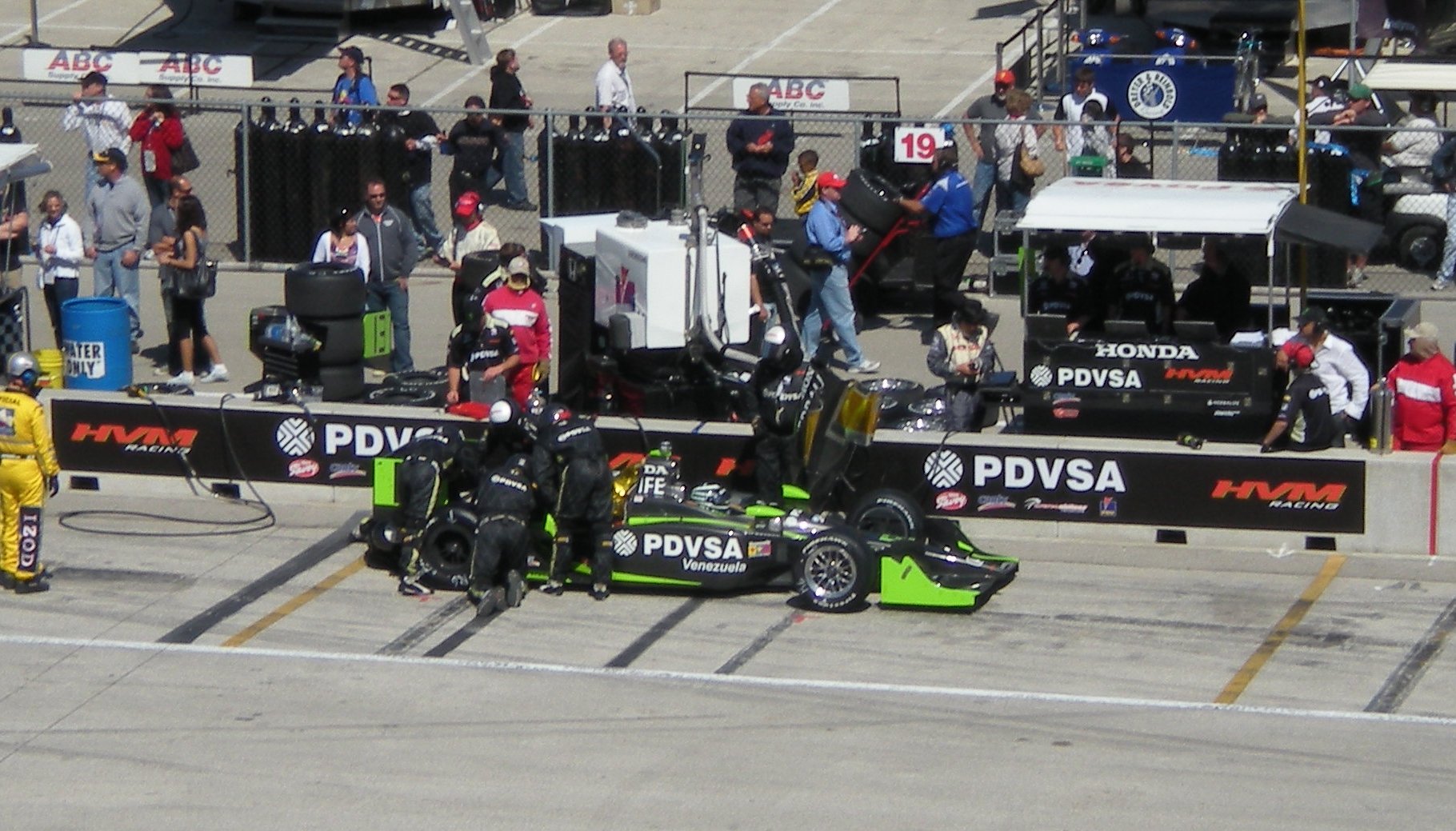
They also made the distinction of being the only team willing to run a car numbered 13 full-time, with driver E. J. Viso, when they did so for the 2009 IndyCar Series season, despite negative superstitions from the past about running it in any form of motorsport.
History
[edit]Bettenhausen Motorsports
[edit]The team began in 1986 as Bettenhausen Motorsports, with Tony Bettenhausen Jr. serving as both the team owner and primary driver through 1991. Bettenhausen began to reduce his role as a driver beginning in 1992 before making his final CART appearance in the 1993 Indianapolis 500. After Bettenhausen's retirement from driving, the team hired on several notable drivers over their tenure. Formula One veteran Stefan Johansson was the team's primary driver from 1993–1996, while future stars Patrick Carpentier and Hélio Castroneves drove for the team in 1997 and 1998, respectively. During most of the 1990s, Bettenhausen Motorsports' cars were primarily dark blue, white and red with Alumax Aluminum sponsorship. The 1992 car appeared in the cover of the 1993 video game IndyCar Racing.
For 1999, the team signed Shigeaki Hattori as their primary driver, but ran only a partial schedule. Hattori, however, struggled, and ultimately had his competitor's license revoked by chief steward Wally Dallenbach Sr. before the race at Laguna Seca due to a high number of crashes and spins throughout the season.
Beginning of the Keith Wiggins era
[edit]Before the 2000 season started, Bettenhausen, his wife and two business associates were killed in a plane crash on their way home from vacation in Florida. The team was renamed Herdez Competition as Michel Jourdain Jr. came aboard with Wiggins taking over as co-owner and managing director. Two uncompetitive seasons followed and Mario Domínguez was brought into the team in 2002. A fortunate victory came at Surfers Paradise in a water-logged event, as Dominguez started last and failed to pass a single car on track but benefited from pit strategy.
The win boosted his confidence and the team recorded a 1-2 result at Miami, Dominguez leading Roberto Moreno, was the highlight of a much-improved 2003 season, finishing fifth in the championship. Ryan Hunter-Reay came into the team in 2004 and led all 250 laps at The Milwaukee Mile from the pole position. Herdez sponsorship faded at the end of the year and for 2005, with the team now called HVM, Wiggins was forced to take on pay-drivers Björn Wirdheim and Ronnie Bremer. Despite Wirdheim's impressive performances in the 2003 International Formula 3000 season, his subsequent championship title, and Jaguar F1 testing experience, he failed to regularly beat Bremer during the season. Both of their funds dried up, however, before the end of the season and several other drivers had chances in the team's two cars.
Cedric the Entertainer became a co-owner late in the season and added a celebrity presence to the field. The cars that year ran a distinctive gunmetal gray livery with Cedric's A Bird and A Bear entertainment company on the sidepods. Nelson Philippe won in Australia and the team recorded their best season with a fourth place in the championship by Philippe.
Minardi Team USA
[edit]In 2006, Paul Stoddart, former owner of the Minardi Formula One team, bought an interest in the team and renamed it Minardi Team USA. For the 2007 season, Stoddart and Wiggins lined up the services of Dan Clarke and Red Bull F1 Racing test driver Robert Doornbos. With Doornbos the team began competing for podium positions regularly. The team scored its first win under the Minardi Team USA banner at the 2007 Champ Car Grand Prix de Mont Tremblant. Doornbos went on to capture another win at San Jose, and his tally for 2007 was 2 wins and 6 podiums. Doornbos went on to finish 3rd in Championship standings, earn Rookie of the Year, and was the highest finishing Rookie in the Champ Car World Series since Juan Pablo Montoya in 1999. Doornbos also won the award for Hard Charger, improving the most positions during the race.

Dan Clarke had a season plagued with bad luck, but had a bright spot when he finished 2nd at Road America, though he was involved in a high-speed incident with Doornbos, which hurt the Dutchman's championship hopes. Clarke later triggered a multi-car pile-up during free practice at Zolder, and was suspended from competition for the race weekend.
HVM in IndyCar
[edit]In 2008, following American open wheel unification, the team moved to the IRL IndyCar Series with E. J. Viso as its driver. The team also participated in the Long Beach Grand Prix with two more cars under the Minardi Team USA name for Nelson Philippe and Roberto Moreno.[2] Viso finished the 2008 season with seven top-10 finishes and a season-best fourth-place finish at St. Petersburg.
Viso stayed in the team in 2009 and the team aligned itself with the Indy Lights team Michael Crawford Motorsports, renaming it HVM Indy Lights. The Indy Lights team ran its first race at Infineon Raceway in August 2009 with driver Juan Pablo Garcia. Ryan Hunter-Reay tested the team's IndyCar at Sebring two weeks before the 2009 season opener at St. Petersburg and appeared to become the second driver for the team, but signed with Vision Racing instead. Nelson Philippe joined the team as its second driver for the Indianapolis 500.[3] Robert Doornbos returned to HVM in August 2009, piloting the #33 for the remainder of the 2009 season.

For the 2010 season, HVM Racing signed Switzerland's Simona de Silvestro full-time to drive the #78 Team Stargate Worlds entry. de Silvestro was one of five women to compete in the IndyCar Series in 2010, along with Ana Beatriz, Milka Duno, Sarah Fisher, and Danica Patrick, and finished 19th in the overall points standings. She was the second highest-placed female in the points standings, behind Danica Patrick, who finished tenth. de Silvestro's best finish in 2010 came at Mid–Ohio Sports Car Course, where she finished in eighth place.

On October 6, 2010, just four days after the 2010 season concluded, HVM Racing announced that they would be bringing de Silvestro back to the team in 2011 in the #78 entry.[4]
On October 30, 2012, de Silvestro signed on to KV Racing Technology for 2013,[5] leaving HVM without a driver or a sponsor. However, former KV driver E. J. Viso had intended to run his own team for 2013, but had little luck. HVM and Viso joined forces with Andretti Autosport to run Viso as a satellite team for Andretti. On 11 November 2015 the team was listed as up for auction officially listing the team as defunct.[6]
List of Drivers for Bettenhausen/Herdez/HVM/CTE-HVM/Minardi Team USA
[edit] Gary Bettenhausen (1982–1983, 1996)
- Tony Bettenhausen Jr. (1986–1993)
 Ronnie Bremer (2005)
 Patrick Carpentier (1997)
 Hélio Castroneves (1998)
 Dan Clarke (2006–2007)
 Simona de Silvestro (2010–2012)
 Fabrizio del Monte (2005)
 Mario Domínguez (2002–2004, 2007)
 Robert Doornbos (2007, 2009)
- Roberto González (2003)
 Shigeaki Hattori (1999)
- Ryan Hunter-Reay (2004)
 Stefan Johansson (1992–1996)
- Michel Jourdain Jr. (2000–2001)
- Rodolfo Lavin (2005)
- Roberto Moreno (2003, 2008)
 Nelson Philippe (2006, 2008, 2009)
- Homero Richards (2005)
- Gualter Salles (1999)
- Alex Sperafico (2005)
 E. J. Viso (2008–2009)
- Björn Wirdheim (2005)
Results
[edit]CART/CCWS
[edit]IndyCar Series
[edit]| Year | Car | Drivers | Races | Wins | Poles | Fast laps | Points | D.C. |
|---|---|---|---|---|---|---|---|---|
| 2008 | Dallara-Honda Panoz-Cosworth |
 Ernesto Viso Ernesto Viso
|
17 | 0 | 0 | 0 | 286 | 18th |
| 2009 | Dallara-Honda | Ernesto Viso
|
17 | 0 | 0 | 0 | 248 | 18th |
 Nelson Philippe Nelson Philippe
|
1 | 0 | 0 | 0 | 16 | 35th | ||
 Robert Doornbos Robert Doornbos
|
5 | 0 | 0 | 0 | 283 | 16th | ||
| 2010 | Dallara-Honda |  Simona de Silvestro Simona de Silvestro
|
17 | 0 | 0 | 0 | 242 | 19th |
| 2011 | Dallara-Honda | Simona de Silvestro
|
15 | 0 | 0 | 1 | 225 | 20th |
| 2012 | Dallara-Lotus | Simona de Silvestro
|
14 | 0 | 0 | 0 | 182 | 24th |
Complete CART / Champ Car World Series results
[edit](key) (results in bold indicate pole position) (results in italics indicate fastest lap)
| Year | Chassis | Engine | Tyres | Drivers | No. | 1 | 2 | 3 | 4 | 5 | 6 | 7 | 8 | 9 | 10 | 11 | 12 | 13 | 14 | 15 | 16 | 17 | 18 | 19 | 20 |
|---|---|---|---|---|---|---|---|---|---|---|---|---|---|---|---|---|---|---|---|---|---|---|---|---|---|
| Bettenhausen Motorsports | |||||||||||||||||||||||||
| 1986 | PHX | LBH | INDY | MIL | POR | MEA | CLE | TOR | MCH | POC | MOH | SAN | MCH | ROA | LAG | PHX | |||||||||
| March 86C | Cosworth DFX V8t | G |  Tony Bettenhausen Jr. Tony Bettenhausen Jr.
|
16 | 28 | ||||||||||||||||||||
| 1987 | LBH | PHX | INDY | MIL | POR | MEA | CLE | TOR | MCH | POC | ROA | MOH | NAZ | LAG | MIA | ||||||||||
| March 86C | Cosworth DFX V8t | G | Tony Bettenhausen Jr.
|
16 | 11 | 15 | 10 | DNQ | 13 | 20 | DNQ | 11 | 22 | 15 | 25 | ||||||||||
| 1988 | PHX | LBH | INDY | MIL | POR | CLE | TOR | MEA | MCH | POC | MOH | ROA | NAZ | LAG | MIA | ||||||||||
| March 86C Lola T87/00 |
Cosworth DFX V8t | G | Tony Bettenhausen Jr.
|
16 | 6 | DNQ | 33 | 19 | 15 | 17 | 8 | 4 | 15 | 16 | 16 | 13 | 26 | ||||||||
| Lola T87/00 | Dennis Vitolo
|
11 | |||||||||||||||||||||||
| 1989 | PHX | LBH | INDY | MIL | DET | POR | CLE | MEA | TOR | MCH | POC | MOH | ROA | NAZ | LAG | ||||||||||
| Lola T87/00 Lola T88/00 |
Cosworth DFX V8t | G | Tony Bettenhausen Jr.
|
16 | DNQ | DNQ | |||||||||||||||||||
| Dennis Vitolo
|
DNQ | DNQ | |||||||||||||||||||||||
| Jean-Pierre Frey
|
15 | ||||||||||||||||||||||||
| John Paul Jr.
|
16 | ||||||||||||||||||||||||
| Steve Chassey
|
28 | 29 | |||||||||||||||||||||||
 Jon Beekhuis Jon Beekhuis
|
13 | 24 | 15 | ||||||||||||||||||||||
| Michael Greenfield
|
DNQ | ||||||||||||||||||||||||
| 1990 | PHX | LBH | INDY | MIL | DET | POR | CLE | MEA | TOR | MCH | DEN | VAN | MOH | ROA | NAZ | LAG | |||||||||
| Lola T88/00 | Cosworth DFX V8t | G |  Guido Daccò Guido Daccò
|
16 | 23 | ||||||||||||||||||||
| Lola T89/00 | Tony Bettenhausen Jr.
|
20 | DNS | 22 | |||||||||||||||||||||
| Buick 3300 V6t | 26 | 13 | 16 | 17 | 12 | 10 | 26 | 22 | 24 | ||||||||||||||||
| 1991 | SFR | LBH | PHX | INDY | MIL | DET | POR | CLE | MEA | TOR | MCH | DEN | VAN | MOH | ROA | NAZ | LAG | ||||||||
| Penske PC-19 | Chevrolet 265A V8t | G | Tony Bettenhausen Jr.
|
16 | 10 | 12 | 18 | 9 | 12 | 13 | 13 | 13 | 21 | 11 | 5 | 10 | 18 | 18 | 13 | 10 | 16 | ||||
| Cornelius Euser
|
90 | 10 | |||||||||||||||||||||||
| 1992 | SFR | PHX | LBH | INDY | DET | POR | MIL | NHA | TOR | MCH | CLE | ROA | VAN | MOH | NAZ | LAG | |||||||||
| Penske PC-20 | Chevrolet 265A V8t | G | Tony Bettenhausen Jr.
|
16 | 13 | 11 | 15 | DNQ | 21 | 18 | 9 | ||||||||||||||
 Stefan Johansson Stefan Johansson
|
3 | 10 | 11 | 9 | 19 | 3 | 6 | 21 | 11 | ||||||||||||||||
| 1993 | SFR | PHX | LBH | INDY | MIL | DET | POR | CLE | TOR | MCH | NHA | ROA | VAN | MOH | NAZ | LAG | |||||||||
| Penske PC-22 | Chevrolet 265C V8t | G | Stefan Johansson
|
16 | 12 | 21 | 26 | 11 | 25 | 20 | 26 | 4 | 24 | 23 | 14 | 21 | 3 | 26 | 7 | 6 | |||||
| Scott Sharp
|
33 | 22 | |||||||||||||||||||||||
| Tony Bettenhausen Jr.
|
76 | 20 | |||||||||||||||||||||||
| 1994 | SFR | PHX | LBH | INDY | MIL | DET | POR | CLE | TOR | MCH | MOH | NHA | VAN | ROA | NAZ | LAG | |||||||||
| Penske PC-22 | Ilmor 265D V8t | G | Stefan Johansson
|
16 | 5 | 4 | 10 | 15 | 26 | 22 | 8 | 5 | 14 | 14 | 12 | 23 | 26 | 8 | 5 | 12 | |||||
| Ilmor 265C V8t | Gary Bettenhausen
|
61 | DNQ | ||||||||||||||||||||||
| Ilmor 265D V8t Ilmor 265C V8t |
 Gary Brabham Gary Brabham
|
76 | 24 | ||||||||||||||||||||||
| Robbie Groff
|
13 | 13 | |||||||||||||||||||||||
| 1995 | MIA | SFR | PHX | LBH | NAZ | INDY | MIL | DET | POR | ROA | TOR | CLE | MCH | MOH | NHA | VAN | LAG | ||||||||
| Penske PC-23 | Mercedes-Benz IC108B V8t | G | Stefan Johansson
|
16 | 22 | 17 | 24 | 6 | 3 | DNQ | 21 | 11 | 6 | 10 | 14 | 8 | 6 | 23 | 25 | 4 | 14 | ||||
| Reynard 94i | Ford XB V8t | 16 | |||||||||||||||||||||||
| 1996 | MIA | RIO | SFR | LBH | NAZ | 500 | MIL | DET | POR | CLE | TOR | MCH | MOH | ROA | VAN | LAG | |||||||||
| Reynard 96i | Mercedes-Benz IC108C V8t | G | Stefan Johansson
|
16 | 19 | 23 | 6 | 19 | 19 | 16 | 27 | 7 | 9 | 12 | 17 | 5 | 11 | 4 | 17 | 21 | |||||
| Penske PC-23 | Mercedes-Benz IC108B V8t | Gary Bettenhausen
|
26 | 21 | |||||||||||||||||||||
| 1997 | MIA | SFR | LBH | NAZ | RIO | GAT | MIL | DET | POR | CLE | TOR | MCH | MOH | ROA | VAN | LAG | FON | ||||||||
| Reynard 97i | Mercedes-Benz IC108D V8t | G | Patrick Carpentier
|
16 | 9 | 15 | 15 | 12 | 28 | 2 | 8 | 15 | 16 | 12 | 16 | 15 | 15 | 27 | DNS | ||||||
 Roberto Moreno Roberto Moreno
|
15 | 10 | |||||||||||||||||||||||
| 1998 | MIA | MOT | LBH | NAZ | RIO | GAT | MIL | DET | POR | CLE | TOR | MCH | MOH | ROA | VAN | LAG | HOU | SFR | FON | ||||||
| Reynard 98i | Mercedes-Benz IC108E V8t | G | Hélio Castroneves
|
16 | 24 | 11 | 9 | 23 | 23 | 7 | 2 | 12 | 13 | 27 | 10 | 12 | 17 | 26 | 24 | 23 | 24 | 21 | 10 | ||
| 1999 | MIA | MOT | LBH | NAZ | RIO | GAT | MIL | POR | CLE | ROA | TOR | MCH | DET | MOH | CHI | VAN | LAG | HOU | SRF | FON | |||||
| Reynard 98i | Mercedes-Benz IC108E V8t | F |  Shigeaki Hattori Shigeaki Hattori
|
16 | DNS | 20 | 26 | Wth | 15 | 23 | 28 | 23 | 17 | Wth | |||||||||||
| Gualter Salles
|
17 | 10 | |||||||||||||||||||||||
| 2000 | MIA | LBH | RIO | MOT | NAZ | MIL | DET | POR | CLE | TOR | MCH | CHI | MOH | ROA | VAN | LAG | GAT | HOU | SRF | FON | |||||
| Lola B2K/00 | Mercedes-Benz IC108F V8t | F |  Michel Jourdain Jr. Michel Jourdain Jr.
|
16 | 14 | 11 | 15 | 12 | 18 | 18 | 8 | 23 | 22 | 19 | 15 | 11 | 15 | 18 | 23 | 24 | 16 | 18 | 7 | 11 | |
| 2001 | MTY | LBH | NAZ | MOT | MIL | DET | POR | CLE | TOR | MCH | CHI | MOH | ROA | VAN | LAU | ROC | HOU | LAG | SRF | FON | |||||
| Lola B01/00 | Ford XF V8t | F | Michel Jourdain Jr.
|
16 | 17 | 13 | 13 | 11 | 13 | 25 | 15 | 25 | 16 | 3 | 23 | 17 | 17 | 6 | 17 | 19 | 25 | 23 | 7 | 16 | |
| Herdez Competition | |||||||||||||||||||||||||
| 2002 | MTY | LBH | MOT | MIL | LAG | POR | CHI | TOR | CLE | VAN | MOH | ROA | MTL | DEN | ROC | MIA | SFR | FON | MXC | ||||||
| Lola B02/00 | Ford XF V8t | B | Mario Domínguez
|
16 | 17 | 14 | 11 | 17 | |||||||||||||||||
| 55 | 15 | 10 | 11 | 18 | 17 | 10 | 16 | 8 | 17 | 14 | 13 | 11 | 1 | 16 | 18 | ||||||||||
| 2003 | STP | MTY | LBH | BRH | LAU | MIL | LAG | POR | CLE | TOR | VAN | ROA | MOH | MTL | DEN | MIA | MXC | SFR | |||||||
| Lola B02/00 | Ford XFE V8t | B | Roberto Moreno
|
4 | 5 | 6 | 17 | 7 | 10 | 19 | 15 | 9 | 18 | 6 | 17 | 7 | 19 | 7 | 16 | 2 | 16 | ||||
| Roberto González
|
10 | ||||||||||||||||||||||||
| Mario Domínguez
|
55 | 14 | 13 | 5 | 3 | 2 | 8 | 10 | 10 | 5 | 12 | 10 | 14 | 16 | 5 | 7 | 1 | 3 | 10 | ||||||
| 2004 | LBH | MTY | MIL | POR | CLE | TOR | VAN | ROA | DEN | MTL | LAG | LSV | SFR | MXC | |||||||||||
| Lola B02/00 | Ford XFE V8t | B | Ryan Hunter-Reay
|
4 | 7 | 8 | 1* | 12 | 11 | 8 | 8 | 4 | 16 | 18 | 5 | 13 | 5 | 19 | |||||||
| Mario Domínguez
|
55 | 5 | 3 | 8 | 17 | 8 | 17 | 6 | 5 | 4 | 3 | 11 | 7 | 3 | 8 | ||||||||||
| HVM Racing | |||||||||||||||||||||||||
| 2005 | LBH | MTY | MIL | POR | CLE | TOR | EDM | SJO | DEN | MTL | LSV | SRF | MXC | ||||||||||||
| Lola B02/00 | Ford XFE V8t | B | Björn Wirdheim
|
4 | 12 | 8 | 15 | 9 | 15 | 15 | 15 | 8 | 11 | 13 | 6 | ||||||||||
| Fabrizio del Monte
|
16 | DNS | |||||||||||||||||||||||
| Homero Richards
|
50 | 16 | |||||||||||||||||||||||
 Ronnie Bremer Ronnie Bremer
|
55 | 7 | 19 | 8 | 8 | 14 | |||||||||||||||||||
| Alex Sperafico
|
8 | 12 | |||||||||||||||||||||||
| Rodolfo Lavín
|
13 | 5 | 14 | 5 | 13 | 15 | |||||||||||||||||||
| CTE-HVM Racing | |||||||||||||||||||||||||
| 2006 | LBH | HOU | MTY | MIL | POR | CLE | TOR | EDM | SJO | DEN | MTL | ROA | SRF | MXC | |||||||||||
| Lola B02/00 | Ford XFE V8t | B | Nelson Philippe
|
4 | 13 | 4 | 17 | 3 | 8 | 10 | 13 | 14 | 4 | 5 | 3 | 14 | 1* | 7 | |||||||
 Dan Clarke Dan Clarke
|
14 | 11 | 16 | 13 | 8 | 6 | 7 | 17 | 9 | 16 | 3 | 4 | 6 | 17 | 18 | ||||||||||
| Minardi Team USA | |||||||||||||||||||||||||
| 2007 | LSV | LBH | HOU | POR | CLE | MTT | TOR | EDM | SJO | ROA | ZOL | ASN | SFR | MXC | |||||||||||
| Panoz DP01 | Cosworth XFE V8t | B | Dan Clarke
|
4 | 15 | 12 | 17 | 6 | 11 | 14 | 12 | 8 | 17 | 2 | 11 | 17 | 17 | ||||||||
| Mario Domínguez
|
17 | ||||||||||||||||||||||||
| Robert Doornbos
|
14 | 2 | 13 | 3 | 3 | 2 | 1 | 6 | 11 | 1 | 14 | 7 | 13 | 4 | 16 | ||||||||||
Complete IndyCar Series results
[edit](key)
- ^ Run to Champ Car specifications.
- ^ Non-points-paying, exhibition race.
- ^ The final race at Las Vegas was canceled due to Dan Wheldon's death.
References
[edit]- ^ "Minardi team to race in Champ Car". BBC News. December 18, 2006.
- ^ Wiggins' HVM Racing to enter series Archived 2008-03-13 at the Wayback Machine, IndyCar.com, March 12, 2008
- ^ "Driver Hopes to Shift the Indy 500 Into Neutral". Fox News. April 24, 2009. Archived from the original on April 26, 2009. Retrieved April 24, 2009.
- ^ "Award-winning de Silvestro back with HVM". IndyCar.com. 2010-10-06. Archived from the original on 2012-09-26. Retrieved 2010-10-06.
- ^ "De Silvestro signs with KV Racing for next year". 30 October 2012.
- ^ "Key Auctioneers | Auction Detail". Archived from the original on 2015-11-09. Retrieved 2015-11-12.
External links
[edit]Grokipedia
HVM Racing
View on GrokipediaHistory
Origins as Bettenhausen Motorsports
Bettenhausen Motorsports was founded in 1986 by Tony Bettenhausen Jr., a veteran IndyCar driver from the prominent Bettenhausen racing family, with the primary goal of competing in the CART IndyCar World Series. Bettenhausen, who had already established himself as a driver with 11 starts in the Indianapolis 500 between 1981 and 1993, shifted focus toward team ownership while continuing to race. The team entered its first event at the 1986 Indianapolis 500, where Bettenhausen piloted the No. 77 Nationwise/Payless March-Cosworth to a 28th-place finish after completing 171 laps. This debut marked the beginning of the team's efforts to build a presence in the competitive CART landscape, initially operating as a small, family-oriented outfit based in the Chicago area.[7][8][9] Throughout the late 1980s and 1990s, Bettenhausen Motorsports fielded entries with a rotation of drivers, including Tony Bettenhausen Jr. himself in the team's early years, his brother Gary Bettenhausen in select races such as the 1996 U.S. 500, and international talents like Jon Beekhuis (1989–1992) and Stefan Johansson (1992–1996). The team participated inconsistently due to limited resources, often entering only a portion of the CART schedule—typically 10 to 15 races per season—while relying on chassis from March, Lola, and later Reynard, powered by Cosworth and Mercedes engines. Notable early efforts included Bettenhausen's drives in 1987–1993, where he achieved several top-10 finishes, though the team's overall performance remained modest amid the dominance of larger operations like Penske and Newman/Haas.[10][11][7] The team's results reflected its underfunded status, with financial challenges leading to sporadic sponsorship deals and occasional missed races, preventing consistent contention for victories or championships. For instance, in 1996, driver Stefan Johansson secured a 17th-place finish at the Molson Indy Toronto, the race red-flagged and not resumed after a fatal incident on lap 93 involving Johansson, highlighting potential amid ongoing budgetary constraints that limited car development and testing. Bettenhausen Jr. continued as owner and occasional driver until retiring from the cockpit in 1993, focusing instead on team management, but the operation never broke into the series' elite tier during this period.[12][13] The era ended tragically on February 14, 2000, when Tony Bettenhausen Jr., his wife Shirley, team partner Russ Roberts, and businessman Larry Rangel were killed in a private plane crash near Lexington, Kentucky, while returning from testing in Florida. The Beechcraft Baron 58 stalled during climb-out after an emergency landing attempt, crashing on a farm; the National Transportation Safety Board attributed the accident to the pilot's failure to maintain airspeed. At age 48, Bettenhausen's death left the team in limbo, marking the close of its independent operations under family control.[14][15][16]Keith Wiggins Era and Rebranding
Following the tragic death of team founder Tony Bettenhausen Jr. in a plane crash on February 14, 2000, the team continued operations for the remainder of the 2000 CART season with Mexican driver Michel Jourdain Jr., who competed in 18 events and finished 23rd in the drivers' standings with 7 points. Later that year, Keith Wiggins acquired the assets of Bettenhausen Motorsports in partnership with Mexican brothers Carlos and Pepe Sanciprián, owners of the Herdez food products brand. Wiggins, a British motorsport veteran who had previously served as team manager for Walker Racing in CART/Champ Car from 1996 to 1999, brought operational expertise to stabilize the operation. The team was rebranded as Herdez Competition, securing primary sponsorship from Herdez and additional backing from Viva Mexico, which provided crucial financial support from Mexican interests to fund the transition into the CART FedEx Championship Series. This sponsorship emphasized a focus on Mexican talent and market expansion, marking the team's entry into Champ Car as a single-car effort powered by Ford-Cosworth engines.[17][18][19][20] The 2001 season marked Herdez Competition's debut in the CART FedEx Championship Series, with Mexican driver Michel Jourdain Jr. behind the wheel of the No. 16 Lola B2/00-Ford Cosworth. Jourdain, who had prior experience with the team in 2000 under the Bettenhausen banner, achieved a best finish of 10th at Mid-Ohio and ended the year 20th in the drivers' standings with 30 points, helping the team establish a foothold amid a challenging rookie campaign. Operations were based out of the original Bettenhausen facilities in Brownsburg, Indiana, with Wiggins as managing director overseeing technical improvements. The season highlighted the team's reliance on reliable engineering rather than immediate podium contention, setting a foundation for growth.[21][22][23] In 2002, Herdez Competition shifted to rookie Mario Domínguez as its lead driver in the No. 16 entry, continuing with Ford-Cosworth power and Bridgestone tires. Domínguez, a Mexican Formula 3000 graduate, scored his first career victory at Surfers Paradise and finished 18th in the championship with 37 points, earning Rookie of the Year honors in a season disrupted by engine reliability issues. The team remained a single-car operation but invested in data analysis and setup refinements under chief engineer Tom Brown, improving consistency on road courses. This period solidified the Mexican sponsorship model, with Herdez branding prominently featured to tap into growing Latin American interest in Champ Car.[24][25] The 2003 season represented a turning point, as Herdez Competition expanded to a two-car team for the first time, fielding the No. 16 for Domínguez and the No. 4 for guest driver Roberto Moreno at select events, later joined by rookie Roberto González for the Mexico City round. Powered by Cosworth XFE V8 engines, the team achieved its breakthrough with Domínguez securing his first Champ Car victory at the Grand Prix Americas in Miami, leading the final 28 laps after a late-race incident elevated him to the lead; this result contributed to four podium finishes overall and Domínguez's sixth-place championship finish with 118 points. The expansion included a 60% increase in race shop space in Brownsburg, enhancing in-house fabrication and testing capabilities. Financial stability from Herdez and Viva Mexico enabled these upgrades, positioning the team as a competitive midfield contender.[26][27][28] Entering 2004 as the Bridgestone Presents Champ Car World Series, Herdez Competition retained Domínguez in the No. 16 Lola B2/00-Cosworth while pairing him with American Ryan Hunter-Reay in the No. 9 for a full two-car effort. Hunter-Reay delivered the team's second victory at the Milwaukee Mile, leading all 250 laps in a dominant oval performance, while Domínguez added podiums at Portland and Cleveland, finishing eighth in points. Amid ongoing sponsorship from Herdez, the team rebranded to HVM Racing late in the season to reflect Wiggins' leadership and broaden appeal beyond Mexican ties. This era of stabilization culminated in a transition to co-ownership with CTE in 2005, paving the way for further international partnerships.[29][26][30]Minardi Team USA Period
In 2005, HVM Racing entered a partnership with actor and comedian Cedric the Entertainer, who acquired a co-ownership stake in the team, leading to its rebranding as CTE-HVM Racing. This collaboration was announced in October 2005 and was set to run through the 2006 Champ Car World Series season, aiming to leverage Cedric's celebrity status to boost the team's visibility and sponsorship opportunities. The move marked a novel infusion of entertainment industry involvement into the series, with Cedric attending races such as the season finale in Mexico City to support the team's efforts. By late 2006, Australian businessman Paul Stoddart, former owner of the Minardi Formula One team, purchased a controlling interest in CTE-HVM Racing, rebranding it as Minardi Team USA ahead of the 2007 season to capitalize on the Minardi name's international recognition while emphasizing an American base. For the 2007 Champ Car World Series, the team fielded a two-car lineup with Dutch driver Robert Doornbos and British driver Dan Clarke, both bringing recent experience from European open-wheel series to enhance the squad's competitiveness. This partnership bridged Formula One heritage with Champ Car operations, fostering technical and promotional synergies under Stoddart's leadership alongside original owner Keith Wiggins. The 2007 season represented the pinnacle of Minardi Team USA's performance in Champ Car, highlighted by Doornbos securing victories at the Circuit Mont-Tremblant Grand Prix in July, where he led the final 14 laps amid chaotic conditions including multiple safety cars, and at the San Jose Grand Prix later that month, executing a strategic pit stop to overtake the leaders. Doornbos amassed six podium finishes overall, culminating in a third-place finish in the drivers' championship with 268 points, while the team achieved its strongest collective results in series history, including consistent points hauls from Clarke. Doornbos was also named Rookie of the Year for his standout debut campaign. Amid these on-track successes, Minardi Team USA navigated sponsorship dynamics and the broader context of ongoing unification discussions between Champ Car and the Indy Racing League, which created uncertainty for team investments and planning during the season. The talks, which intensified in late 2007, influenced strategic decisions as the series faced potential restructuring, though the team focused on maximizing its Champ Car commitments.IndyCar Series Involvement
Following the unification of American open-wheel racing, HVM Racing transitioned to the IndyCar Series in 2008, fielding a single entry powered by Honda engines with Venezuelan driver E.J. Viso at the helm. The team's debut season saw competitive adaptation to the series' ovals and road courses, highlighted by Viso's fourth-place finish in the season-opening Honda Grand Prix of St. Petersburg, where he led 12 laps in the No. 33 Dallara/Honda/Firestone. This result marked one of three top-10 finishes for the team that year, establishing a solid mid-pack presence despite the challenges of integrating into the unified series.[31][32] From 2009 to 2011, HVM maintained a full-time program with the No. 13 car, continuing with Viso through 2011 and defying racing superstitions associated with the number, which is often avoided due to its unlucky connotations. In 2010, the team made history by signing Swiss driver Simona de Silvestro for a full-season campaign, becoming the second woman to compete full-time in the IndyCar Series, following Danica Patrick. De Silvestro, supported by Nuclear Clean Air Energy, earned Rookie of the Year honors at the Indianapolis 500 with a 14th-place finish and demonstrated resilience with consistent mid-pack results, including a career-best fourth at Watkins Glen International in 2011. The era underscored HVM's commitment to diverse talent amid operational constraints as an independent outfit.[33][34][35] In 2012, HVM partnered with Lotus to run the British manufacturer's twin-turbo V6 engines, a move that aimed to expand engine options in the series but faced reliability and performance hurdles, limiting the team to mid-pack finishes with de Silvestro. By 2013, financial pressures prompted a shift to collaborative efforts, including a joint entry with Andretti Autosport for Viso in the No. 33 Team Venezuela car, allowing HVM to sustain involvement through shared resources. The alliance continued into 2014, when Colombian rookie Carlos Muñoz drove the No. 34 Cinsay/AndrettiTV.com entry, achieving an eighth-place finish at the MAVTV 500 at Auto Club Speedway amid declining budgets that reduced the program to part-time status. Throughout its IndyCar tenure, HVM secured no victories but delivered reliable mid-pack performances, often punching above its weight through strategic partnerships.[36][6][37]Decline and Dissolution
Following the 2014 Verizon IndyCar Series season, in which Carlos Muñoz drove HVM Racing's No. 34 entry in partnership with Andretti Autosport and finished eighth in the driver standings while earning Sunoco Rookie of the Year honors, the team faced mounting financial pressures that prevented it from securing the necessary sponsorship and budget to compete in 2015.[38] These challenges were compounded by the cumulative financial strain of operating in the competitive IndyCar environment over multiple seasons, where smaller teams often struggled to maintain viability without major backing. HVM Racing ultimately withdrew from the 2015 schedule, marking the end of its on-track activities. In November 2015, HVM Racing auctioned off its remaining assets through Key Auctioneers in Indianapolis, including two IndyCar chassis, a semi-truck, transporters, tools, equipment, and historical memorabilia from its Bettenhausen Motorsports origins, such as Lola chassis from earlier Champ Car eras and Honda engines.[39] The sale, held on November 19 at 57 Gasoline Alley, effectively signaled the team's defunct status and liquidation of operations. No further racing entries or team activities followed the auction. Team principal Keith Wiggins transitioned away from direct team ownership to focus on engineering and consultancy ventures in motorsport, including roles in design and prototyping through firms like Prototyped Technologies, with no documented attempts to revive HVM Racing.[40][41] The organization has remained inactive from 2016 through 2025, with no reported asset sales or operational resurgence beyond the 2015 liquidation.[42]Team Structure and Operations
Ownership and Key Personnel
Keith Wiggins served as the primary owner, chairman, and CEO of HVM Racing from its early years through 2015, bringing over three decades of open-wheel racing experience to the team.[43] His background began as a kart racer in London during the 1970s, where he earned a spot on the British International Kart Team in 1975 and 1976; he later transitioned into engineering roles with McLaren's Formula 3 team, Lola Cars, and Toleman in Formula 2 before founding Pacific Racing in 1984, which achieved success in Formula 3000 and entered Formula One as Pacific Grand Prix in 1994.[43] After the F1 venture ended in 1995, Wiggins shifted focus to American open-wheel racing, establishing HVM as a Champ Car entrant in the mid-2000s.[44] The team saw notable co-ownership during its Champ Car era. In 2005, actor and comedian Cedric the Entertainer (Cedric Kyles) joined as a co-owner from 2005 through 2006, forming CTE-HVM Racing and leveraging his celebrity to attract sponsorship and visibility.[45] The following year, Australian businessman Paul Stoddart, former owner of the Minardi Formula One team, acquired a controlling interest in 2006 and co-owned through 2007, rebranding the operation as Minardi Team USA to align with his motorsport heritage.[46] Under Wiggins' leadership, HVM maintained a streamlined management structure centered on his role as team principal, supported by a core technical staff. Key personnel included race engineer Will Phillips, who contributed to setup and strategy during the team's early IndyCar years, including the 2008 season.[47] Wiggins influenced key decisions, including driver selections such as Robert Doornbos for the 2007 season.[48] Following the 2008 unification of Champ Car and the IndyCar Series, Stoddart withdrew his involvement, leaving Wiggins as sole owner to lead the transition.[49] This period involved adapting the team's operations for IndyCar compliance, including hires in engineering and operations to meet series technical standards and oval racing requirements, ensuring HVM's entry with E. J. Viso as its flagship driver.[49]Facilities and Technical Partnerships
HVM Racing's primary operations were centered in Indianapolis, Indiana, where the team maintained its headquarters at 57A Gasoline Alley to support its transition into the IndyCar Series beginning in 2008. This facility accommodated two-car operations, providing space for maintenance, assembly, and testing of Dallara chassis equipped with Honda engines during the 2008–2011 and 2014 seasons, Chevrolet in 2013 (in partnership with Andretti Autosport), and Lotus in 2012. In 2013 and 2014, HVM's entries were run in technical partnership with Andretti Autosport, utilizing their facilities and resources, before the team fully ceased operations. The Indianapolis base allowed for efficient logistics in proximity to the Indianapolis Motor Speedway and other Midwestern ovals, facilitating the team's growth from its Champ Car roots.[50][51][52] In its earlier Champ Car World Series era from 2002 to 2007, the team utilized Lola chassis powered by Ford-Cosworth XFE V8 engines, which contributed to key successes including two race wins in 2007. For the 2012 IndyCar season, HVM shifted to Lotus twin-turbo V6 engines in Dallara DW12 chassis, marking a brief departure from Honda as part of a technical partnership aimed at introducing competition to the engine supplier landscape. These engine deals were supplemented by a collaboration with the UK-based Status Grand Prix, utilizing facilities near Silverstone Circuit for European operations during the 2013 FIA World Endurance Championship campaign.[53][54][55][36] Following the team's withdrawal from competition after the 2014 season, its assets were liquidated through an auction in 2015, which included transporters, tooling, and other equipment from the Indianapolis shop. No public records indicate subsequent ownership or repurposing of these remnants, marking the end of HVM's physical infrastructure.[56]Drivers
Core Drivers Across Eras
During the Bettenhausen era, Tony Bettenhausen Jr. served as the primary full-season driver and owner from 1986 to 1993, establishing the team's foundation in CART racing with consistent participation in major events, including 11 Indianapolis 500 starts where he achieved three top-10 finishes.[7][8] The team continued under his ownership through 1999, focusing on competitive fielding of entries in the series, though Bettenhausen Jr. transitioned to a non-driving role after 1993.[7] In the Herdez/Wiggins era following Keith Wiggins' 2001 acquisition and rebranding, Mario Domínguez served as the primary driver from 2002 to 2003, securing the team's first victory at Surfers Paradise in 2002 and contributing to consistent midfield results with 37 starts, 1 win, and 1 pole position across his tenure with Herdez Competition. Roberto Moreno joined as a core driver in 2003, providing experienced leadership with 17 starts and strong qualifying performances. The Minardi Team USA period in 2007 featured Robert Doornbos as the lead full-season driver, whose two victories that year significantly boosted the team's profile and contributed to his third-place finish in the drivers' championship.[57] Dan Clarke anchored the lineup in 2006 with CTE-HVM and continued into 2007 with Minardi, delivering reliable road course results and a pole position at Road America, with a total of 25 starts and 1 pole across his HVM-affiliated seasons.[58] In the IndyCar Series involvement from 2008 onward, E.J. Viso was a mainstay full-season driver from 2008 to 2011, known for his aggressive style and oval track competitiveness, amassing 66 starts and 0 poles with HVM while helping the team navigate the transition to Dallara chassis and Honda engines.[59][60] Simona de Silvestro drove full-season in 2010 and 2011, marking a milestone as one of the few women in IndyCar and earning Rookie of the Year honors in 2010 with solid midfield performances across 28 starts and 0 poles.[5][61] Carlos Muñoz joined for the 2014 season under the Andretti-HVM partnership, impressing as a rookie with three podiums en route to eighth in the championship, including 19 starts and 0 poles in his HVM tenure.[62]Notable Guest and Development Drivers
HVM Racing, during its origins as Bettenhausen Motorsports, featured notable guest appearances from established drivers seeking competitive opportunities in CART. Swedish veteran Stefan Johansson competed for the team from 1992 to 1996, bringing Formula One experience to the squad and achieving consistent top-10 finishes in multiple seasons, though without a victory.[63] Similarly, Brazilian prospect Hélio Castroneves conducted a significant test session with Bettenhausen in January 1998 at Sebring International Raceway, which paved the way for his partial-season debut in five CART races that year before transitioning to a full-time role elsewhere.[64] In the development driver realm, HVM emphasized junior programs to nurture emerging talent, particularly through its entry into the Indy Lights series. In 2010, the team launched a dedicated Indy Lights effort with Dutch driver Junior Strous, who participated in the first three races of the season aboard the No. 6 Shell/Car Channel entry, marking HVM's initial foray into lower-tier driver cultivation aimed at eventual IndyCar promotion. This program highlighted the team's focus on international prospects, though Strous finished 19th in points with no podiums. Simona de Silvestro's tenure with HVM from 2010 to 2011 also tied into broader women in motorsports initiatives, as her groundbreaking achievements—becoming the first woman to lead laps in IndyCar and earning Rookie of the Year honors at the 2010 Indianapolis 500—served as a catalyst for gender diversity efforts within the series. HVM's support during her early tests and development phase underscored the team's role in advancing female participation, aligning with advocacy groups promoting inclusivity in American open-wheel racing.[65][66] Short-term stints included French driver Nelson Philippe's full 2006 campaign with CTE-HVM Racing, where he secured a victory at Surfers Paradise, but his involvement tapered off in 2007 amid team transitions.[67] Post-2011, as HVM entered decline, documentation of junior programs remains sparse, with no major unfielded entries or developmental efforts publicly detailed before the team's dissolution. Some drivers, such as E.J. Viso, briefly tested in preparatory roles before assuming core positions with the team.[68]Racing Results
Champ Car World Series Performance
HVM Racing, operating under various guises including Herdez Competition and CTE-HVM during its early years, entered the CART/Champ Car World Series in 2002 and competed through the 2007 season, the final year before the series' unification with the IndyCar Series. The team recorded its first victory in 2002 with rookie Mario Dominguez winning the rain-shortened Honda Indy 300 at Surfers Paradise.[69] In 2003, the team achieved its best early overall performance, finishing seventh in the teams' championship, though without poles or wins that year. The team's performance peaked from 2004 to 2007, marked by increasing competitiveness and additional wins. In 2004, operating as Herdez Competition, Ryan Hunter-Reay secured a dominant victory at the Milwaukee Mile, leading every lap from the pole position.[3] In 2006, as CTE-HVM, Nelson Philippe claimed the team's victory at Surfers Paradise, contributing to four podium finishes and strong showings in select events.[70] The 2007 season, run as Minardi Team USA, represented the high point with two victories—both by rookie Robert Doornbos at Circuit Mont-Tremblant and the San Jose Grand Prix—alongside seven podiums and a third-place finish in the teams' championship. Doornbos scored 268 points and earned Rookie of the Year honors, highlighting the team's strong late-season form.[2][71] The 2007 unification with the IndyCar Series, announced mid-season, marked the end of Champ Car as a standalone entity and influenced team strategies, including HVM's transition to the unified series in 2008. This merger absorbed Champ Car's assets but led to the dissolution of some operations, affecting smaller teams like HVM in their shift to new regulations and ovals.[72] Over its Champ Car tenure from 2002 to 2007, the team made 133 starts, secured 5 victories (2002: Dominguez at Surfers Paradise; 2004: Hunter-Reay at Milwaukee; 2006: Philippe at Surfers Paradise; 2007: Doornbos at Mont-Tremblant and San Jose), 3 poles, and 22 podiums, establishing itself as a mid-pack contender that evolved into a podium threat by the series' close.[51]Year-by-Year Performance Summary
| Year | Team Name | Starts | Poles | Wins | Entrant Points | Team Ranking |
|---|---|---|---|---|---|---|
| 2002 | Herdez Competition | 19 | 1 | 1 | 70 | 10th |
| 2003 | Herdez Competition | 18 | 0 | 0 | 65 | 7th |
| 2004 | Herdez Competition | 14 | 1 | 1 | 443 | 3rd |
| 2005 | HVM Racing | 26 | 0 | 0 | 152 | 8th |
| 2006 | CTE-HVM Racing | 28 | 1 | 1 | 248 | 5th |
| 2007 | Minardi Team USA | 28 | 0 | 2 | 479 | 3rd |
IndyCar Series Performance
HVM Racing entered the IndyCar Series in 2008 following the unification of American open-wheel racing, transitioning from the Champ Car World Series with a focus on road and street courses to a schedule dominated by ovals and higher operational costs. The team, initially fielding a single car with Honda power and Dallara IR-05 chassis, faced significant adaptation challenges, including the need for enhanced oval racing expertise and increased budgets for superspeedway events. Despite these hurdles, HVM competed consistently in its early years, though it struggled to secure podiums or victories amid fierce competition from established teams.[76] From 2008 to 2010, HVM Racing recorded no wins, with its best result a fourth-place finish by E.J. Viso at St. Petersburg in 2008. Viso, driving the No. 33 entry, completed 16 starts that season, earning 286 points and finishing 18th in the driver standings. In 2009, the team switched to the No. 13 car for Viso, achieving 17 starts and 283 points while placing 11th in the teams' championship. The 2010 season marked Simona de Silvestro's rookie campaign in the No. 78 car, where she completed 17 starts, scored 242 points, and notched a career-best eighth place at Mid-Ohio, demonstrating resilience despite mechanical issues and inexperience on ovals. She also earned Indianapolis 500 Rookie of the Year honors. Throughout this period, the team relied on Honda engines and the Dallara IR-05 chassis, with zero fastest laps recorded.[77][78][79][80] The 2011–2012 era saw HVM Racing grapple with escalating costs, resulting in partial schedules and did-not-qualify (DNQ) attempts at select events, particularly ovals, due to funding shortfalls. De Silvestro continued in the No. 78 Honda-powered Dallara DW12 from 2011, securing 16 starts and 225 points in 2011, highlighted by a fourth-place finish at Long Beach and one fastest lap. In 2012, budget constraints limited the team to 14 of 15 races using underpowered Lotus engines, yielding 182 points and a best of 13th. Following 2012, HVM ceased independent operations but partnered with Andretti Autosport for entries in 2013 (E.J. Viso No. 5 Chevrolet, 18 starts, 340 points, best fifth at Toronto) and 2014 (Carlos Muñoz No. 34 Honda, 18 starts, 483 points, eighth in championship; partial schedule for de Silvestro No. 78). Across its independent IndyCar tenure from 2008 to 2012, HVM tallied 80 starts with zero victories and zero pole positions, emphasizing endurance over outright success amid financial pressures.[76][81][82]| Season | Starts | Points | Fastest Laps | Retirements | Chassis/Engine |
|---|---|---|---|---|---|
| 2008 | 16 | 286 | 0 | 7 | Dallara IR-05 / Honda |
| 2009 | 17 | 283 | 0 | 7 | Dallara IR-05 / Honda |
| 2010 | 17 | 242 | 0 | 6 | Dallara IR-05 / Honda |
| 2011 | 16 | 225 | 1 | 6 | Dallara DW12 / Honda |
| 2012 | 14 | 182 | 0 | 7 | Dallara DW12 / Lotus |