



Community hub
Recent from talks
Contribute something to knowledge base
Content stats: 0 posts, 0 articles, 1 media, 0 notes
Members stats: 0 subscribers, 0 contributors, 0 moderators, 0 supporters
Subscribers
Supporters
Contributors
Moderators
Hub AI
Invisible rail AI simulator
(@Invisible rail_simulator)
Hub AI
Invisible rail AI simulator
(@Invisible rail_simulator)
Invisible rail
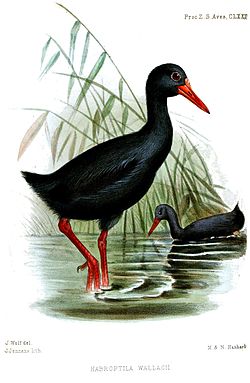
The invisible rail, Wallace's rail, or drummer rail (Gallirallus wallacii) is a large flightless rail that is endemic to the island of Halmahera in Northern Maluku, Indonesia, where it inhabits impenetrable sago swamps adjacent to forests. Its plumage is predominantly dark slate-grey, and the bare skin around its eyes, the long, thick bill, and the legs are all bright red. Its call is a low drumming sound which is accompanied by wing-beating. The difficulty of seeing this shy bird in its dense habitat means that information on its behaviour is limited.
Recorded dietary items include sago shoots and insects, and it also swallows small stones to help break up its food. It is apparently monogamous, but little else is known of its courtship behaviour. The only known nest was a shallow bowl in the top of a rotting tree stump that was lined with wood chips and dry leaves. The two young chicks were entirely covered in black down typical of precocial newly hatched rails. The estimated population of 3,500–15,000 birds and the restricted range mean that the invisible rail is classified as vulnerable by the International Union for Conservation of Nature (IUCN). Habitat loss has occurred through the harvesting of sago and conversion of the wetlands to rice cultivation, and the rail is eaten by local people. The described nest was in an area frequented by local villagers, so the rail may be more adaptable to habitat changes than had been thought.
The rails are a large and very widespread family, with nearly 150 species. They are small to medium-sized, terrestrial or wetland birds, and their short bodies are often flattened laterally to help them move through dense vegetation. Island species readily become flightless; of 53 extant or recently extinct taxa restricted to islands, 32 have lost the ability to fly.
The invisible rail was formally described by the English zoologist George Robert Gray in 1860 as Habroptila wallacii. The species is now placed in the genus Gallirallus that was introduced in 1841 by the French ornithologist Frédéric de Lafresnaye. The genus name Gallirallus is a portmanteau of the genera Gallus that had been introduced by Mathurin Jacques Brisson in 1760 for the fowl, and the genus Rallus that had been introduced by Carl Linnaeus in 1758 for the rails. The specific epithet wallacii commemorates British zoologist Alfred Russel Wallace. Local names include "soisa", "tibiales" and "rèie".
This rail is related to the New Guinea flightless rail, Megacrex inepta, and the chestnut rail, Gallirallus castaneoventris, all three Australasian genera probably being derived from Amaurornis ancestors. Storrs Olson argued that the genus Megacrex was so similar to Habroptila that Megacrex should be considered a junior synonym of Habroptila, resulting in two species in the genus. This was further lumped in Sidney Dillon Ripley's 1977 monograph of the Rallidae; he included Habroptila within the large genus Rallus. This suggestion was not accepted by Gerlof Fokko Mees, who pointed out distinct differences in the shape and structure of the bill. A 2012 molecular phylogenetic analysis based on mitochondrial DNA sequence similarity found that Habroptila is part of evolutionary radiation within the broad genus Gallirallus that took place around 400,000 years ago in the region. A 2014 genetic study found that it formed a clade with the extinct Hawkins's rail of the Chatham Islands, New Zealand, the divergence was estimated to have taken place around 10 million years ago, this clade was in turn sister to Gallirallus.
The invisible rail is a large, 33 to 40 cm (13–16 in) long, flightless bird. The adult has a mainly dark slate-grey body, dark brown plumage on the lower back, rump and wings, and a black uppertail. Its underparts are slightly paler slate-grey than the back, and the bare skin around the eye, the long, thick bill and the strong legs are bright red. It has a small spine at the bend of the wings. The sexes are identical in appearance; the plumage of fledged immature birds has not been described.
The invisible rail is superficially similar to the purple swamphen, Porphyrio porphyrio, which has recently been found in Halmahera, but that species is larger, with a short, thick red bill and a red forehead shield; it also has purple underparts and a white undertail. The invisible rail is different from the Calayan rail, Gallirallus calayanensis, in that it is larger and lacks the barred plumage of that species; there is no overlap between the ranges of the two species.
The call is a low drumming, accompanied by a tuk, tuk, tuk made with the wings. The nature of the vocalisation led to a local legend that the sound is made by the bird beating on a hollow tree or branch with its feet. Gerd Heinrich noted the local name "soisa", meaning drum, and described the call as being a subdued drumming purre – purre – purre – purre – purre which sometimes ends in a loud shrill scream. The bird also produced a dull hum similar to the voice of the banded pig (Sus scrofa vittatus) and reminiscent of the call of the snoring rail (Aramidopsis plateni). Calling is most frequent in the early morning or late evening, and a human tapping a sago stem with a machete may elicit a response from the bird. A quieter version of the call is given at the nest. Other sounds attributed to this rail, such as loud screams, may be incorrect, since they are like those produced by the pale-vented bush-hen (Amaurornis moluccana).
Invisible rail
The invisible rail, Wallace's rail, or drummer rail (Gallirallus wallacii) is a large flightless rail that is endemic to the island of Halmahera in Northern Maluku, Indonesia, where it inhabits impenetrable sago swamps adjacent to forests. Its plumage is predominantly dark slate-grey, and the bare skin around its eyes, the long, thick bill, and the legs are all bright red. Its call is a low drumming sound which is accompanied by wing-beating. The difficulty of seeing this shy bird in its dense habitat means that information on its behaviour is limited.
Recorded dietary items include sago shoots and insects, and it also swallows small stones to help break up its food. It is apparently monogamous, but little else is known of its courtship behaviour. The only known nest was a shallow bowl in the top of a rotting tree stump that was lined with wood chips and dry leaves. The two young chicks were entirely covered in black down typical of precocial newly hatched rails. The estimated population of 3,500–15,000 birds and the restricted range mean that the invisible rail is classified as vulnerable by the International Union for Conservation of Nature (IUCN). Habitat loss has occurred through the harvesting of sago and conversion of the wetlands to rice cultivation, and the rail is eaten by local people. The described nest was in an area frequented by local villagers, so the rail may be more adaptable to habitat changes than had been thought.
The rails are a large and very widespread family, with nearly 150 species. They are small to medium-sized, terrestrial or wetland birds, and their short bodies are often flattened laterally to help them move through dense vegetation. Island species readily become flightless; of 53 extant or recently extinct taxa restricted to islands, 32 have lost the ability to fly.
The invisible rail was formally described by the English zoologist George Robert Gray in 1860 as Habroptila wallacii. The species is now placed in the genus Gallirallus that was introduced in 1841 by the French ornithologist Frédéric de Lafresnaye. The genus name Gallirallus is a portmanteau of the genera Gallus that had been introduced by Mathurin Jacques Brisson in 1760 for the fowl, and the genus Rallus that had been introduced by Carl Linnaeus in 1758 for the rails. The specific epithet wallacii commemorates British zoologist Alfred Russel Wallace. Local names include "soisa", "tibiales" and "rèie".
This rail is related to the New Guinea flightless rail, Megacrex inepta, and the chestnut rail, Gallirallus castaneoventris, all three Australasian genera probably being derived from Amaurornis ancestors. Storrs Olson argued that the genus Megacrex was so similar to Habroptila that Megacrex should be considered a junior synonym of Habroptila, resulting in two species in the genus. This was further lumped in Sidney Dillon Ripley's 1977 monograph of the Rallidae; he included Habroptila within the large genus Rallus. This suggestion was not accepted by Gerlof Fokko Mees, who pointed out distinct differences in the shape and structure of the bill. A 2012 molecular phylogenetic analysis based on mitochondrial DNA sequence similarity found that Habroptila is part of evolutionary radiation within the broad genus Gallirallus that took place around 400,000 years ago in the region. A 2014 genetic study found that it formed a clade with the extinct Hawkins's rail of the Chatham Islands, New Zealand, the divergence was estimated to have taken place around 10 million years ago, this clade was in turn sister to Gallirallus.
The invisible rail is a large, 33 to 40 cm (13–16 in) long, flightless bird. The adult has a mainly dark slate-grey body, dark brown plumage on the lower back, rump and wings, and a black uppertail. Its underparts are slightly paler slate-grey than the back, and the bare skin around the eye, the long, thick bill and the strong legs are bright red. It has a small spine at the bend of the wings. The sexes are identical in appearance; the plumage of fledged immature birds has not been described.
The invisible rail is superficially similar to the purple swamphen, Porphyrio porphyrio, which has recently been found in Halmahera, but that species is larger, with a short, thick red bill and a red forehead shield; it also has purple underparts and a white undertail. The invisible rail is different from the Calayan rail, Gallirallus calayanensis, in that it is larger and lacks the barred plumage of that species; there is no overlap between the ranges of the two species.
The call is a low drumming, accompanied by a tuk, tuk, tuk made with the wings. The nature of the vocalisation led to a local legend that the sound is made by the bird beating on a hollow tree or branch with its feet. Gerd Heinrich noted the local name "soisa", meaning drum, and described the call as being a subdued drumming purre – purre – purre – purre – purre which sometimes ends in a loud shrill scream. The bird also produced a dull hum similar to the voice of the banded pig (Sus scrofa vittatus) and reminiscent of the call of the snoring rail (Aramidopsis plateni). Calling is most frequent in the early morning or late evening, and a human tapping a sago stem with a machete may elicit a response from the bird. A quieter version of the call is given at the nest. Other sounds attributed to this rail, such as loud screams, may be incorrect, since they are like those produced by the pale-vented bush-hen (Amaurornis moluccana).
Recent media
Recent media