

Recent from talks
Hagen Kleinert
Knowledge base stats:
Talk channels stats:
Members stats:
Hagen Kleinert
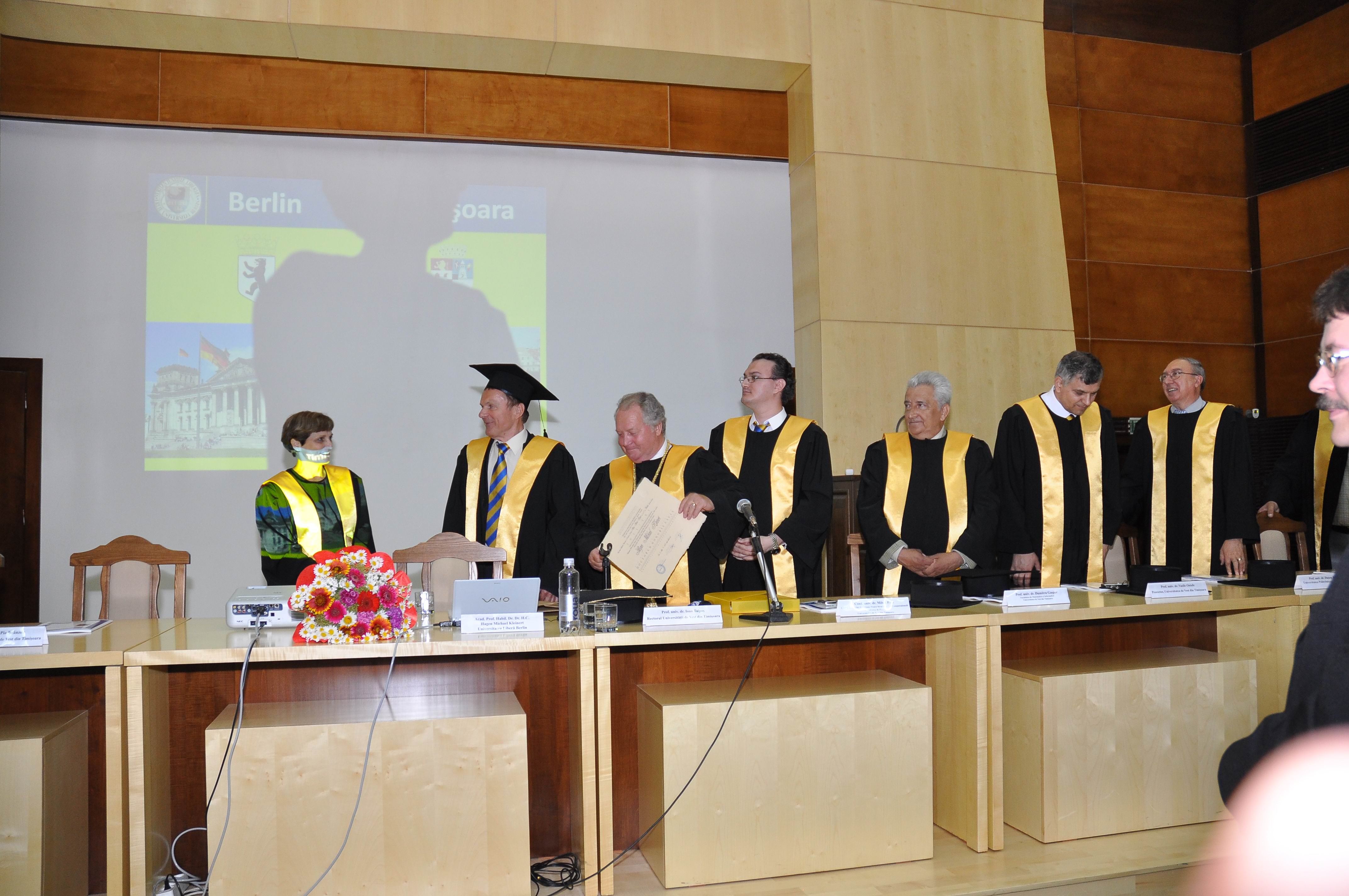
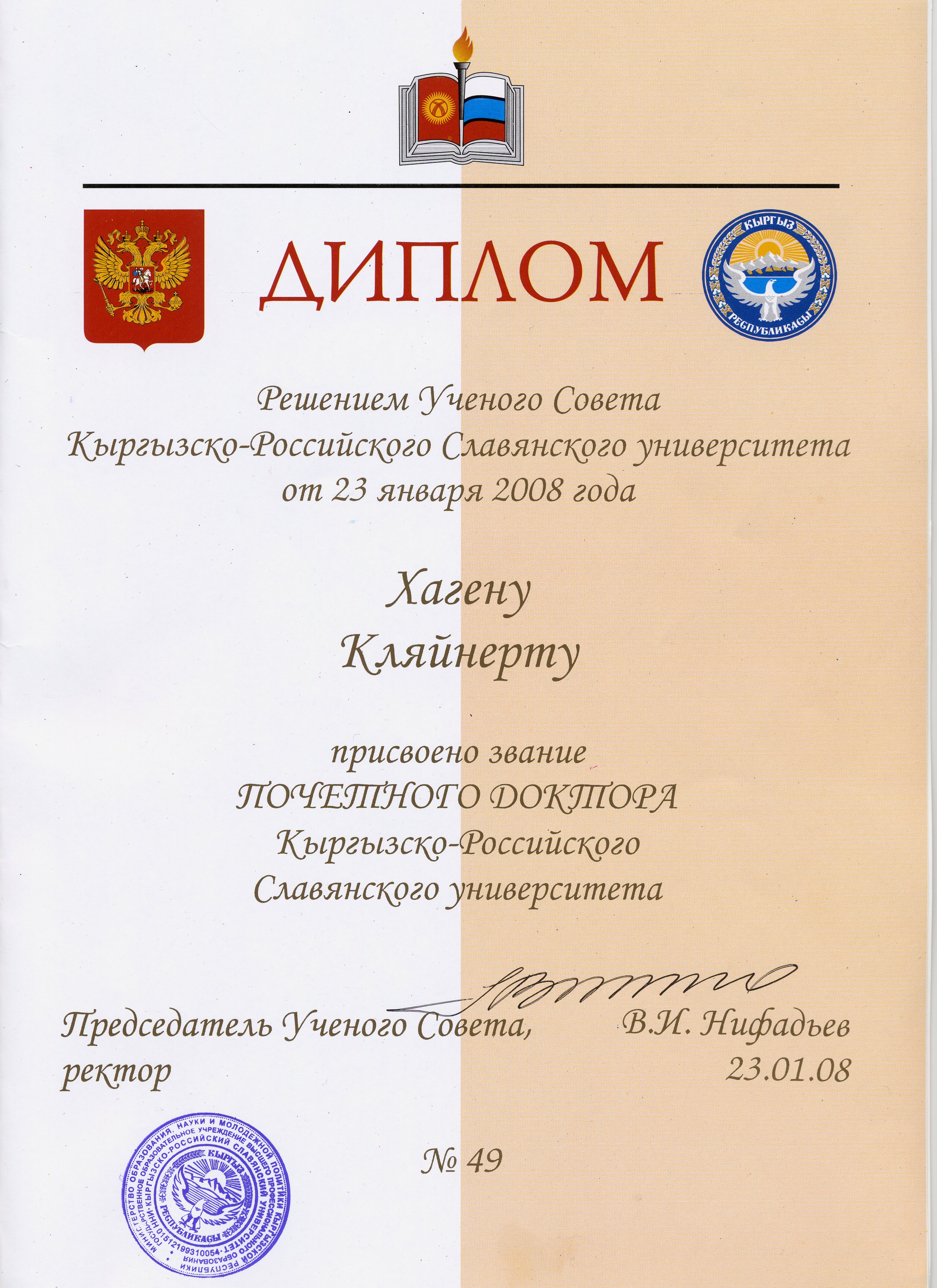
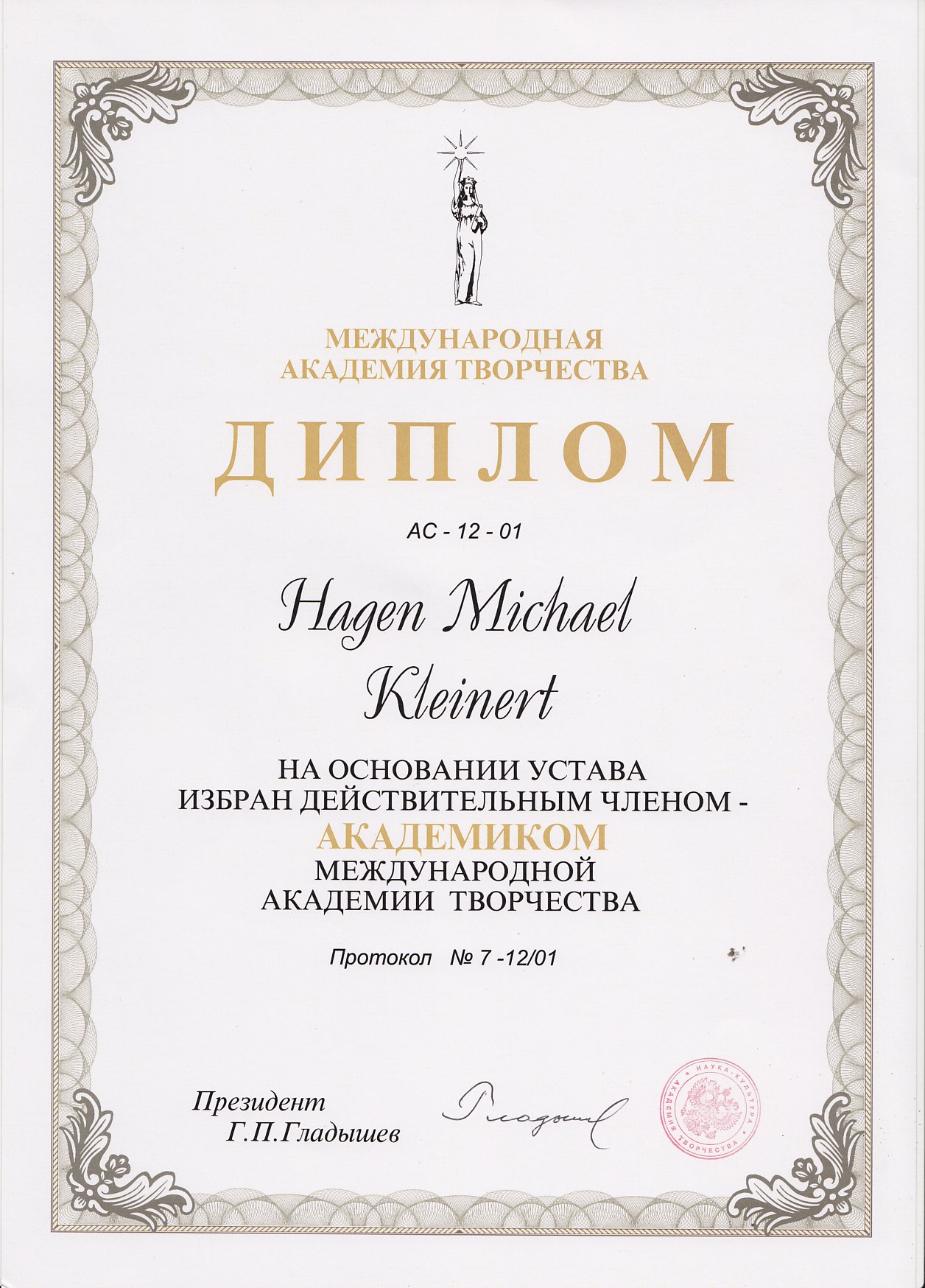
Hagen Kleinert (15 June 1941 – 7 March 2025) was a professor of theoretical physics at the Free University of Berlin, Germany (since 1968), Honorary Doctor at the West University of Timișoara, and at the Kyrgyz-Russian Slavic University in Bishkek. He is also Honorary Member of the Russian Academy of Creative Endeavors. For his contributions to particle and solid-state physics he was awarded the Max Born Prize 2008 with Medal. His contribution to the memorial volume celebrating the 100th birthday of Lev Davidovich Landau earned him the Majorana Prize 2008 with Medal. He is married to Dr. Annemarie Kleinert since 1974 with whom he has a son Michael Kleinert.
Kleinert has written ~420 papers on mathematical physics and the physics of elementary particles, nuclei, solid state systems, liquid crystals, biomembranes, microemulsions, polymers, and the theory of financial markets. He has written several books on theoretical physics, the most notable of which, Path Integrals in Quantum Mechanics, Statistics, Polymer Physics, and Financial Markets, has been published in five editions since 1990 and has received enthusiastic reviews.
He studied physics at the Leibniz University Hannover between 1960 and 1963, and at several American universities including Georgia Institute of Technology, where he learned general relativity as a graduate student from George Gamow, one of the fathers of the Big Bang theory. Kleinert earned his doctorate in 1967 at the University of Colorado, Boulder.
As a young professor in 1972, Kleinert visited Caltech and was impressed by noted US physicist Richard Feynman. Later, Kleinert was to collaborate with Feynman in some of the latter's last work. This collaboration led to a mathematical method for converting divergent weak-coupling power series into convergent strong-coupling ones. This so-called variational perturbation theory yields at present the most accurate theory of critical exponents observable close to second-order phase transitions, as confirmed for superfluid helium in satellite experiments. He also discovered an alternative to Feynman's time-sliced path integral construction which can be used to solve the path integral formulations of the hydrogen atom and the centrifugal barrier, i.e. to calculate their energy levels and eigenstates, as special cases of a general strategy for treating systems with singular potentials using path integrals.
Within the quantum field theories of quarks he found the origin of the algebra of Regge residues conjectured by N. Cabibbo, L. Horwitz, and Y. Ne'eman (see p. 232 Archived 11 June 2020 at the Wayback Machine in reference).
For superconductors he predicted in 1982 a tricritical point in the phase diagram between type-I and type-II superconductors where the order of the transition changes from second to first. The predictions were confirmed in 2002 by Monte Carlo computer simulations.
The theory is based on a disorder field theory dual to the order field theory of L.D. Landau for phase transitions which Kleinert developed in the books on Gauge Fields in Condensed Matter. In this theory, the statistical properties of fluctuating vortex or defect lines are described as elementary excitations with the help of fields, whose Feynman diagrams are the pictures of the lines.
At the 1978 summer school in Erice he proposed the existence of broken supersymmetry in atomic nuclei, which has since been observed experimentally.
Hub AI
Hagen Kleinert AI simulator
(@Hagen Kleinert_simulator)
Hagen Kleinert
Hagen Kleinert (15 June 1941 – 7 March 2025) was a professor of theoretical physics at the Free University of Berlin, Germany (since 1968), Honorary Doctor at the West University of Timișoara, and at the Kyrgyz-Russian Slavic University in Bishkek. He is also Honorary Member of the Russian Academy of Creative Endeavors. For his contributions to particle and solid-state physics he was awarded the Max Born Prize 2008 with Medal. His contribution to the memorial volume celebrating the 100th birthday of Lev Davidovich Landau earned him the Majorana Prize 2008 with Medal. He is married to Dr. Annemarie Kleinert since 1974 with whom he has a son Michael Kleinert.
Kleinert has written ~420 papers on mathematical physics and the physics of elementary particles, nuclei, solid state systems, liquid crystals, biomembranes, microemulsions, polymers, and the theory of financial markets. He has written several books on theoretical physics, the most notable of which, Path Integrals in Quantum Mechanics, Statistics, Polymer Physics, and Financial Markets, has been published in five editions since 1990 and has received enthusiastic reviews.
He studied physics at the Leibniz University Hannover between 1960 and 1963, and at several American universities including Georgia Institute of Technology, where he learned general relativity as a graduate student from George Gamow, one of the fathers of the Big Bang theory. Kleinert earned his doctorate in 1967 at the University of Colorado, Boulder.
As a young professor in 1972, Kleinert visited Caltech and was impressed by noted US physicist Richard Feynman. Later, Kleinert was to collaborate with Feynman in some of the latter's last work. This collaboration led to a mathematical method for converting divergent weak-coupling power series into convergent strong-coupling ones. This so-called variational perturbation theory yields at present the most accurate theory of critical exponents observable close to second-order phase transitions, as confirmed for superfluid helium in satellite experiments. He also discovered an alternative to Feynman's time-sliced path integral construction which can be used to solve the path integral formulations of the hydrogen atom and the centrifugal barrier, i.e. to calculate their energy levels and eigenstates, as special cases of a general strategy for treating systems with singular potentials using path integrals.
Within the quantum field theories of quarks he found the origin of the algebra of Regge residues conjectured by N. Cabibbo, L. Horwitz, and Y. Ne'eman (see p. 232 Archived 11 June 2020 at the Wayback Machine in reference).
For superconductors he predicted in 1982 a tricritical point in the phase diagram between type-I and type-II superconductors where the order of the transition changes from second to first. The predictions were confirmed in 2002 by Monte Carlo computer simulations.
The theory is based on a disorder field theory dual to the order field theory of L.D. Landau for phase transitions which Kleinert developed in the books on Gauge Fields in Condensed Matter. In this theory, the statistical properties of fluctuating vortex or defect lines are described as elementary excitations with the help of fields, whose Feynman diagrams are the pictures of the lines.
At the 1978 summer school in Erice he proposed the existence of broken supersymmetry in atomic nuclei, which has since been observed experimentally.
Recent media