



Community hub
Recent from talks
Contribute something
Nothing was collected or created yet.
Hallam F.C.
View on Wikipedia
Hallam Football Club is an English football club based in Crosspool, Sheffield, South Yorkshire. Hallam have played at their Sandygate home in the Sheffield suburb of Crosspool since 1860, with the ground being officially recognised by the Guinness Book of Records as "The Oldest Football Ground in the World".[3] In 1867, the club made history by winning the world's first ever football tournament, the Youdan Cup.[4]
Key Information








Hallam currently play in the Northern Premier League Division One East, at the eighth level of the English football league system.
History
[edit]The football club can trace its links to 1804, when the owner of the Plough Inn public house on Sandygate Road agreed to allow a new cricket club, Hallam CC, to start playing on an adjacent field he owned.
The club had in excess of 300 members by the 1850s,[5] and in 1860 it decided to form a football club to oppose Sheffield F.C., formed three years earlier. On Boxing Day 1860, the two clubs played each other at Sandygate for the first time. The match report for the game in the Sheffield Daily Telegraph[6] states that the game was played between 16 of Sheffield and 16 of Hallam and Stumperlowe (Stumperlowe being a hamlet half a mile from Sandygate).[1]
The Hallam Football Club's founder and captain, John Charles Shaw, soon became President of the Sheffield Football Association which organised matches according to the locally preferred rules for its growing number of member clubs. Shaw was directly instrumental, with Charles Alcock of the London-based Football Association, in the formation of nationally accepted rules for playing the game. Shaw and Alcock were the respective captains in the first game between a Sheffield XI and a London XI, in 1871, in which the preferred rules were tried out.
In 1867, Hallam won the first ever football competition, the Youdan Cup. The trophy was subsequently misplaced by the club, and did not resurface again until 1997 when a Scottish antiques collector who had come into possession of the silver trophy sold it back to the club for £2,000. In 2014 the trophy was featured on the BBC programme Antiques Roadshow, where it was valued at £100,000. Club chairman Chris Taylor subsequently said the club had no plans to sell the trophy.[7]
Although professionalism began to creep into the game during the 1870s and 1880s, Hallam chose to remain fully amateur. In the summer of 1886, for reasons unknown but likely because of financial constraints, the club was dissolved, but a year later the club was re-formed and re-registered with the Sheffield & Hallamshire FA.[1]
Hallam entered their first league competition in 1892 when joining the newly formed Hallamshire League, and they would also play in the Sheffield Minor Cup League, Sheffield Alliance and the Hatchard League as the 19th century came to a close.[1] They won the Hatchard League title for the first time in 1903, and a year later won the league again, though they lost the play-off final played between the top four teams, and so surrendered their title. They also reached the final of the Sheffield and Hallamshire Senior Cup for the first time in 1904, but lost 1–6 to Barnsley reserves at Bramall Lane.
In 1911 the club first competed in a Football Association (FA) cup competition, when they entered the FA Amateur Cup. Three years later the First World War began, but Hallam continued to play, dropping out of the Hatchard League to join the Sheffield Amateur and Minor Leagues, previously staples of the club's reserve team. Eventually, in 1917, Hallam decided they could no longer keep playing, and suspended playing operations, only re-joining the Sheffield Amateur League after hostilities had ended, in 1919.[1]
In 1925 Hallam pulled off one of their greatest ever results when they knocked out five-time Amateur Cup winners Bishop Auckland in front of over 2,000 people at Sandygate. Two years later the club entered the FA Cup for the first time. After winning the Sheffield Amateur League for the second time in 1927, they were admitted back into the Sheffield Association League.
At the end of the 1932–33 season the landlord of the Plough Inn public house decided to lease Sandygate to other teams (Crookes WMC and later Fulwood) as Hallam were not providing enough bar takings. Although the club retained its affiliation with the local FA, Hallam's eviction from their ground saw them refrain from playing any football for a period of 15 years.[1]
Hallam's return to football came about in 1947 when they finally arranged a return to Sandygate, playing in the Sheffield Amateur League and the re-formed Hatchard League (which they won) before finally re-joining the Sheffield Association League in 1949, winning the title for the first time.[1] A year later Hallam won the Sheffield Senior Cup for the first time when they beat Stocksbridge Works at Hillsborough in front of 7,240 spectators, and in 1952 they entered the Yorkshire League.
That same season an Amateur Cup tie with Dulwich Hamlet was switched to Hillsborough stadium because of increased ticket demands – the attendance of over 13,000 proving to be a club record. After winning promotion to the top flight of the Yorkshire League for a second time in 1960,[8] Hallam spent twenty years playing at the same level.
The 1982–83 season saw the demise of the old Yorkshire League, with Hallam entering the new Northern Counties East League (NCEL), which demanded more stringent ground grading rules. With only seven years of its ground lease remaining the club could not commit to expensive improvements. Protracted negotiations with the landlord eventually led to a 99 years extension being granted but a large premium was demanded within one year.[5] A massive fund raising effort secured the new lease and continued for the provision of floodlights, first used in 1992, and a stand behind one goal to shelter 100 people.
The club has spent most of its time in the NCEL in the Premier Division (which currently sits at level 9 of the English football league system), and won the League Cup competition in 2004 when beating Mickleover Sports in the final,[9] but in 2011 they were relegated back to the First Division.
In 2012, Sandygate received a much needed facelift, paid for by a posthumous donation by a lifelong supporter who had left the club a substantial amount of money in his will.[10] In 2016 and 2017, the club qualified for the Division One end of season play-offs, but were eliminated in the semi-finals on both occasions.
The appointment of Craig Denton as manager in 2020 was followed by an upturn in results and attendances, and in the 2021–22 season Hallam secured the Division One title and promotion to the NCEL Premier Division, with Sandygate hosting record crowds in excess of 1,100.
The 2024–25 season, saw Hallam finish second in the regular season, beating Beverley Town on penalties in the play-off final to secure promotion to step four.[11]
Season-by-season record
[edit]| Season | Division | Level | Position | FA Cup | FA Amateur Cup | FA Trophy | FA Vase | Notes |
|---|---|---|---|---|---|---|---|---|
| 1892–93 | Hallamshire League Division One | – | 5th/8 | – | – | – | – | |
| 1893–94 | Sheffield Minor Cup League (qualifying) | – | 8th/8 | – | – | – | – | |
| 1894–95 | Sheffield Minor Cup League (qualifying) Hatchard League |
– | 5th/7 1st/6 |
– | – | – | – | Lost league play-off |
| 1895–96 | Sheffield Minor Cup League (qualifying) Hatchard League |
– | 4th/6 |
– | – | – | – | |
| 1896–97 | Sheffield Alliance League Division Two | – | 6th/12 | – | – | – | – | |
| 1897–98 | Sheffield Alliance League | – | 2nd/11 | – | – | – | – | |
| 1898–99 | Hatchard League | – | 2nd/11 | – | – | – | – | |
| 1899–1900 | Hatchard League | – | – | – | – | – | ||
| 1900–01 | Hatchard League | – | – | – | – | – | ||
| 1901–02 | Hatchard League | – | – | – | – | – | ||
| 1902–03 | Hatchard League | – | 2nd/8 | – | – | – | – | League champions (won play-off) |
| 1903–04 | Hatchard League | – | 1st/11 | – | – | – | – | Lost league play-off |
| 1904–05 | Hatchard League | – | 1st/13 | – | – | – | – | Lost league play-off |
| 1905–06 | Sheffield Association League | – | – | – | – | – | ||
| 1906–07 | Hatchard League | – | – | – | – | – | ||
| 1907–08 | Hatchard League | – | – | – | – | – | ||
| 1908–09 | Hatchard League | – | – | – | – | – | ||
| 1909–10 | Hatchard League | – | – | – | – | – | ||
| 1910–11 | Hatchard League | – | 3rd/9 | – | – | – | – | |
| 1911–12 | Hatchard League | – | – | – | – | – | ||
| 1912–13 | Hatchard League | – | – | – | – | – | ||
| 1913–14 | Hatchard League | – | – | – | – | – | ||
| 1914–15 | Sheffield Amateur League | – | – | 2R | – | – | ||
| 1915–16 | Sheffield Minor League | – | – | – | – | – | ||
| 1916–17 | Sheffield Minor League | – | – | – | – | – | ||
| 1917–18 | Club did not enter any competitions due to World War I | |||||||
| 1918–19 | Club did not enter any competitions due to World War I | |||||||
| 1919–20 | Sheffield Amateur League | – | – | 1R | – | – | ||
| 1920–21 | Sheffield Amateur League | – | – | 3QR | – | – | ||
| 1921–22 | Sheffield Amateur League | – | 1st/13 | – | 3QR | – | – | Lost league play-off |
| 1922–23 | Sheffield Amateur League | – | – | – | – | – | League champions (won play-off) | |
| 1923–24 | Sheffield Amateur League | – | 4th/15 | – | 4QR | – | – | |
| 1924–25 | Sheffield Amateur League | – | – | QF | – | – | ||
| 1925–26 | Sheffield Amateur League | – | – | 3R | – | – | ||
| 1926–27 | Sheffield Amateur League | – | PR | 1R | – | – | League champions (won play-off) | |
| 1927–28 | Sheffield Association League | – | 1st/13 | 1QR | 3R | – | – | |
| 1928–29 | Sheffield Association League | – | 8th/15 | PR | 3R | – | – | |
| 1929–30 | Sheffield Association League | – | 4th/15 | PR | 2R | – | – | |
| 1930–31 | Sheffield Association League | – | PR | 1R | – | – | ||
| 1931–32 | Sheffield Association League Division Two | – | 8th/12 | PR | – | – | – | |
| 1932–33 | Sheffield Association League Division Two | – | 12th/12 | PR | – | – | – | |
| 1933–34 | Club did not enter any competitions | |||||||
| 1934–35 | Club did not enter any competitions | |||||||
| 1935–36 | Club did not enter any competitions | |||||||
| 1936–37 | Club did not enter any competitions | |||||||
| 1937–38 | Club did not enter any competitions | |||||||
| 1938–39 | Club did not enter any competitions | |||||||
| 1939–40 | Club did not enter any competitions | |||||||
| 1940–41 | Club did not enter any competitions | |||||||
| 1941–42 | Club did not enter any competitions | |||||||
| 1942–43 | Club did not enter any competitions | |||||||
| 1943–44 | Club did not enter any competitions | |||||||
| 1944–45 | Club did not enter any competitions | |||||||
| 1945–46 | Club did not enter any competitions | |||||||
| 1946–47 | Club did not enter any competitions | |||||||
| 1947–48 | Sheffield Amateur League | – | – | 2QR | – | – | ||
| 1948–49 | Hatchard League | – | 1st | – | 4QR | – | – | League champions |
| 1949–50 | Sheffield Association League | – | 1st/16 | – | 4QR | – | – | League champions (won play-off) |
| 1950–51 | Sheffield Association League | – | 2nd/15 | EPR | 1R | – | – | |
| 1951–52 | Sheffield Association League | – | 1QR | 4QR | – | – | ||
| 1952–53 | Yorkshire League Division Two | – | 11th/14 | 1QR | 3R | – | – | |
| 1953–54 | Yorkshire League Division Two | – | 8th/16 | 2QR | 3R | – | – | |
| 1954–55 | Yorkshire League Division Two | – | 10th/16 | 1QR | 2R | – | – | |
| 1955–56 | Yorkshire League Division Two | – | 5th/16 | 2QR | 1R | – | – | |
| 1956–57 | Yorkshire League Division Two | – | 2nd/17 | 1QR | 1R | – | – | Promoted |
| 1957–58 | Yorkshire League Division One | – | 14th/18 | 3QR | 4QR | – | – | |
| 1958–59 | Yorkshire League Division One | – | 14th/18 | 2QR | 3R | – | – | |
| 1959–60 | Yorkshire League Division One | – | 17th/18 | – | 2R | – | – | Relegated |
| 1960–61 | Yorkshire League Division Two | – | 1st/19 | – | 3R | – | – | League champions, promoted |
| 1961–62 | Yorkshire League Division One | – | 8th/16 | – | 1R | – | – | |
| 1962–63 | Yorkshire League Division One | – | 12th/16 | – | 1R | – | – | |
| 1963–64 | Yorkshire League Division One | – | 10th/16 | – | 4QR | – | – | |
| 1964–65 | Yorkshire League Division One | – | 11th/16 | – | 1QR | – | – | |
| 1965–66 | Yorkshire League Division One | – | 12th/16 | – | 1QR | – | – | |
| 1966–67 | Yorkshire League Division One | – | 10th/17 | – | 1R | – | – | |
| 1967–68 | Yorkshire League Division One | – | 15th/17 | – | 1R | – | – | |
| 1968–69 | Yorkshire League Division One | – | 13th/18 | – | 1R | – | – | |
| 1969–70 | Yorkshire League Division One | – | 10th/18 | – | 4QR | – | – | |
| 1970–71 | Yorkshire League Division One | – | 5th/14 | – | 4QR | – | – | |
| 1971–72 | Yorkshire League Division One | – | 9th/16 | – | 1R | – | – | |
| 1972–73 | Yorkshire League Division One | – | 10th/16 | – | 4QR | – | – | |
| 1973–74 | Yorkshire League Division One | – | 5th/16 | – | 3QR | – | – | |
| 1974–75 | Yorkshire League Division One | – | 7th/16 | – | – | PR | – | |
| 1975–76 | Yorkshire League Division One | – | 3rd/16 | – | – | – | 4R | |
| 1976–77 | Yorkshire League Division One | – | 7th/16 | – | – | – | 4R | |
| 1977–78 | Yorkshire League Division One | – | 6th/16 | – | – | – | 3R | |
| 1978–79 | Yorkshire League Division One | – | 10th/16 | – | – | – | 2R | |
| 1979–80 | Yorkshire League Division One | – | 7th/16 | – | – | – | 3R | |
| 1980–81 | Yorkshire League Division One | – | 9th/16 | – | – | – | 5R | |
| 1981–82 | Yorkshire League Division One | – | 12th/16 | – | – | – | 4R | |
| 1982–83 | Northern Counties East League Division One South | – | 10th/14 | – | – | – | 3R | |
| 1983–84 | Northern Counties East League Division One South | – | 9th/14 | – | – | – | 2R | |
| 1984–85 | Northern Counties East League Division One South | – | 9th/16 | – | – | – | 1R | |
| 1985–86 | Northern Counties East League Division Two | – | 5th/16 | – | – | – | 1R | Promoted |
| 1986–87 | Northern Counties East League Division One | – | 6th/18 | – | – | – | 2R | Promoted |
| 1987–88 | Northern Counties East League Premier Division | – | 10th/17 | – | – | – | 1R | |
| 1988–89 | Northern Counties East League Premier Division | – | 12th/17 | – | – | – | PR | |
| 1989–90 | Northern Counties East League Premier Division | – | 14th/18 | – | – | – | EPR | Relegated |
| 1990–91 | Northern Counties East League Division One | – | 2nd/13 | – | – | – | EPR | |
| 1991–92 | Northern Counties East League Division One | – | 5th/16 | – | – | – | 1R | |
| 1992–93 | Northern Counties East League Division One | – | 3rd/14 | – | – | – | PR | |
| 1993–94 | Northern Counties East League Division One | – | 2nd/15 | – | – | – | 1R | Promoted |
| 1994–95 | Northern Counties East League Premier Division | – | 17th/20 | 1QR | – | – | PR | |
| 1995–96 | Northern Counties East League Premier Division | – | 17th/20 | 1QR | – | – | 1QR | |
| 1996–97 | Northern Counties East League Premier Division | – | 7th/20 | PR | – | – | 3R | |
| 1997–98 | Northern Counties East League Premier Division | – | 17th/20 | – | – | – | 2QR | |
| 1998–99 | Northern Counties East League Premier Division | – | 4th/20 | – | – | – | 2R | |
| 1999–2000 | Northern Counties East League Premier Division | – | 12th/20 | PR | – | – | 1QR | |
| 2000–01 | Northern Counties East League Premier Division | – | 5th/20 | PR | – | – | 2QR | |
| 2001–02 | Northern Counties East League Premier Division | – | 3rd/20 | 1QR | – | – | 3R | |
| 2002–03 | Northern Counties East League Premier Division | – | 17th/20 | 1QR | – | – | 1R | |
| 2003–04 | Northern Counties East League Premier Division | – | 15th/20 | PR | – | – | 2R | |
| 2004–05 | Northern Counties East League Premier Division | 9 | 15th/20 | PR | – | – | 1R | |
| 2005–06 | Northern Counties East League Premier Division | 9 | 17th/20 | PR | – | – | 1QR | |
| 2006–07 | Northern Counties East League Premier Division | 9 | 14th/20 | 2QR | – | – | 1QR | |
| 2007–08 | Northern Counties East League Premier Division | 9 | 6th/20 | 1QR | – | – | 3R | |
| 2008–09 | Northern Counties East League Premier Division | 9 | 10th/20 | EPR | – | – | 1R | |
| 2009–10 | Northern Counties East League Premier Division | 9 | 15th/20 | 1QR | – | – | 2R | |
| 2010–11 | Northern Counties East League Premier Division | 9 | 19th/20 | EPR | – | – | 1R | Relegated |
| 2011–12 | Northern Counties East League Division One | 10 | 14th/20 | EPR | – | – | 1QR | |
| 2012–13 | Northern Counties East League Division One | 10 | 12th/22 | EPR | – | – | 1QR | |
| 2013–14 | Northern Counties East League Division One | 10 | 20th/22 | – | – | – | 1QR | |
| 2014–15 | Northern Counties East League Division One | 10 | 14th/22 | – | – | – | 2QR | |
| 2015–16 | Northern Counties East League Division One | 10 | 6th/21 | – | – | – | 2R | |
| 2016–17 | Northern Counties East League Division One | 10 | 5th/22 | EPR | – | – | 2R | |
| 2017–18 | Northern Counties East League Division One | 10 | 8th/22 | PR | – | – | 2QR | |
| 2018–19 | Northern Counties East League Division One | 10 | 3rd/20 | EPR | – | – | 2R | |
| 2019–20 | Northern Counties East League Division One | 10 | – | EPR | – | – | 1QR | League season abandoned due to COVID-19 pandemic |
| 2020–21 | Northern Counties East League Division One | 10 | – | – | – | – | 2R | League season abandoned due to COVID-19 pandemic |
| 2021–22 | Northern Counties East League Division One | 10 | 1st/21 | – | – | – | 1QR | League champions, promoted |
| 2022–23 | Northern Counties East League Premier Division | 9 | 6th/20 | EPR | – | – | 2R | |
| 2023–24 | Northern Counties East League Premier Division | 9 | 9th/20 | EPR | – | – | 5R | |
| 2024–25 | Northern Counties East League Premier Division | 9 | 2nd/20 | 2QR | – | – | 4R | Play-off winners, promoted |
| Season | Division | Level | Position | FA Cup | FA Amateur Cup | FA Trophy | FA Vase | Notes |
| Source: Football Club History Database | ||||||||
Current squad
[edit]- As of 2 October 2025[12]
Note: Flags indicate national team as defined under FIFA eligibility rules; some limited exceptions apply. Players may hold more than one non-FIFA nationality.
|


Notable former players
[edit]Players that have played in the Football League either before or after playing for Hallam –
Ground
[edit]Sandygate, Crosspool, Sheffield, UK, S10 5SE.
Sandygate is a football and cricket stadium in the Sheffield suburb of Crosspool, South Yorkshire, England. It is home to Hallam F.C. and Hallam C.C.
First opened in 1804, Hallam have played at the ground since 1860. Sandygate has been recognised by the Guinness Book of Records as the "Oldest Football Ground in the World".[13] On 26 December 1860, the world's first inter-club football match was played at the ground, Hallam taking on Sheffield F.C.
The ground offers viewing for spectators from 3 sides of the pitch. The Shed End, the Main Stand and the Cricket Net End.
- The Shed End
The Shed End is a covered terrace behind the goal on the Sandygate Road side of the ground. This mainly houses the vocal home supporters and is where the bulk of the atmosphere is created.
Gallery
[edit]-
 The cover at the north side of the ground in 2010
 -
 The refurbished clubhouse and main stand in 2014
 -
 The pitch, with cricket ground at the west end of the ground, in 2014
 -
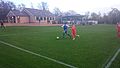 Hallam (in blue) on the attack in an NCEL match against Louth Town in 2014. The new clubhouse and main stand are in the background
 -
 World record certificate for Sandygate
 -
 World record certificate for the Youdan Cup win


Honours
[edit]
League[edit]
|
Cup[edit]
|
Records
[edit]- Best FA Cup performance: Third qualifying round, 1957–58
- Best FA Amateur Cup performance: Quarter-finals, 1924–25
- Best FA Trophy performance: First qualifying round, 2025–26
- Best FA Vase performance: Fifth round, 1980–81, 2023–24
- Record attendance – 2,000 vs. Hendon, FA Amateur Cup, 1958–59 (at Hillsborough – 13,855 vs. Dulwich Hamlet, FA Amateur Cup, 1952–53)[2]
References
[edit]- ^ a b c d e f g Steele, John A (2010). The Countrymen: History of Hallam Football Club. Northern Map Distributors.
- ^ a b Hallam Northern Counties East League Premier Division
- ^ "World's oldest football teams play in derby". BBC News. 27 July 2013. Retrieved 24 July 2022.
- ^ Murphy, Brendan (2007). From Sheffield with Love. SportBooks Limited. ISBN 978-1-899807-56-7.
- ^ a b History Archived 20 October 2014 at the Wayback Machine Hallam FC
- ^ Sheffield Daily Telegraph, 28 December 1860
- ^ "World's oldest football trophy 'not for sale'". BBC News. 14 October 2014.
- ^ Hallam Football Club History Database
- ^ Honours Northern Counties East League
- ^ . World's oldest football ground receives financial boost BBC
- ^ "NCEL Match Review 2024/25 #70". ncefl.org.uk. 20 April 2025. Retrieved 21 April 2025.
- ^ "Hallam".
- ^ "World's oldest football teams play in derby". BBC. 27 July 2013. Retrieved 30 September 2014.
External links
[edit]Hallam F.C.
View on GrokipediaHistory
Origins and early years
Hallam Football Club was established in 1860 by a group of members from the Hallam Cricket Club, which had been founded in 1804 by the landlord of the Plough Inn in Sheffield. The football club emerged as cricketers sought a more inclusive alternative to the established Sheffield F.C., formed three years earlier in 1857, allowing broader participation beyond elite players. This connection to the cricket club provided Hallam F.C. with an early organizational foundation and access to Sandygate Road as its home ground. The club's inaugural match occurred on Boxing Day 1860 against Sheffield F.C. at Sandygate, recognized as the world's oldest surviving inter-club football fixture, drawing a crowd and setting a precedent for organized matches in the region.[1] During its early years, Hallam F.C. quickly became a cornerstone of Sheffield's burgeoning football scene, participating in informal challenge matches and local derbies that helped standardize play under Sheffield Rules. A pivotal achievement came in 1867 when the club entered the Youdan Cup, the first-ever football tournament open to clubs, organized by local philanthropist Tommy Youdan with a prize of a silver cup and £40. Hallam F.C. advanced through the knockout format, defeating teams like Pitsmoor and the Military in preliminary rounds before securing the title with a 2-0 victory (in rouges) over Hallam Unity Club in the final at Bramall Lane. This win not only crowned Hallam as the inaugural champions but also highlighted Sheffield's leadership in codifying competitive association football before the Football Association's formation in 1863.[5][6][7] Key figures shaped Hallam F.C.'s formative period, with John Charles Shaw serving as the primary founder, captain during the Youdan Cup triumph, and a influential advocate for Sheffield Rules through his involvement in the Sheffield Football Association. Shaw's leadership extended to broader football governance, including roles in early representative matches. The club played a vital role in Sheffield's football evolution, fostering rivalries, promoting amateur play, and contributing to the transition from ad-hoc games to structured competitions that influenced national rules. Despite these successes, Hallam F.C. faced mounting challenges and dissolved in 1886 amid financial difficulties, though it was reformed in 1887 to continue its legacy.[8][9][10]Reformation and 20th century
Following its dissolution in 1886, Hallam F.C. was reformed in 1887 and resumed competitive play, entering the newly formed Hallamshire League in 1892 as its first organised league competition. Over the subsequent decades, the club participated in various regional leagues, including the Sheffield Alliance and the Hatchard League, securing titles in the latter during the 1903–04 and 1904–05 seasons.[10] A notable highlight came in the 1924–25 FA Amateur Cup, where Hallam achieved its best performance in the competition by reaching the quarter-finals; they defeated Bishop Auckland 2–1 at home in the third round before falling 0–1 away to eventual finalists Clapton.[11] The club's fortunes were disrupted in 1932 when it was evicted from Sandygate due to a dispute with the landlord, resulting in the loss of its home ground for six years during the 1930s and forcing temporary arrangements at other venues.[12] This led to a prolonged hiatus in regular competitive football, with the club inactive for much of the period until resuming operations in 1947 upon regaining access to Sandygate and rejoining the Sheffield Amateur League.[11] Post-World War II, Hallam faced ongoing challenges in lower-tier regional football, competing in the Yorkshire League Division Two from the 1952–53 season onward and experiencing mixed results, including relegations and mid-table finishes.[11] The club marked a significant achievement by winning the Yorkshire League Division Two title in 1960–61, earning promotion to Division One.[11] During this era, Hallam also recorded its highest attendance for an FA Amateur Cup tie against Dulwich Hamlet in 1952, hosted at Hillsborough Stadium due to capacity constraints at Sandygate.[13]21st century and recent developments
In the early 2000s, Hallam F.C. maintained a presence in the Northern Counties East League (NCEL) Premier Division, finishing fifth in the 2000–01 season before experiencing a period of mid-table stability followed by challenges. The club faced relegation to NCEL Division One at the end of the 2010–11 season after finishing 19th in the Premier Division, marking a low point that shifted focus toward rebuilding.[14] This relegation prompted a renewed emphasis on youth development and local talent, setting the stage for a gradual resurgence in the lower tier. Hallam spent over a decade in NCEL Division One, gradually improving their standing and reaching the play-off semi-finals in the 2015–16 and 2016–17 seasons, as well as securing third place in 2018–19 before the season was curtailed by the COVID-19 pandemic.[1] The club's breakthrough came in the 2021–22 season, when they clinched the NCEL Division One title with a record 102 points from 40 matches, earning promotion back to the Premier Division and drawing record crowds exceeding 1,100 at Sandygate.[15] Upon returning to the Premier Division, Hallam finished sixth in 2022–23 and ninth in 2023–24, steadily climbing, culminating in the 2024–25 season where they placed second with 77 points, securing promotion to the Northern Premier League Division One East via the play-offs after defeating Beverley Town 4–3 on penalties in the final on April 20, 2025.[16][4] In their debut 2025–26 season at the eighth tier, Hallam have occupied a mid-table position, sitting 17th in the Northern Premier League Division One East as of November 19, 2025, after 17 matches with 4 wins, 7 draws, 6 losses, 21 goals for, 27 against (goal difference of -6), and 19 points (win rate approximately 24%). The season remains in progress, with full results pending.[17] The team advanced through the FA Cup extra-preliminary round with a win over City of Liverpool on August 17, 2025, but exited in the first qualifying round following a 2–2 draw and 0–2 replay defeat to Ashton United in early September 2025.[18][19] Hallam F.C., founded in 1860, is widely recognized as the world's second-oldest football club, trailing only Sheffield F.C. (established 1857), and plays host to the oldest continuously used football ground at Sandygate, a distinction affirmed by the Guinness Book of Records.[1] Their historic rivalry with Sheffield F.C., dating to the first inter-club match on December 26, 1860, is known as the world's oldest derby and remains a highlight of local football.[20] Post-2012, the club has seen significant community engagement and attendance growth, bolstered by facility upgrades funded by a legacy donation from lifelong supporter Roger Bell, including the opening of the "1860 Suite" clubhouse on April 13, 2012, by then-Deputy Prime Minister Nick Clegg.[1] These improvements, combined with targeted community programs, have driven consistent increases in matchday crowds, with attendances surpassing 1,000 in four consecutive seasons by January 2025, peaking at 1,490 for a key fixture.[21] This revival underscores Hallam's role as a community anchor in Sheffield, fostering local pride amid their ascent through the non-league pyramid.Season-by-season record
Hallam F.C. entered competitive league football in 1892 upon joining the inaugural Hallamshire League, but detailed season-by-season statistics from this period and subsequent local competitions, such as the Sheffield Association League (where the club won the title in 1949–50), are limited and not comprehensively recorded in available historical databases. The club's first sustained involvement in a regional league began in 1952 with entry into the Yorkshire League Division Two, marking the start of more verifiable records. The following tables summarize the club's league performances across key eras, focusing on division, position, matches played, wins, draws, losses, goals for and against, and points. Data for the Northern Counties East League (NCEL) era emphasizes completeness from 1982 onward, with the transition to the Northern Premier League (NPL) Division One East in 2025–26 noted as ongoing.Yorkshire League Era (1952–1982)
| Season | Division | Pld | W | D | L | F/A | Pts | Pos |
|---|---|---|---|---|---|---|---|---|
| 1952–53 | Division Two | 26 | 9 | 4 | 13 | 59/57 | 22 | 11/14 |
| 1953–54 | Division Two | 30 | 12 | 5 | 13 | 68/62 | 29 | 8/16 |
| 1954–55 | Division Two | 30 | 9 | 5 | 16 | 51/60 | 23 | 10/16 |
| 1955–56 | Division Two | 30 | 18 | 4 | 8 | 70/47 | 40 | 5/16 |
| 1956–57 | Division Two | 32 | 21 | 5 | 6 | 87/43 | 47 | 2/17 (promoted) |
| 1957–58 | Division One | 34 | 11 | 6 | 17 | 50/76 | 28 | 14/18 |
| 1958–59 | Division One | 34 | 11 | 4 | 19 | 57/78 | 26 | 14/18 |
| 1959–60 | Division One | 34 | 5 | 7 | 22 | 51/96 | 17 | 17/18 (relegated) |
| 1960–61 | Division Two | 36 | 26 | 8 | 2 | 132/42 | 60 | 1/19 (promoted) |
| 1961–62 | Division One | 30 | 12 | 5 | 13 | 65/59 | 29 | 8/16 |
| 1962–63 | Division One | 30 | 11 | 5 | 14 | 60/60 | 28 | 12/16 |
| 1963–64 | Division One | 30 | 12 | 3 | 15 | 40/61 | 27 | 10/16 |
| 1964–65 | Division One | 30 | 11 | 4 | 15 | 55/56 | 26 | 11/16 |
| 1965–66 | Division One | 30 | 11 | 4 | 15 | 50/59 | 26 | 12/16 |
| 1966–67 | Division One | 32 | 13 | 6 | 13 | 50/50 | 32 | 10/17 |
| 1967–68 | Division One | 32 | 5 | 8 | 19 | 48/86 | 18 | 15/17 |
| 1968–69 | Division One | 34 | 10 | 6 | 18 | 53/84 | 26 | 13/18 |
| 1969–70 | Division One | 34 | 13 | 6 | 15 | 72/76 | 32 | 10/18 |
| 1970–71 | Division One | 26 | 13 | 5 | 8 | 49/42 | 31 | 5/14 |
| 1971–72 | Division One | 30 | 12 | 4 | 14 | 48/68 | 28 | 9/16 |
| 1972–73 | Division One | 30 | 11 | 6 | 13 | 60/67 | 28 | 10/16 |
| 1973–74 | Division One | 30 | 13 | 8 | 9 | 66/64 | 34 | 5/16 |
| 1974–75 | Division One | 30 | 12 | 7 | 11 | 50/45 | 31 | 7/16 |
| 1975–76 | Division One | 30 | 15 | 4 | 11 | 58/44 | 34 | 3/16 |
| 1976–77 | Division One | 30 | 14 | 9 | 7 | 47/33 | 37 | 7/16 |
| 1977–78 | Division One | 30 | 14 | 6 | 10 | 47/42 | 34 | 6/16 |
| 1978–79 | Division One | 30 | 12 | 4 | 14 | 33/42 | 28 | 10/16 |
| 1979–80 | Division One | 30 | 13 | 5 | 12 | 42/46 | 31 | 7/16 |
| 1980–81 | Division One | 30 | 11 | 7 | 12 | 42/39 | 29 | 9/16 |
| 1981–82 | Division One | 30 | 10 | 6 | 14 | 46/53 | 26 | 12/16 |
NCEL and NPL Era (1982–2025)
| Season | Division | Pld | W | D | L | F/A | Pts | Pos |
|---|---|---|---|---|---|---|---|---|
| 1982–83 | Division One (South) | 26 | 9 | 5 | 12 | 31/44 | 23 | 10/14 |
| 1983–84 | Division One (South) | 26 | 8 | 7 | 11 | 28/39 | 23 | 9/14 |
| 1984–85 | Division One (South) | 30 | 10 | 9 | 11 | 46/41 | 39 | 9/16 |
| 1985–86 | Division Two | 30 | 15 | 2 | 13 | 48/42 | 47 | 5/16 |
| 1986–87 | Division One | 34 | 16 | 8 | 10 | 49/37 | 56 | 6/18 (promoted) |
| 1987–88 | Premier Division | 32 | 11 | 6 | 15 | 48/53 | 39 | 10/17 |
| 1988–89 | Premier Division | 32 | 9 | 5 | 18 | 47/77 | 32 | 12/17 |
| 1989–90 | Premier Division | 34 | 9 | 8 | 17 | 45/64 | 35 | 14/18 (relegated) |
| 1990–91 | Division One | 24 | 18 | 1 | 5 | 61/27 | 55 | 2/13 |
| 1991–92 | Division One | 30 | 17 | 6 | 7 | 57/36 | 57 | 5/16 |
| 1992–93 | Division One | 26 | 15 | 5 | 6 | 50/23 | 50 | 3/14 |
| 1993–94 | Division One | 28 | 18 | 5 | 5 | 64/26 | 59 | 2/15 (promoted) |
| 1994–95 | Premier Division | 38 | 9 | 8 | 21 | 46/76 | 35 | 17/20 |
| 1995–96 | Premier Division | 38 | 11 | 7 | 20 | 41/68 | 40 | 17/20 |
| 1996–97 | Premier Division | 38 | 17 | 7 | 14 | 56/69 | 58 | 7/20 |
| 1997–98 | Premier Division | 38 | 10 | 10 | 18 | 52/77 | 40 | 17/20 |
| 1998–99 | Premier Division | 38 | 22 | 5 | 11 | 95/63 | 71 | 4/20 |
| 1999–00 | Premier Division | 38 | 14 | 9 | 15 | 72/67 | 51 | 12/20 |
| 2000–01 | Premier Division | 38 | 19 | 7 | 12 | 61/51 | 64 | 5/20 |
| 2001–02 | Premier Division | 38 | 21 | 6 | 11 | 72/62 | 69 | 3/20 |
| 2002–03 | Premier Division | 38 | 10 | 9 | 19 | 50/75 | 39 | 17/20 |
| 2003–04 | Premier Division | 38 | 13 | 5 | 20 | 56/76 | 44 | 15/20 |
| 2004–05 | Premier Division | 38 | 10 | 9 | 19 | 45/71 | 39 | 16/20 |
| 2005–06 | Premier Division | 38 | 10 | 8 | 20 | 44/73 | 38 | 17/20 |
| 2006–07 | Premier Division | 38 | 14 | 6 | 18 | 57/63 | 48 | 14/20 |
| 2007–08 | Premier Division | 38 | 19 | 5 | 14 | 82/69 | 62 | 6/20 |
| 2008–09 | Premier Division | 38 | 17 | 5 | 16 | 78/69 | 56 | 10/20 |
| 2009–10 | Premier Division | 38 | 12 | 6 | 20 | 82/93 | 42 | 15/20 |
| 2010–11 | Premier Division | 38 | 7 | 6 | 25 | 48/96 | 27 | 19/20 (relegated) |
| 2011–12 | Division One | 38 | 15 | 6 | 17 | 66/74 | 51 | 14/20 |
| 2012–13 | Division One | 42 | 15 | 11 | 16 | 76/72 | 56 | 12/22 |
| 2013–14 | Division One | 42 | 6 | 11 | 25 | 58/99 | 29 | 20/22 |
| 2014–15 | Division One | 42 | 16 | 4 | 22 | 81/88 | 52 | 14/22 |
| 2015–16 | Division One | 40 | 20 | 12 | 8 | 87/43 | 72 | 6/21 |
| 2016–17 | Division One | 42 | 25 | 7 | 10 | 107/48 | 82 | 5/22 |
| 2017–18 | Division One | 42 | 21 | 10 | 11 | 100/58 | 73 | 8/22 |
| 2018–19 | Division One | 38 | 22 | 10 | 6 | 84/39 | 76 | 3/20 |
| 2019–20 | Division One | 23 | 10 | 7 | 6 | 41/30 | 37 | 8/20^ |
| 2020–21 | Division One | 8 | 4 | 1 | 3 | 21/17 | 13 | 11/20^^ |
| 2021–22 | Division One | 40 | 33 | 3 | 4 | 146/43 | 102 | 1/21 (promoted) |
| 2022–23 | Premier Division | 38 | 21 | 4 | 13 | 88/65 | 67 | 6/20 |
| 2023–24 | Premier Division | 38 | 17 | 8 | 13 | 70/55 | 59 | 9/20 |
| 2024–25 | Premier Division | 38 | 23 | 8 | 7 | 92/48 | 77 | 2/20 (promoted via playoffs) |
^^ Season heavily abbreviated due to COVID-19 restrictions.
In 2024–25, Hallam finished second in the regular season before defeating Beverley Town 4–3 on penalties in the playoff final after a 2–2 draw, securing promotion to the NPL Division One East.[16][4]
2025–26 NPL Division One East (Ongoing)
As of 19 November 2025, after 17 matches, Hallam sit 17th in the Northern Premier League Division One East with 4 wins, 7 draws, 6 losses, 21 goals for, 27 against (goal difference of -6), and 19 points (win rate approximately 24%). The season remains in progress, with full results pending.[17]Ground and facilities
Sandygate
Sandygate is situated in the Crosspool suburb of Sheffield, South Yorkshire, England, at coordinates 53°22′35″N 1°31′52″W. The ground serves as the home venue for Hallam F.C. and has a capacity of 1,496 spectators, with approximately 250 seats available in the main stand. It also accommodates Hallam Cricket Club during the summer months, sharing the space as a multi-sport facility. Recognized by Guinness World Records as the oldest football ground in the world still in use, Sandygate originally opened in 1804 as a cricket venue before hosting its first football matches in 1860. The inaugural competitive football game took place on 26 December 1860, when Hallam F.C. faced Sheffield F.C. in what is considered the world's first inter-club match, ending in a 0-0 draw under Sheffield Rules. The ground's longevity stems from its continuous operation without major interruptions, predating other historic venues like Stamford Bridge and Anfield by decades. The pitch at Sandygate measures 100.5 meters in length by 64 meters in width, featuring natural grass with a noticeable north-to-south slope that influences play. Spectator areas include a covered seated main stand along one sideline, providing covered viewing for around 250 people, while the opposite side borders the adjacent cricket field and is largely inaccessible to fans. The ends consist of open standing terraces, with one end featuring a covered "Shed End" shelter near the entrance and the other incorporating cricket nets behind the goal. Facilities encompass a clubhouse with changing rooms, a licensed bar, and basic catering options, all supported by pylon floodlights installed in the 1990s for evening fixtures. Notable historical events at Sandygate include the 1860 match against Sheffield F.C., which marked the birth of club football rivalries. The ground also hosted key matches in the 1867 Youdan Cup—the world's first knockout football tournament—where Hallam F.C. played home games en route to victory, contributing to its status as a cradle of the sport.Development history
Sandygate's origins trace back to the early 19th century, when it was established as a cricket ground in 1804 by the Hallam Cricket Club, providing a shared venue for local sports in Sheffield's Crosspool suburb. Hallam F.C. adopted the site in 1860 upon the club's formation, hosting the world's first inter-club football match against Sheffield F.C. on Boxing Day that year, marking the beginning of its football heritage with a basic layout featuring a sloped pitch and rudimentary spectator areas.[1][22] In the 1930s, a dispute with the landlord led to the club being displaced from Sandygate for six years, necessitating moves to other venues before the postwar return solidified the site's role as Hallam F.C.'s permanent home.[12] Community campaigns have been instrumental in preserving Sandygate's historical integrity, including efforts in the 2010s to protect the adjacent Plough Inn—a pub dating to 1695 and linked to football's early development—from demolition for commercial redevelopment. Local residents and heritage groups successfully lobbied Sheffield City Council, highlighting the site's cultural value opposite the world's oldest football ground, though the building was ultimately approved for demolition and redevelopment into townhouses in 2021, with demolition commencing in 2023.[23][24][25] A major facelift in 2012, funded by a substantial posthumous donation from lifelong supporter Roger Bell, introduced key upgrades such as improved seating, refurbished changing facilities, and the creation of the 1860 Suite clubhouse, officially reopened on 13 April 2012 to align with contemporary league requirements. These enhancements modernized the venue while preserving its historic character, including upgrades to existing floodlights.[1][26] Following Hallam F.C.'s promotion to the Northern Premier League via the 2024–25 Northern Counties East League play-offs, ongoing maintenance efforts as of 2025 have focused on ensuring Sandygate complies with step 4 standards, including pitch conditioning and facility inspections to support increased matchday demands. In January 2025, Sandygate hosted a record sell-out crowd of 1,496 for the annual derby against Sheffield F.C.[27], highlighting its ability to meet step 4 demands. Future plans emphasize sustainable expansions, such as enhanced terracing and visitor amenities, to accommodate rising attendances at this iconic site.[4]Club personnel
Management and coaching staff
As of the 2025–26 season, Hallam F.C. is managed by Craig Denton, who was appointed in May 2020 and led the club to promotion from the Northern Counties East Football League Premier Division via the play-offs in April 2025.[28][4] His management team includes assistant managers Wayne Thompson and Rob Poulter, both of whom joined in 2020 to support the first-team operations.[28] The coaching staff comprises first-team coach Andy Emsley, who has held a UEFA A Licence and contributes to tactical development, alongside goalkeeper coaches Ryan Pugh and Jack Mitchell, with Pugh appointed in September 2024 to enhance specialist training.[28] Backroom support includes sports therapists Harry Oldroyd and Georgie Gibbs, responsible for injury prevention and rehabilitation, kit manager Ian Jones, who also serves as matchday secretary, and lead scout Declan Considine, recruited in June 2025 to aid recruitment efforts.[28] Hallam F.C. operates under chairman Richard Pillinger, with the club emphasizing community involvement through its membership scheme and volunteer contributions to daily operations, reflecting its status as a fan-owned, non-profit entity focused on grassroots development.[29][30]Current squad
As of November 2025, Hallam F.C.'s first-team squad for the 2025–26 Northern Premier League season features a mix of experienced players and recent summer acquisitions, with notable additions including defender Paulo Aguas and midfielder Mason Warren to bolster depth. The roster emphasizes local talent from England, alongside a few international players, and includes youth integrations such as 21-year-old central midfielder Charlie Staniland, who joined ahead of the campaign. Squad numbers are assigned based on the club's official listings, and all players are contracted through at least the end of the 2025–26 season unless otherwise noted.[31][28]Goalkeepers
- No. 1: Harrison Davison-Hale (England, born 2001, age 24; joined July 2023). Davison-Hale has been the primary goalkeeper, featuring in the majority of matches during the early 2025–26 season.[31]
- No. 13: Hugo Warhurst (England, born 1999, age 26; joined 2020). Warhurst, primarily a midfielder, has occasionally deputized in goal and serves as vice-captain.[28][32]
Defenders
- No. 5: Jamie Sharman (England, born 2001, age 24; joined June 2022). Sharman anchors the center-back position with consistent performances.[31]
- No. 2: Keenan Ferguson (England, born 2000, age 25; joined July 2025 from Bradford Park Avenue). A versatile right-back, Ferguson was a key summer signing to add pace and experience from higher divisions.[31]
- No. 3: Daniel Pudil (Czech Republic, born 1985, age 40; joined July 2022; on loan to Handsworth FC since August 2025). The veteran left-back brings professional-level expertise from his Premier League past.[31]
- No. 15: Paulo Aguas (England, born 2003, age 22; joined June 2025). Aguas provides solid defensive cover as a center-back following his summer transfer.[31]
- No. 17: Stephen Brogan (England, born 1988, age 37; joined 2024). Brogan offers leadership at left-back with over 500 career appearances.[32]
- No. 20: Alfie Smith (England, born 2000, age 25; joined 2024). Smith rotates as a full-back, contributing to set-piece duties.[32]
Midfielders
- No. 4: Jack Brownell (England, born 1999, age 26; joined January 2024). Brownell is a central midfielder known for his work rate and recent goal-scoring contributions.[31][28]
- No. 6: Hugo Warhurst (vice-captain; England, born 1999, age 26; joined 2020). A box-to-box midfielder, Warhurst leads the team on the pitch with his versatility.[28]
- No. 7: Brandon Bradbury (England, born 2002, age 23; joined July 2024). Bradbury provides creative flair in central midfield.[28]
- No. 8: Anton Foster (England, born 1982, age 43; joined 2023). The experienced central midfielder adds tactical nous from the bench.[31]
- No. 10: Adam Blakeley (England, born 1995, age 30; joined 2023, contract extended May 2025). Blakeley offers versatility across midfield positions.[31]
- No. 11: Danny Buttle (England, born 1998, age 27; joined 2024). Buttle supports in wide midfield roles.[28]
- No. 14: Jay Glover (England, born 2003, age 22; joined September 2025 on short-term contract from Hamilton Wanderers). A youth integration, Glover brings energy to central midfield.[31]
- No. 16: Charlie Staniland (England, born 2004, age 21; joined July 2025). Staniland, a young central midfielder, represents ongoing youth development efforts.
- No. 18: Mason Warren (England, born 1997, age 28; joined June 2025). Warren, a summer signing, adds attacking midfield depth with prior experience at higher levels.[31]
- No. 21: Nico DeGirolamo (England, born 2001, age 24; joined 2024). DeGirolamo plays as an attacking midfielder.[28]
Forwards
- No. 9: Danny South (captain; England, born 1992, age 33; joined July 2022). South leads the line as the club's top scorer and captain.[32][28]
- No. 12: Will Sykes (England, born 1996, age 29; joined 2024). Sykes provides forward options with his physical presence.[28]
- No. 19: Ethan Blackbourn (England, born 2000, age 25; joined 2024). Blackbourn rotates as a striker.[28]
- No. 22: Shaun Tuton (England, born 1991, age 33; joined October 2025). Tuton, a prolific center-forward, was acquired to enhance goal threat.[33]
- No. 23: Harrison Poulter (England, born 2004, age 21; joined July 2025). Poulter, a young center-forward, integrates from the youth setup.