


Community hub
Recent from talks
Contribute something
Nothing was collected or created yet.
Harrogate
View on Wikipedia
Harrogate (/ˈhærəɡət, -ɡeɪt, -ɡɪt/ HARR-ə-gət, -gayt, -ghit)[1] is a spa town and civil parish in the district and county of North Yorkshire, England. Historically in the West Riding of Yorkshire, the town is a tourist destination; its visitor attractions include its spa waters and RHS Harlow Carr gardens. Yorkshire Dales National Park and the Nidderdale AONB are 13 miles (21 km) away from the town centre.
Key Information


.svg)

In the 17th century, Harrogate grew out of two smaller settlements, High Harrogate and Low Harrogate. For three consecutive years (2013–2015), polls voted the town as "the happiest place to live" in Britain.[2][3][4] Harrogate spa water contains iron, sulphur, and common salt (NaCl). The town became known as 'The English Spa' in the Georgian era, after its waters were discovered in the 16th century. In the 17th and 18th centuries its 'chalybeate' waters (containing iron) were a popular health treatment, and the influx of wealthy but sickly visitors contributed significantly to the wealth of the town.

Harrogate railway station and Harrogate bus station in the town centre provide transport connections. Leeds Bradford Airport is 10 miles (16 km) southwest of Harrogate. The main roads through the town are the A61, connecting Harrogate to Leeds and Ripon, and the A59, connecting the town to York and Skipton. Harrogate is also connected to Wetherby and the A1(M) by the A661, while the A658 from Bradford forms a bypass around the south of the town. Harrogate had a population of 73,576 at the 2011 UK census;[5][6] the built-up area comprising Harrogate and nearby Knaresborough had a population of 89,060,[5] while the figure for the much wider Borough of Harrogate, comprising Harrogate, Knaresborough, Ripon, as well as a number of smaller settlements and a large rural area, was 157,869.[7]
The town motto is Arx celebris fontibus, which means "a citadel famous for its springs".[8]
Toponym
[edit]The name Harrogate is first attested in the 1330s as Harwegate, Harougat and Harrowgate.[9] The origin of the name is uncertain. It may derive from Old Norse hǫrgr 'a heap of stones, cairn' + gata 'street', in which case the name presumably meant 'road to the cairn'.[10] Another possibility is that the name means "the way to Harlow". The form Harlowgate is known from 1518,[11] and apparently in the court rolls of Edward II.[12]
History
[edit]

In medieval times Harrogate was a place on the boundary of the township of Bilton with Harrogate in the ancient parish of Knaresborough, and the parish of Pannal, also known as Beckwith with Rossett. The part within the township of Bilton developed into the community of Low Harrogate, and the part within Pannal developed into the community of High Harrogate. Both communities were within the Royal Forest of Knaresborough. In 1372 King Edward III granted the Royal Forest to his son John, Duke of Lancaster (also known as John of Gaunt), and the Duchy of Lancaster became the principal landowner in Harrogate.[13]
Harrogate's development is owed to the discovery of its chalybeate- and sulphur-rich spring water from the 16th century. The first mineral spring was discovered in 1571 by William Slingsby, who found that water from the Tewit Well in High Harrogate possessed similar properties to that from springs in the Belgian town of Spa, which gave its name to spa towns.[14] The medicinal properties of the waters were publicised by Edmund Deane; his book, Spadacrene Anglica, or the English Spa Fountain was published in 1626.[15]

In the 17th and 18th centuries further chalybeate springs were discovered in High Harrogate, and both chalybeate and sulphur springs were found in Low Harrogate. The two communities attracted many visitors. A number of inns were opened for visitors in High Harrogate in the 17th century (the Queen's Head, the Granby, the Dragon and the World's End). In Low Harrogate, the Crown Hotel was open by the mid-18th century, and possibly earlier.[16][17]

In accordance with the Forest of Knaresborough Inclosure Act 1770 (10 Geo. 3. c. 94 Pr.), promoted by the Duchy of Lancaster, the Royal Forest of Knaresborough was enclosed.[18] The enclosure award of 1778 clarified ownership of land in the Harrogate area. Under the award, 200 acres (81 ha) of land, which included the springs known at that time, were reserved as a public common, The Stray, which has remained public open space.[19] The Enclosure Award facilitated development around the Stray. During the 19th century, the area between High Harrogate and Low Harrogate, which until then had remained separate communities a mile apart, was developed, and what is now the central area of Harrogate was built on high ground overlooking Low Harrogate.[20] An area to the north of the developing town was reserved to the Duchy of Lancaster, and was developed for residential building. To provide entertainment for the increasing numbers of visitors the Georgian Theatre was built in 1788.[18] Bath Hospital (later the Royal Bath Hospital) was built in 1826. The Royal Pump Room was built in 1842. The site of Tewit Well is marked by a dome on the Stray. Other wells can be found in the Valley Gardens and Royal Pump Room museum.[21][22]
In 1870, engineering inventor Samson Fox perfected the process of creating water gas, in the basement laboratory of Grove House. After constructing a trial plant at his home on Skipton Road, making it the first house in Yorkshire to have gas lighting and heating; he built a plant of suitable size to supply the whole town. When Parliament Street became the world's first route to be lit by water-gas, newspapers commented: "Samson Fox has captured the sunlight for Harrogate." After donating the town's first fire engine, and building the town's theatre, he was elected mayor for three successive years (1890–92), a record never equalled since.[23][24][25]
In 1893 Harrogate doctor George Oliver was the first to observe the effect of adrenaline on the circulation.
Like many spa town all over Europe, Harrogate's popularity declined after the First World War.[26] During the Second World War, Harrogate's large hotels accommodated government offices evacuated from London, paving the way for the town to become a commercial, conference, and exhibition centre.[14]
Former employers in the town were the Central Electricity Generating Board (CEGB), the Milk Marketing Board and ICI who occupied offices and laboratories at Hornbeam Park where Crimplene was invented in the 1950s and named after the nearby Crimple Valley and beck.
In 2007, two metal detectorists found the Harrogate hoard, a 10th-century Viking treasure hoard, near Harrogate. The hoard contains almost 700 coins and other items from as far away as Afghanistan. The hoard was described by the British Museum as the most important find of its type in Britain for 150 years.[27]
Governance
[edit]
In 1884 the Municipal Borough of Harrogate was created, taking High Harrogate from the civil parish of Bilton with Harrogate and Low Harrogate from the civil parish of Pannal, from 1894 the district contained only the parish of Harrogate.[28] The borough absorbed neighbouring areas in subsequent years, including the whole of the civil parishes of Bilton and Starbeck, and a large part of the civil parish of Pannal, including the village of Pannal, in 1938. The municipal borough and parish were abolished on 1 April 1974, when Harrogate was transferred from the West Riding to North Yorkshire and became part of the wider non-metropolitan district of Harrogate. No successor parish was formed so it became an unparished area, with no local government of its own.[29]

On 1 April 2016 a new civil parish was formed in the south of the unparished area for Pannal and the neighbouring village of Burn Bridge, known as Pannal and Burn Bridge.[30]
The MP for the Harrogate and Knaresborough constituency is Tom Gordon, a Liberal Democrat. He was elected in 2024, ousting the Conservative who had won the seat at the previous general election.[31] It had a Conservative majority since the 2010 election.[32] On 1 April 2023 Harrogate district was abolished and became part of North Yorkshire unitary authority area, a charter trustees was formed.[33]
The remaining unparished area of Harrogate was subsequently reparished, on 1 April 2025[34] with a town council, which was elected on 1 May 2025[35] with a Liberal Democrat majority and met for the first time on 15 May.[36]
Twin towns
[edit]The Borough of Harrogate is twinned with:
- Bagnères-de-Luchon, France (since 1953)
- Barrie, Canada (since 2013)[37]
- Montecatini Terme, Italy (since 1963)
- Wellington, New Zealand (since 1953)
Geography
[edit]
The town has good commuter services for people who work in the City of Leeds, City of Bradford, York and North Yorkshire in general.[38][39] Harrogate is prosperous and has some of the highest property prices in England, with many properties in the town and surrounding villages valued at £1 million or more, it is generally considered the most expensive place to live in the North of England.[40] Fulwith Mill Lane in Harrogate is the most expensive street in Yorkshire.[41]
Harrogate is situated on the edge of the Yorkshire Dales, with the Vale of York to the east and the upland Yorkshire Dales to the west and north-west. It has a dry and mild climate, typical of places in the rain shadow of the Pennines. It is on the A59 from Skipton to York. At an altitude of between 100 and 200 metres (330 and 660 ft), Harrogate is higher than many English settlements. It has an average minimum temperature in January of slightly below 1 °C (34 °F) and an average maximum in July and August of 21 °C (70 °F).[42]
Climate
[edit]Harrogate's climate is classified as warm and temperate. There is significant rainfall throughout the year in Harrogate. Even the driest month still has a lot of rainfall. The Köppen-Geiger climate classification is Cfb. The average annual temperature in Harrogate is 9.7 °C (49.5 °F). In a year, the average rainfall is 671 millimetres (26.4 in).[43]
The highest temperature on record between 1959 and 2003 in Harrogate was 33.1 °C (91.6 °F) on 2 August 1990 and the lowest was −16.9 °C (1.6 °F) on 18 December 1981.[44]
| Climate data for Harrogate (1991-2020, extremes 1959-2003) | |||||||||||||
|---|---|---|---|---|---|---|---|---|---|---|---|---|---|
| Month | Jan | Feb | Mar | Apr | May | Jun | Jul | Aug | Sep | Oct | Nov | Dec | Year |
| Record high °C (°F) | 14.0 (57.2) |
16.8 (62.2) |
22.2 (72.0) |
22.1 (71.8) |
27.1 (80.8) |
30.1 (86.2) |
29.6 (85.3) |
33.1 (91.6) |
26.2 (79.2) |
25.6 (78.1) |
17.4 (63.3) |
16.0 (60.8) |
33.1 (91.6) |
| Mean daily maximum °C (°F) | 7.0 (44.6) |
7.9 (46.2) |
10.2 (50.4) |
13.1 (55.6) |
16.1 (61.0) |
19.0 (66.2) |
21.3 (70.3) |
20.7 (69.3) |
17.9 (64.2) |
13.9 (57.0) |
9.8 (49.6) |
7.2 (45.0) |
13.7 (56.6) |
| Mean daily minimum °C (°F) | 1.1 (34.0) |
1.1 (34.0) |
2.2 (36.0) |
3.9 (39.0) |
6.6 (43.9) |
9.5 (49.1) |
11.5 (52.7) |
11.4 (52.5) |
9.3 (48.7) |
6.6 (43.9) |
3.3 (37.9) |
1.0 (33.8) |
5.6 (42.1) |
| Record low °C (°F) | −16.0 (3.2) |
−13.9 (7.0) |
−12.8 (9.0) |
−5.2 (22.6) |
−2.3 (27.9) |
−0.7 (30.7) |
2.8 (37.0) |
2.2 (36.0) |
−0.2 (31.6) |
−4.8 (23.4) |
−7.9 (17.8) |
−16.9 (1.6) |
−16.9 (1.6) |
| Average precipitation mm (inches) | 54.7 (2.15) |
45.6 (1.80) |
41.8 (1.65) |
46.0 (1.81) |
46.5 (1.83) |
58.3 (2.30) |
58.0 (2.28) |
66.2 (2.61) |
57.2 (2.25) |
66.5 (2.62) |
68.4 (2.69) |
61.8 (2.43) |
671 (26.42) |
| Average precipitation days | 11.9 | 10.2 | 9.1 | 8.7 | 9.4 | 9.7 | 9.7 | 10.3 | 8.9 | 11.2 | 12.3 | 12.2 | 123.6 |
| Mean monthly sunshine hours | 65.7 | 79.7 | 114.5 | 166.9 | 197.9 | 166.4 | 188.5 | 172.6 | 135.6 | 95.3 | 61.2 | 47.4 | 1,491.7 |
| Source 1: Met Office[45] | |||||||||||||
| Source 2: Starlings Roost Weather[46] | |||||||||||||
Places adjacent to Harrogate | ||||||||||||||||
|---|---|---|---|---|---|---|---|---|---|---|---|---|---|---|---|---|
| ||||||||||||||||


Divisions
[edit]


- Central Harrogate is bounded by 'the Stray' or 'Two Hundred acres' to the south and west, and borders High Harrogate and the Duchy estate to the east and north respectively. It is a district centre for retail and the Victoria Shopping Centre houses a number of major chains. Pedestrianised Cambridge Street and Oxford Street are the main high streets, and Harrogate Theatre is on Oxford Street. Parliament Street, Montpellier and James Street offer designer shopping and upmarket department stores. An Odeon cinema is located on the edge of central Harrogate, as are Asda and Waitrose supermarkets. Marks and Spencer has a large food hall in its store on Oxford Street. A number of bars and restaurants can be found on Cheltenham Crescent and John Street, while the Royal Baths and Parliament Street are at the centre of the town's nightlife. The southern end of central Harrogate consists largely of detached houses that have been converted to offices, although Harrogate Magistrates' Court and Harrogate Central Library can be found on Victoria Avenue. Some upmarket boutiques are situated along the Stray in central southern Harrogate.
- Oatlands is a wealthy area in the south of Harrogate. It includes two schools, Oatlands Junior School and Oatlands Infant School, and some allotments.
- Woodlands is a large area in south-east Harrogate which adjoins Starbeck/Knareborough Road. It is home to Harrogate Town F.C., Willow Tree Primary School, Morrisons and Sainsbury's supermarkets as well as the Woodlands pub.
.JPG)
- Bilton is a large area of Harrogate with many churches, stores and schools. It has several schools, Richard Taylor School, Woodfield and Bilton Grange. Poets' Corner is known for its 'poetic' street names and expensive housing. On the first May bank holiday each year the Bilton Gala takes place. The first gala was held in 1977 and the event raises money for local groups and organisations.
- Jennyfields is a large, modern area in the north west of Harrogate, it has two schools, Saltergate Infant School and Saltergate Primary School. The town's main public swimming pool is located on the edge of Jennyfield.
- The Duchy estate is an area close to central Harrogate where most houses are large detached homes or large detached homes converted into flats. There are several private schools, notably Harrogate Ladies' College. There is a golf club and open countryside for walking.

.jpg)
- Starbeck is a large area to the east of Harrogate with a railway station with trains to elsewhere in Harrogate on to Leeds, Knaresborough and York. A frequent bus service links Starbeck to Harrogate and Knaresborough. A number of schools, churches and shops are situated in Starbeck.
- Pannal is to the south of Harrogate, off the A61 road. It retains much of its village character. Pannal railway station links it to Harrogate and on to York, Knaresborough and Leeds.
- High Harrogate is an inner section to the east of the town centre. It is focused on Westmoreland Street and the A59 Skipton Road, where a number of shops and cafés are located. Expensive terraced houses line the Stray, which stops in High Harrogate.
- Low Harrogate is an inner section to the west of the town centre. It is the focus of most tourist activity in the town, with the Royal Pump Room, Mercer Art Gallery and the Valley Gardens.
- Harlow Hill is a district to the west of the town, accessed by Otley Road. It has a number of new developments and an office park. It is known for RHS Harlow Carr Gardens. Harrogate Spring Water bottling plant is on Harlow Hill, as is a water treatment centre.
.jpg)
- New Park is a small area to the north of Harrogate with a primary school. There are a number of terraced houses and some light industrial and commercial premises.
- Wheatlands is a wealthy district south of the Stray. It is residential and has two high schools, St Aidan's and St John Fisher's.

- Knox, north of the town, is separated from Bilton by greenbelt. It straddles Oak Beck, which vehicles used to be able to cross via a ford. This route was blocked in the 1980s and the beck can now be crossed only by pedestrians and cyclists using the adjacent Spruisty packhorse bridge. Cars must go via the A61 (Ripon) road.
- Hornbeam Park is a small, recently developed area accessed only by Hookstone Road. It was developed as an office park and retains many offices, and is also home to Harrogate College (formerly part of Hull College Group, but part of Luminate Education Group, previously known as Leeds City College, since 1 August 2019), a Nuffield fitness and wellbeing centre, Travel Inn and restaurant, hospice and some small warehouses. It is served by Hornbeam Park railway station with trains to Harrogate and Leeds.
- In 2018, 2019, 2020, 2022 and 2023, Fulwith Mill Lane was labelled the most expensive road in Yorkshire. It is located within the Golden Triangle on the south side of Harrogate and the average house price on Fulwith Mill Lane is £1.9 million, with some properties worth in excess of £3 million.[47][48][49]
Economy
[edit]Shopping and dining
[edit].jpg)
Harrogate has a strong and varied economy. The town's main shopping district is focused on Cambridge Street, Oxford Street, Beulah Street and James Street where most of the high street shops can be found. There is a wide range of boutique and designer shopping on Parliament Street and in the Montpellier Quarter, as well as independent shopping around Commercial Street.
Eating out is popular in Harrogate, and the town is well served by restaurants. Parliament Street and Cheltenham Parade are lined with many independent and chain restaurants, while there is a concentration of chain restaurants on John Street and Albert Street.
Conference and exhibition
[edit]
The conference and exhibition industry is the focus of the town's business, with Harrogate International Centre[50] the third largest fully integrated conference and exhibition centre in the UK, and one of the largest in Europe.[51] Harrogate draws numerous visitors because of its conference facilities. In 2016 such events alone attracted 300,000 visitors to Harrogate.[52] The convention centre was developed in 2020 to be used as a Nightingale Hospital. However, whilst it has been used in an NHS capacity, it has not treated any Coronavirus patients (as of late January 2021) because the conventional hospitals had not run out of capacity.[53]

It brings in over £150 million to the local economy every year and attracts in excess of 350,000 business visitors annually.[54] The town is home to the Great Yorkshire Showground and Pavilions of Harrogate, which are major conference destinations.[55] The Great Yorkshire Showground is the hub of the regional agricultural industry, hosted by the Yorkshire Agricultural Society. The Great Yorkshire Show, Countryside Live and the twice yearly Harrogate Flower Shows take place there annually. The many business visitors to Harrogate sustain a number of large hotels, some originally built for visitors to the Spa.
Companies based in the town
[edit]Harrogate is the home of Yorkshire Tea, exported by Taylors of Harrogate, as well as internationally exported Harrogate Spring Water.[56][57] The town also exports Farrah's Toffee, Harrogate Blue cheese.

The following companies are either headquartered or have significant bases in Harrogate.
- Adler and Allan – Environmental services to the oil industry
- Association for Perioperative Practice – medical training charity
- Bettys and Taylors of Harrogate – Tea rooms, bakers, tea and coffee merchants and blenders
- Fattorini and Sons – Jeweller
- Harrogate Convention Centre – conference centre
- Harrogate Spring Water – Bottled water suppliers
- Old Swan Hotel – Hotel, part of the Classic Lodges group
- Transdev Blazefield – Bus holding company; parent company of Harrogate Bus Company. Until 1987, Harrogate was also the headquarters of the precursor West Yorkshire Road Car Company.
- White Stone – The Ski Store – Ski wear and equipment online store, with retail premises in Harrogate
Military
[edit]Two military installations are located to the west of Harrogate, the Army Foundation College and RAF Menwith Hill, an electronic monitoring station. There used to be a Royal Air Force supply depot and logistics centre on St George's Road in the south-west of the town, but this closed down in 1994.[58] During the Second World War, RAF Harrogate was used as a training establishment for medical staff and recruit training for the Women's Auxiliary Air Force.[59]
Landmarks
[edit].jpg)
There are many fine examples of architecture about the town. The only Grade I listed building in Harrogate is St Wilfrid, Duchy Road, which was designed by the architect Temple Lushington Moore and is often considered to be his masterpiece.[60] In Station Parade stands the Jubilee Memorial, commemorating Queen Victoria's 1887 golden jubilee.[61]
Montpellier Quarter
[edit]An imposing cenotaph is an important landmark in the centre of the town. Bettys are tea rooms established in 1919 owned by Bettys and Taylors of Harrogate – the same company that markets Yorkshire Tea. Bettys has a second tea room at the RHS Harlow Carr Gardens.[62]
The Mercer Art Gallery,[63] now operated by North Yorkshire Council,[64] is home to a collection of some 2,000 works of art, mainly from the 19th and 20th centuries. The collection includes works by William Powell Frith, Atkinson Grimshaw, Sir Edward Burne-Jones, Dame Laura Knight and Alan Davie.
Buildings on Crescent Gardens
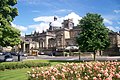
[edit]Crescent Gardens is a small open area in central Harrogate surrounded by some of the town's main tourist attractions including the Royal Pump Room, Royal Baths, Royal Hall and the Harrogate Council Offices; Hall M of the Harrogate International Centre fronts onto Crescent Gardens.
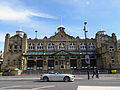
The Royal Hall theatre, a Grade II listed building designed by Frank Matcham.[65] As the only surviving Kursaal in Britain, the Royal Hall is an important national heritage building.[66] Restoration work was completed in 2007, and the hall was reopened on 22 January 2008, by the Prince of Wales.[67]
The Royal Pump Room, just off the gardens, houses Europe's strongest sulphur well;[68] it is now a museum showcasing the town's spa history.
-
 Montpellier Road
 -
![Harrogate war memorial, by Ernest Prestwich[69]](//upload.wikimedia.org/wikipedia/commons/thumb/7/73/The_Cenotaph%2C_Prospect_Square%2C_Harrogate_%28geograph_7509739%29.jpg/120px-The_Cenotaph%2C_Prospect_Square%2C_Harrogate_%28geograph_7509739%29.jpg) Harrogate war memorial, by Ernest Prestwich[69]
Harrogate war memorial, by Ernest Prestwich[69] -
-
 The Royal Baths

![Harrogate war memorial, by Ernest Prestwich[69]](https://en.wikipedia.org/wiki/File:The_Cenotaph,_Prospect_Square,_Harrogate_(geograph_7509739).jpg)

Parks and gardens
[edit]
The Valley Gardens, in Low Harrogate, is the town's main park and covers much of the area originally known as 'Bogs Field', where a number of springs were discovered. The Valley Gardens (locals use the definite article) has an ice-cream parlour, children's play area with outdoor paddling pool, a skate park, frisbee golf, crazy golf and mini golf. The Sun Pavilion at the northern edge of the park can be privately hired for weddings. Tennis courts and a bowling green are in the west of the park. The Friends of Valley Gardens group was formed in 2009 to support the park. It works in partnership with Harrogate Borough Council to guide the park's development.
The Stray is an area of open parkland in the centre of the town. It was created in 1778 to link most of Harrogate's springs in one protected area by an act of Parliament which fixed its area as 200 acres (81 ha), and even now when part is removed, e.g. due to road widening, it must be replaced elsewhere. During the Victorian period, there was a racecourse for horses there.
RHS Harlow Carr gardens, on the western edge of Harrogate, are award-winning themed gardens and are the Royal Horticultural Society's main presence and representative in the North of England.
The town has several smaller parks and gardens, including The Softpot Garden at Grove House, the Jubilee Gardens and Victoria Gardens on the eastern side of central Harrogate.
Culture
[edit]On 11 January 1900, Harrogate Grand Opera House, now Harrogate Theatre, opened with a charity gala in aid of British soldiers fighting the Boer War in South Africa; this was followed, on 13 January 1900, by J Tully's pantomime Dick Whittington.
In 1966, the Harrogate Festival of Arts & Science was established, now known as the Harrogate International Festivals, and is recognised as the North of England's leading arts festival;[70] it incorporates a number of festivals within the portfolio including the Theakstons Old Peculier Crime Writing Festival & Theakston's Old Peculier Crime Novel of the Year Award, Raworths Harrogate Literature Festival, Harrogate Music Festival and a number of year-round events.
The town hosted the Eurovision Song Contest 1982 in the Harrogate International Centre.[71]
Harrogate won the 2003 and 2016 Britain in Bloom in the category of 'Large Town' and the European Entente Florale in 2004, reprising its win in the first Entente Florale in 1977. Harrogate was a gold medal winner of Europe in Bloom in 2004. In 2005, a Channel 4 TV show listed Harrogate as the UK's third best place to live; in 2006, it came fourth in the same league, where the programme claimed that it placed lower due to "a slight dip in exam results", although presenter Phil Spencer noted that it was his personal favourite.[72]
Harrogate has two orchestras: Harrogate Symphony Orchestra[73] and Harrogate Philharmonic Orchestra.[74]
The town is also home to an underground music scene that has produced heavy metal and punk rock groups including Workshed, Acid Reign and Blood Youth.[75][76] It is also home to Bombed Out records, an independent record label, who has signed groups such as Fig 4.0.[77]
Sport
[edit]Cycling
[edit]On 5 July 2014, Harrogate served as the finish line of the first stage[78] of the Tour de France. The event attracted record crowds to the town centre and was televised to a global audience. British cyclist Mark Cavendish was forced to drop out of the race, when he crashed a few metres from the finish line and suffered a dislocated shoulder.[79] The town has since been the focal point for finishing stages of the Tour de Yorkshire in 2017.[80] Each event of the 2019 UCI Road World Championships finished in the town, although the entire historic county of Yorkshire was the official host.
Football
[edit]_005.jpg)
Harrogate Town AFC play at Wetherby Road Stadium. The club competes in League Two, the fourth tier of English football, following promotion to the English Football League, which came via victory in the 2019–20 National League Play-offs.[81] They have a historical rivalry with Harrogate Railway Athletic F.C., of the Northern Counties East Football League, located at Station View.
Harrogate RUFC is a North Premier team and formerly based at The County Ground, on Claro Road, but relocated to Rudding Lane on the south side of the town.
Cricket
[edit]Harrogate Cricket Club is to be the home of Yorkshire Women cricket team. Until 1995, the town hosted one Yorkshire county game per year at St George's Road cricket ground. Since 2022, the ground has been sponsored by Kirbys Solicitors. In 2008, a fire destroyed the historic old pavilion at the ground, but it has since been re-built with a modern pavilion, bar, function room and changing rooms.
Harrogate Cricket Club has 4 Saturday teams:
- 1st XI play in the Yorkshire Premier League North; they were the league's inaugural champions in 2016 and is one of the teams eligible to play in the Yorkshire championship whenever the team wins the league. The team formerly played in the Yorkshire ECB County Premier League until 2016.
- 2nd XI play in York Senior League – Division 2
- 3rd XI (also known as Harrogate Strays) play in Nidderdale League Division 1
- 4th XI (also known as Harrogate Devs) play in Nidderdale League Division 5[when?]
Bilton Cricket Club, off Bilton Lane, provides opportunities for players of all ages to play in local league cricket; they beat Harrogate Cricket Club at St George's Road in the Black Sheep Trophy of 2006.
Field hockey
[edit]Harrogate Hockey Club is a field hockey club that competes in the Women's England Hockey League, the North Hockey League and the Yorkshire & North East Hockey League.[82][83]
Other
[edit]According to designer Thomas Heatherwick, the Olympic Cauldron for the 2012 London Olympics was built in a 'Bond Gadget Workshop' in Harrogate.[84]
Harrogate Harriers run from Harrogate Squash & Fitness Centre on Hookstone Drive and Nidd Valley Road Runners share their premises with Harrogate Hockey Club. Harrogate District Swimming Club is at amateur level and has had teams compete at national level. Rock climbing is a sport in and around Harrogate, indoors at the Harrogate Climbing Centre and at Almscliffe Crag and Brimham Rocks.
Transport
[edit]Railway
[edit].jpg)

The town is served by four railway stations on the Harrogate Line: Harrogate, Hornbeam Park, Pannal and Starbeck; services on this line run to Leeds and York and are operated by Northern Trains.[85]
London North Eastern Railway operates a two-hourly service to London King's Cross. [86][87]
The former railway lines to Tadcaster and Wetherby were dismantled in the 1960s.[88]
Former line to Ripon
[edit]The Ripon line was closed to passengers on 6 March 1967 and to freight on 5 September 1969 as part of the wider Beeching Axe, despite a vigorous campaign by local campaigners, including the city's MP.[89]
Today, much of the route of the line through the city is now a relief road; however, the former station still stands and it is now surrounded by a new housing development. The issue remains a significant one in local politics and there are movements to restore the line.[89] Reports suggest the reopening of a line between Ripon and Harrogate would be economically viable, costing £40 million and could initially attract 1,200 passengers a day, rising to 2,700.[89][90] Campaigners renewed their calls on MPs to restore the railway link in 2015.[91]
Buses
[edit]Bus services are operated predominantly by The Harrogate Bus Company and Connexions Buses. Key routes include:[92]
- Route 36: Buses run every 10 minutes between Harrogate, Leeds (via Harewood, Moortown and Chapel Allerton) and every 30 minutes to Ripon.
- Route 1: Buses are also every 10 minutes to Knaresborough via Starbeck.
- Route 7: Runs to Leeds via Wetherby, Boston Spa and Seacroft, as well as other parts of semi-rural Leeds.
- Other routes connect the town to Otley, Bradford, Pateley Bridge, Boroughbridge, Skipton and local estates within Harrogate.
Harrogate bus station is sited in the town centre. It is managed by The Harrogate Bus Company;[93] the 13 stands are also used by other local operators, Flyer and National Express.[94][95]
.jpg)
In 2018, all bus routes to local housing suburbs within Harrogate became operated by electric buses. These buses charge on stands 1–3 at Harrogate bus station; the scheme is part funded by the government's Low Emission Bus Scheme.[96]
Roads
[edit]Road transport to Leeds is via the A61 (north and central Leeds), A658 (north-west Leeds/Leeds Bradford Airport) and A661 (for north-east Leeds). The A61 continues northwards to Ripon, while the A658 connects to Bradford after passing through north-west Leeds. The A658 also forms the Harrogate by-pass that skirts the south and east of the town, joining the A59 linking York and the A1(M) to the east and Skipton to the west with Harrogate.
Airports
[edit]The nearest airport is Leeds Bradford, 10 miles (16 km) to the south-west, to which there are bus services on Flyer route A2[95] and train services on the Harrogate Line to Horsforth, one of the closest stations. Teesside and Manchester Airport are accessible by rail via Leeds.
Education
[edit].jpg)
Harrogate has multiple colleges, schools and private schools:
- Ashville College
- Harrogate College, part of the Luminate Education Group[97]
- Harrogate Grammar School, (An academy, part of the Red Kite Learning Trust) Specialist in Language and Technology
- Harrogate High School, a specialist Sports College rebuilt under a governmental scheme in mid-2017
- Harrogate Ladies' College[98]
- Harrogate Tutorial College
- Rossett School a specialist computing and mathematics college
- St. Aidan's C of E High School, a specialist Language and Science School
- St John Fisher Catholic High School, a specialist arts and humanities school
- Army Foundation College.
Media
[edit]- The town's main printed news source is the Harrogate Advertiser, formerly part of Ackrill Media Group, now part of National World. The newspaper was first printed in 1836.
- The Stray Ferret is the main online news service for the Harrogate district.[99]
- The Harrogate Informer publishes news online throughout the district.[100]
- The local radio stations are BBC Radio York on 104.3 & 103.7 FM and Greatest Hits Radio Harrogate & The Yorkshire Dales on 97.2 FM.
- Local news and television programmes are provided by BBC Yorkshire and BBC North East & Cumbria on BBC One and ITV Yorkshire & ITV Tyne Tees on ITV.
Notable statistics
[edit]In 2012, Harrogate had the highest concentration of drink-drivers in the UK.[101] A March 2013 survey from the British property website Rightmove ranked Harrogate as the "happiest place" to live in the United Kingdom; the same result was seen in 2014 and 2015.[102] In 2014, Harrogate District Hospital had the best cancer care of any hospital in England.[103]
Notable people
[edit]- Olly Alexander (born 1990), singer and musician[104]
- Kathleen Frances Barker (1901–1963), children's book illustrator and writer. Daughter of Wright Barker.[105]
- Wright Barker (1863–1941), painter, specialising in animal portraits, landscapes, and portraits of people. Father of Kathleen Frances Barker.[105]
- Donald Simpson Bell, (1890–1916), First World War Victoria Cross recipient[106][107]
- Sir Dhunjibhoy Bomanji (1862–1937), shipping magnate, philanthropist.[108]
- Paul Bottomley (born 1965), footballer[109]
- Dewey Bunnell (born 1952), singer and songwriter with the band America[110]
- Jim Carter (born 1948) actor[111]
- Edward Chapman (1901–1977), actor
- Ben Coad, (1994), English cricketer[112]
- Rachel Daly (1991), English Footballer[113]
- Oliver Dingley (born 1992), Olympic diver[114]
- Ian Douglas-Wilson (1912–2013), physician and editor of The Lancet[115]
- Jenny Duncalf (born 1982), squash player[116]
- Wilfrid Edgecombe (1871–1963), spa physician who was instrumental in the founding of Harrogate District Hospital.[117]
- Richard Ellis (1820–1895), one of the first mayors of Harrogate.[118][119]
- Bernard Walter Evans (1843–1922), landscape painter and watercolourist. Harrogate resident 1890s to 1911.[120][121]
- John Farrah (1849–1907) grocer, confectioner, biologist, born in Harrogate.
- Gerald Finzi (1901–1956), composer[122]
- Courtenay Foote (1879–1925), silent-film actor[123]
- Samson Fox (1838–1903), engineer, industrialist, and philanthropist[124]
- Luke Garbutt (born 1993), footballer for Blackpool, attended Harrogate Grammar School.[125]
- Thom Sonny Green (born 1985), drummer for indie rock band Alt-J.
- H. L. A. Hart (1907–1992), legal philosopher[126]
- Thomas Holroyd (1821–1904), portrait and landscape painter, co-owner of photographic studio T & J. Holroyd.
- Charles Hull (1890–1953), soldier who received the Victoria Cross.[127]
- Garry Jennings, musician born in Harrogate.[128]
- Mik Kaminski (born 1951), violinist and band member of ELO and Violinski[129]
- Jack Laugher (born 1995), Olympic diver.[130]
- Christina Le Moignan (born 1942), minister and academic, who served as President of the British Methodist Conference
- Peter McCormick (born 1952), solicitor, Chairman of the Premier League, Vice Chairman of The Football Association[131]
- Fridel Meyer (1904–1982), Long-distance kayaker and businesswoman. German-born; later a Harrogate resident.[119]
- Sarah Moore (born 1993), a racing driver who competes in the W Series
- David Nobbs (1935–2015) author and screenwriter, creator of Reginald Perrin[132]
- Andy O'Brien (born 1979), footballer for the Vancouver Whitecaps.[133]
- Jack Ogden, jewellery historian, grew up in Harrogate.
- Gord Pettinger (born 11 November 1911 in Harrogate, England – d. 12 April 1986) was a British professional ice hockey centre[134]
- William Pope (1825–1905), clergyman and follower of the Oxford Movement, who seceded from Anglicanism to the Catholic Church and became rector of St Robert's Church, Harrogate.[135]
- Richard Ridgeway (1848–1924), Victoria Cross recipient, lived his later life and died in Harrogate[136]
- Ilona Rodgers (born 1942), actress
- Kathleen Rutherford (1896–1975). Physician, philanthropist, humanitarian aid worker, peace campaigner.[137]
- Arnold Shaw (1896–1972), British Army officer and cricketer
- David Simpson (1860–1931), former freeman and four times mayor of Harrogate, and contractor who built the Grand Hotel in the town.[138][139]: 519–520
- John Smith (1797–1866), philanthropist, partner in Beckett's Bank, and founder of the Harrogate mansion "Belvedere", where he lived in retirement.[139]: 134–135 [140]
- Hugo Speer (born 1968), actor[141]
- Harold Styan O.B.E. (1895–1982), gymnast, sports teacher and youth worker.[142]
- Jonathan Tattersall (born 1994), cricketer[112]
- Laura Veale (1867–1963), first qualified female doctor practising in Harrogate and the North Riding of Yorkshire.[143]
- William John Seward Webber (1842–1919), sculptor
- Mark Wharton, musician born in Harrogate[144][145]
- Shirley Wray, neuro-ophthalmologist and Professor at Harvard Medical School
See also
[edit]- Listed buildings in Harrogate
- Association of Harrogate Apprentices
- Churches in Harrogate
- Harrogate power station
- Harrogate (Stonefall) Commonwealth War Graves Commission Cemetery
- Harrogate District Hospital
- List of public art in Harrogate
- List of spa towns in the United Kingdom
- The Harrogate International Youth Festival
References
[edit]- ^ Jones, Daniel (2011). Roach, Peter; Setter, Jane; Esling, John (eds.). "Harrogate". Cambridge English Pronouncing Dictionary (18th ed.). Cambridge University Press. p. 225. ISBN 978-0-521-15255-6.
- ^ "Harrogate named as happiest place to live in Britain" Archived 3 September 2017 at the Wayback Machine, BBC, 6 August 2015
- ^ Collinson, Patrick; Norton, Jim. "Harrogate is 'happiest town' to live in in the UK | Money". The Guardian. Archived from the original on 7 April 2014. Retrieved 16 May 2014.
- ^ "Best places to live in the UK – our top 30". housetohome.co.uk. Archived from the original on 8 April 2014. Retrieved 16 May 2014.
- ^ a b UK Census (2011). "Local Area Report – Harrogate Built-up area (E34004646)". Nomis. Office for National Statistics. Retrieved 22 March 2021.
- ^ The population of the Harrogate Unparished Area is derived from the totals for Bilton; Granby; Harlow Moor; High Harrogate; Hookstone; Low Harrogate; New Park; Pannal; Rossett; Saltergate; Starbeck; Stray; and Woodfield wards then subtracting that part of Killinghall Civil Parish within Saltergate Ward. The population for the portion of Killinghall Civil Parish is derived from subtracting the populations of Nidd and Ripley Civil Parishes from the total for Killinghall ward. This gives the portion of Killinghall Civil Parish in Killinghall Ward; this is then subtracted from the total for Killinghall Civil Parish to give the total for the portion of Killinghall Civil Parish in Saltergate Ward.
- ^ "North Yorkshire population information". North Yorkshire County Council. 19 December 2013. Archived from the original on 7 August 2013. Retrieved 16 May 2014.
- ^ "Harrogate". Bottled Water of the World. 9 December 2003. Archived from the original on 10 February 2009. Retrieved 26 December 2008.
- ^ "Harrogate, High Harrogate, Low Harrogate :: Survey of English Place-Names". epns.nottingham.ac.uk. Archived from the original on 28 September 2022. Retrieved 19 February 2021.
- ^ Victor Watts (ed.), The Cambridge Dictionary of English Place-Names Based on the Collections of the English Place-Name Society (Cambridge: Cambridge University Press, 2004), s.v. HARROGATE.
- ^ Smith, A. H. (1961). The Place-names of the West Riding of Yorkshire. Vol. 5. Cambridge University Press. p. 108.
- ^ Neesam, Malcolm (2005). Harrogate Great Chronicle 1332–1841. Carnegie. p. 9. ISBN 978-1-85936-145-0.
- ^ Neesam 2005, p. 42.
- ^ a b Winn, Christopher (2010). I never knew that about Yorkshire. London: Ebury. p. 164. ISBN 978-0-09-193313-5.
- ^ Spadacrene Anglica; or, The English spa fountain ... the first work on the waters of Harrogate at the Internet Archive
- ^ Neesam 2005, pp. 102–108.
- ^ "History of The Crown Hotel". www.crownhotelharrogate.com. Archived from the original on 18 January 2018. Retrieved 18 January 2018.
- ^ a b HCACA 2010, p. 7.
- ^ "Harrogate Borough Council: the Stray". Archived from the original on 8 July 2010.
- ^ Neesam 2005, pp. 285ff.
- ^ Historic England. "Royal Pump Room Museum (Grade II*) (1149478)". National Heritage List for England. Retrieved 19 February 2021.
- ^ Historic England. "Tewit Well (Grade II*) (1293847)". National Heritage List for England. Retrieved 19 February 2021.
- ^ "Emilia Fox". The Genealogist. Retrieved 7 September 2011.
- ^ Martin Wainwright (4 May 2012). "Fox family actors return to great-grandfather's glittering Yorkshire hall". The Guardian.
- ^ "Emilia Fox". Who Do You Think You Are?. Series 8. Episode 5. 7 September 2011. BBC One. Retrieved 7 September 2011.
- ^ HCACA 2010, p. 9.
- ^ "Viking treasure hoard uncovered". BBC News. 19 July 2007. Archived from the original on 8 August 2007. Retrieved 19 July 2007.
- ^ "Harrogate (Municipal Borough) through time". A Vision of Britain through Time. Retrieved 12 November 2025.
- ^ "Claro Registration District". UKBMD. Retrieved 12 November 2025.
- ^ "Pannal and Burn Bridge Parish Council. How A New Parish Council Was Created In Pannal, Yorkshire". National Association of Local Councils. Retrieved 17 March 2017.
- ^ Robinson, Calvin; Minting, Stuart (31 March 2023). "Harrogate Borough Council to be abolished today". The Stray Ferret. Archived from the original on 15 May 2023. Retrieved 15 May 2023.
- ^ "Harrogate". BBC News Online. 19 April 2009. Archived from the original on 18 April 2024. Retrieved 23 January 2011.
- ^ "The North Yorkshire (Structural Changes) Order 2022". legislation.gov.uk. Retrieved 12 November 2025.
- ^ "North Yorkshire Registration District". UKBMD. Retrieved 12 November 2025.
- ^ "New Town Councils for Harrogate and Scarborough". North Yorkshire Council. Retrieved 7 February 2025.
- ^ "New Harrogate Town Council will seek to take on meaningful role and find the budget to do so". Harrogate Advertiser. 13 May 2025. Retrieved 15 May 2025.
- ^ "International partnership between City of Barrie, Canada and the Harrogate district". Harrogate Borough Council. 7 June 2013. Archived from the original on 2 August 2014. Retrieved 16 May 2014.
- ^ "Rail misery for commuters". harrogateadvertiser.net. Archived from the original on 6 December 2008. Retrieved 17 July 2008.
- ^ "untitled" (PDF). Archived from the original (PDF) on 27 March 2009.
- ^ "The most expensive streets in Yorkshire and the Humber 2008". The Times. London. 19 February 2008. Archived from the original on 16 May 2008. Retrieved 4 May 2010.
- ^ "Greatest Hits Radio (Harrogate and the Yorkshire Dales) – The Good Times Sound Like This". Planetradio.co.uk. Archived from the original on 21 January 2022. Retrieved 22 January 2022.
- ^ "Harrogate Historical Weather Conditions". Uk.weather.com. Archived from the original on 4 January 2015. Retrieved 16 May 2014.
- ^ "Dishforth Airfield Climate Period: 1991-2020". Retrieved 9 August 2025.
- ^ https://www.roostweather.com/ukobs/temp_station_extreme_map.php [bare URL]
- ^ "UK climate averages". Met Office. Retrieved 9 August 2025.
- ^ "Monthly Temperature Extremes". Roost Weather. Retrieved 9 August 2025.
- ^ "Zoopla Statistics".
- ^ "House prices England survey". 27 December 2019.
- ^ "Yorkshire Post". 23 September 2019.
- ^ "Harrogate International Centre". harrogateinternationalcentre.co.uk. Archived from the original on 20 August 2008. Retrieved 17 July 2008.
- ^ "Harrogateinternationalcentre.co.uk" (PDF). Archived from the original (PDF) on 10 July 2007.
- ^ "WE'VE BEEN EVOLVING FOR ALMOST TWO HUNDRED YEARS". Harrogateconventioncentre.co.uk. Archived from the original on 28 February 2021. Retrieved 1 March 2021.
- ^ Webster, Jacob (28 January 2021). "Why is Harrogate's NHS Nightingale hospital not being used?". The Harrogate Advertiser. Archived from the original on 28 January 2021. Retrieved 19 February 2021.
- ^ What HIC means to Harrogate Archived 28 August 2010 at the Wayback Machine Harrogate International Centre
- ^ "The first news on what's coming at Great Yorkshire Show 2020 in Harrogate". The Harrogate Advertiser. 10 December 2019. Archived from the original on 21 June 2021. Retrieved 19 February 2021.
- ^ Blow, John (27 July 2020). "Yorkshire's food 'production powerhouse' explored on prime time television". The Yorkshire Post. Archived from the original on 6 September 2021. Retrieved 19 February 2021.
- ^ "Harrogate Spring Water to be taken over by Evian owner". BBC News. 11 June 2020. Archived from the original on 5 February 2021. Retrieved 19 February 2021.
- ^ Bellamy, Christopher (15 August 1992). "RAF changes will create two new command units". The Independent. Archived from the original on 9 May 2022. Retrieved 24 November 2017.
- ^ Escott, Beryl E. (1989). Women in air force blue : the story of women in the Royal Air Force from 1918 to the present day. Wellingborough: Patrick Stephens Ltd. pp. 122–131. ISBN 1-85260-066-7.
- ^ Pevsner, Nikolaus (1967). The Buildings of England. Yorkshire: The West Riding (2nd ed.). London: Penguin Books. p. 248. ISBN 0-14-071017-5.
- ^ "Unveiling the statue of Queen Victoria at Harrogate". Leeds Mercury. British Newspaper Archive. 7 October 1887. p. 3 col.4. Retrieved 14 July 2021.
- ^ "Harrogate". bettys.co.uk. Archived from the original on 17 August 2015. Retrieved 26 August 2015.
- ^ "Mercer Art Gallery". Archived from the original on 2 April 2009.
- ^ "Mercer Art Gallery". North Yorkshire Council. 17 February 2023. Retrieved 6 April 2025.
- ^ "Harrogate International Centre". Royal Hall. Archived from the original on 20 April 2014. Retrieved 16 May 2014.
- ^ "Harrogate.co.uk – Guide to Harrogate B&Bs, Hotels, Restaurants & Attractions". harrogate.co.uk. Archived from the original on 8 December 2005.
- ^ "Prince reopens saved Royal Hall". BBC News. 22 January 2008. Archived from the original on 24 January 2008. Retrieved 4 May 2010.
- ^ "The Royal Pump Room Museum on". Aboutbritain.com. Archived from the original on 8 June 2014. Retrieved 16 May 2014.
- ^ Historic England. "Harrogate War Memorial (1446943)". National Heritage List for England. Retrieved 30 December 2022.
- ^ "An arts festival truly for all". harrogateadvertiser.co.uk. Archived from the original on 30 June 2015. Retrieved 22 January 2015.
- ^ Maguire, Ben (18 November 2019). "Here are ten unusual facts about Harrogate". Harrogate Advertiser. Archived from the original on 3 January 2020. Retrieved 19 November 2019.
- ^ "Channel 4 Best & Worst". channel4.com. Archived from the original on 25 July 2008. Retrieved 8 August 2006.
- ^ "HARROGATE SYMPHONY ORCHESTRA". Archived from the original on 17 March 2018. Retrieved 17 March 2018.
- ^ "Harrogate Philharmonic Orchestra". Archived from the original on 11 April 2018. Retrieved 17 March 2018.
- ^ "Why Harrogate is a metal capital of rock music – and it's not all Blood Youth". 24 January 2020. Archived from the original on 6 February 2020. Retrieved 6 February 2020.
- ^ "Fastix: New UK Hardcore Band Kick Off 2020 with Purpose". 15 January 2020. Archived from the original on 6 February 2020. Retrieved 6 February 2020.
- ^ "BOMBED OUT RECORDS". Archived from the original on 2 November 2019. Retrieved 6 February 2020.
- ^ "Tour de France : Stage 1 Leeds to Harrogate". www.letour.fr. Archived from the original on 5 July 2014. Retrieved 22 January 2022.
- ^ "Tour de France: Mark Cavendish recovering well after crash". BBC Sport. Archived from the original on 17 October 2015. Retrieved 12 February 2018.
- ^ "Tour de Yorkshire 2017 route: maps and race profiles for every stage – Cycling Weekly". Cycling Weekly. 24 April 2017. Archived from the original on 29 May 2017. Retrieved 19 May 2017.
- ^ "National League promotion final: Harrogate Town beat Notts County 3-1 to secure place in League Two". BBC Sport. 2 August 2020. Archived from the original on 2 August 2020. Retrieved 2 August 2020.
- ^ "Harrogate Hockey Club". Retrieved 4 October 2024.
- ^ "England Hockey - Harrogate Hockey Club". Retrieved 4 October 2024.
- ^ "Olympic Cauldron Built In 'Bond Gadget Workshop', Says Designer Thomas Heatherwick". The Huffingham Post. 28 July 2012. Archived from the original on 31 July 2012. Retrieved 8 September 2012.
- ^ "Timetables and engineering information for travel with Northern". Northern Railway. May 2023. Archived from the original on 5 July 2023. Retrieved 31 August 2023.
- ^ "LNER Azuma: Six trains to serve Harrogate". LNER. 29 October 2019. Archived from the original on 21 August 2023. Retrieved 31 August 2023.
- ^ "Our timetables". LNER. May 2023. Archived from the original on 22 September 2023. Retrieved 31 August 2023.
- ^ Chapman, Stephen (2011). Harrogate & Wetherby. Todmorden: Bellcode. p. 23. ISBN 978-1871233-24-7.
- ^ a b c "Reopening line makes economic sense, says study". NorthernEcho.co.uk. Archived from the original on 2 January 2010. Retrieved 1 February 2009.
- ^ "Backing for restoring rail link". BBC News Online. BBC. 11 May 2004. Archived from the original on 16 July 2004. Retrieved 4 January 2010.
- ^ "Campaigners call on MPs to restore Ripon railway link". Yorkshire Post. Retrieved 2 March 2015.[permanent dead link]
- ^ "Harrogate Bus Services". Bus Times. 2023. Archived from the original on 31 August 2023. Retrieved 21 May 2023.
- ^ "Times". Transdev in Harrogate. Archived from the original on 25 May 2014. Retrieved 24 May 2014.
- ^ "North & West Yorkshire bus routes". Connexionsbuses. Archived from the original on 20 October 2014. Retrieved 24 May 2014.
- ^ a b "Flyer A2 Bus Timetable" (PDF). Passenger-line-assets.s3.eu-west-1.amazonaws.com. Archived (PDF) from the original on 17 June 2022. Retrieved 22 January 2022.
- ^ "Harrogate to get electric bus fleet". Smt.co.uk. 6 February 2017. Archived from the original on 13 July 2019. Retrieved 13 July 2019.
- ^ "Transfer of activities at Harrogate College from Leeds Metropolitan University to Hull College" Archived 20 August 2008 at the Wayback Machine, Hull College website, accessed 28 August 2008
- ^ "Harrogate Ladies' College – Independent School Harrogate". HLC. Archived from the original on 8 June 2019. Retrieved 13 March 2006.
- ^ Sharman, David (20 February 2020). "Ex-BBC boss to create journalism jobs with launch of local news website". Hold The Front Page. Archived from the original on 20 October 2021. Retrieved 19 October 2021.
- ^ "Harrogate Informer". Archived from the original on 11 March 2017. Retrieved 20 February 2017.
- ^ "Harrogate tops drink-driver list". BBC News. 7 December 2012. Archived from the original on 10 November 2018. Retrieved 20 June 2018.
- ^ "Harrogate is the UK's happiest place to call home". Rightmove.co.uk. 26 March 2013. Archived from the original on 6 October 2014. Retrieved 16 May 2014.
- ^ "Harrogate District Hospital – Harrogate Still Number 1 in England for Cancer Care". Hdft.nhs.uk. Archived from the original on 22 April 2014. Retrieved 16 May 2014.
- ^ "Years & Years: 'I believe if you want the world to change you have to do something about it'". The Yorkshire Post. 18 July 2019. Archived from the original on 23 June 2021. Retrieved 20 February 2021.
- ^ a b Jennings, Paul (April 2022). "The Barkers". harrogatecivicsociety.org. Harrogate Civic Society. Retrieved 21 June 2025.
- ^ RVC 1981, p. 25.
- ^ "Second Lieutenant Donald Simpson Bell". Harrogate People and Places. Archived from the original on 17 October 2015. Retrieved 10 June 2013.
- ^ "New life for the house where time stood still". The Times. 16 September 2013. Archived from the original on 19 January 2021. Retrieved 20 February 2021.
- ^ "Paul Bottomley". www.doncasterrovers.co.uk. Archived from the original on 4 March 2016.
- ^ "Welcome home". The Northern Echo. 8 February 2007. Archived from the original on 21 August 2023. Retrieved 20 February 2021.
- ^ McLean, Craig (9 June 2016). "Downton's Mr Carter on the Skiffle star who inspired rock'n'roll". The Independent. Archived from the original on 9 May 2022. Retrieved 20 February 2021.
- ^ a b "Yorkshire squad". BBC Sport. Archived from the original on 12 April 2021. Retrieved 20 February 2021.
- ^ "Women's World Cup 2019: Mapping England's Lionesses squad". BBC Sport. 2 July 2019. Archived from the original on 2 July 2019. Retrieved 6 September 2019.
- ^ "Dingley learns from Commonwealths". BBC Sport. 20 October 2010. Archived from the original on 18 April 2024. Retrieved 20 February 2021.
- ^ Pincock, Stephen (November 2013). "Ian Douglas-Wilson". The Lancet. 382 (9906): 1697–1698. doi:10.1016/S0140-6736(13)62393-4. S2CID 54229048.
- ^ "Jenny on the up". The Northern Echo. 23 April 2003. Archived from the original on 21 August 2023. Retrieved 20 February 2021.
- ^ "Edgecombe, Wilfred (1871 - 1963)". Lancet. 1: 895. 1963. Retrieved 20 July 2025 – via Royal College of Surgeons of England.
Also in British Medical Journal 1963, page 1350.
- ^ "1861 England Census, York Place, Harrogate. RG/9/3207 page 12". ancestry.co.uk. H.M. Government. 1861. Archived from the original on 24 January 2023. Retrieved 24 January 2023.
- ^ a b Neesam, Malcolm (2019). "Ellis, Richard". A-Z of Harrogate. UK: Amberley Publishing. ISBN 9781445696577. Archived from the original on 5 April 2023. Retrieved 21 March 2023.
- ^ Matthews, Anne. "Bolton Abbey from the Soay by Bernard Walter Evans". lythamstannesartcollection.org. Lytham St Annes Art Collection. Archived from the original on 2 December 2021. Retrieved 2 December 2021.
- ^ "Bernard Walter Evans, biography". britishmuseum.org. British Museum. Archived from the original on 1 December 2021. Retrieved 1 December 2021.
- ^ McVeagh, Diana. "Finzi, Gerald Raphael". Oxford Dictionary of National Biography (online ed.). Oxford University Press. doi:10.1093/ref:odnb/33136. (Subscription, Wikipedia Library access or UK public library membership required.)
- ^ "Courtenay Foote". bfi.org.uk. Archived from the original on 21 August 2023. Retrieved 20 February 2021.
- ^ Owen, W. B. "Fox, Samson". Oxford Dictionary of National Biography (online ed.). Oxford University Press. doi:10.1093/ref:odnb/33235. (Subscription, Wikipedia Library access or UK public library membership required.)
- ^ Wobschall, Leon (26 June 2015). "Harrogate's Luke Garbutt is tipped to impress by John Stones at Euro finals". The Yorkshire Post. Archived from the original on 26 September 2021. Retrieved 20 February 2021.
- ^ Mullender, Richard: "Nicola Lacey, A Life of H.L.A. Hart: the Nightmare and the Noble Dream – H.L.A. Hart in Anglo-American Context" Archived 12 May 2013 at the Wayback Machine, Web Journal of Current Legal Issues (review 2007). Oxford University Press, (2004). ISBN 978-0-19-920277-5
- ^ "Corporal Charles Hull". Harrogate People and Places. Archived from the original on 13 March 2012. Retrieved 10 June 2013.
- ^ Chalmers, Graham. "Harrogate 'black metal band' sign to record label!". Archived from the original on 22 July 2018. Retrieved 22 July 2018.
- ^ "ELO, ELO, ELO! Violinist Mik Kaminski back in Huddersfield for third gig". 18 March 2010. Archived from the original on 16 March 2023. Retrieved 16 March 2023.
- ^ Westcott, Matt (12 April 2018). "Commonwealth Games: 'I was on fire' – Laugher claims second diving gold". The Northern Echo. Archived from the original on 21 August 2023. Retrieved 20 February 2021.
- ^ Riach, James (20 May 2014). "Richard Scudamore arbitrator Peter McCormick 'is shooting buddy'". The Guardian. Archived from the original on 4 December 2020. Retrieved 20 February 2021.
- ^ Evans, Jeff. "Nobbs, David Gordon". Oxford Dictionary of National Biography (online ed.). Oxford University Press. (Subscription, Wikipedia Library access or UK public library membership required.)
- ^ "Leeds United's O'Brien to get boot". York Press. 21 November 2011. Archived from the original on 21 August 2023. Retrieved 20 February 2021.
- ^ "UK stars on ice". infoweb.newsbank.com. 28 September 2007. Archived from the original on 18 April 2024. Retrieved 22 February 2021.
- ^ "Death of Canon Pope, at Harrogate. Well-known disciple of Newman passes away. His connections with Ilkley and Harrogate". Wharfedale & Airedale Observer. 10 November 1905. p. 8 cols 4–6. Retrieved 23 July 2024 – via British Newspaper Archive.
- ^ RVC 1981, p. 222.
- ^ "Dr Kathleen Eleanor Hyde Rutherford MBE, MB, ChB, (1896-1975)" (PDF). sigbi.org. Soroptimist International. Retrieved 23 June 2025.
- ^ "Obituary. Four times mayor of Harrogate. Ald. David Simpson". Yorkshire Post and Leeds Intelligencer. British Newspaper Archive. 16 January 1931. p. 4 col.1. Retrieved 22 December 2022.
- ^ a b Neesam, Malcolm G. (2022). Wells & Swells, the golden age of Harrogate Spa, 1842-1923 (1 ed.). Lancaster, England: Carnegie Publishing. ISBN 9781859362389.
- ^ Historic England. "Harrogate School of Art, Victoria Avenue (1149399)". National Heritage List for England. Retrieved 30 December 2022.
- ^ "Hugo Speer narrates Prokofiev's Peter And The Wolf, Harrogate Royal Hall, June 22". York Press. 19 June 2013. Archived from the original on 21 August 2023. Retrieved 20 February 2021.
- ^ "To our boys on service". Harrogate Herald. 1 December 1915. p. 4 col.3. Retrieved 29 October 2024 – via British Newspaper Archive. The article is reproduced here
- ^ Neesam, Malcolm (2022). Wells and Swells: The Golden Age of Harrogate Spa, 1842–1923. Carnegie Publishing Ltd. ISBN 978-1859362389.
- ^ Chalmers, Graham. "Metal legend was Harrogate's 'class clown'". Archived from the original on 24 July 2018. Retrieved 13 October 2018.
- ^ McIver, Joel (2000). Extreme Metal II. Omnibus. ISBN 9780711980402.
Sources
[edit]- The Register of the Victoria Cross. Cheltenham: This England Books. 1981. ISBN 0906324033.
- Harrogate Conservation Area Character Appraisal (PDF). harrogate.gov.uk (Report). Harrogate: Harrogate Borough Council. December 2010. Retrieved 19 February 2021.
External links
[edit]


Harrogate
View on GrokipediaHarrogate is a spa town in North Yorkshire, England, with a population of approximately 75,000. It originated as a health resort following the discovery of mineral springs in the 16th century and developed into a fashionable Victorian-era destination known for its sulphur-rich waters, elegant architecture, and landscaped gardens.[1][2][3]
The town's defining characteristic stems from its natural springs, first identified in 1571 by William Slingsby at Tewit Well, which contain high levels of sulphur and were promoted for their purported medicinal properties, attracting visitors seeking cures for ailments through bathing and drinking the waters.[3][4] This led to the construction of facilities like the Royal Pump Room in 1842, where the waters were dispensed, solidifying Harrogate's reputation as one of Britain's premier spas by the late 19th century.[5]
Harrogate's economy relies heavily on tourism, hosting over five million visitors annually who come for its preserved heritage sites, including the Turkish Baths, Valley Gardens, and RHS Garden Harlow Carr, as well as its role as a conference hub and retail center featuring upscale boutiques and tearooms like Betty's.[6] The town maintains high standards in horticulture, frequently earning accolades in national competitions for its floral displays and green spaces, contributing to its affluent and well-maintained character.[2][7]
Etymology
Origins of the name
The name Harrogate derives from Old Norse hǫrgr (a cairn or heap of stones) combined with gata (road or street), signifying "the road to the cairn," a toponym reflecting Viking settlement patterns in northern England where such stone markers denoted boundaries or waypoints along ancient trackways.[8] This interpretation aligns with the region's Norse linguistic legacy, as evidenced by comparable place names like those incorporating gata for routes near significant features.[9] The earliest documented form appears around 1200 as Harelow in local records, potentially an ancestral variant linking to hare-haunted or hoary (frost-covered) lowlands near early paths, though direct etymological continuity remains debated.[10] By the 1330s, it is attested in charters and administrative documents as Harwegate, Harougat, and Harrowgate, evolving toward the modern spelling while retaining the core sense of a roadside feature.[9] This nomenclature distinguishes Harrogate from similarly prefixed locales, such as Harlow in Essex, with a recorded 1518 variant Harlowgate possibly denoting a specific route to nearby Harlow Hill rather than direct derivation from the distant settlement.[11] Alternative folk etymologies, like "road of robbers" (harw-gate) or British Celtic compounds for "hey-wray-gate" (moorland stream road), lack primary charter support and appear in 19th-century speculations without corroborating medieval evidence.[10]History
Prehistoric and medieval periods
Evidence of human activity in the Harrogate area dates to the Mesolithic period, though local archaeological remains are sparse compared to coastal sites like Star Carr, approximately 35 miles east, where settlements from around 9000 BC yielded tools, headdresses, and structural evidence of post-glacial hunter-gatherer life. Neolithic activity is attested by a rare ceremonial hand axe, likely from circa 2000 BC, unearthed in nearby Knaresborough, suggesting ritual or elite use in a regional context of early farming communities. Further west, at Kirk Hammerton about 7 miles from Harrogate, geophysical surveys indicate a possible henge monument from the same era, part of broader prehistoric ceremonial landscapes in the Vale of York, though excavation has yet to confirm its full extent.[12][13][14] Roman influence reached the Harrogate vicinity indirectly through infrastructure and administration, with no major settlements or artifacts identified locally. The civitas capital of Isurium Brigantum at Aldborough, 15 miles east, functioned as the administrative center for the Brigantes tribe from around AD 70, featuring town walls, mosaics, and trade links that likely extended Roman roads and supply networks into surrounding rural areas like Harrogate. Place-name evidence and minor finds, such as pottery scatters, hint at peripheral use of the landscape for agriculture or transit, but the area remained largely undeveloped under Roman rule.[15] Post-Roman and Anglo-Saxon periods left limited direct traces in Harrogate, with settlement patterns inferred from parish divisions and linguistics in adjacent townships like Bilton and Pannal. The region fell within the kingdom of Deira, later Northumbria, where Anglo-Saxon farming communities established steadings amid forested ridges, as evidenced by etymological roots in [Old English](/page/Old English) terms for clearings and enclosures in local manors. Viking incursions from the 9th century onward are marked by the Vale of York Hoard, a 10th-century deposit of over 600 silver items—including coins from multiple Scandinavian mints—discovered in 2007 near Harrogate, representing wealth accumulation or ritual burial amid Norse colonization of Yorkshire.[9][16] In the high medieval era, Harrogate lay on the fringes of Knaresborough manor, administered from Knaresborough Castle, a Norman stronghold constructed after 1070 on earlier earthworks overlooking the River Nidd. The castle served as a royal demesne, granted to various magnates like Robert de Stuteville in the 12th century, with records of assize courts and musters reflecting its role in forest law enforcement over the Honor of Knaresborough, encompassing open commons and wooded pastures around Harrogate. Local economy centered on arable farming, sheep rearing, and tenant obligations under manorial custom, as documented in 14th-century extents listing villein holdings and services, though the area itself comprised scattered hamlets rather than nucleated villages. By the 15th century, the manor's oversight extended to minor ecclesiastical ties, such as chapels dedicated to early saints like Wilfrid, amid a landscape dominated by gentry estates and royal hunting grounds.[17][9]Emergence as a spa town (17th–19th centuries)
The discovery of mineral springs initiated Harrogate's development as a health resort. In 1571, William Slingsby identified the Tewit Well in High Harrogate, the first chalybeate spring noted for its iron content and purported medicinal properties, drawing initial local interest despite the area's remote moorland setting.[18][19] Subsequent explorations revealed additional springs; in 1631, Dr. Michael Stanhope located St. John's Well nearby, promoting its therapeutic waters through analysis and publication, which highlighted benefits for ailments like rheumatism and skin conditions based on contemporary medical observations.[20][21] By the mid-17th century, sulphur springs emerged in Low Harrogate, including the Old Sulphur Well, whose strong mineral content—Europe's most potent—further attracted visitors seeking treatments for digestive and respiratory issues, with over 80 springs eventually cataloged across the district.[22] Early infrastructure supported this nascent spa economy. The first public bathing house opened in 1663 adjacent to the Sweet Spa (an alias for St. John's Well), enabling heated immersion for broader access beyond elite visitors; by century's end, around 20 such facilities operated, rudimentary but pivotal in commodifying the waters.[21][23] Stanhope's advocacy, emphasizing the springs' efficacy without excessive infrastructure, spurred private investments in basic lodgings and paths, though growth remained modest due to poor accessibility.[21] Improved transport and land management accelerated visitor influx by the late 18th and early 19th centuries. The Forest of Knaresborough Inclosure Act of 1770 consolidated common lands, preserving areas like The Stray as open spaces while reallocating plots for development, which indirectly enhanced the town's layout for resort functions without fragmenting spring sites.[24] Turnpike trusts, authorized between 1752 and 1777 for roads into Bilton-with-Harrogate townships, imposed tolls to fund surfacing and widening, reducing travel times from York and Leeds; this facilitated coach arrivals, boosting annual visitors from hundreds to thousands by 1800 and enabling Harrogate's shift from obscure wells to recognized spa destination.[25][26]Victorian expansion and Edwardian era
The arrival of the railway line to Harrogate in 1848, via the Leeds and Thirsk Railway, catalyzed rapid urban expansion by improving accessibility for tourists seeking the town's mineral springs, transforming it from a modest settlement into a prominent spa resort. Population figures reflect this causal link: the local area grew from around 1,300 inhabitants in 1801 to over 14,000 by the 1881 census, driven primarily by influxes of seasonal visitors and associated service industries rather than local agriculture or manufacturing.[27] This infrastructure-enabled boom prioritized elite leisure over industrial output, with empirical records showing visitor numbers surging from 4,000 annually in 1831 to over 10,000 by the late 1830s and 25,000 by 1900, as spa-taking became a staple of upper-class health regimens.[28][29] Central to this era's infrastructure was the Royal Pump Room, constructed in 1842 as an octagonal rotunda to centralize the dispensation of curative waters, replacing earlier rudimentary pumps and accommodating the growing demand for supervised mineral intake.[18] Chemical analyses confirmed the waters' composition, including high sulphide content—described as Europe's strongest sulphur springs—and iron salts, which proponents claimed offered therapeutic benefits for ailments like rheumatism and digestive disorders based on observed precipitation reactions with reagents such as tincture of galls.[30][31] Economic dependence on these springs is evident in building records: the Harrogate Improvement Commissioners funded the Pump Room as their inaugural project, underscoring how verified mineral properties, rather than unsubstantiated folklore, underpinned investor confidence and visitor patronage. Elite endorsement further amplified Harrogate's status, with aristocracy including Russian nobility frequenting the town for its waters and amenities, as documented in contemporary accounts of imperial visits during the late Victorian and Edwardian periods.[32] Hotels like the Grand, erected in 1903 to designs emphasizing opulent Victorian-style grandeur, catered to this demographic, featuring extensive facilities for prolonged stays and reinforcing the town's role as a refined retreat.[33] Such patronage, tied directly to railway-enabled mobility, peaked in the Edwardian era with tens of thousands of annual season visitors, though analyses of spa efficacy remained grounded in period chemical assays rather than later medical consensus.[34]20th century to present
Harrogate's spa industry, which had thrived into the early 20th century, experienced a marked decline starting in the 1930s, primarily due to the economic pressures of the Great Depression that reduced visitor numbers to the town's therapeutic springs and facilities.[35] This downturn persisted through World War II, during which many government departments relocated to Harrogate, utilizing its hotels and infrastructure, while the spa treatments waned further amid wartime constraints and advancing medical alternatives like antibiotics.[36] Several Harrogate hotels were requisitioned to support Royal Air Force training operations under the designation RAF Harrogate, contributing to the town's wartime role without direct combat involvement.[37] Post-1945, the establishment of the National Health Service in 1948 accelerated the "de-spafication" of Harrogate, as public healthcare diminished reliance on private spa therapies for ailments previously treated with mineral waters.[36] By the 1960s and 1970s, traditional spa patronage had significantly eroded, prompting economic diversification toward conferences and retail; this shift was bolstered by the opening of the Harrogate International Centre in 1982, a modern convention facility designed to host large events and offset the loss of spa-related tourism.[38] The centre's debut was highlighted by hosting the Eurovision Song Contest on April 24, 1982, drawing international attention and establishing Harrogate as a venue for global gatherings.[39] In the late 20th and early 21st centuries, Harrogate's population grew steadily, with the district's residents increasing from approximately 151,000 in 2001 to 166,000 by the 2021 census, reflecting suburban expansion and economic appeal despite an ageing demographic profile.[40] The 2008 financial recession impacted tourism and retail sectors, yet recovery was supported by Harrogate's conference infrastructure and proximity to the Yorkshire Dales, maintaining visitor numbers through adapted leisure offerings.[41] Following the COVID-19 pandemic's severe disruptions to hospitality and events in 2020–2021, Harrogate's tourism rebounded by 2023, aided by domestic travel resurgence and the centre's resumption of major conferences, though full pre-pandemic levels remained challenged by ongoing global economic factors.[38]Geography
Topography and administrative divisions
Harrogate occupies a position in the Vale of York, on the eastern fringes of the Pennine uplands, with an average elevation of 131 metres (430 feet) above sea level, reflecting its location on relatively flat to gently undulating terrain formed by Permian and post-Permian deposits overlaying older Carboniferous strata to the west.[42][43] The town's topography features subtle elevations rising westward toward the Nidderdale Area of Outstanding Natural Beauty and southward toward Wharfedale, with the built-up area encompassing low-lying valleys and minor escarpments that influence local drainage patterns.[43] The urban layout distinguishes between High Harrogate, situated on slightly elevated ground to the north and west, and the lower-lying original spa district traditionally known as Low Harrogate, centered around the Stray and Valley Gardens, where natural springs emerge from permeable magnesian limestone layers.[43] Outlying areas extend to the east and south, incorporating suburban developments along routes toward Pannal and Starbeck, with the overall civil parish boundary enclosing approximately 31 square kilometres of mixed urban and semi-rural land.[44] Since the formation of the North Yorkshire unitary authority on 1 April 2023, which absorbed the former Harrogate district under the North Yorkshire (Structural Changes) Order 2022, Harrogate operates as a civil parish governed by Harrogate Town Council, responsible for local services within defined boundaries that include core wards and peripheral settlements. The parish is subdivided into electoral wards such as High Harrogate, Pannal, Fairfax, and Harlow, with adjacent areas like Starbeck integrated into the town's administrative footprint for planning and community representation.[45][46] These divisions align with Ordnance Survey mapping of urban extents, facilitating coordinated management of infrastructure across the varied topographic zones.Climate and environmental features
Harrogate experiences a temperate oceanic climate classified as Köppen Cfb, characterized by mild temperatures, moderate rainfall, and low seasonal variability.[47] Average annual precipitation totals approximately 800 mm, distributed fairly evenly throughout the year, with slightly higher amounts in late summer and autumn.[48] Winters are mild, with January mean temperatures ranging from 2°C to 7°C, while summers remain cool, featuring July averages of 15°C to 20°C; extremes are infrequent, with temperatures rarely falling below -4°C or exceeding 25°C based on 1981–2010 climatological normals from nearby stations.[48] The town's position in the rain shadow of the Pennines contributes to relatively drier conditions compared to western Yorkshire, moderated further by its elevation of 100–200 meters above sea level, which introduces subtle microclimatic cooling effects.[49] This topography fosters consistent westerly airflow with limited convective storms, resulting in fewer frost days annually than upland areas to the west.[50] Environmental features include the town's renowned mineral springs, emerging from groundwater aquifers in the underlying Carboniferous limestone and Millstone Grit formations, which influence local hydrology. These springs, particularly the sulphur-rich ones at the Royal Pump Room, exhibit high mineral content including sulphates, chlorides, and bicarbonates, contributing to exceptional water quality metrics for therapeutic use, though variability in flow and composition arises from geological faulting along the Harrogate Anticline.[51] [52] Borehole data indicate sustained groundwater recharge from permeable strata, supporting consistent spring yields without significant contamination risks.[51]Demographics
Population trends and statistics
The population of Harrogate town was recorded as 75,507 in the 2021 census, encompassing the core urban built-up area spanning 20.06 km².[53] The surrounding Harrogate district, which includes rural parishes and extends over 1,301 km², had 162,700 residents in the same census, up from 157,900 in 2011.[54] This represents a decennial growth of 3.1% for the district, or roughly 0.3% annually, lagging behind England's national rate of 6.6%.[54][55] Historical trends show steadier expansion prior to the 2010s, with the district's population increasing by about 15% from 1981 to 2015, averaging approximately 0.4-0.5% annual growth amid post-1950s suburbanization that extended residential zones beyond the historic spa core.[56] Urban density in the town center reached 3,764 inhabitants per km² in 2021, reflecting compact Victorian and interwar development, while the district-wide density remained low at 124.4 per km² due to predominant countryside.[53][57] The demographic structure exhibits an aging skew, with the proportion of residents aged 65 and over rising 23.0% between 2011 and 2021 to comprise over one-fifth of the district's total.[54] Office for National Statistics projections anticipate modest continued growth, with the district population nearing 165,000 by mid-2025 based on 2018-based estimates adjusted for recent census revisions, assuming sustained low fertility and net in-migration patterns.[58][59]Socioeconomic profile
Harrogate's labor market features a low unemployment rate of 2.2% for the year ending September 2023 in North Yorkshire, encompassing the Harrogate area, compared to the UK national rate of 4.8% in the three months to August 2025; this disparity arises from the robustness of local service-oriented industries, including tourism and hospitality, which provide steady employment opportunities despite broader economic pressures.[60] [61] Economic inactivity remains moderate, with the area's high participation rates sustained by a mix of retail, accommodation, and food services sectors that dominate employment, often characterized by part-time and seasonal roles contributing to relatively subdued median earnings for full-time resident workers.[6] Housing tenure data indicate approximately 70% home ownership in the former Harrogate district as of the 2011 census, a figure reflecting preferences for property ownership amid stable local demand, though affordability is strained by average sale prices exceeding £397,000 in the year to October 2025, driven by constrained supply in this sought-after spa town location with limited developable land.[62] [63] These elevated prices, surpassing North Yorkshire's county average of £273,000 in August 2025, result from desirability factors such as proximity to natural amenities and historical appeal, juxtaposed against sector-driven income levels that hinder purchasing power for younger or lower-earning households.[64]Ethnic and cultural composition
In the 2021 United Kingdom census, 95.4% of residents in Harrogate district identified as White, a slight decline from 96.3% in 2011.[40] Within this group, the proportion identifying specifically as White British—encompassing English, Welsh, Scottish, Northern Irish, or British—remains the dominant category, exceeding 90% of the total population based on regional patterns of minimal non-British White immigration.[65] Non-White groups are minimal: Asian or Asian British at 1.8% (up from 1.5%), Mixed or Multiple ethnic groups at 1.6% (up from 1.1%), Black, Black British, or Caribbean at 0.6%, and Other ethnic groups at 0.5%.[40] These figures underscore Harrogate's low ethnic diversity relative to national trends, where White identification averages 81.0%.[65] Cultural indicators reflect strong homogeneity and integration, with English as the main language for nearly all residents aged three and over—far exceeding the national 91.1% figure due to the limited presence of non-English-speaking minorities.[66] Proficiency in English among the small non-native cohort is high, with negligible reports of limited ability, supporting seamless societal integration absent the ethnic enclaves common in more diverse urban areas.[66] Local heritage draws heavily from Yorkshire Dales incomers, fostering a culturally conservative profile marked by low multiculturalism indices, such as minimal segregation and deprivation linked to ethnic minorities, in contrast to multicultural urban centers.[67]Governance and politics
Local government structure
North Yorkshire Council, established as a unitary authority on 1 April 2023 under the North Yorkshire (Structural Changes) Order 2022, serves as the principal local authority for Harrogate, assuming responsibilities previously held by Harrogate Borough Council and North Yorkshire County Council, including planning, highways, education, social care, and waste management.[68] This reform abolished the two-tier district structure, centralizing decision-making at the county level to streamline services across a population of approximately 618,000, with Harrogate forming one of its key urban divisions.[69] Harrogate Town Council, created on 1 April 2025 as the parish authority for the town's previously unparished area, focuses on localized functions such as community amenities, parks maintenance, event organization, and cultural facilities, while providing input on planning applications through consultation with the unitary council. Comprising 19 single-councillor wards aligned with former borough boundaries, the council emphasizes grassroots accountability, deriving its funding primarily from a local precept on council tax rather than relying on broader regional devolution mechanisms.[70] Its establishment followed a community governance review to enhance parochial representation without duplicating unitary powers.[71] Parish-level entities, including Harrogate Town Council and surrounding smaller parish councils like those in Bilton or Starbeck, retain advisory roles in local planning decisions and community events, fostering direct resident engagement while deferring to North Yorkshire Council for statutory approvals and enforcement.[72] This tiered structure prioritizes efficiency at the unitary level alongside localized oversight, with the town council's scope limited to non-statutory services to avoid overlap.[73]Parliamentary and electoral history
The Harrogate area has been represented in Parliament primarily through the Harrogate constituency from 1950 to 1983, followed by redistribution into neighbouring seats until the creation of Harrogate and Knaresborough in 1997. Prior to 1950, it formed part of the Ripon constituency, which was consistently held by Conservatives in the early 20th century. The Harrogate constituency was established for the 1950 general election and saw unbroken Conservative representation, reflecting the area's affluent, rural-suburban character that favored conservative economic policies over Labour's urban-focused appeals. Labour candidates consistently polled below 20% in these elections, underscoring limited support among voters prioritizing low taxes and property values.[74] In the Harrogate constituency, Conservative Major Christopher York served from 1950 until his retirement in 1954 due to ill health. A by-election that year delivered a landslide for Conservative James Ramsden, who secured 71% of the vote against Labour in a two-party contest. Ramsden retained the seat through the 1950s and 1960s with large majorities, often exceeding 50% vote shares amid national Conservative dominance. In the February and October 1974 elections, Conservative Robert Banks succeeded Ramsden, polling 54% against a rising Liberal challenge at 30%, with Labour trailing far behind. Banks held the seat until 1992, achieving 60% in 1983 and majorities never dipping below 11,000 votes, as boundary changes in 1983 redistributed Harrogate into Skipton, Ripon, and other seats— all of which remained Conservative strongholds.[74] The Harrogate and Knaresborough constituency, formed in 1997, initially bucked the prior Conservative trend when Liberal Democrat Phil Willis won with 52% of the vote against former Chancellor Norman Lamont's 39% for the Conservatives; Labour received just 4,000 votes, or about 7%. Willis defended the seat in 2001 and 2005 with increased majorities, capitalizing on tactical anti-Conservative voting in this educated, middle-class electorate. Conservatives reclaimed it in 2010 with Andrew Jones's narrow victory by 1,000 votes over the Liberal Democrats. Jones expanded his lead in 2015 to over 50% amid UKIP's 11% surge, and held on in 2017 and 2019 with majorities of around 9,000, as Labour hovered below 10%. This pattern illustrates persistent weakness for Labour—never exceeding single digits in vote share—while Conservatives and Liberal Democrats alternated based on national swings, with the former benefiting from the area's resistance to left-wing redistributionism.[74]| Election Year | Constituency | Winner | Party | Conservative Vote Share | Liberal Democrat Vote Share | Labour Vote Share |
|---|---|---|---|---|---|---|
| 1954 (by) | Harrogate | James Ramsden | Conservative | 71% | - | 29% |
| 1974 (Feb) | Harrogate | Robert Banks | Conservative | 54% | 30% | <20% |
| 1983 | Harrogate | Robert Banks | Conservative | 60% | - | <20% |
| 1997 | Harrogate and Knaresborough | Phil Willis | Liberal Democrat | 39% | 52% | ~7% |
| 2015 | Harrogate and Knaresborough | Andrew Jones | Conservative | >50% | ~40% | <10% |
| 2019 | Harrogate and Knaresborough | Andrew Jones | Conservative | ~47% | ~42% | ~8% |
Recent political shifts
In April 2023, North Yorkshire transitioned to a unitary authority structure under North Yorkshire Council, abolishing the previous two-tier system that included Harrogate Borough Council and transferring its district-level functions to the new single entity. This reorganisation centralised decision-making but prompted the creation of new town and parish councils to address hyper-local issues, including the establishment of Harrogate Town Council to manage services such as community facilities and minor planning consultations.[73] The inaugural election for Harrogate Town Council occurred on 1 May 2025, resulting in a Liberal Democrat majority that secured overall control across multiple wards.[76] Liberal Democrat candidates prevailed in key areas like Stray Ward, where Patrick Francis Milne received 526 votes (42%), and High Harrogate Ward, led by Chris Aldred with 323 votes (40%), enabling the party to form the council's leadership.[77][78] Conservatives captured two wards, Reform UK one, and an independent the fourth, reflecting a fragmented opposition but affirming Liberal Democrat dominance in this post-merger local body.[79] This outcome has fueled discussions on devolution, with the new council positioning itself to advocate for greater local autonomy against unitary-level centralisation, particularly in restraining expansive development to align with community preferences over national housing targets.[80] Local representatives, including Harrogate and Knaresborough MP Tom Gordon, have highlighted disruptions from the merger, such as halted district plans now subject to revised central mandates, underscoring tensions between resident-driven restraint and imposed growth imperatives.[80] In response to broader economic strains like inflation and reduced public funding, the council has initiated community-focused efforts, such as enhanced resident consultations on budgets and services, to bolster local resilience without relying on speculative national policies.[81]International relations
Harrogate maintains formal twin town partnerships with four international locations, coordinated by the not-for-profit Harrogate International Partnerships organization, which promotes cultural, educational, and historical exchanges.[82] These relationships emphasize shared spa heritage, World War II commemorations, and community events rather than extensive economic ties.[82]- Bagnères-de-Luchon, France (twinned 1953): The partnership originated from mutual spa town status, with Harrogate participating in Luchon's annual Fête des Fleurs festival, featuring music, dance, and floral displays, for several years running.[82]
- Montecatini Terme, Italy (twinned 1961): Focused on cultural and spa connections, activities have included music performances by local bands, educational exchanges between schoolchildren, Italian fashion shows, cooking demonstrations, and art exhibitions; recent efforts involve youth band concerts and cycling event inspirations from the Giro d’Italia.[83]
- Wellington, New Zealand (informal links from 1953, formalized as sister city in 1978): Rooted in World War II ties, including honors for New Zealand airmen buried locally, the partnership features the New Zealand Garden in Harrogate's Valley Gardens (opened 1954 with donated plants) and reciprocal gifts like a ceremonial mace to Wellington; ongoing activities include Anzac Day services at Stonefall Cemetery since 2022 and garden refurbishments.[84][82]
- Barrie, Ontario, Canada (twinned 2013): Established via historical links to Admiral Sir Robert Barrie, a Royal Navy officer connected to the region, with annual celebrations of "Sir Robert Barrie Day" on June 7 to foster community and heritage awareness.[82]
Economy
Sectoral composition and growth
The economy of Harrogate district exhibits a strong service sector orientation, with services comprising the dominant share of employment at approximately 80% or more when aggregating sub-sectors such as accommodation and food services, wholesale, retail, and professional services. A 2016 economic assessment identified accommodation and food services as the largest employer at 9.6% of full-time equivalent (FTE) jobs (totaling 69,300 FTE across the district), followed closely by wholesale at 9.4%, retail at 8.8%, and professional services at 8.7%, reflecting a post-industrial pivot from limited manufacturing toward tourism-supported and consumer-facing activities that leverage the town's spa heritage and visitor appeal.[85][86] This composition underpins a total gross value added (GVA) of around £3.7 billion, though with uneven contributions across sub-sectors.[86] Tourism has been a key driver of sectoral growth, injecting over £500 million annually into the local economy pre-pandemic, with 2019 figures recording £606 million in impact from 6.47 million visitors, primarily through spending on hospitality and related services.[87] In the 2020s, the district adapted to disruptions like the COVID-19 downturn via an influx of remote professionals drawn to Harrogate's lifestyle advantages, spurring expansion in digital services, fintech, and remote-compatible professional roles, which helped buck national high street retail declines and supported employment resilience—evidenced by claimant counts falling below regional trends as of mid-2025.[88][89] Despite this adaptability, productivity lags behind national benchmarks, with workplace wages ranking in the bottom 16% of English local authorities, largely due to heavy reliance on low-value sectors like accommodation (which ranks eighth in GVA despite leading in FTE jobs) and residential care, fostering vulnerability to economic shocks such as the 5.8% contraction during the 2007-2009 recession—steeper than the UK average of 4.5%.[85] Forecasts from the period projected further job growth in these areas (e.g., 708 new FTE roles by 2021 in low-value services), perpetuating an unbalanced structure unless offset by higher-productivity shifts.[85]Tourism, retail, and hospitality
Harrogate's tourism sector leverages its historic spa heritage and modern conference infrastructure to draw visitors, with the district recording 6.47 million visitors in 2019 and generating £606 million in economic impact.[87] The Harrogate Convention Centre attracts over 150,000 delegates annually, contributing more than £35 million to the local economy through events requiring specialized facilities unavailable elsewhere in the region.[90] Peak attendance occurs during major conferences and agricultural shows, such as the Great Yorkshire Show, which drew 140,000 visitors over four days in July 2025.[91] Post-COVID recovery has been robust, with visitor numbers in the Harrogate district increasing by two million in 2023 compared to the prior year, reflecting renewed demand for spa-related attractions like the Royal Pump Room and Valley Gardens alongside conference activity.[92] By 2024, lettings income at the convention centre rose 19% year-over-year, signaling sustained growth toward or beyond pre-2020 levels amid broader North Yorkshire tourism expansion to £4.2 billion in value and 32.2 million visitors regionally.[93][94] Retail complements tourism in pedestrian-friendly districts like the Montpellier Quarter, which hosts over 50 independent boutiques, salons, and eateries catering to visitors seeking upscale, localized shopping experiences distinct from chain-dominated outlets. Hospitality integrates seamlessly, with venues such as Betty's Café and Tearooms serving as enduring draws for afternoon tea and light fare, supporting extended stays tied to spa and event tourism.[95]Key industries and businesses
Harrogate hosts several prominent businesses in manufacturing and food production, including Harrogate Spring Water, which operates a bottling facility sourcing from local mineral springs for national distribution.[96] The company maintains ongoing extraction and packaging operations, supporting regional supply chains in the beverage sector. Bettys & Taylors Group, headquartered in the town, produces Yorkshire Tea and operates the iconic Bettys tearooms, achieving a record turnover of £319.2 million in the year ending October 2024 through tea blending and retail.[97] RAF Menwith Hill, a Royal Air Force station near Harrogate managed jointly with U.S. forces, functions as a major communications and intelligence hub, employing approximately 2,200 personnel, predominantly American, with indirect economic effects extending to local services and contractors.[98] Military presence in North Yorkshire, including the RAF component, generates an estimated £434 million annual gross economic impact from employment and expenditures.[99] In 2025, Harrogate has emerged as a hub for community-driven business growth, with co-working spaces like the Harrogate Business Centre and Innovation Hub at Cardale Park supporting freelancers and startups in tech and creative sectors.[88] Local collaborations have contributed to low unemployment, standing at 1,740 claimants in June 2025, fostering resilient small-scale enterprises amid a top-10 UK tech cluster shared with York.[100][101]Employment, wages, and challenges
Harrogate district maintains a high employment rate of 79.2% for working-age residents, exceeding the UK national average, reflecting robust local labor participation amid low unemployment of 1.7%.[60] [102] However, median workplace earnings average approximately £28,000 annually, trailing resident-based pay due to structural factors including a high incidence of part-time roles that suppress full-time equivalents.[6] [103] Skills deficiencies in advanced manufacturing, digital technologies, and professional services constrain upward mobility into higher-productivity occupations, despite above-average resident qualifications, perpetuating wage stagnation independent of sectoral composition.[104] [105] Elevated housing costs, with average property prices at £360,000 against district incomes of £27,700—yielding an affordability ratio of 13—drive extensive outbound commuting to Leeds and beyond, where workers access superior pay but incur longer travel durations and reduced local spending.[106] [107] Universal Credit and Jobseeker's Allowance claimant counts remain subdued at levels below regional and national norms, with recent declines of 185 claimants in the Skipton and Ripon area encompassing Harrogate, underscoring minimal welfare reliance and a culture of workforce independence, though youth claimants have ticked upward amid broader economic pressures.[102] [108]Controversies and planning disputes
Harrogate Spring Water expansion
Harrogate Spring Water, a bottling company based in Harrogate, North Yorkshire, has pursued expansion of its facility on Harlow Moor Road since receiving outline planning permission in 2017.[109] The proposed development includes three new blocks to increase production capacity, amid ongoing disputes centered on environmental impacts versus economic benefits.[110] The expansion plans have drawn significant opposition, with the latest reserved matters application receiving 1,068 objections and only 11 expressions of support as of October 2025. Conservation groups, including the Pinewoods Conservation Group, have formally objected, citing threats to local woodland, including trees planted by schoolchildren, and procedural flaws in the planning process.[111] Protests have been organized against the project, highlighting concerns over habitat loss and the encroachment into community green spaces.[112] In response, Harrogate Spring Water committed to a 10% biodiversity net gain beyond planning requirements, including planting approximately 2,500 new trees in a community woodland adjacent to the site—equating to a three-for-one replacement ratio for lost trees.[113] The company argues the expansion would create 50 new jobs and inject £2.3 million annually into the local economy, commissioning a Censuswide survey in October 2025 that reported 71% local support, though this was funded by the firm itself.[113][114] Council planning officers recommended approval of the reserved matters in October 2025, despite the volume of objections, positioning the decision as a balance between conservation priorities and economic growth in a divided community.[110] The dispute, described as Harrogate's longest-running and most contentious development battle, underscores tensions between industrial expansion and environmental preservation in the area.[115]Urban development conflicts
The Harrogate Station Gateway project, valued at £12 million and led by North Yorkshire Council, aims to redevelop areas around the railway station, including One Arch and Station Square, through improved traffic signals, bus priority measures, enhanced cycling infrastructure, and expanded pedestrian zones to reduce congestion and promote sustainable transport. Local traders and the Harrogate Get Away campaign group opposed the scheme, contending it would disrupt commercial viability in the town center by altering traffic flows and prioritizing non-motorized access over retail accessibility, potentially exacerbating retail decline amid post-pandemic shifts. A 2021 public consultation by the council received feedback highlighting these risks, yet proceeded to implementation, prompting a legal challenge alleging breaches in planning procedures and inadequate impact assessments.[116] On August 7, 2025, High Court judge Christopher Ockelton dismissed the challenge on all grounds after a two-day hearing in Leeds, ruling that the council's decisions were lawful and evidenced by traffic modeling showing net congestion relief despite localized disruptions. The council described the verdict as vindication, citing projected benefits like a 20% increase in bus usage and safer pedestrian routes based on prior congestion studies. Campaigners announced an appeal shortly after, on August 24, 2025, arguing the judge erred in interpreting consultation obligations and traffic data reliability, while traders voiced frustration that economic impact studies underestimated retail footfall losses, estimated by opponents at up to 15% in adjacent zones without compensatory measures.[117][118][119] Proposals for a new 3,000-home village at Maltkiln, located between Harrogate and York near Cattal railway station, have intensified conflicts over balancing housing growth with infrastructure limits, as outlined in the Maltkiln New Settlement Development Plan Document under Regulation 19 consultation. North Yorkshire Council maintains such greenfield developments are essential to fulfill government-mandated housing targets of over 10,000 units annually across the region by 2035, with the plan incorporating a local center, employment zones, and rail links to mitigate car dependency. Opponents, including local residents, highlight empirical shortfalls: existing roads like the A168 already experience peak-hour delays averaging 10-15 minutes, per council traffic audits, and the scheme risks unmitigated habitat fragmentation in adjacent countryside without proven biodiversity offsets, as critiqued in sustainability appraisals.[120][121][122] Public consultations for Maltkiln, running through late 2025, have drawn objections on service gaps, with projections indicating a 25% rise in local traffic volumes straining water, school, and healthcare capacities already at 90% utilization in nearby Harrogate wards, per district infrastructure assessments. Similar disputes arose in West Harrogate urban extensions, where 2024 proposals for hundreds of homes off Penny Pot Lane faced delays over unaddressed junction overloads on the A61, underscoring tensions between growth imperatives—driven by a 5.2% regional population increase since 2020—and verifiable strains on roadways and ecosystems, as evidenced by independent modeling showing potential 30% habitat loss in proposed zones without robust green corridors. Council responses emphasize phased delivery with £50 million in infrastructure funding, but skeptics, citing historical under-delivery in comparable Yorkshire schemes, question enforceability amid fiscal constraints.[123][124]Other environmental and infrastructure debates
Harrogate's Green Belt policies, as outlined in the Harrogate District Local Plan 2014-2035, seek to curb urban sprawl and maintain the openness of surrounding countryside to prevent merger with adjacent settlements like Knaresborough.[125] Planning consultations have identified diversification-related development pressures as a threat to the area's intrinsic rural character, prompting calls for managed growth that avoids landscape harm.[126] Residents and council reports emphasize the Green Belt's role as a permanent barrier to inappropriate expansion, prioritizing protection of natural settings over unchecked housing or commercial demands.[127] The River Nidd presents ongoing flood risks to Harrogate's periphery and nearby Knaresborough, exacerbated by heavy rainfall and upstream runoff.[128] North Yorkshire's Local Flood Risk Strategy 2022-2027 employs engineering interventions, including permissive flood defense construction and sustainable drainage systems, to manage main river overflows and surface water accumulation.[129] A severe event on May 6, 2024, flooded over 50 properties in Knaresborough, leading to post-incident assessments that reinforce natural flood management techniques like increased channel roughness and upland runoff reduction to lower downstream peaks.[130] Bank branch closures have strained cash access in Harrogate and surrounding North Yorkshire areas, fostering conditions akin to banking deserts in less urbanized locales.[131] Mitigation includes rollout of shared banking hubs offering counter services, with industry commitments targeting 350 such facilities UK-wide by the end of the parliamentary term, including expansions in Yorkshire towns by 2025 to restore face-to-face transactions.[132][133] These hubs, supported by free ATMs and LINK reviews, address vulnerabilities for vulnerable groups without full branch reinstatement.[131]Landmarks and architecture
Spa facilities and wells
Harrogate's spa facilities originated from its natural mineral springs, discovered in the 16th century, with the Tewit Well noted as early as 1571 for its chalybeate properties containing iron salts. The Old Sulphur Well, identified in 1631, became central, featuring high concentrations of hydrogen sulphide gas and sulphate ions, responsible for its distinctive odor and effervescence.[134] Chemical analyses from the 19th century, such as those by Thomas Garnett, revealed the sulphur waters containing approximately 20-30 grains of solid matter per imperial gallon, including calcium sulphate, magnesium sulphate, and trace iron, while chalybeate springs added ferrous bicarbonate for purported blood-tonifying effects.[31] These compositions were empirically linked to mild diuretic and laxative actions due to sulphate content, though historical claims of curing rheumatism, skin ailments, and digestive disorders relied heavily on anecdotal reports rather than controlled trials.[51] The Royal Pump Room, constructed in 1842 over the Old Sulphur Well, served as the primary site for visitors to drink the mineral water, with daily routines involving measured glasses to ingest the pungent, effervescent liquid.[34] Water from this well exhibited the highest hydrogen sulphide levels among European spas, measured at up to 5.5 cubic centimeters per liter in older samples, contributing to inhalation therapies for respiratory issues, though modern assessments indicate limited therapeutic efficacy beyond hydration and trace mineral supplementation.[134] Today, the Pump Room functions mainly as a museum preserving tasting facilities for experiential tourism, with the water's mineral profile—verified in 2011 tests showing compliant levels of sulphates, iron, and microbes—supporting no substantiated medical claims under current regulatory standards. The Turkish Baths, integrated into the Royal Baths complex opened on July 23, 1897, remain operational as Harrogate's sole surviving traditional spa facility, offering steam rooms, hot rooms, and a cold plunge pool in a Moorish Revival style.[135] These baths utilized heated mineral water circuits for sequential sweating and cooling, historically prescribed for detoxification and circulation based on the waters' sulphate and mineral content aiding mild perspiration.[136] Empirical evidence for such treatments is sparse, with benefits attributable more to thermal effects and relaxation than unique mineral efficacy, as broader studies on mineral waters show inconsistent outcomes for chronic conditions.[137] In contemporary use, the baths emphasize wellness tourism, with sessions priced accessibly and restored in 2018 to maintain Victorian authenticity, shifting focus from curative to recreational hydrotherapy.[138] Other wells, such as the Crescent Well and Victoria Springs, supplied additional bathing facilities until the mid-20th century closures, but their waters shared similar geochemical profiles dominated by Permian sandstone aquifer mineralization, with no distinct empirical advantages over the principal sites.[139] Overall, while Harrogate's springs provided tangible mineral inputs—e.g., 50-100 mg/L sulphates—historical health assertions outpaced verifiable causal mechanisms, with modern engagement prioritizing sensory and cultural experiences over proven medical outcomes.[140]Notable buildings and quarters
Harrogate features several Grade II and II* listed buildings from the Victorian and Edwardian periods, emblematic of its growth as a spa town with grand public and commercial structures. The Montpellier Quarter encompasses pedestrianised streets with restored 19th-century buildings, including arcades that originally housed shops and galleries, many designated Grade II listed for their architectural merit.[141] These developments, dating to the mid-to-late 1800s, reflect the town's commercial expansion tied to tourism.[142] In the Crescent Gardens area, Victorian-era hotels such as the Crown Hotel exemplify the opulent hospitality infrastructure built to accommodate visitors, with facades featuring classical detailing and red brick construction typical of the period. The Harrogate War Memorial, a Grade II* listed cenotaph in Prospect Square designed by Ernest Prestwich of J.C. Prestwich and Sons Ltd in 1922, was unveiled on 1 September 1923 and inscribed with the names of 1,163 locals killed in the two World Wars, serving as a focal point of civic remembrance with its Portland stone construction and bronze sculpture.[143][144] The Grand Opera House, Grade II listed and opened in 1909, boasts an Edwardian interior enriched with gilded plasterwork and floral motifs, preserving the theatrical heritage of the era.[145] Civic structures like these, often evoking the grandeur of the British Empire through their scale and ornamentation, have been protected via statutory listing since the mid-20th century. Preservation initiatives, led by the Harrogate Civic Society through heritage plaques and advocacy, alongside restorations such as those at the Royal Hall (Grade II* listed, completed 1923), ensure the ongoing maintenance of these buildings' fabric against modern development pressures.[146][147][148]Parks, gardens, and green spaces
![RHS Garden Harlow Carr - North Yorkshire, England - DSC01554.jpg][float-right] Harrogate maintains substantial green spaces, encompassing approximately 391 hectares of parkland and open areas across the district, which support biodiversity and urban livability.[149] The town's wards exhibit an average tree canopy cover of 10.8 percent, with higher concentrations in areas like Knaresborough Castle ward at 34.7 percent, aiding in ecological balance and air quality.[150] The Valley Gardens, a Grade II listed park spanning about 20 hectares, features formal landscaping, themed gardens, and woodland in the adjacent Pinewoods, hosting diverse tree species such as Dawn Redwood, Ginkgo biloba, and Wollemi Pine that enhance biodiversity.[151] [152] Specific plantings in the gardens attract pollinators like bees, contributing to local wildlife habitats, while the site's mineral springs area preserves natural geological features amid manicured sections.[153] The Stray comprises 200 acres of protected common land, designated as public pasture under the 1778 Great Award following the 1770 Enclosure Act, ensuring its role as open grazing and recreational space free from development.[154] [155] RHS Garden Harlow Carr, a 58-acre site on the town's western edge managed by the Royal Horticultural Society, demonstrates experimental horticulture with varied plantings that promote biodiversity through native and ornamental species integration.[156] These spaces collectively draw significant usage, with Valley Gardens alone receiving over 3 million visitors annually, underscoring their ecological and communal value.[149]Culture and society
Festivals and events
Harrogate International Festivals, established in 1966 as a registered charity, encompasses an annual summer season of music, theatre, dance, and literary events, primarily held in July at venues like the Royal Hall.[157] The program has drawn significant audiences, with nearly 100,000 attendees in 2009 generating over £4 million in spending on local hotels, restaurants, and shops.[158] These gatherings enhance the town's cultural profile by attracting international performers and fostering arts engagement in North Yorkshire, though post-pandemic recovery has involved scaled-back or virtual formats, such as the 2020 edition reaching over 10,000 participants from more than 60 countries.[159] A key component is the Harrogate International Crime Writing Festival, featuring panels and author talks that spotlight genre literature. In 2019, organizers expanded an exclusivity clause for special guest authors, prohibiting appearances at competing crime festivals within a specified period, which rivals labeled "predatory" for potentially stifling author mobility and market competition.[160] Harrogate International Festivals defended the policy as voluntary and limited to about 5% of invited authors, aimed at preserving event value without broadly restricting participation.[161] This measure underscores tensions in festival economics, where exclusivity can secure high-profile draws but risks alienating stakeholders in a fragmented literary circuit. The Great Yorkshire Show, held annually over four days in mid-July at the Great Yorkshire Showground, serves as a premier agricultural event showcasing livestock, machinery, and rural enterprise to capped daily attendances of 35,000 visitors.[162] The 2019 edition attracted over 135,000 people across three days, featuring more than 8,000 animals from pigeons to prize cattle.[163] Economically, the show contributes around £39.8 million to the region, part of the showground's broader £73.7 million impact from multiple events, supporting farming networks and tourism amid debates on agricultural sustainability.[164] These festivals collectively drive seasonal economic boosts exceeding tens of millions while reinforcing Harrogate's identity as a hub for cultural and agrarian traditions.Media and literary scene
The Harrogate Advertiser, a weekly newspaper founded in 1836, serves as the primary local print outlet, covering news, sports, business, and community events in Harrogate and surrounding areas.[165] It maintains a focus on regional developments, with digital editions complementing its traditional distribution.[166] BBC Radio York broadcasts news, talk, and sports coverage across North Yorkshire, including Harrogate, via FM, DAB transmitters at sites such as Harrogate, and online streams.[167] The station provides dedicated commentary for local teams like Harrogate Town FC and general updates on area affairs.[168] Harrogate's literary scene centers on crime fiction and broader literature festivals. The Theakston Old Peculier Crime Writing Festival, held annually in July at the Old Swan Hotel since 2000, is the world's longest-running event dedicated to the genre, featuring over 120 authors, panels, and awards in 2025, drawing global participants.[169] Complementing this, the Raworths Harrogate Literature Festival in October showcases established and emerging writers across genres, with events spanning ten days.[170] The town's historical literary ties include Agatha Christie's 1926 disappearance, resolved when she was identified at the Swan Hydro (now Old Swan Hotel) on 14 December after 11 days missing, registered under the alias of her husband's mistress.[171] This episode, amid her personal turmoil, has since linked Harrogate to mystery narratives.[172]Social and community life
Harrogate has been recognized in multiple surveys for high resident satisfaction linked to community factors. In Rightmove's annual Happy at Home index, the town topped the rankings as the happiest place to live in Britain for three consecutive years from 2013 to 2015, with respondents citing strong community spirit, green spaces, and low stress levels as key contributors.[173][174][175] These polls, based on over 24,000 responses nationwide, emphasized perceptions of safety and neighborly trust, which empirical data supports through Harrogate's crime rate of 51 incidents per 1,000 residents in 2023—23% below the North Yorkshire average and well under the national figure.[176][173] Voluntary organizations play a central role in fostering social cohesion, with Harrogate & District Community Action (HADCA) coordinating over 750 volunteer organizers and supporting local charities in areas like befriending and emergency aid.[177][178] Groups such as Supporting Older People match volunteers for visits and activities targeting isolation among the elderly, while Mind in Harrogate District relies on more than 40 volunteers for mental health outreach and fundraising.[179][180] These efforts align with surveys showing high interpersonal trust, as evidenced by the town's repeated high rankings in well-being indices grounded in resident feedback on neighborliness and mutual support.[174] Churches contribute significantly to community bonds through practical initiatives, with networks like Netmakers uniting local congregations to provide resources for social welfare and inter-church collaboration.[181] Christ Church High Harrogate, for instance, partners with debt counseling via Christians Against Poverty and broader aid programs to address vulnerability.[182][183] This involvement reflects enduring traditional values emphasizing familial and communal responsibility, which underpin resilience observed in the 2020s, including third-sector responses to COVID-19 disruptions where local volunteers sustained support networks amid sector-wide strains.[184][185] Such structures have helped maintain social stability, with HADCA's programs explicitly targeting health inequalities and regeneration through volunteer-driven cohesion.[178]Education
Schools and further education
Harrogate maintains a mix of state secondary schools, including selective grammar institutions that prioritize academic entrance criteria over broader inclusivity policies. Harrogate Grammar School, a co-educational grammar school for ages 11-18 with approximately 2,100 pupils, consistently achieves strong performance metrics due to its selective admissions process. In the 2025 GCSE examinations, 82% of students attained five or more passes including English and mathematics, while 35% of all grades awarded were at levels 9-7; the school's Ofsted rating remains outstanding, reflecting sustained high standards in pupil progress and attainment.[186][187][188] Other state secondary schools include Harrogate High School, a non-selective academy for ages 11-16 serving around 720 pupils, which received a "requires improvement" Ofsted rating in 2023 amid challenges in pupil outcomes, with only 24% achieving grade 5 or above in English and mathematics GCSEs.[189][190] Independent options, such as Harrogate Ladies' College, offer alternative pathways but emphasize similar rigorous academic tracking without state-mandated inclusivity quotas influencing admissions.[191]| School Name | Type | Ofsted Rating (Latest) | Key Performance Metric |
|---|---|---|---|
| Harrogate Grammar School | Selective state grammar (11-18) | Outstanding | 82% 5+ GCSEs incl. Eng/Maths (2025)[186] |
| Harrogate High School | Non-selective state academy (11-16) | Requires Improvement (2023) | 24% grade 5+ Eng/Maths GCSE (2024)[189] |
Higher education institutions
Harrogate lacks a dedicated university campus, with higher education provision centered on vocational and preparatory programs at Harrogate College.[195] The college, part of the Luminate Education Group, delivers degree-level qualifications and higher national diplomas in fields including business management, catering and hospitality, and health sciences, often through apprenticeships or adult learning pathways.[195][196] These align with local economic demands in tourism and services, emphasizing practical skills over broad academic research.[197] Access to Higher Education diplomas at the college prepare learners for university entry, particularly in health professions like nursing and paramedicine, with progression to validated degrees at partner institutions such as the University of Bradford.[198][199] Enrollment remains limited, avoiding the high student densities seen in cities like Leeds, and supporting adult upskilling rather than large-scale undergraduate cohorts.[195] Historically, Leeds Beckett University maintained a campus in Harrogate from 1998 until 2008, focusing on similar vocational areas before its closure and the college's reintegration into independent further education.[200] Today, many Harrogate residents commute to regional universities, including the University of York (approximately 35 km away) or Leeds Beckett's main sites, for full bachelor's and postgraduate study.[201]Sports and recreation
Team sports and clubs
Harrogate Town A.F.C. serves as the town's principal association football club, currently competing in EFL League Two, the fourth tier of English football, during the 2024–25 season. Originally established in 1907, the club rebranded as Harrogate Town in 1948 and entered the Yorkshire League in 1957, where it finished as runners-up in its debut season while securing the County Cup. Subsequent promotions included the Northern Premier League Division One title in 2001–02, the National League North play-off final victory in 2017–18 against Brackley Town, and the National League promotion final win in 2019–20 via penalties against Notts County, marking its entry into the Football League. The team plays home matches at Wetherby Road, a 5,000-capacity stadium previously sponsored as the CNG Stadium, which underwent redevelopment starting in 2016 to support professional operations adjacent to Harrogate District Hospital.[202][203][204][205] Harrogate Cricket Club, founded in 1877 with roots tracing to 1846, fields multiple teams from its St George's Road ground, which hosted 98 first-class matches between 1882 and 2000, including international fixtures and Yorkshire County Cricket Club games during their 1960s County Championship successes. The club maintains a community focus with senior, junior, and women's sections, contributing players to county and England sides over its history, though specific senior team titles remain regionally oriented within Yorkshire leagues.[206][207] Harrogate RUFC, established in the early 1870s, fields four senior teams and competes in Regional 1 North East, the fifth tier of English rugby union, following relegation from National League 2 in 2024–25. The club has secured the Yorkshire Cup on multiple occasions, first in 1907, alongside a National Sevens Championship and consistent top-four league finishes in regional competitions during the early 20th century. It formerly played at Claro Road for nearly 120 years before relocating, emphasizing development across senior and youth squads.[208][209][210] Harrogate Hockey Club, operational for over a century, supports six men's and seven ladies' teams, with its first men's XI achieving promotion to the National League in the 2003–04 season and the ladies' first team reaching the North Premier Division that year. The club's under-18 boys team claimed the England national championship in 2020, defeating Warwickshire 2–1 in the final, highlighting youth development successes amid its longevity as one of England's oldest field hockey outfits.[211][212][213]Individual and outdoor activities
The Nidderdale Greenway provides a primary cycling route in the Harrogate area, consisting of a 4-mile (6.4 km) traffic-free path along a disused railway line from Harrogate to Ripley, suitable for cyclists of varying abilities and crossing the Nidd Gorge via a Grade II-listed viaduct.[214][215] Regional cycling events include the annual Harrogate Nova Road Race, which features laps of a 12 km circuit in Nidderdale, and the Struggle Dales sportive, a challenging 108-mile route through the Yorkshire Dales with over 9,430 feet of elevation gain, attracting participants for its demanding terrain.[216][217] Harrogate Golf Club, established in May 1892, operates an 18-hole parkland course and serves as the area's oldest golf venue, having hosted national championships and Yorkshire County events since its inception with an initial 9-hole layout at Birk Crag.[218][219] Walking opportunities draw from Harrogate's adjacency to the Yorkshire Dales National Park and Nidderdale Area of Outstanding Natural Beauty, with over 820 km of public footpaths and bridleways available, including segments of the Nidderdale Way for multi-day treks and shorter routes like the Knaresborough Round or trails around Pateley Bridge.[220][221] In North Yorkshire, which encompasses Harrogate, 66.5% of residents engage in at least 150 minutes of moderate-intensity activity weekly, with cycling and walking contributing significantly to regional participation rates, though specific local data for these activities align with national trends where approximately 11% of adults cycle weekly.[222][223]Transport
Rail infrastructure
Harrogate railway station, the town's principal rail terminus, opened on 1 August 1862 as the central facility built by the North Eastern Railway, replacing earlier stations and facilitating the town's growth as a spa destination.[224][225] The station features Victorian architecture by Thomas Prosser and handles services on the Harrogate line, a 39-mile diesel-operated route linking Leeds to York via Knaresborough, with journey times of approximately 35 minutes to Leeds and 40 minutes to York.[225][226] Current passenger services are operated by Northern, providing roughly half-hourly frequencies between Leeds and Harrogate, and between York and Harrogate, with additional direct London King's Cross trains run by London North Eastern Railway up to six times daily.[227][228] The station recorded peak annual entries and exits of 1,770,554 passengers in 2019–20, reflecting its role in regional commuting and tourism, though volumes dropped significantly during the 2020–21 pandemic period before partial recovery.[229] Freight traffic on the line remains limited, with operations prioritizing passenger accommodation over goods transport.[230] A former branch line from Harrogate to Ripon, opened in the mid-19th century, carried passengers until its closure on 6 March 1967 amid the Beeching rationalization of British Railways, which eliminated low-usage routes; the line had seen declining traffic post-World War II, with full goods closure following in 1969.[231][232] No significant freight or heritage operations persist on the disused alignment, and reopening proposals have gained minimal traction despite occasional local advocacy.[231]Road and bus networks
The primary arterial roads serving Harrogate are the A61 and A661, which form the town's main transport spines and handle significant commuter and tourist traffic. The A61 links Harrogate northward to Ripon and Thirsk while connecting southward to Leeds, carrying high volumes that frequently exceed road capacity, particularly during peak hours. Similarly, the A661 runs from Wetherby through Spofforth into Harrogate, intersecting key routes like the A59 and contributing to bottlenecks at junctions such as the Prince of Wales Roundabout.[233] Traffic congestion in Harrogate is exacerbated by tourism, with seasonal influxes straining the A61, A661, and A59 corridors, leading to capacity issues and delays noted in local authority assessments. North Yorkshire Council has conducted public engagements on these problems, highlighting how visitor volumes compound daily commuter flows from surrounding areas like Leeds.[234] Efforts to mitigate this include proposals for improved bus priority and junction enhancements under the Harrogate transport improvement package.[235] Bus services are predominantly operated by the Harrogate Bus Company, a Transdev subsidiary providing local routes within Harrogate and regional links to destinations including Leeds, Ripon, and Knaresborough. Key services like the 36 route run every 10-30 minutes between Leeds, Harrogate, and Ripon, serving the bus station as a central hub.[236] In October 2025, the company introduced a fleet of 39 electric buses, achieving a fully zero-emission operation to address environmental concerns amid congestion.[237] Complementary services from operators like Connexions cover outlying areas, with timetables coordinated via North Yorkshire Council resources.[238]Air access and future plans
The primary airport serving Harrogate is Leeds Bradford Airport (LBA), situated 12 miles (19 km) southwest of the town center.[239] [240] LBA handles domestic flights to destinations such as London Heathrow, Edinburgh, and Belfast, alongside international routes to over 20 European cities including Amsterdam, Dublin, and Palma de Mallorca, accommodating around 5 million passengers annually prior to recent expansions.[241] Smaller airfields, including Newton-on-Rawcliffe Airstrip approximately 20 miles north, support limited general aviation activities like private flights and gliding but offer no scheduled commercial services.[242] Leeds Bradford Airport's ongoing £100 million terminal regeneration, initiated in 2023, reached a key milestone with the opening of a 9,500 m² extension in June 2025, expanding arrivals and baggage facilities while increasing overall customer space by 40%.[243] [244] Phase two, set for completion by late 2026, will refurbish the existing terminal and add retail and lounge areas, supported by £200 million in private investment to handle growing demand and create 5,500 jobs.[245] [246] These upgrades aim to elevate LBA's capacity toward 7-8 million passengers by 2030 under its Vision 2030 strategy, enhancing direct international links and indirectly improving air access for regional centers like Harrogate.[247] No specific airport development plans exist within Harrogate itself, with reliance on LBA's growth amid broader Yorkshire transport devolution discussions emphasizing integrated connectivity.[248]References
- https://commons.wikimedia.org/wiki/File:Grand_Hotel_Harrogate_%2810a%29.jpg