Hubbry Logo
Hammerbeam roofHammerbeam roofMain
Open search
Hammerbeam roof
Community hub
Hammerbeam roof
logo
8 pages, 0 posts
0 subscribers
Be the first to start a discussion here.
Hammerbeam roof
Hammerbeam roof
from Wikipedia
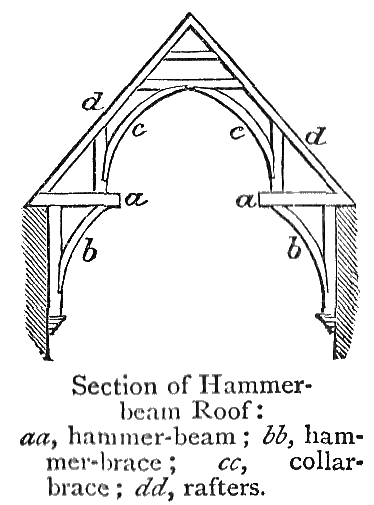
Illustration of a single hammer-beam truss. The collar-braces (c) join to the hammer posts on the bottom and collar beam on top. Chambers 1908

A hammerbeam roof is a decorative, open timber roof truss typical of English Gothic architecture and has been called "the most spectacular endeavour of the English Medieval carpenter".[1] They are traditionally timber framed, using short beams projecting from the wall on which the rafters land, essentially a tie beam which has the middle cut out. These short beams are called hammer-beams[2] and give this truss its name. A hammerbeam roof can have a single, double or false hammerbeam truss.

Design

[edit]

A hammer-beam is a form of timber roof truss, allowing a hammerbeam roof to span greater than the length of any individual piece of timber. In place of a normal tie beam spanning the entire width of the roof, short beams – the hammer beams – are supported by curved braces from the wall, and hammer posts or arch-braces are built on top to support the rafters and typically a collar beam. The hammerbeam truss exerts considerable thrust on the walls or posts that support it.[3] Hammerbeam roofs can be highly decorated including ornamented pendants and corbels, with church roofs often including carved angels.

Interior of the Middle Temple hall in London, showing its double-hammerbeam roof

A roof with one pair of hammer beams is a single hammerbeam roof. Some roofs have a second pair of hammer beams and are called double hammerbeam roofs (truss).

A false hammerbeam roof (truss) has two definitions:

  1. There is no hammer post on the hammer beam[4][5] as sometimes found in a type of arch-brace truss;[6] or
  2. The hammer beam joins into the hammer post, instead of the hammer post landing on the hammer beam.[7]

Examples

[edit]
Westminster Hall in the early 19th century
A modern hammerbeam roof at Windsor Castle

Possibly the earliest hammer-beamed building still standing in England, built in about 1310 [8] and located in Winchester Cathedral Close, is the Pilgrims' Hall, now part of The Pilgrims' School.

The roof of Westminster Hall, which underwent renovation from 1395 to 1399, is a fine example of a hammerbeam roof. The span of Westminster Hall is 20.8 metres (68 ft. 4 in.), and the opening between the ends of the hammer beams 7.77 metres (25 ft. 6 in). The height from the paving of the hall to the hammerbeam is 12.19 m (40 ft.), and to the underside of the collar beam 19.35 metres (63 ft. 6 in.), so that an additional height in the centre of 7.16 m (23 ft. 6 in.) has been gained. In order to give greater strength to the framing, a large arched piece of timber is carried across the hall, rising from the bottom of the wall piece to the centre of the collar beam, the latter also supported by curved braces rising from the end of the hammerbeam.[9]

Other important examples of hammerbeam roofs exist over the halls of Hampton Court and Eltham palaces, and Burghley House near Stamford. There are also numerous examples of smaller dimensions in churches throughout England, particularly in the eastern counties. The ends of the hammerbeams are usually decorated with winged angels holding shields; the curved braces and beams are richly moulded, and the spandrels in the larger examples filled in with tracery, as can be seen in Westminster Hall. Sometimes, but rarely, the collar beam is similarly treated, or cut through and supported by additional curved braces, as in the hall of the Middle Temple, London.[9]

Recently, as part of an extensive restoration project undertaken by Historic Scotland, the hammerbeam roof of the Great Hall at Stirling Castle was completely restored. Green oak from 350 Perthshire trees was used to fabricate and erect 57 hammerbeam trusses spanning approximately 15 metres. Since its construction around 1502 by King James IV of Scotland, structural loads from the roof had caused the walls of the hall to deflect outwards. To ensure that the ridge of the roof would be level and straight, the trusses were each made with a slightly different pitch and span. The restoration started in 1991 and was completed in 1999.[10]

Other examples are in the Parliament Hall in Edinburgh, the Great Hall in Edinburgh Castle, the chapel of New College, Oxford, the Great Hall of Athelhampton House, Dorchester, Dorset the Great Hall of Darnaway Castle in Moray, and the Great Hall of Dartington Hall, Totnes.

A spectacular modern example of a hammer-beam roof is the new Gothic roof of St George's Hall at Windsor Castle, designed by Giles Downe and completed in 1997. This replaced the previous flatter roof which was destroyed in the 1992 Windsor Castle fire.

It is incorrectly believed by some that the widest hammerbeam roof in England at 72 ft (22 m) wide is in the train shed at Bristol Temple Meads railway station by Isambard Kingdom Brunel .[11] In fact, the station roof uses modern cantilever construction; the hammerbeam style elements are purely decorative. The hammer posts and brackets support nothing, as all the weight of the roof is braced and supported by the massive side walls via the main timber ribs of the roof and the pillars inside the train shed.[12]

References

[edit]

Further reading

[edit]
Revisions and contributorsEdit on WikipediaRead on Wikipedia
from Grokipedia
A hammerbeam roof is a distinctive form of open timber employed in , characterized by projecting horizontal beams—known as hammer-beams—that extend from the wall plates to support vertical posts and arched braces, thereby eliminating the need for a continuous tie beam and enabling expansive, uninterrupted interior spaces without central supports. This structural innovation, which evolved from earlier medieval roof designs such as the arch-braced , first appeared in around the late 13th or early , with the earliest documented precursor in the Pilgrims' Hall at dating to 1310–1311. By the late , the design reached its pinnacle in the roof of , constructed between 1396 and 1399 under the master carpenter Hugh Herland, spanning approximately 68 feet (20.7 meters) and renowned for its intricate carpentry that combines functional load-bearing elements with elaborate ornamental arches and . The hammerbeam roof's key components include the hammer-beam itself—a thickened, extended sole-piece projecting outward from the wall—paired with struts rising to collars or principal rafters, and curved braces that distribute weight effectively to the walls, allowing for roof pitches that could be steeper or flatter depending on the variant. Double hammerbeam roofs, featuring two tiers of hammer-beams, emerged as an adaptation for even larger spans or lower pitches, as seen in examples like the roof of St. Wendreda's Church in March, Cambridgeshire, from the early 16th century. This roofing style flourished primarily between the 14th and 16th centuries in ecclesiastical and secular buildings across England, symbolizing technical prowess and aesthetic grandeur in late medieval carpentry, though its use declined with the shift to stone vaulting and later Renaissance influences. Notable surviving examples beyond Westminster Hall include the roofs of the Middle Temple Hall in London (early 16th century) and St. Margaret's Church in Ipswich (15th century), which showcase the roof's adaptability and decorative potential through carved embellishments and painted details.

History

Origins in Medieval England

The hammerbeam roof is an open-timber structure designed to achieve wide spans without tie beams, utilizing projecting horizontal hammerbeams that extend from the walls to support curved braces and principal rafters, thereby creating an unobstructed interior space. This configuration addressed the limitations of earlier medieval , which often required internal supports or low tie beams that interrupted the height and openness desired in grand halls and buildings. In the context of 14th-century English architecture, hammerbeam roofs emerged as an innovative response to the Gothic emphasis on verticality and expansive interiors, reflecting a period of increasing architectural ambition amid economic recovery following the Black Death. They evolved from 13th-century precursors such as pseudo-hammerbeam roofs, which employed decorative cantilevered elements without full structural projection, and base cruck roofs, featuring curved timbers rising from low wall plates to the ridge for support. These earlier forms, often derived from aisled hall constructions with truncated posts on brackets, laid the groundwork for eliminating tie beams while distributing thrust through angled bracing. The earliest extant example may be the Bishop’s Kitchen at (c.1300), followed by the earliest surviving true hammerbeam roof dates to the late 13th or early at Pilgrims' Hall in Winchester Cathedral Close, dendrochronologically dated to circa 1308, where masonry walls support a 30-foot span with 23% projection on the hammerbeams. This example, adapted from aisled origins, represents the initial experimentation with the form's core principles. Further early developments include Tiptofts Manor in (dendro-dated 1282–1327, median circa 1304/5) and Balle’s Place in (1370–85), demonstrating progressive refinements in scale and aesthetics. The invention and early adoption of hammerbeam roofs were propelled by the skills of organized ' guilds and regional workshops, initially concentrated in , where master carpenters innovated with angled timbers to optimize stability and load distribution. By the mid-14th century, these practices began influencing East Anglian workshops, fostering experimentation that enhanced the roof's structural efficiency for broader application in Gothic settings.

Development and Variations

The hammerbeam roof, first developed in late 13th- to early 14th-century , saw significant development and widespread adoption during the , particularly in for ecclesiastical and royal buildings across . This period marked its peak popularity, driven by regional carpentry traditions in , where carpenters refined the design to enhance verticality and aesthetic appeal in large interiors. The double hammerbeam variant emerged around 1440 in , exemplified by structures like Holy Trinity Church, which featured secondary projecting beams to support additional arched braces and allow for greater height without compromising structural integrity. Of the approximately 32 surviving double hammerbeam roofs in , 21 are located in , underscoring the region's dominance in this evolution. Key variations of the hammerbeam roof distinguished between structural functionality and decorative elaboration. The single hammerbeam type, the foundational form, consisted of projecting horizontal beams (hammers) braced by curved arches that connected to the principal rafters, enabling clear spans while minimizing visual interruption at floor level. The double hammerbeam introduced a second tier of hammers, often adorned with carved figures such as angels, to further elevate the roofline and incorporate ornamental elements like posts or fan vaulting, as seen in late-15th-century examples from workshops. Distinctions also arose between "clean" or true hammerbeam designs, which relied on fully structural projecting beams for load-bearing, and "false" hammerbeam variants, where upper elements mimicked the form using non-structural arch-braces for purely decorative purposes, allowing carpenters to achieve ornate effects without additional engineering complexity. Developments in hammerbeam roofs were largely influenced by the need to accommodate longer spans in prestigious buildings, reaching up to 20-21 meters in royal halls and wide naves of churches, as demonstrated by the roof commissioned in 1393. To reinforce these expansive structures, carpenters incorporated crown posts—vertical timbers above the collars—and struts to distribute loads more effectively, responding to the demands of ecclesiastical patrons and the growing scale of architecture. This adaptation not only addressed practical engineering challenges but also facilitated the integration of symbolic carvings, enhancing the roofs' role in religious and ceremonial spaces. By the late , hammerbeam roofs began to phase out, supplanted by the rising influence of and the preference for stone vaults in new constructions. The around 1540 further contributed to their decline through reduced funding for ornate church features and iconoclastic damage to existing carvings, with the last major ecclesiastical examples dating to approximately 1510-1520 in . Although secular applications persisted briefly, such as the hammerbeam ceiling at in the 1530s, the style yielded to Renaissance-inspired designs emphasizing and permanence over medieval timber .

Design and Structure

Key Components

The hammerbeam roof features a series of interlocking timber elements that enable wide, unobstructed interiors characteristic of late medieval English architecture. At its core are the hammerbeams, horizontal projections extending from the wall plates into the interior space, typically projecting 19% to 28% of the span, or approximately 2 to 6 meters for spans of 12 to 24 meters. These cantilevers support the roof's upper framework by distributing vertical loads directly to the walls while minimizing horizontal thrust. Curved braces, often arched timbers of oak, connect the outer ends of the hammerbeams to the principal rafters, forming elegant arcs that both reinforce the structure against lateral forces and contribute to the roof's visual flow. The principal rafters, the primary sloping beams, rise from these braced connections to converge at the ridge, defining the roof's pitch—commonly between 49° and 54°—and carrying the weight of the covering materials. Complementing these are collar beams, horizontal ties positioned at mid-height along the principal rafters, which act to stabilize the assembly by countering the tendency of the rafters to spread apart under load. Additional supporting components include wall posts, vertical timbers embedded into or rising from corbels on the walls, which anchor the inner ends of the hammerbeams and help transmit forces downward. Struts, typically diagonal or slightly curved reinforcements, extend from the hammerbeams upward to the collar beams or principal rafters, providing further for rigidity. Purlins, horizontal secondary beams parallel to the , are positioned at intervals along the principal rafters to support the lighter common rafters that fill the spaces between them. Integrating seamlessly with the structural framework are decorative elements that enhance the Gothic aesthetic without compromising function, such as intricately carved in the spandrels formed by braces and , life-sized angelic figures perched on hammerbeam ends, and ornate bosses securing joints between rafters and collars. These features, often executed in high-relief sculpture, underscore the roof's role as a display of craftsmanship. Hammerbeam roofs generally accommodate spans of 12 to 24 meters, with interior heights up to 20 meters in double-layered variants that stack additional tiers of beams for greater elevation.

Engineering Principles

The hammerbeam in a hammerbeam roof functions as a cantilever projecting horizontally from the wall plate, transferring thrust generated by the principal rafters downward and outward to the supporting masonry via angled arch braces and wall posts. This arrangement converts predominantly vertical loads—such as dead weight from timbers and coverings, as well as live loads from snow or wind—into horizontal compression forces that are resisted by the wall plates and the inherent mass of the structure below. Unlike direct vertical load-bearing, the hammer beams and associated vertical posts primarily manage diagonal and shear forces, with primary vertical resolution often occurring through continuous arched ribs bearing on corbels integrated into the walls. Stability mechanisms rely on the formation of a line through curved arch braces, which efficiently funnel resultant forces downward into the foundation while minimizing eccentricity and potential . Collar beams, positioned higher in the roof, and supporting or queen posts prevent under lateral wind loads and counteract the outward spread of rafters, thereby maintaining structural equilibrium without requiring a continuous low-level tie beam that would obstruct interior space. This triangulated framework, incorporating wall posts, braces, and occasional spurs or joggled connections, distributes stresses redundantly across multiple paths, enhancing resistance to asymmetric loading and in-plane deformation. Medieval builders empirically adjusted proportional dimensions—often through iterative scaling and refinements—to ensure the line remained within the kern of supporting elements and avoided excessive eccentricity. Compared to predecessor designs like scissor-beam roofs, which relied on crossing braces and low tie beams to contain , hammerbeam roofs innovated by fully eliminating such low ties, permitting unobstructed interior sightlines while channeling and loads through redundant cantilevered paths and diagonal bracing. This shift prioritized open spans up to 68 feet, as in , by leveraging masonry buttresses for horizontal resistance and incorporating novel elements like joggled king posts for enhanced tension handling.

Construction Techniques

Materials and Joinery

The primary material for hammerbeam roofs in medieval was seasoned (), sourced from local English forests and selected for its exceptional of approximately 50 MPa and natural resistance to decay due to the durability of its heartwood. This dominated structural applications, comprising the overwhelming majority of timbers in surviving examples, though and were occasionally employed for secondary elements like non-load-bearing braces where availability or cost favored them. 's density and slow charring rate further enhanced its suitability for fire-prone roof environments, allowing it to maintain integrity longer than softer woods. Joinery techniques emphasized durable, metal-free connections to withstand tensile and compressive forces without nails, relying on mortise-and-tenon joints secured by draw-bored hardwood pegs of 1-2 cm diameter, which offset holes pulled the tenon tightly into the mortise for a compression-fit assembly. Scarf joints, such as face-halved and bladed variants, were used to lengthen beams by overlapping and interlocking end sections, ensuring continuous spans in principal rafters or hammer beams while distributing loads evenly. For high-stress connections, like those in arched ribs or purlins, trunnels (treenails)—larger wooden dowels—provided reinforcement, often dovetailed or wedged to lock composite timbers against shear. Timber preparation involved hand-hewing logs with adzes and axes to square sections and shape profiles, followed by selection of naturally for curved braces or of straight pieces where single curved timbers were unavailable. Surfaces were finished with planes to achieve precise, tight-fitting joints, minimizing gaps that could lead to movement. Sourcing drew heavily from royal forests like the , where medieval kings reserved for crown projects, including building works, with logs seasoned for 5-10 years under cover to reduce moisture content and prevent warping during fabrication. This practice ensured stability in large spans, though green was sometimes used directly from managed coppices and pollards when urgency demanded it.

Assembly and Challenges

The assembly of a hammerbeam roof typically began with ground-level of individual trusses, where timbers were laid out, scribed for fit, cut, and test-assembled using techniques like mortise-and-tenon joints before final carving and transport to the site. For the roof, commissioned in 1393, the 660 tons of oak were framed near in and transported by wagons and barges to the site, allowing for controlled preparation away from the construction hazards. Erection proceeded sequentially from the walls upward: horizontal hammerbeams were first fixed to buttressed wall plates using open-ended mortices for easier sliding onto tenons, followed by the lifting of arched braces and principal rafters into position with temporary and windlasses to manage the heavy loads, culminating in the assembly and roof slopes. This process demanded precise alignment to accommodate site variations, such as the tapering width of (from 68 feet 6 inches at the south end to 67 feet 5 inches at the north), using timber packing and folding wedges for adjustments. Labor was organized into teams of skilled carpenters and laborers, often numbering 20 to 50 for major projects, led by a master carpenter like Hugh Herland at , with work spanning 1 to 3 years depending on scale—though the full Westminster roof took about eight years overall, including funding delays. Carpenters, paid comparably to or higher than masons (e.g., 2 shillings 1 pence to 2 shillings 3 pence per week at ), collaborated with woodcarvers for ornamental details, using templates and cords to ensure consistency in curved elements like arched braces without relying on numerical measurements. Medieval builders faced significant challenges, including sourcing large oak timbers up to 1 meter in girth amid widespread deforestation, which strained native supplies and required procurement from distant forests like those at Odiham and Aliceholt for Westminster, sometimes supplemented by imports from Baltic ports by the 14th century. Weather delays were common during erection, with scaffolds designed for storm resistance, while alignment precision was critical to prevent torque from uneven green oak (weighing around 720 kg per cubic meter) that could shift during lifting. Early attempts at fireproofing involved applying lime washes to timber surfaces, which acted as retardants by slowing charring and reducing flammability, though this was more preventive than fully protective. Quality control relied on empirical methods, including test-assemblies of prototypes during to verify joint fits and load distribution, with on-site adjustments for span-specific deflections using scribing techniques to achieve tight, level connections. At Westminster, the use of dovetailed keys and joggled king posts ensured stability, drawing on carpenters' rather than formal calculations, as evidenced by the roof's enduring performance since 1401.

Notable Examples

Iconic English Structures

One of the most renowned examples of a hammerbeam roof is found in , , constructed between 1393 and 1399. Commissioned by King Richard II, this structure represents the largest medieval timber roof in , spanning 20.7 meters across and rising to approximately 28 meters in height, with a total length of 73.2 meters. The roof features 20 principal trusses adorned with intricately carved angels, symbolizing divine protection and royal authority, crafted by master carpenter Hugh Herland. It has undergone significant restorations in the 19th and 20th centuries to address decay and structural concerns, ensuring its survival as a pinnacle of late medieval English . In , , , an exemplary double hammerbeam roof dates to c. 1430, spanning the 10-bay and exemplifying the peak of East Anglian craftsmanship through its intricate and carved elements. The design alternates hammerbeams with arch-braced trusses, featuring life-sized recumbent angels in procession, which highlight the roof's decorative sophistication and structural innovation. This roof not only spans the impressively but also integrates elaborate detailing. Other notable 15th-century English hammerbeam roofs include the single hammerbeam structure in Christ Church Hall, Oxford, built between 1525 and 1529, which employs a clean, open design to emphasize the hall's grandeur as part of Cardinal Wolsey's founding of Cardinal College. Similarly, Holy Trinity Church in Long Melford, Suffolk, features an elaborate hammerbeam roof from circa 1480 that creates a harmonious blend of timber framing and Perpendicular Gothic aesthetics in the nave. Additional iconic examples include the double hammerbeam roof at St. Wendreda's Church in (early 16th century), the single hammerbeam roof at Middle Temple Hall in (early 16th century), and the hammerbeam roof at St. Margaret's Church in (15th century), showcasing regional variations and decorative carved embellishments. The survival of these medieval hammerbeam roofs has been aided by historical preservation efforts against threats such as bombing damage to surrounding structures and infestations that have necessitated ongoing treatments in many English churches.

Later and International Instances

In the 19th century, the Gothic Revival movement in Britain led to the revival of hammerbeam roof designs as part of broader efforts to emulate medieval architectural forms. A prominent example is the in , completed in 1877 under architect Alfred Waterhouse, where a richly decorated hammerbeam roof spans the space, featuring gilded coats of arms in its panels to symbolize Manchester's trading partners. This structure exemplifies Victorian-era adaptations, blending traditional with ornate detailing to create expansive, column-free interiors. Similarly, the reconstruction of the Palace of Westminster after the 1834 fire incorporated Gothic Revival elements inspired by medieval precedents like hammerbeam roofs, though retained its original 14th-century example. The 20th century saw significant restorations that preserved and reinforced historic hammerbeam roofs using a mix of traditional carpentry and modern engineering. Westminster Hall's roof underwent major repairs between 1914 and 1923, led by architect Frank Baines of the Office of Works, who inserted concealed steel trusses between the medieval timbers to stabilize the structure without altering its appearance, employing original techniques for visible elements. These efforts extended into later decades, ensuring the roof's longevity as part of the Palace of Westminster, designated a in 1987 for its architectural significance. Beyond , hammerbeam roofs found adaptations in during the late medieval period and were revived internationally in the 19th and 20th centuries. At Stirling Castle's , constructed around 1503 under James IV, a simplified hammerbeam roof design supported the large span, reflecting Scottish interpretations of English Gothic influences; this was faithfully reconstructed in the 1990s using traditional and no modern fasteners, completed in 1999 to restore the hall's original grandeur. In the United States, Gothic Revival churches adopted the form, such as St. Paul's Episcopal Cathedral in , redesigned in the by Robert A. Gibson with a hammerbeam timber roof painted in dark blue, allowing for a wide, open typical of early American adaptations. Contemporary applications demonstrate the hammerbeam roof's enduring appeal in timber engineering, often enhanced for sustainability. The Stirling Castle reconstruction prioritized sustainable sourcing of European and hand-crafted joints, avoiding reinforcements to maintain authenticity while achieving structural over a 18-meter span. This approach has influenced modern exposed-truss designs in eco-conscious projects, where hammerbeam principles inform hybrid timber-steel systems for wide spans in public buildings, emphasizing renewability over medieval England's oak-dependent methods. The legacy of these roofs is evident in their role within UNESCO-recognized sites, underscoring their contribution to global architectural heritage.

References

Add your contribution
Related Hubs
User Avatar
No comments yet.