Hubbry Logo
CruckCruckMain
Open search
Cruck
Community hub
Cruck
logo
8 pages, 0 posts
0 subscribers
Be the first to start a discussion here.
Cruck
Cruck
from Wikipedia
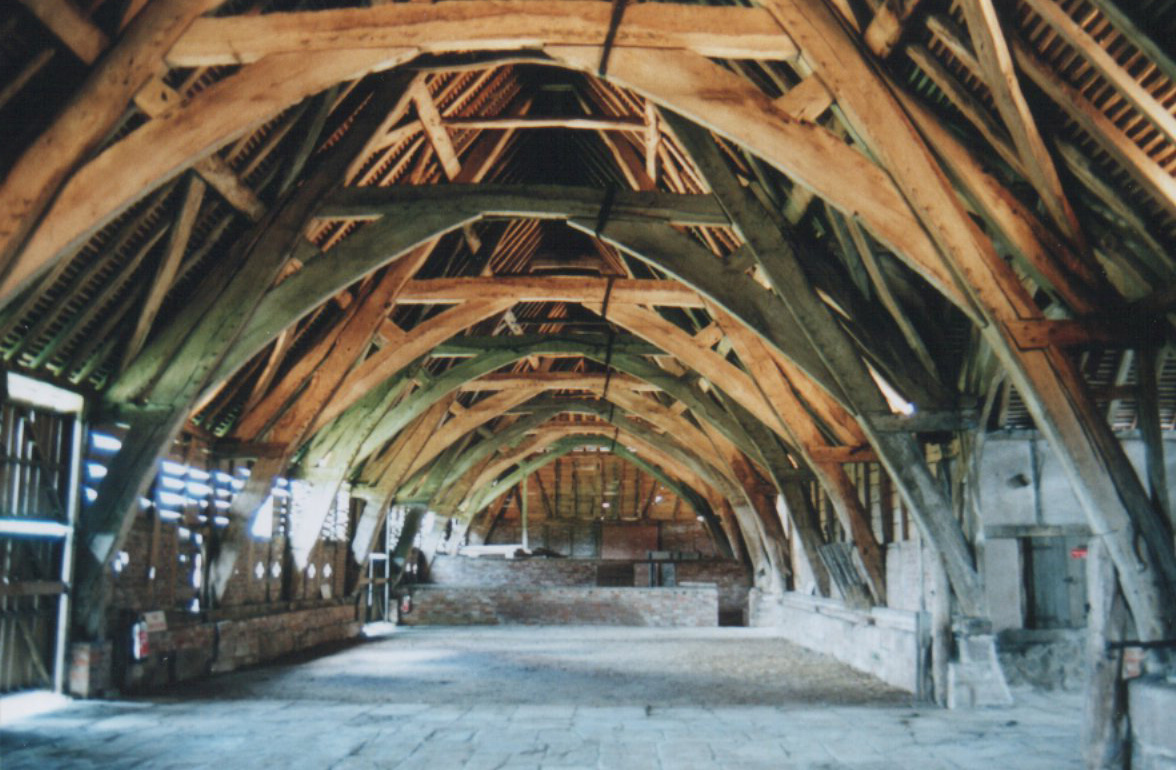
Cruck framing, Leigh Court Barn, Worcester, England
The Moirlanich Longhouse, a byre dwelling with a cruck frame

A cruck or crook frame is a curved timber, one of a pair, which support the roof of a building, historically used in England and Wales. This type of timber framing consists of long, generally naturally curved, timber members that lean inwards and form the ridge of the roof. These posts are then generally secured by a horizontal beam which then forms an "A" shape. Several of these "crooks" are constructed on the ground and then lifted into position. They are then joined together by either solid walls or cross beams which aid in preventing 'racking' (the action of each individual frame going out of square with the rest of the frame, and thus risking collapse).

Etymology

[edit]

The term crook or cruck comes from Middle English crok(e), from Old Norse krāka, meaning "hook". This is also the origin of the word "crooked", meaning bent, twisted or deformed, and also the crook used by shepherds and symbolically by bishops.

Use

[edit]
A half timbered house in Worcestershire framed with a full cruck

Crucks were chiefly used in the medieval period for structures such as houses and large tithe barns, which were entirely timber-framed. They were also often used for the roofs of stone-walled buildings such as churches. However, these bent timbers were comparatively rare, as they were also in high demand for the shipbuilding industry.

Where naturally curved timbers were convenient and available, carpenters continued to use them at much later dates. For instance, base crucks are found in the roofs of the residential range of Staple Inn Buildings, Nos. 337 – 338, High Holborn, London. This is dated by documented records to 1586, with significant alterations in 1886 (under Alfred Waterhouse) and further restorations in 1936, and 1954–55. Despite these changes Cecil Hewett, an authority on English Historic Carpentry, has stated that these 16th-century crucks are original.

The large main barn of the manor house Barlow Woodseats Hall features what is claimed to be the longest continuously roofed cruck barn in Derbyshire, and possibly even in the United Kingdom.

An example of a Yorkshire cruck barn complete with a heather-thatched roof can be found in Appletreewick.[1] The crucks or cruck "blades" are a single oak tree riven (split) in two to form an equally shaped A frame.

Rare examples of cruck framing are found on continental Europe such as in Belgium,[2] Flanders, Northern France and the Corrèze region of France.[3] No cruck frames are known to have been built in North America though there are rare examples of what may be an upper cruck or knee rafters.

History

[edit]

The oldest surviving crucks with dates confirmed by tree ring analysis date from around the middle of the 13th century.[4] They may have declined due to providing an inconveniently shaped space in cases where an upper floor was used.[5]

Revival

[edit]

During the current revival of green-oak framing for new building work, which has occurred mainly since approximately 1980 in the UK, genuine cruck frames have quite often been included in traditionally carpentered structures.[6]

There are also some fine, historically authentic reconstructions. For instance, Tithe Barn, Pilton, Glastonbury, whose original roof was destroyed by lightning, has been carefully rebuilt in 2005 from curved oaks. The necessary trees were sought out, using special templates, in English woodlands.

Types

[edit]
A jointed cruck
  1. True cruck or full cruck: The blades, straight or curved, extend from a foundation near the ground to the ridge. A full cruck does not need a tie beam and may be called a "full cruck - open" or with a tie beam a "full cruck - closed".[7]
  2. Base cruck: The tops of the blades are truncated by the first transverse member such as by a tie beam.[7]
  3. Raised cruck: The blades land on masonry wall and extend to ridge.[7]
  4. Middle cruck: The blades land on masonry wall and are truncated by collar beam.[7]
  5. Upper cruck: The blades land on tie beam, very similar to knee rafters.[7]
  6. Jointed cruck: The blades made from two pieces joined near eaves. They can be joined in at least five ways.[8]

The apex of a cruck frame also helps to define the style and region of the cruck. Different types include the butt apex, halved, housed, yoke, and crossed forms.[8]

See also

[edit]

References

[edit]

Further reading

[edit]
[edit]
Revisions and contributorsEdit on WikipediaRead on Wikipedia
from Grokipedia
A cruck is a pair of curved timbers forming the primary load-bearing elements in a traditional timber-framed building, typically rising from ground level or low sills to meet at a roof apex, thereby supporting the roof independently of the walls. This construction technique, also known as crook framing, emerged in medieval vernacular architecture, with possible origins tracing back to the Iron Age or early medieval period in Europe, though the earliest securely dated examples in Britain date to the 13th century. Crucks were formed from naturally curved oak trees or shaped timbers, joined at the top by a yoke, collar, or simply abutted, and often spanned up to 10 meters or more, as seen in structures like Leigh Court in Herefordshire, the largest recorded true cruck with a 10.2-meter span from the late 13th century. The method's popularity peaked between the 13th and 15th centuries, particularly for rural dwellings, barns, and halls, before declining in the 16th and 17th centuries due to preferences for taller box-frame buildings offering better headroom. Geographically, cruck construction is most densely concentrated in western Britain, including the West Midlands, Welsh borders, (such as with 137 recorded true crucks), and parts of and , with over 3,054 true crucks cataloged across by 1981; the updated database records 4,477 true crucks across Britain as of 2021. It is notably rare in eastern and southeastern regions. Variants include true crucks (ground-to-apex), raised crucks (from wall plates), upper crucks (from mid-wall height), and jointed crucks (assembled from multiple pieces), reflecting adaptations to local materials and site conditions. Beyond Britain, examples appear in , such as in France's and regions, , and the , underscoring its broader medieval diffusion, though British instances remain the most extensively studied. Notable surviving structures, like the 13th-century Pilliven in (dated to 1247/48) and the medieval Tithe Barn at Swalcliffe in , highlight crucks' enduring architectural and cultural significance in preserving pre-industrial building traditions.

Overview and Characteristics

Definition and Basic Structure

A cruck is a fundamental element of traditional , defined as a pair of curved or angled timbers, known as cruck blades, that form a self-supporting A-shaped frame extending from the ground or a low foundation directly to the apex, serving as the primary support for the roof load. These blades, often derived from naturally curved sections of trees, are positioned symmetrically to create an arch-like structure that bypasses intermediate wall supports, allowing the roof weight to transfer vertically through the frame to the base. The blades are splayed outward at the base for stability and converge at the apex, where they are joined using techniques such as half-lapping, , or dovetailing to form a secure, load-distributing connection, sometimes incorporating a collar or to accommodate the piece. At the base, the feet of the blades rest on sill beams, padstones, or low walls, ensuring even distribution of forces and precise leveling to prevent settling. In a basic illustrative , the cruck is depicted as a pair of curving lines rising from ground level pads to meet at a central point, outlining the inverted V configuration that defines its structural integrity. Supporting elements integrate with the core frame to enhance rigidity and distribute secondary loads: tie beams span horizontally between the blades, typically at mid-height or the base, to resist spreading and form a complete triangular unit; struts provide diagonal bracing from tie beams to the apex or collar; and purlins—horizontal timbers laid along the inner faces of the blades—carry the rafters and roofing materials, evening out the . The cruck's design offers key advantages in structural performance, including simplicity of load-bearing through direct from roof to foundation, which minimizes the need for load-bearing walls and enables lighter materials. Its inherent triangular also confers resistance to lateral forces like , as the angled blades and tie beam create a rigid capable of withstanding torsion and shear without excessive joints.

Materials and Components

Cruck construction primarily utilizes seasoned timber, selected for its strength and availability, with blades typically sourced from naturally curved sections of mature trees to achieve the required arch-like form. These timbers are often complete trunks or halved lengthwise for , with blade thicknesses ranging up to 15 inches (0.38 m) to support spans without additional framing. Other hardwoods like may occasionally substitute in regional variations, though predominates due to its durability and workability. Key components include the paired cruck blades, which form the primary and are joined at the apex using halved or lapped joints, often secured with multiple wooden pegs driven through draw-bored holes for a tight, enduring fit. Mortise-and-tenon joints connect struts, braces, and secondary timbers to the blades, providing lateral stability, while draw-bored pegs—typically ½ to 1 inch (13–25 mm) in diameter—prevent loosening over time by offsetting the peg holes to draw components together upon insertion. A beam, pegged or housed into the blade tops, spans between trusses to support purlins and rafters, integrating with thatch or roofing systems. Wall plates, laid longitudinally on cross-beams, accommodate infill panels such as , distributing non-structural loads. Sourcing naturally bent timbers posed challenges in traditional , relying on local woodlands where suitable curved were felled and processed on-site with axes and adzes. In modern contexts, steam-bending techniques allow straight to be curved artificially, enabling replication while using air-dried timber with content around 20–30% for successful bending. This approach addresses scarcity of natural curves but maintains 's preference for its resistance to decay. The inherent of cruck blades enhances by minimizing accumulation at and facilitating direct load transfer to the ground, with oak's natural oils and further resisting when properly maintained. The use of draw-bored pegs and minimal complexity contributes to , as components can be individually replaced without compromising the frame.

Historical Context

Origins and Early Development

The origins of cruck framing remain a subject of scholarly debate, with evidence suggesting possible influences from prehistoric or early medieval traditions, though definitive pre-13th-century structures are scarce. Etymological ties link the term "cruck" to the Middle English crok(e), derived from Old Norse krāka meaning "hook," reflecting the curved timber's shape and potentially indicating Viking-era linguistic influences on building terminology in Britain. Some researchers propose Celtic roots, associating crucks with ancient cuppill structures—paired timbers forming an apex—in Ireland and Scotland, which may trace back to Iron Age roundhouses through shared use of naturally bent timbers for roofing support. However, archaeological evidence for such prehistoric links is limited and unproven, with no surviving cruck-like frames predating the medieval period. The earliest confirmed surviving cruck buildings date to the mid-13th century in , established through dendrochronological analysis of timbers. At Pilliven in Witheridge, , tree-ring dating indicates felling between late summer 1247 and early 1248, marking it as the earliest true cruck identified, featuring a central with notch-lap joints. Other early examples include the Royal George in Cottingham, (1262), and Townsend in , (c. 1260), both verified by similar dendrochronological methods. Documentary references to "furca" (forks) appear as early as 1189 in records, hinting at conceptual precursors, but physical evidence begins with these 13th-century structures concentrated in the and . Cruck framing emerged regionally in rural areas of England and Wales, particularly the West Midlands, Welsh borders, and southwestern counties, where abundant naturally curved oak trees from coppiced woodlands suited local agricultural communities. This distribution aligns with vernacular needs for sturdy, low-cost farmhouses and barns, leveraging timber availability in agrarian landscapes away from urban stone-building traditions. Dendrochronological studies of over 400 sites reveal a construction peak between 1250 and 1400 CE, with felling dates clustering in the late 13th and 14th centuries, indicating rapid adoption during medieval population growth and settlement expansion. Early crucks integrated wattle-and-daub panels for wall infill—woven hazel hurdles plastered with clay and dung—and thatched roofs of straw or reed, enhancing weatherproofing in these timber-reliant rural dwellings.

Peak Usage and Decline

Cruck construction reached its zenith between the 14th and 16th centuries, particularly in western and midland , where it became the dominant framing method for rural dwellings and agricultural structures. This peak coincided with a post-Black Death economic boom in the mid-14th century, when labor shortages drove up wages and land availability, enabling middling peasants and farmers to invest in more substantial . The technique's popularity stemmed from its cost-effectiveness in spanning wide open halls and barns using naturally curved timbers, requiring fewer skilled carpenters and suiting resource-poor rural settings amid demographic recovery. Surveys indicate the highest density in regions like the West Midlands and Welsh borders, reflecting localized timber availability and agrarian needs. Socioeconomically, crucks were closely tied to farmers and prosperous peasants managing holdings of 20-30 acres, who built them as multifunctional open-hall houses for living and . Their association with lower- to middle-status rural communities is evident in the scarcity of examples in high-status manors or urban settings, where stone or more refined timber-framing prevailed; base crucks occasionally appeared in barns, but true crucks remained a hallmark of , low-prestige . This period saw over 3,000 cruck-framed buildings constructed, as dendrochronological dating of surviving examples confirms a surge from the 1380s to 1500. The decline of cruck construction began in the late and accelerated into the 17th, supplanted by rectangular box-frame methods that better accommodated upper storeys and partitioned rooms during the 'Great Rebuilding' era (c. 1570-1720). Key drawbacks included the irregular sloping walls created by curved blades, which limited usable upper-floor space and headroom, hindering adaptations for chimneys or private chambers demanded by rising living standards. Additionally, the increasing availability of sawn straight timbers from expanding sawmills allowed box-frames to use smaller, more uniform pieces, reducing reliance on scarce large crooked oaks depleted by agricultural clearance. By the early , crucks were largely obsolete outside remote areas, with approximately 3,000-3,100 surviving in the UK as of early 21st-century surveys, primarily in western .

Classification and Types

Full and Base Crucks

Full crucks, also known as true crucks, consist of pairs of curved or straight timbers, referred to as blades, that extend continuously from near ground level to the roof apex, forming the principal structural supports for both the walls and roof without intermediate posts or joints along their height. These blades typically meet at the ridge in an configuration, providing direct load-bearing from the foundation upward and allowing for open interiors in traditional buildings. In contrast, base crucks feature blades that rise only partway to the , starting from a point above ground level—often on short sills, tie-beams, or low walls—and terminating at the lowest transverse member, such as a tie-beam at level, with the upper structure supported separately. This design emphasizes partial direct contact with the foundation via the base supports, creating a hybrid form that integrates cruck elements with aisled or braced framing traditions, and it often accommodates wider spans of 20 to 28 feet compared to the 16 to 18 feet typical of full crucks. Structurally, full crucks differ from base crucks in their complete vertical continuity, which enables them to bear the full load independently of framing below the curve, whereas base crucks rely on intermediate horizontal elements for stability and distribute loads through their truncated height and base foundations. Full crucks thus offer a simpler, arch-like form suited to rural settings, while base crucks adapt cruck principles to more complex hall-like structures with added bracing. Full crucks represent the most prevalent medieval cruck type, with over 3,000 documented examples across , particularly in open-hall houses of the 13th to 15th centuries, whereas base crucks are less common, numbering around 115 instances and concentrated in regions like where they appear in tithe barns and farm buildings as experimental hybrids. Identification of these types relies on the footing depth of the blades and the absence of framing below the : full crucks are recognized by timbers embedded substantially into the ground or low sills, extending uninterrupted to the apex, often below a quarter of the height, while base crucks are distinguished by blades beginning well above ground and ending at a transverse beam, with visible joints or supports at both ends.

Raised and Upper Crucks

Raised crucks represent an adaptation of traditional cruck framing where the curved blades rise from wall plates, short vertical posts, or masonry sills positioned above ground level, rather than directly from the earth. This elevation allows for the integration of spaces or stone bases beneath the timber structure, enhancing the building's functionality by providing storage or areas below the main living or working space. Such designs emerged prominently in the 15th and 16th centuries across regions like , , Dorset, and , as builders sought to address the spatial constraints of ground-level crucks in increasingly urbanized or land-limited settings. Upper crucks further refine this elevation by confining the blades exclusively to the roof truss, where they spring from tie-beams or ceiling joists at the top of straight gable walls, without extending downward into the lower structure. This configuration supports expansive roof spans while relying on masonry or timber walls for foundational stability below, making it particularly suited to multi-story or partitioned buildings. Like raised crucks, upper crucks gained prevalence in the 15th and 16th centuries, especially in the West Midlands, Lancashire, and North East England, evolving as a response to the headroom limitations imposed by upper floors in earlier full cruck forms. Both raised and upper crucks offer key advantages in floor space utilization and compatibility with masonry foundations, as the elevated blades protect the timber from ground moisture and damp, while allowing seamless integration with stone or brick lower walls for greater durability. This adaptability proved beneficial in elongated agricultural structures and ecclesiastical settings, where wide spans were needed without compromising the integrity of solid bases. Notable examples include the raised cruck trusses in Frocester Barn, Gloucestershire, re-roofed in the 16th century, and the Glastonbury Abbey Barn in Somerset, featuring eight raised base-cruck trusses with a span of 33 feet (10 m) and an overall length of 93 feet (28 m), dating to the late 14th century. For upper crucks, the late medieval longhouse at Bearpark Estate in Durham exemplifies their use in extended farm buildings, while the hall range at Samlesbury Old Hall in Lancashire demonstrates application in domestic contexts with roof-only framing. These variations contributed to the eventual decline of ground-level crucks by the 16th century, as elevated forms better accommodated evolving spatial demands.

Jointed and Other Variations

Jointed crucks represent a variation of cruck where each is assembled from two or more straight timbers, typically joined at the or apex to form the characteristic curve, enabling the use of shorter, more readily available wood in place of scarce naturally curved timbers. This adaptation maintains the structural integrity of traditional crucks by securely connecting the post and sections, allowing the pair of blades to support the independently of the side walls. Examples include buildings like Bury Barton in , where the jointed blades are strongly elbowed and face-pegged for stability. The joints in jointed crucks vary in type to ensure load-bearing strength, including scarfed joints (often splayed and face-pegged with multiple pegs in alternating directions), tenoned connections (with the post tenoned under the ), half-lap or notched joints (sometimes dovetailed), and side-lapped assemblies. These methods distribute stress effectively across the , with pegging enhancing resistance to shear forces, though the overall strength depends on the timber and precise fitting. In some cases, additional elements like collar beams or threaded purlins reinforce the assembly, as seen in structures in where the lower principal is extended via housed joints. Other variations of cruck construction include spaced crucks, where multiple pairs of blades are positioned within a single bay rather than at the ends, providing intermediate support for longer spans. Aisle crucks extend this principle to support lateral aisles in wider buildings, though such forms are rare in Britain and typically limited to larger ecclesiastical or agricultural structures. Hybrid crucks combine elements with box-frame techniques, integrating jointed blades into rectangular timber frameworks for enhanced wall stability, as documented in examples from Herefordshire and Worcestershire. Jointed crucks emerged around 1300 in south-west , particularly in , , and Dorset, as a response to increasing timber shortages that limited access to full-length curved oaks. This evolution allowed construction to continue into the 17th century in regions like , where oral traditions preserved the technique amid ongoing resource constraints. Overall, jointed and related variations are less common than unjointed true crucks, with concentrations in the south-west and scattered occurrences elsewhere, reflecting localized adaptations to environmental and economic pressures. Similar jointed forms appear in , such as on the Isle of Skye, and in Ireland, including counties , Antrim, and Donegal, where they support roofs in vernacular buildings but are often not classified as full crucks due to hybrid wall integrations.

Construction and Applications

Building Techniques

The of cruck frames begins with sourcing suitable timbers, typically large, naturally curved oaks selected for their strength and to form matching pairs of blades. These timbers are often felled using two-man saws and axes, then roughly squared and shaped while green—unseasoned—to facilitate working the wood before it dries and hardens in place. occurs naturally post-erection, as fully dried timber is harder to joint precisely, though local availability and quality varied regionally, influencing blade dimensions from 0.28 to 0.38 meters square. Regional variations included the use of adzes for shaping bog-fir blades and scarfed in northern examples. Assembly typically proceeds on the ground near the site, where blades are laid out, numbered with a or for pairing, and marked for joints to ensure alignment. Joints are cut using axes, adzes, and chisels: the apex often features a half-lap or connection secured with up to four tapered pegs driven through auger holes, while lower sections incorporate notched or dovetailed cross-beams and braces via mortise-and-tenon or joints. Purlins and wall-plates are trenched or pegged into the blades, with temporary fittings adjusted for the building's span before final pegging. Raising the frame involves erecting the prefabricated trusses sequentially, often starting from one end toward , using manpower, ropes, and leverage to lift the heavy A-shaped pairs into position over prepared bases or low walls. Temporary shores or props provide stability during this labor-intensive phase, preventing slippage via dead-mortise pegs or braces, while the heaviest effort focuses on positioning the apex. Historical accounts emphasize involvement alongside skilled carpenters. Key challenges include aligning the curved blades for structural , as mismatches could compromise load distribution, and ensuring overall stability amid the frame's weight—up to several tons per —before walls are added. Non-load-bearing walls of or clay are integrated post-erection, requiring careful notching to avoid weakening the crucks. The technique's reliance on expertise in hand-hewing and pegging is evident.

Traditional Uses and Examples

Crucks were primarily employed in the of houses featuring open-hall plans, where the central space served as the main living area without an upper floor, allowing smoke from the open hearth to rise directly to the roof. These structures catered to smallholders, parsons, and peasants, providing simple, functional dwellings in rural settings. Additionally, crucks supported larger agricultural buildings such as barns, which required wide spans to store grain and hay, and were occasionally used in churches or mills for their structural efficiency in spanning open interiors. During the medieval period, at its peak usage, cruck framing reached its greatest prevalence, particularly from the 13th to 15th centuries. Typical cruck buildings measured 20 to 40 feet in width to accommodate single-bay halls or multi-bay extensions for longer structures, enabling efficient use of curved timbers sourced from local forests. Infill panels between the cruck frames were commonly filled with , consisting of woven twigs plastered with clay, which provided weatherproofing while maintaining breathability in the timber skeleton. Regional distribution concentrated in the Welsh borders, including and , as well as , where abundant and suitable favored the technique. Functional adaptations in cruck houses often included smoke bays—projecting upper sections of the end walls designed to capture and vent —integrated from around 1500 to improve air quality in open halls. Later modifications, typically in the post-medieval period, involved inserting lofts over the hall to create additional sleeping or storage space, transforming the single-story layout without altering the core cruck frame. Notable surviving examples illustrate these uses. The Boarhunt Hall House, a late 14th-century open-hall dwelling from (now reconstructed at the in ), exemplifies a modest residence with a central cruck supporting its thatched . Leigh Court Barn in , built around 1325 as a tithe for Pershore , demonstrates large-scale application with 18 full cruck pairs spanning over 140 feet in length, one of the widest and longest of its kind. In an urban context, Staple Inn in , constructed in 1586, adapts cruck framing to a multi-story with a timber-framed facade and internal cruck , highlighting its versatility beyond rural settings.

Modern Revival and Preservation

Contemporary Adaptations

The resurgence of cruck framing in the late began in the with the establishment of specialist firms focused on green oak timber construction, such as Border Oak in 1980, which originated from efforts to salvage medieval cruck structures in the 1970s. This revival gained momentum through the broader renewal of traditional oak framing, incorporating cruck elements into new eco-friendly buildings to emphasize and local timber sourcing. By the , the practice expanded to , where timber framing guilds promoted cruck techniques via educational programs; for instance, North House Folk School, founded in 1997 in , , offers hands-on cruck framing courses to teach medieval English methods using curved timbers. Similarly, the in the United States has hosted cruck workshops at institutions like the Heartwood School since at least the early 2000s, fostering community-based learning and application in contemporary designs. Modern adaptations of cruck framing incorporate advanced techniques to enhance precision and scalability while preserving the form's aesthetic and structural integrity. Steam-bending is employed to create custom curved timbers from straight green oak, allowing for more consistent blade shapes in new constructions where naturally crooked trees are scarce. CNC milling has revolutionized joint fabrication, enabling accurate tenons, mortises, and braces in large-scale frames. For example, the Sheepdrove Organic Farm building in the UK (completed in the early 2000s) utilized jointed cruck ribs with modern engineering to form a sustainable agricultural structure spanning multiple bays. Notable global examples illustrate cruck's versatility in 21st-century architecture. In the United States, prefabricated plans like the 16x24 cruck timber frame design from Timber Frame HQ have popularized compact cabins and workshops, featuring embellished tails and beam ends for visual appeal in rural settings. Another instance is the cruck-trussed residence in Horninghold, UK, completed by Natural Structures in the 2020s, which blends full crucks with contemporary cladding for a heritage-style home. These projects are driven by motivations including environmental through renewable local timber, the timeless aesthetic of exposed curved frames in modern interiors, and widespread educational workshops offered by guilds to train artisans. Innovations in cruck design address contemporary challenges like site conditions and .

Conservation Efforts

Cruck buildings face several significant threats that compromise their structural integrity and survival. Timber decay, primarily caused by moisture ingress and insect infestations such as wood-boring beetles, is a primary concern, leading to rot in the curved blades that form the core of cruck frames. Structural settling occurs over time due to foundation shifts and uneven load distribution in these earth-fast constructions, exacerbating cracks and instability. Additionally, urban development pressures, including changes and proximity to modern infrastructure, threaten many rural cruck structures through demolition risks or incompatible alterations. Conservation methods emphasize non-destructive and historically informed approaches to preserve authenticity. Dendrochronological surveys are widely used to date timbers accurately, aiding in understanding construction phases and prioritizing repairs without invasive sampling. Traditional repair techniques, such as scarf-jointing new sections into decayed blades, allow for like-for-like replacement while maintaining the original form. Reversible interventions, including the avoidance of chemical treatments or drilling that could alter the timber's , align with principles of minimal intervention to ensure future adaptability. Notable conservation projects highlight successful restorations of surviving medieval examples. The Pilton Tithe Barn in underwent a comprehensive rebuild of its roof structure in 2005, using traditional materials to restore its 14th-century cruck frame after decades of neglect. In 2019, the planned repairs on a rare 400-year-old cruck barn in Great Langdale, , to address timber decay and stabilize the frame. Key organizations guide these efforts through research and standards. The Society for the Protection of Ancient Buildings (SPAB) provides guidelines promoting breathable repairs and natural materials, as demonstrated in their 2024 restoration of a cruck-framed cob using traditional techniques. The Group (VAG) maintains a comprehensive cruck database, facilitating surveys that document over 4,400 known examples and inform targeted conservation. As of 2021, the database records 4,477 true crucks, with ongoing surveys likely increasing this number. Challenges in conservation include balancing historical authenticity with compliance to modern building codes, such as and energy efficiency requirements, which can necessitate compromises like partial reinforcements. Successes are evident in the protection of surviving structures, ensuring their ongoing preservation amid these tensions.

References

Add your contribution
Related Hubs
User Avatar
No comments yet.