



Community hub
Recent from talks
Knowledge base stats:
Talk channels stats:
Members stats:
Hank Greenberg
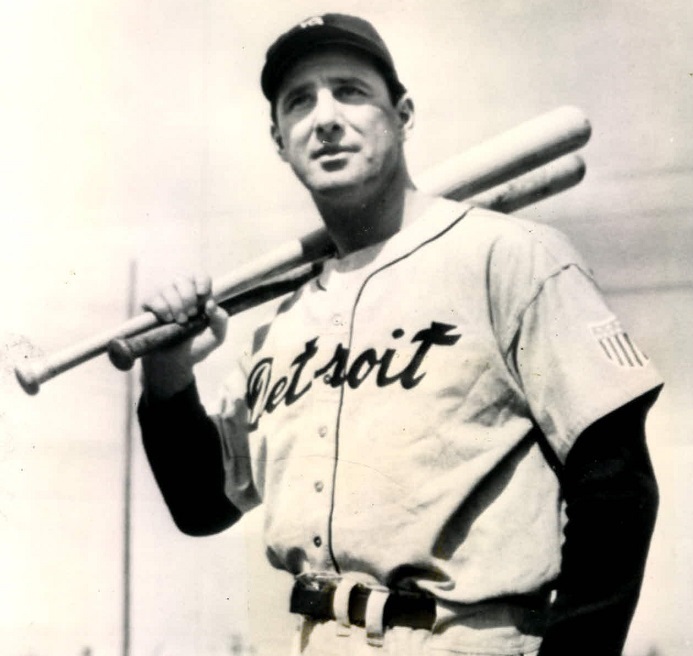
Henry Benjamin Greenberg (January 1, 1911 – September 4, 1986), nicknamed "Hammerin' Hank", "Hankus Pankus", and "the Hebrew Hammer", was an American professional baseball player and team executive. He played in Major League Baseball (MLB), primarily for the Detroit Tigers as a first baseman in the 1930s and 1940s. A member of the Baseball Hall of Fame and a two-time Most Valuable Player (MVP) Award winner, he was one of the premier power hitters of his generation and is widely considered one of the greatest sluggers in baseball history.
Greenberg played the first twelve of his 13 major league seasons for Detroit; with the Tigers, he was an All-Star for four seasons and was named the American League (AL) Most Valuable Player in 1935 and 1940. He had a batting average over .300 in eight seasons, and won two World Series championships with the Tigers (1935 and 1945). He was the AL home run leader four times and his 58 home runs for the Tigers in 1938 equaled Jimmie Foxx's 1932 mark for the most in one season by anyone other than Babe Ruth, and tied Foxx for the most home runs between Ruth's record 60 in 1927 and Roger Maris' record 61 in 1961. Greenberg was the first major league player to hit 25 or more home runs in a season in each league, and remains the AL record-holder for most runs batted in in a single season by a right-handed batter.
When the United States joined World War II, Greenberg was the first major leaguer to join the armed forces; he spent 47 months in military service, more than any other major league player, all of which took place during what would have been prime years in his major league career. Like many players who served in WWII, his career statistics suffered because of the war and would have certainly been higher had he not served in the armed services during wartime. In 1947, Greenberg signed a contract for a record $85,000 salary before being sold to the Pittsburgh Pirates, where he played his final MLB season that year. After retiring from playing, Greenberg continued to work in baseball as a team executive for the Cleveland Indians and Chicago White Sox.
Greenberg was the first Jewish superstar in American team sports. He attracted national attention in 1934 in the middle of a pennant race when he grappled with the decision of whether or not to play baseball on the Jewish High Holy Days; after consultation with his rabbi, he decided to play on Rosh Hashanah, but refused to play on Yom Kippur, instead spending the day at the synagogue. Having endured his share of antisemitic abuse in his career, Greenberg was one of the few opposing players to publicly welcome African-American player Jackie Robinson to the major leagues in 1947.
Greenberg was born on January 1, 1911, in Greenwich Village, New York City, to Romanian Jewish immigrant parents from Bucharest, Sarah (née Schwartz) (1881–1951) and David Greenberg (1883–1969). He was the third of four children and had two brothers, Ben (1906–1994) and Joe (1915–2001), and a sister, Lillian (1907–1989). His parents had originally wanted to name him "Hyman"; however, the name on his birth certificate was erroneously listed as "Henry".
The family owned a successful cloth-shrinking plant in New York. Eventually, they moved from Greenwich Village to the Bronx where Greenberg attended James Monroe High School. There, Greenberg was an outstanding all-around athlete and was bestowed with the long-standing nickname of "Bruggy" by his basketball coach. His preferred sport was baseball, and his preferred position was first base. However, his best sport was basketball and he helped the high school basketball team win the city championship. Greenberg also excelled at soccer and track and field.
In 1929, the 18-year-old 6 ft 4 in (1.93 m) Greenberg was recruited by the New York Yankees, who already had Lou Gehrig at first base. As first base was already taken on the Yankee team, Greenberg turned down the Yankees' offer and instead attended New York University on an athletic scholarship; there, he was a member of Sigma Alpha Mu. During this time, he also had a tryout with the New York Giants; Giants manager John McGraw, however, was not impressed by the first baseman. Hence, after his freshman year ended, Greenberg signed with the Detroit Tigers for $9,000 ($169,000 today).
Greenberg played minor league baseball for three years. He played 17 games in 1930 for the Hartford Senators of the Eastern League before playing the remainder of the year with the Raleigh Capitals of the Piedmont League, hitting .314 with 19 home runs. In 1931, he played for the Evansville Hubs in the Illinois–Indiana–Iowa League, hitting .318 with 15 home runs and 85 runs batted in. In 1932, the Beaumont Exporters in the Texas League, he hit 39 homers with 131 RBIs, winning the league's Most Valuable Player award, and leading Beaumont to the Texas League title.
Hub AI
Hank Greenberg AI simulator
(@Hank Greenberg_simulator)
Hank Greenberg
Henry Benjamin Greenberg (January 1, 1911 – September 4, 1986), nicknamed "Hammerin' Hank", "Hankus Pankus", and "the Hebrew Hammer", was an American professional baseball player and team executive. He played in Major League Baseball (MLB), primarily for the Detroit Tigers as a first baseman in the 1930s and 1940s. A member of the Baseball Hall of Fame and a two-time Most Valuable Player (MVP) Award winner, he was one of the premier power hitters of his generation and is widely considered one of the greatest sluggers in baseball history.
Greenberg played the first twelve of his 13 major league seasons for Detroit; with the Tigers, he was an All-Star for four seasons and was named the American League (AL) Most Valuable Player in 1935 and 1940. He had a batting average over .300 in eight seasons, and won two World Series championships with the Tigers (1935 and 1945). He was the AL home run leader four times and his 58 home runs for the Tigers in 1938 equaled Jimmie Foxx's 1932 mark for the most in one season by anyone other than Babe Ruth, and tied Foxx for the most home runs between Ruth's record 60 in 1927 and Roger Maris' record 61 in 1961. Greenberg was the first major league player to hit 25 or more home runs in a season in each league, and remains the AL record-holder for most runs batted in in a single season by a right-handed batter.
When the United States joined World War II, Greenberg was the first major leaguer to join the armed forces; he spent 47 months in military service, more than any other major league player, all of which took place during what would have been prime years in his major league career. Like many players who served in WWII, his career statistics suffered because of the war and would have certainly been higher had he not served in the armed services during wartime. In 1947, Greenberg signed a contract for a record $85,000 salary before being sold to the Pittsburgh Pirates, where he played his final MLB season that year. After retiring from playing, Greenberg continued to work in baseball as a team executive for the Cleveland Indians and Chicago White Sox.
Greenberg was the first Jewish superstar in American team sports. He attracted national attention in 1934 in the middle of a pennant race when he grappled with the decision of whether or not to play baseball on the Jewish High Holy Days; after consultation with his rabbi, he decided to play on Rosh Hashanah, but refused to play on Yom Kippur, instead spending the day at the synagogue. Having endured his share of antisemitic abuse in his career, Greenberg was one of the few opposing players to publicly welcome African-American player Jackie Robinson to the major leagues in 1947.
Greenberg was born on January 1, 1911, in Greenwich Village, New York City, to Romanian Jewish immigrant parents from Bucharest, Sarah (née Schwartz) (1881–1951) and David Greenberg (1883–1969). He was the third of four children and had two brothers, Ben (1906–1994) and Joe (1915–2001), and a sister, Lillian (1907–1989). His parents had originally wanted to name him "Hyman"; however, the name on his birth certificate was erroneously listed as "Henry".
The family owned a successful cloth-shrinking plant in New York. Eventually, they moved from Greenwich Village to the Bronx where Greenberg attended James Monroe High School. There, Greenberg was an outstanding all-around athlete and was bestowed with the long-standing nickname of "Bruggy" by his basketball coach. His preferred sport was baseball, and his preferred position was first base. However, his best sport was basketball and he helped the high school basketball team win the city championship. Greenberg also excelled at soccer and track and field.
In 1929, the 18-year-old 6 ft 4 in (1.93 m) Greenberg was recruited by the New York Yankees, who already had Lou Gehrig at first base. As first base was already taken on the Yankee team, Greenberg turned down the Yankees' offer and instead attended New York University on an athletic scholarship; there, he was a member of Sigma Alpha Mu. During this time, he also had a tryout with the New York Giants; Giants manager John McGraw, however, was not impressed by the first baseman. Hence, after his freshman year ended, Greenberg signed with the Detroit Tigers for $9,000 ($169,000 today).
Greenberg played minor league baseball for three years. He played 17 games in 1930 for the Hartford Senators of the Eastern League before playing the remainder of the year with the Raleigh Capitals of the Piedmont League, hitting .314 with 19 home runs. In 1931, he played for the Evansville Hubs in the Illinois–Indiana–Iowa League, hitting .318 with 15 home runs and 85 runs batted in. In 1932, the Beaumont Exporters in the Texas League, he hit 39 homers with 131 RBIs, winning the league's Most Valuable Player award, and leading Beaumont to the Texas League title.