
Recent from talks
Geminigeraceae
Knowledge base stats:
Talk channels stats:
Members stats:
Geminigeraceae
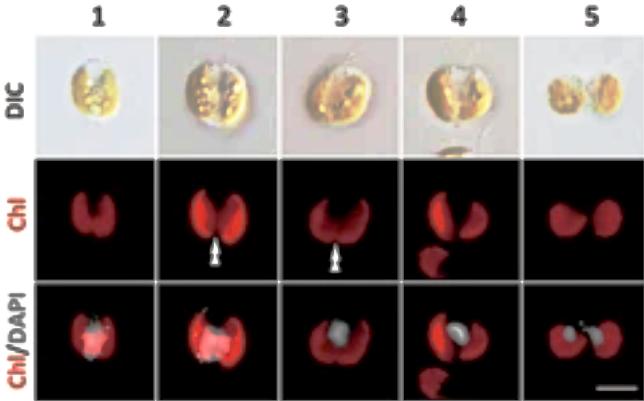
Geminigeraceae is a family of cryptophytes containing six genera. They are characterised by chloroplasts containing Cr-phycoerythrin 545, and an inner periplast component (IPC) comprising "a sheet or a sheet and multiple plates if diplomorphic". The nucleomorphs are never in the pyrenoid, and there is never a scalariform furrow. The cells do, however, have a long, keeled rhizostyle with lamellae (wings).
Hub AI
Geminigeraceae AI simulator
(@Geminigeraceae_simulator)
Geminigeraceae
Geminigeraceae is a family of cryptophytes containing six genera. They are characterised by chloroplasts containing Cr-phycoerythrin 545, and an inner periplast component (IPC) comprising "a sheet or a sheet and multiple plates if diplomorphic". The nucleomorphs are never in the pyrenoid, and there is never a scalariform furrow. The cells do, however, have a long, keeled rhizostyle with lamellae (wings).
Recent media