Hubbry Logo
Hard disk drive platterHard disk drive platterMain
Open search
Hard disk drive platter
Community hub
Hard disk drive platter
logo
8 pages, 0 posts
0 subscribers
Be the first to start a discussion here.
Hard disk drive platter
from Wikipedia
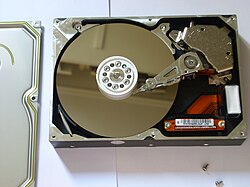
Hard disk with platter
Inside view of a hard disk
Hard disk drive platter, 2.5" Samsung MP0402H

A hard disk drive platter or hard disk is the circular magnetic disk on which digital data is stored in a hard disk drive.[1] The rigid nature of the platters is what gives them their name (as opposed to the flexible materials which are used to make floppy disks). Hard drives typically have several platters which are mounted on the same spindle. A platter can store information on both sides, typically requiring two recording heads per platter, one per surface.

Design

[edit]

The magnetic surface of each platter is divided into small sub-micrometer-sized magnetic regions, each of which is used to represent a single binary unit of information. A typical magnetic region on a hard-disk platter (as of 2006) is about 200–250 nanometers wide (in the radial direction of the platter) and extends about 25–30 nanometers in the down-track direction (the circumferential direction on the platter),[citation needed] corresponding to about 100 billion bits per square inch of disk area (15.5 Gbit/cm2). The material of the main magnetic medium layer is usually a cobalt-based alloy. In today's hard drives each of these magnetic regions is composed of a few hundred magnetic grains, which are the base material that gets magnetized. As a whole, each magnetic region will have a magnetization.

One reason magnetic grains are used as opposed to a continuous magnetic medium is that they reduce the space needed for a magnetic region. In continuous magnetic materials, formations called Néel spikes tend to appear. These are spikes of opposite magnetization, and form for the same reason that bar magnets will tend to align themselves in opposite directions. These cause problems because the spikes cancel each other's magnetic field out, so that at region boundaries, the transition from one magnetization to the other will happen over the length of the Néel spikes. This is called the transition width.

Many hard drive platters have a layer of lubricant made of amorphous carbon such as diamond-like carbon, called an overcoat, which is deposited onto the disk using sputtering, or using chemical vapor deposition.[2] Silicon Nitride, PFPE[3][4] and hydrogenated carbon have also been used as overcoats.[5][6][7] Alternatively PFPE can be used as a lubricant on top of the overcoat.[8]

Comparison of the transition width caused by Néel Spikes in continuous media and granular media, at a boundary between two magnetic regions of opposite magnetization

Granular media is oriented based on whether longitudinal or perpendicular magnetic recording is used.[9] Ordered granular media can allow for higher storage densities than conventional granular media, and bit patterned media can succeed ordered granular media in storage density.[10]

Grains help solve this problem because each grain is in theory a single magnetic domain (though not always in practice). This means that the magnetic domains cannot grow or shrink to form spikes, and therefore the transition width will be on the order of the diameter of the grains. Thus, much of the development in hard drives has been in reduction of grain size.[11][12]

Manufacture

[edit]
Destroyed hard disk, glass platter visible

Platters are typically made using an aluminium, glass or ceramic substrate.[13] Laptop hard drive platters are made from glass while aluminum platters are often found in desktop computers.[14][15] In disk manufacturing, a thin coating is deposited on both sides of the substrate, mostly by a vacuum deposition process called magnetron sputtering. The coating has a complex layered structure consisting of various metallic (mostly non-magnetic) alloys as underlayers, optimized for the control of the crystallographic orientation and the grain size of the actual magnetic media layer on top of them, i.e. the film storing the bits of information. On top of it a protective carbon-based overcoat is deposited in the same sputtering process. Platters typically contain several layers of materials such as a seed layer, soft magnetic under layers (SULs) that may contain Cobalt and Iron[16][17] made of materials such as, an antiferromagnetic (A-FM) layer made of Nickel oxide, Nickel-Manganese or Iron-Manganese alloy,[18] intermediate layer made of Ruthenium[18] and a layer of Cobalt-Chromium-Palladium alloy with oxide.[8] In post-processing a nanometer thin polymeric lubricant layer gets deposited on top of the sputtered structure by dipping the disk into a solvent solution, after which the disk is buffed by various processes [clarification needed] to eliminate small defects and verified by a special sensor on a flying head for absence of any remaining asperities or other defects (where the size of the bit given above roughly sets the scale for what constitutes a significant defect size). In the hard-disk drive the hard-drive heads fly and move radially over the surface of the spinning platters to read or write the data. Extreme smoothness, durability, and perfection of finish are required properties of a hard-disk platter.

In 1990, the Toshiba MK1122FC hard drive was released in Japan. It introduced the first platter with glass substrate, replacing the aluminium alloys used in earlier hard drives.[19] In February 1991, Areal Technology released the MD-2060, one of the first hard drives to use a glass substrate. It was originally designed for laptops, for which the greater shock resistance of glass substrates are more suitable.[20][21][22] In April 1991, the Toshiba MK1122FC was released in North America; Toshiba's factories were able to produce many more drives than Areal, which soon disappeared from the market.[20][23] Around 2000, other hard drive manufacturers started transitioning from aluminum to glass platters because glass platters have several advantages over aluminum platters.[24][25][26]

In 2005–06, a major shift in technology of hard-disk drives and of magnetic disks/media began. Originally, in-plane magnetized materials were used to store the bits, but this has now been replaced by perpendicular recording. The reason for this transition is the need to continue the trend of increasing storage densities, with perpendicularly oriented media offering a more stable solution for a decreasing bit size. Orienting the magnetization perpendicular to the disk surface has major implications for the disk's deposited structure and the choice of magnetic materials, as well as for some of the other components of the hard-disk drive (such as the head and the electronic channel).

See also

[edit]

References

[edit]
Revisions and contributorsEdit on WikipediaRead on Wikipedia
from Grokipedia
A hard disk drive platter, commonly referred to as a disk, is a rigid, circular plate coated with magnetic material that serves as the core storage medium in a (HDD) for persistently encoding through magnetic domains. Typically 3.5 inches in for desktop drives or smaller for laptops, the platter consists of an aluminum-magnesium alloy or substrate overlaid with multiple thin films: a nickel-phosphorus intermediate layer (approximately 10 μm thick on aluminum substrates), a cobalt-based magnetic recording layer (10-20 nm), a (DLC) protective overcoat (2-5 nm), and a layer (roughly 1 nm). These layers enable the platter to store data at high areal densities while withstanding the mechanical stresses of rotation at speeds between 5,400 and 15,000 (RPM). In operation, one or more platters are coaxially mounted on a spindle driven by an , forming a stack where each usable surface—up to two per platter—is accessed by a read/write head suspended on an air-bearing attached to an actuator arm. The heads, positioned via a voice-coil motor, float approximately 3-5 nm above the platter surface on a thin air cushion generated by the rotation, allowing them to magnetize microscopic regions (grains) on the platter to represent or detect existing magnetic orientations for reading. is organized into concentric tracks (thousands per surface) subdivided into fixed-size sectors (typically 512 bytes or 4 KB), enabling efficient and supporting capacities from hundreds of gigabytes to over 36 terabytes per drive as of 2025 in multi-platter configurations. This electromechanical design ensures non-volatile storage, where data persists without power, though seek times (around 5-10 ms) and rotational latency (dependent on RPM) influence overall performance. Modern advancements, such as (HAMR), heat the platter locally during writing to enable smaller, more stable magnetic grains, pushing areal densities beyond 1 terabit per square inch and supporting exabyte-scale data centers. Despite competition from solid-state drives, platters remain vital for cost-effective, high-capacity bulk storage in enterprise and consumer applications.

Fundamentals

Definition and Role

A hard disk drive platter is a rigid, circular disk constructed from a non-magnetic substrate, such as or , and coated with a thin magnetic layer that enables the storage of through magnetized patterns representing binary . This component serves as the core medium for non-volatile in hard disk drives (HDDs), where is encoded on both surfaces of the platter in the form of microscopic magnetic domains. Within an HDD, one or more platters are mounted on a central spindle and rotate at high speeds—typically ranging from 5,400 to 15,000 (RPM)—to facilitate rapid access. As the platters spin, read/write heads mounted on arms hover just above the surfaces to detect or alter magnetic orientations along concentric tracks divided into sectors, enabling the writing, reading, and erasure of . Multiple platters are often stacked coaxially in a single drive to multiply storage capacity, with each contributing independently to the overall volume. The platters interact closely with key HDD components: the spindle motor provides the rotational force to maintain consistent speed, while the actuator mechanism precisely positions the heads across the platter surfaces without physical contact, minimizing wear through an air-bearing design. This assembly is enclosed in a hermetically sealed head disk assembly (HDA) to shield the ultra-thin magnetic coating and floating heads from airborne contaminants like dust particles, which could cause data errors or mechanical failure. In modern drives, each platter surface can hold several terabytes of data, allowing high-capacity HDDs to reach tens of terabytes overall. This fundamental architecture traces its origins to rigid disk designs pioneered in the 1950s.

Historical Development

The hard disk drive platter originated with the invention of the rigid disk drive by in , when the company introduced the RAMAC 305 system featuring the Model 350 unit. This pioneering device utilized 50 aluminum platters, each 24 inches in diameter, to achieve a total storage capacity of approximately 5 MB, marking the first commercial use of magnetic for data. During the and , platter technology advanced through reductions in diameter to enhance compactness and efficiency, transitioning from 14-inch platters in early drives to 8-inch formats by the late 1970s, which facilitated broader adoption in minicomputers and personal systems. In 1979, introduced thin-film heads with the 3370 drive, enabling higher recording densities on platters by improving head precision and reducing flying heights, though thin-film magnetic media coatings emerged shortly thereafter in the early to further boost areal density. The 1990s brought further refinements, including the adoption of glass substrates for platters starting with Toshiba's MK1122FC drive in 1990, which provided superior rigidity and flatness compared to aluminum, allowing for lower head flying heights and denser data packing. Additionally, the development of (GMR) heads, building on earlier magnetoresistive technology introduced by in 1991, indirectly enhanced platter utilization by dramatically improving read sensitivity and enabling areal densities to exceed previous limits. In the 2000s and , perpendicular magnetic recording (PMR) emerged as a transformative innovation, with commercializing it in 2005, followed by GST and Seagate in 2006, orienting magnetic bits vertically on platters to increase areal density from around 100 Gbit/in² to over 1 Tbit/in² by the mid-. (HAMR) prototypes also advanced during this period, with Seagate demonstrating systems as early as 2002 using heating to write on high-coercivity media. By the 2020s, HAMR technology matured into production, as seen in Seagate's 2024 release of 30 TB+ drives employing iron-platinum alloys in the platter media for enhanced thermal stability and densities exceeding 1.5 Tbit/in², with 36 TB drives released in 2025. Concurrently, microwave-assisted magnetic recording (MAMR) gained traction as an energy-efficient alternative, with ongoing implementations by companies like to extend platter-based storage scalability. Throughout this evolution, platter diameters continued to shrink—from the original 24 inches to as small as 0.85 inches for mobile applications—while the rise of solid-state drives (SSDs) shifted HDD innovation toward higher-capacity enterprise platters rather than performance-focused designs.

Physical Design

Materials and Composition

Hard disk drive platters are constructed with a multi-layered composition designed to support high-density magnetic data storage while maintaining structural integrity under high rotational speeds. The substrate forms the foundational layer, typically made from an aluminum-magnesium (Al-Mg) alloy, such as AA5083 containing approximately 96% aluminum and 4% magnesium, which provides a lightweight, non-magnetic base that is cost-effective and highly machinable for precise shaping and polishing. This alloy constitutes the majority of platter drives due to its favorable balance of density and workability, enabling efficient production for consumer and standard applications. In enterprise-grade drives, particularly those employing advanced recording technologies, glass-ceramic substrates, often based on aluminosilicate compositions, are preferred for their superior rigidity, reduced thermal expansion coefficient, and enhanced resistance to warping, which better support higher areal densities and operational reliability. For example, Seagate employs glass substrates in its HAMR enterprise drives, achieving areal densities enabling 3.6 TB per platter as of 2025. Over the substrate, a thin magnetic recording layer is deposited, primarily using cobalt-based alloys such as CoPtCr (cobalt-platinum-chromium), which exhibit strong ferromagnetic properties essential for data retention. These alloys are engineered into a granular structure, typically 10–20 nm thick, where magnetic grains are separated by non-magnetic oxide barriers to enhance thermal stability and reduce inter-grain magnetic coupling, thereby minimizing noise during read operations. To protect the magnetic layer from environmental degradation and mechanical wear, a diamond-like carbon (DLC) overcoat, approximately 2–3 nm thick, is applied, offering excellent corrosion resistance, hardness, and low surface friction. An optional topcoat of perfluoropolyether (PFPE) lubricant, such as Fomblin Zdol, is often added at monolayer thicknesses to further minimize head-disk interactions and prevent adhesive wear. Key material properties are optimized for platter performance: substrates must remain non-magnetic to avoid interference with fields, achieve extreme flatness with waviness controlled to within micrometers (often below 1 μm across the surface), and maintain dynamic balance to withstand rotational speeds exceeding 10,000 RPM without vibration-induced errors. The magnetic layers are tailored for high , typically exceeding 5,000 Oe in magnetic recording (PMR) configurations, ensuring resistance to self-demagnetization and stable bit retention over time. In emerging (HAMR) platters, iron-platinum (FePt) alloys replace traditional cobalt-based media, leveraging their chemically ordered L10 structure and elevated around 700 K for improved thermal stability and higher recording densities.

Dimensions and Specifications

Hard disk drive platters originated with diameters of 24 inches in the , as seen in the system, which featured 50 such platters for storing approximately 5 million characters of data. Over decades, platter sizes have progressively shrunk to enable higher areal densities and compact form factors, reducing from those early 24-inch models to the dominant 3.5-inch standard by the 1980s, driven by exponential improvements in storage efficiency that reached 1–2 terabits per square inch by 2025. This miniaturization supports modern applications while maintaining compatibility with established drive enclosures. Contemporary platters adhere to standardized form factors defined by industry specifications, with 3.5-inch diameters prevalent in desktop and enterprise hard drives for optimal capacity in data centers, and 2.5-inch diameters standard for and mobile systems to fit slim profiles. Smaller 1.8-inch and sub-1.8-inch platters remain relevant for embedded and portable devices into the , ensuring across consumer and industrial hardware. These dimensions align with ANSI/INCITS guidelines for interfaces, promoting consistent physical integration in systems like and SAS drives. Individual platters typically measure 0.8–1.0 mm in thickness to balance rigidity and stackability, allowing modern 20+ TB drives to incorporate 1–12 platters separated by spacers for multi-surface recording. For instance, 2025-era 36 TB models utilize 10 platters to achieve high-capacity configurations within the 3.5-inch form factor. has verified stacking up to 12 platters, enabling 40 TB-class drives through optimized . Surface specifications emphasize precision for reliable head operation, with track pitches narrowing to approximately 100 nm in advanced 2025 drives to support areal densities of 1–2 Tbit/in², corresponding to track densities exceeding 250,000 tracks per inch (TPI). Platter surfaces achieve a roughness below 0.5 nm RMS to maintain head flying heights under 5 nm, minimizing and enabling denser placement. Manufacturing tolerances ensure rotational stability, with platter imbalance limited to levels compliant with ISO 1940 standards (typically G2.5 quality grade) and controlled to under 5 μm for precise spindle alignment. These metrics, verified through high-resolution measurements, support sustained operation at speeds up to 15,000 RPM without compromising .

Manufacturing Process

Substrate Preparation

Substrate preparation for hard disk drive platters involves the initial fabrication of the base disk, starting from raw materials and culminating in a highly precise, clean surface ready for subsequent processing. Common materials include aluminum-magnesium (Al-Mg) alloys for cost-effective substrates and chemically strengthened glass for enhanced rigidity and smoothness in high-capacity drives. Aluminum substrates are formed by blanking or stamping Al-Mg alloy sheets into circular disks, a process that shapes the material while introducing minimal deformation. Following forming, annealing is applied at controlled temperatures to relieve residual stresses, preventing warping during high-speed rotation. Glass substrates, in contrast, are produced via press-molding of molten glass into approximate disk shapes, succeeded by a heat treatment step to induce chemical strengthening through ion exchange, which boosts surface hardness and thermal stability; as of 2025, glass is increasingly adopted for multi-platter high-capacity configurations, such as 12-disk drives. Machining refines the formed blanks to exact specifications. Precision grinding achieves diameter tolerances of ±0.01 mm, using multi-stage fixed-abrasive techniques with progressively finer grits (from 140 µm to 0-2 µm) on air-bearing spindles for nanometer-scale control. Inner and outer edges are lathed to create precise hubs for spindle attachment, ensuring concentricity and balance. For brittle glass substrates, grinding employs ductile-regime methods with deionized to avoid subsurface damage, targeting flatness within 8 µm. Polishing follows machining through multi-stage chemical-mechanical polishing (CMP), which combines chemical slurries with mechanical abrasion to reduce to below 1 nm root-mean-square (rms), often achieving 0.331 nm in optimized processes using composite abrasives like α-alumina-grafted polystyrene . occurs in ultrasonic baths with deionized solutions to remove contaminants and particles larger than 50 nm, preventing defects that could compromise . Final inspection employs optical , such as grazing-incidence techniques, to measure flatness deviations across the substrate surface, ensuring compliance with sub-micrometer tolerances. For substrates, helium leak testing detects internal or micro-cracks that could lead to failure under stress. These rigorous steps guarantee the substrate's integrity at rotational speeds up to 15,000 RPM without warping.

Coating and Assembly

The magnetic layer on the hard disk drive platter substrate is deposited using DC magnetron sputtering within high-vacuum chambers to form a thin film of cobalt (Co)-alloy granular media, typically 10-15 nm thick, enabling high-density perpendicular magnetic recording. Underlayers, such as ruthenium (Ru), are first sputtered to establish epitaxial growth and optimal crystal orientation of the Co-alloy grains, promoting isolated magnetic domains with grain sizes around 7-8 nm for reduced intergranular exchange coupling. This process occurs in an inline sputtering system where multiple platters are sequentially passed through deposition stations, ensuring uniform layer adhesion and magnetic coercivity exceeding 5 kOe. Following magnetic layer deposition, a protective overcoat of (DLC) is applied via (PECVD) to a thickness of 2-3 nm, providing corrosion resistance and wear protection for the underlying media. A (PFPE) lubricant topcoat, approximately 1-2 nm thick, is then added through dip-coating in a solvent bath or vapor deposition to minimize head-disk friction and enable low-flying-height operation. Layer thicknesses are precisely controlled during deposition using monitoring, which measures mass accumulation by frequency shifts in an oscillating crystal sensor exposed to the vapor flux. Post-deposition heat treatment involves annealing the coated platters at 200-300°C in a to refine microstructure, reduce internal stresses, and enhance magnetic properties such as and . For (HAMR) platters, specialized laser texturing is applied to the surface to create microscale features that improve thermal gradient control and heat distribution during write operations, mitigating thermal protrusions in the recording head. In preliminary assembly, the coated platters are bonded to a precision-machined aluminum hub using epoxy adhesive and mounted onto the spindle motor shaft for rotational stability up to 15,000 rpm. Servo tracks—embedded alignment patterns for head positioning—are then written onto the platters using dedicated servowriter tools equipped with laser interferometry for and high-precision magnetic heads to achieve track misregistration below 5 nm. Quality assurance during coating and assembly emphasizes uniformity and defect minimization, with ellipsometry used to measure overcoat thickness variations to within 0.1 nm across the platter surface. Defect densities are maintained below 1 per cm² through in-line optical inspection, while overall process yields in production facilities operated by manufacturers like Seagate and typically range from 90-98%, supported by automated defect mapping and rework protocols.

Data Storage and Operation

Magnetic Recording Principles

In hard disk drive platters, data is stored by encoding binary in magnetic domains within a thin ferromagnetic layer coated on the substrate surface. Each bit is represented by the orientation of these domains, where the direction of —either north or south pole facing up—corresponds to a 0 or 1. Early platters employed longitudinal magnetic recording (LMR), in which domains were aligned parallel to the platter surface, limiting areal densities due to magnetostatic interactions between adjacent bits. Since , perpendicular magnetic recording (PMR) has become the standard, aligning domains to the surface for improved stability and higher densities, as the vertical orientation reduces self-demagnetization effects. Areal density, the key metric for storage capacity, is determined by the product of linear bit density (bits per inch, BPI) and track density (tracks per inch, TPI), expressed as areal density (bits/in²) = BPI × TPI. This measures how many bits can be packed onto the platter surface, with modern PMR-based platters achieving approximately 1.2 Tbit/in² in 2025 through refinements in and track spacing. The (Hc) of the magnetic media, which quantifies resistance to demagnetization, typically ranges from 3,000 to 10,000 oersteds (Oe) in PMR platters, enabling stable bit retention against stray fields while allowing write heads to flip domains. Complementing this, (Mr), or the residual after the applied field is removed, determines signal strength during readout, with higher Mr values enhancing the detectability of bit transitions without excessive noise. The superparamagnetic limit poses a fundamental challenge to scaling densities further, as thermal fluctuations can randomly flip small magnetic grains, leading to data loss. Thermal stability is characterized by the factor KuV/kT, where Ku is the magnetic anisotropy constant, V is the grain volume, k is Boltzmann's constant, and T is temperature; values exceeding 60 ensure stability over typical drive lifetimes of 5–10 years at room temperature. To push beyond current limits, smaller grains require higher Ku materials, such as FePt alloys, to maintain this threshold while increasing BPI and TPI. Techniques like heat-assisted magnetic recording (HAMR) use a laser to locally heat the media during writing, allowing higher coercivity materials such as FePt and achieving areal densities around 1.4 Tbit/in² in commercial drives as of 2025. Advanced techniques like shingled magnetic recording (SMR) address density constraints by intentionally overlapping adjacent tracks, allowing narrower effective track widths and up to 20% higher areal density compared to conventional PMR, though at the cost of sequential write constraints. Similarly, bit-patterned media (BPM) employs lithographically defined magnetic islands, each storing a single bit, to eliminate inter-grain interference and achieve isolated, thermally stable domains for densities beyond 1 Tbit/in².

Read-Write Mechanisms

The write process in hard disk drives involves an inductive writer head that generates a exceeding the (Hc) of the platter's magnetic layer to align or flip magnetic domains during recording. This field is produced by passing electrical current through a coil within the head, creating a localized that orients the domains in the desired direction as the platter rotates beneath it. The head maintains a precise flying of 3–5 nm above the platter surface, sustained by an that exploits the airflow from the spinning platter to prevent contact and ensure reliable operation. In the read process, giant magnetoresistive (GMR) or tunneling magnetoresistive (TMR) sensors in the read head detect variations in the produced by the recorded domains on the platter. These sensors operate on the principle of resistance changes in response to the stray s, converting them into electrical signals that represent the stored data bits. A then boosts these weak analog signals, typically from microvolt levels to 1–10 mV, for further processing by the drive's electronics. Track following is managed by a motor (VCM) that precisely positions the read-write head over the target track on the platter, achieving positioning accuracy on the order of ±5 nm to minimize off-track errors. The VCM operates by applying current to a coil in a permanent , producing linear to move the actuator arm; closed-loop feedback is provided by servo bursts—pre-recorded magnetic patterns embedded on the platter—that the read head senses to correct for disturbances like vibrations or . Error correction during read-write operations relies on run-length limited (RLL) encoding to constrain data patterns and avoid magnetic interference, with modern implementations using schemes such as (0,4/4) to optimize recording density while limiting run lengths of zeros. Additionally, error-correcting codes (ECC) like low-density parity-check (LDPC) codes are employed to detect and correct bit errors, achieving sector-level bit error rates below 10^{-15} after decoding, which ensures data integrity in high-density environments. Overall, these mechanisms contribute to typical seek times of 5–10 ms for head positioning and sustained transfer rates up to 250 MB/s in 2025-era SATA drives, constrained by platter rotational speed and linear recording density.

Performance and Limitations

Capacity and Density Factors

The capacity of a hard disk drive platter is fundamentally determined by its areal density, which measures the number of bits stored per square inch (bits/in²) on the platter surface and is calculated as the product of linear density (bits per inch, or BPI, along a track) and track density (tracks per inch, or TPI, across the platter radius). Linear density is primarily driven by the width of the write head and the sharpness of magnetic transitions on the media, allowing more bits to be packed into each track without overlap, while track density depends on the precision of the head positioning system, often enhanced by servo mechanisms that maintain alignment within nanometers. These factors enable progressive increases in storage efficiency, though they are constrained by physical limits in magnetism and mechanical stability. Advancements in , such as partial response maximum likelihood (PRML) channels, have historically boosted effective by 20–50% through better detection of partially overlapping signals, moving beyond simple peak detection to probabilistic decoding. Modern enterprise drives achieve linear densities of approximately 2–2.5 million BPI, facilitated by evolved PRML variants and error-correcting codes that mitigate noise in high-density environments. The total volume capacity of a drive, accounting for multiple platters, can be estimated using the formula: total gigabytes (GB) = [π × (platter radius in inches)² × number of recording surfaces × areal density in bits/in²] / (8 × 10⁹), where the denominator converts bits to GB (1 GB = 10⁹ bytes). This raw calculation must be adjusted downward by approximately 10% to account for formatting overhead, including sector headers, error correction codes, and reserved zones for servo data and defect management. For a typical 3.5-inch drive with platters of about 1.59-inch radius, this yields capacities scaling directly with areal density improvements. Pushing higher densities introduces trade-offs, as narrower write heads required for increased BPI and TPI exacerbate inter-symbol interference (ISI), where adjacent bits distort each other's read signals due to magnetic overlap and channel noise. Advanced equalization and detection algorithms partially compensate for ISI, but it limits reliable without complementary media enhancements. Additionally, helium-filled drives mitigate aerodynamic turbulence from spinning platters, enabling tighter head-disk spacing (as low as 3–5 nanometers) and more platters per drive (up to 10), which supports higher overall capacity at reduced power. As of November 2025, enterprise platters in Seagate's Exos M series achieve areal densities of about 1.84 terabits per (Tbit/in²) using (HAMR), supporting 30 TB per drive with ten 3 TB platters; higher-capacity 36 TB models extend this to approximately 2.2 Tbit/in² with ten 3.6 TB platters, though consumer adoption lags due to elevated costs.

Failure Modes and Durability

Hard disk drive platters are susceptible to several failure modes that can compromise and drive functionality. One primary mechanical failure is the , where the read-write head physically contacts the rotating platter surface, often due to sudden shocks, manufacturing defects, or dust particles disrupting the head's air-bearing flight. This contact can gouge or scratch the platter, removing portions of the thin magnetic recording layer and rendering affected sectors unreadable. Such incidents are exacerbated in environments with high , as rotational vibration can misalign heads and increase contact risk. Surface defects on platters, including bad sectors and media errors, represent another common category, often stemming from wear during operation, manufacturing imperfections, or gradual degradation of the magnetic coating. parameters like scan errors, which detect platter surface anomalies, correlate strongly with impending ; drives exhibiting scan errors are up to 39 times more likely to fail within 60 days. Similarly, reallocation counts—indicating sectors remapped due to platter damage—increase probability by 3 to 6 times, with offline reallocations posing a 21-fold in the short term. of the platter's metallic layers, particularly the cobalt-based magnetic material, occurs in humid conditions where gaseous contaminants like SO₂ and H₂S enter via the drive's breather port, forming corrosive compounds such as sulfate that pit the surface. This process accelerates at higher relative (e.g., deposition rates rising from 12.25 × 10⁻⁶ kg/m²-s at 30% RH to 28.63 × 10⁻⁶ kg/m²-s at 70% RH) and can lead to widespread if the protective carbon overcoat is breached. Delamination of the platter's multilayer coating—comprising substrate, magnetic film, and overcoat—can also occur under thermal stress or chemical exposure, causing layers to separate and expose the substrate to further degradation. While less frequent than head crashes, such failures are mitigated by advanced (DLC) coatings designed to enhance scratch resistance and corrosion barriers. Environmental factors like extreme temperatures and further degrade platter durability, though operational utilization shows minimal correlation with failure rates. In terms of durability, platters contribute significantly to overall hard drive reliability, with modern enterprise drives achieving (MTBF) ratings up to 2.5 million hours through rigorous testing phases that progressively reduce annualized failure rates (AFR) by approximately 400%. Field studies of large populations indicate AFRs ranging from 1.7% in the first year to 8.6% by the third year, influenced more by drive model and age than by temperature or . Protective measures, including sealed enclosures and workload limits (e.g., 550 TB/year for nearline drives), extend platter lifespan, though self-monitoring tools like SMART predict fewer than 50% of failures due to unmonitored latent defects.

References

Add your contribution
Related Hubs
User Avatar
No comments yet.