Hubbry Logo
Hazel ScottHazel ScottMain
Open search
Hazel Scott
Community hub
Hazel Scott
logo
8 pages, 0 posts
0 subscribers
Be the first to start a discussion here.
Hazel Scott
Hazel Scott
from Wikipedia

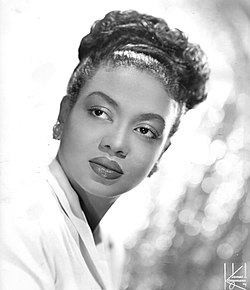
Hazel Dorothy Scott (June 11, 1920 – October 2, 1981) was a Trinidadian American jazz and classical pianist and singer. An outspoken critic of racial discrimination and segregation, she used her influence to improve the representation of Black Americans in film.[1]

Key Information

Born in Port of Spain, Scott moved to New York City with her mother at the age of four. Scott was a child musical prodigy, receiving scholarships to study at the Juilliard School when she was eight. In her teens, she performed at Café Society while still at school.[2] She also performed on the radio.

She was active as a jazz singer throughout the 1930s and 1940s. In 1950, she became the first black American to host her own TV show, The Hazel Scott Show.[3] Her career in the United States faltered after she testified before the House Un-American Activities Committee in 1950 during the era of McCarthyism. Scott subsequently moved to Paris, France, in 1957 and began performing in Europe, not returning to the United States until 1967.

Early life

[edit]

Born in Port of Spain, Trinidad and Tobago, on June 11, 1920,[4] Hazel Dorothy Scott was the only child of R. Thomas Scott, a West African scholar from Liverpool, England, and Alma Long Scott, a classically trained pianist, and music teacher. In 1924, the family moved from Trinidad to the United States and settled in Harlem, New York City.[5] Her parents had separated by this time, and Scott lived with her mother and grandmother.[6]

By now, Scott could play anything she heard on the piano. With her mother's guidance and training, she mastered advanced piano techniques and was labeled a child prodigy.[7] When Scott was eight years old, she began studying with Professor Paul Wagner of the Juilliard School of Music. In 1933, her mother organized her own Alma Long Scott's All-Girl Jazz Band, where Scott played the piano and trumpet.[8]

Career

[edit]
Scott during a visit to Israel, 1962

By the age of 16, Hazel Scott regularly performed for radio programs for the Mutual Broadcasting System, gaining a reputation as the "hot classicist".[9] In the mid-1930s, she also performed at the Roseland Dance Hall with the Count Basie Orchestra. Her early musical theatre appearances in New York included the Cotton Club Revue of 1938, Sing Out the News alongside Will Geer, June Allyson and Maude Simmons;[10] and The Priorities of 1942.[9]

Throughout the 1930s and 1940s, Scott performed jazz, blues, ballads, Broadway and boogie-woogie songs, and classical music in various nightclubs. Barney Josephson, the owner of the black and tan club Café Society, hired her[11] and, from 1939 to 1943, she was a leading attraction at both the downtown and uptown branches of Café Society. Her performances created national prestige for the practice of "swinging the classics".[12] By 1945, Scott was earning $75,000 ($1,309,935 today)[13] a year.[14]

Along with Lena Horne, Scott was one of the first black women to gain respectable roles in major Hollywood pictures. She refused to take roles in Hollywood playing a "singing maid", and she turned down the first four roles she was offered for this reason.[15][2] When she began performing in Hollywood films, she insisted on having final cut privileges when it came to her appearance.[16] She performed as herself in the films I Dood It (MGM, 1943), Broadway Rhythm (MGM, 1944) with Lena Horne, in the otherwise all-white cast of The Heat's On (Columbia, 1943), Something to Shout About (Columbia, 1943), and Rhapsody in Blue (Warner Bros, 1945). She appeared in five Hollywood films in all, always insisting on the credit line "Miss Hazel Scott as Herself", and wearing her own clothes and jewelry to protect her image.[2] Her final break with Columbia Pictures' Harry Cohn involved "a costume which she felt stereotyped blacks".[16] In the 1940s, in addition to her film appearances, she was featured in Café Society's From Bach to Boogie-Woogie concerts in 1941 and 1943 at Carnegie Hall.

Scott on December 17, 1943, playing at Naval Station Great Lakes

She was the first person of African descent to have her own television show in America, The Hazel Scott Show, which premiered on the DuMont Television Network on July 3, 1950. Variety reported that "Hazel Scott has a neat little show in this modest package," its "most engaging element" being Scott herself.[3] The show became so popular, it soon ran three times a week. On the show, Scott performed with the jazz musicians Charles Mingus and Max Roach who were among the members of her supporting band.[2]

Activism and blacklisting

[edit]

Civil rights

[edit]

Scott had long been committed to civil rights.[15] Scott refused to perform in segregated venues when she was on tour. She was once escorted from the city of Austin, Texas by Texas Rangers because she refused to perform when she discovered that black and white patrons were seated separately. "Why would anyone come to hear me, a Negro," she told Time magazine, "and refuse to sit beside someone just like me?"[17][18]

In 1949, Scott brought a suit against the owners of a Pasco, Washington restaurant when a waitress refused to serve Scott and her traveling companion, Mrs. Eunice Wolfe, because "they were Negroes".[19] Scott's victory helped African Americans challenge racial discrimination in Spokane, as well as inspiring civil rights organizations "to pressure the Washington state legislature to enact the Public Accommodations Act" in 1953.[20]

McCarthyism

[edit]

With the advent of the Red Scare in the television industry, Scott's name appeared in Red Channels: A Report on Communist Influence in Radio and Television in June 1950. In an effort to clear her name, Scott voluntarily appeared before the House Un-American Activities Committee (HUAC) on September 22, 1950, and insisted on reading a prepared statement.[21] She denied that she was "ever knowingly connected with the Communist Party or any of its front organizations." However, she stated that she had supported Communist Party member Benjamin J. Davis's run for City Council, arguing that Davis was supported by socialists, a group that "has hated Communists longer and more fiercely than any other."[22] She also expressed her frustrations with the mass amount of false accusations of entertainers and offered the suggestion to use "democratic methods to immediately eliminate a good many irresponsible charges." Scott concluded her statement to the HUAC with a request that entertainers be not already "covered with the mud of slander and the filth of scandal" when proving their loyalty to the United States.[23]

Her television variety program, The Hazel Scott Show, was cancelled a week after Scott appeared before HUAC, on September 29, 1950. (Her program predated Nat King Cole's show by six years.) Scott suffered a nervous breakdown in 1951. On returning to full health, Scott continued to perform in the United States and Europe, even getting sporadic bookings on television variety shows like Cavalcade of Stars and guest starring in an episode of CBS Television's Faye Emerson's Wonderful Town musical series. Scott's short-lived television show "provided a glimmer of hope for African American viewers"[20] during a time of continued racial bias in the broadcasting industry and economic hardships for jazz musicians in general. Scott remained publicly opposed to McCarthyism and racial segregation throughout her career.

Scott in Israel on December 2, 1962

In France (1957–67)

[edit]

To evade political fallout in the United States, Scott moved to Paris in 1957. She appeared in the French Gilles Grangier crime film Le désordre et la nuit (1958).[2] In 1963, she marched with a number of other African-American expatriates, including James Baldwin, to the US Embassy in Paris to demonstrate support of the upcoming March on Washington.[1]

Later US years (1967–81)

[edit]

Scott did not return to the US until 1967. By this time, the Civil Rights Movement had led to federal legislation making racial segregation in housing and public accommodations illegal and enforcing the protection of voting rights of all citizens in addition to other social advances.

Scott continued to perform occasionally in nightclubs, while also appearing on daytime television, until the year of her death. She made her television acting debut in 1970, performing as Dolly Martin in the NBC drama The Bold Ones: The New Doctors, the "If I Can't Sing, I'll Listen" episode. In 1973 on the ABC daytime soap opera One Life to Live, she performed a wedding song at the nuptials of her "onscreen cousin" Carla Gray Hall, portrayed by Ellen Holly.

Personal life

[edit]

Although a Catholic, Scott in 1945 married Baptist minister and US Congressman Adam Clayton Powell.[14][24] The couple had one child, Adam Clayton Powell III, but divorced in 1960 after a separation. Their relationship provoked controversy, as Powell was married when their affair began.[3] At the end of 1960, Powell married his secretary.[25]

On January 19, 1961, Scott married Ezio Bedin, a Swiss-Italian comedian who was 15 years her junior; they divorced a few years later, before her return to the U.S.[25][26]

Bahá'í Faith

[edit]

Scott had heard about the Bahá'í Faith from her longtime friend Dizzy Gillespie, who joined the religion in early 1968.[27] Following heartfelt conversations with him, she joined the faith in late 1968.[28][27] While she was at Vic Damone's career re-announcement in late 1968,[29] she was introduced by Damone to the crowd recalling how he was an usher for her show. This might have been the November 1942 performance by Scott and others at the Paramount Theatre.[30] Damone shared with the crowd that she had just recently been at a Bahá'í fireside, an informational meeting of the religion, at his home and had joined the religion – Scott was very moved and in tears.[29] Scott also sang at an October 1970 award dinner in New York – singing "When the World was Young", "A Lonely Christmas", "Put a Little Love in Your Heart" for an International Education Year Award to James L. Olivero, who remembered Louis Gregory, presented by Daniel Jordan of the Bahá'ís on behalf of the US National Spiritual Assembly.[31] Her singing was praised by Whitney Young, executive director of the National Urban League, who was speaking at the event.[32] A musicale was held in Kingston, Jamaica, in May 1971, entitled The Sounds of a New World, co-presented by Scott with Dizzy Gillespie, Seals and Crofts, and Linda Marshall and others, as part of a ship-and-shore conference of Bahá'ís.[33]

Death

[edit]

On October 2, 1981, Hazel Scott died of cancer at Mount Sinai Hospital in Manhattan. She was 61 years old. She is buried at Flushing Cemetery in Queens, New York, near other musicians including Louis Armstrong, Johnny Hodges, and Dizzy Gillespie (who died in 1993).[34]

Legacy

[edit]

Scott was renowned as a virtuosic jazz pianist, in addition to her successes in dramatic acting and classical music. She also used her status as one of the best-known African-American entertainers of her generation to shine a spotlight on issues of racial injustice and civil rights. Scott recorded as the leader of various groups for Decca, Columbia and Signature, among them a trio that consisted of Bill English and the double-bass player Martin Rivera, and another trio with Charles Mingus on bass and Rudie Nichols on drums. Her 1955 album Relaxed Piano Moods on the Debut label, with Mingus and Roach, is generally her work most highly regarded by critics today. Her unique swinging style and fusion of jazz and classical influences kept her in demand for performances through the very end of her life.[34] Alicia Keys cited Scott as her inspiration for her performance at the 61st Grammy Awards, saying: "I've been thinking about people who inspire me; shout out to Hazel Scott, I've always wanted to play two pianos."

In 2020, she was the subject of the BBC World Service programme Hazel Scott: Jazz star and barrier breaker in the series The Forum.[35]

In When Women Invented Television, author Jennifer Keishin Armstrong features her as one of four women who had a major influence on the medium.[36]

In 2022, Dance Theatre of Harlem debuted a new ballet about the life of Hazel Scott.[37]

On February 21, 2025, the American Masters documentary The Disappearance of Miss Scott aired on PBS stations.[38]

Selected discography

[edit]
  • Swinging the Classics: Piano Solos in Swing Style with Drums (Decca #A-212 [78rpm 3-disc album set], 1941; reissue: Decca #DL-5130 [10" LP], 1949)
  • Her Second Album of Piano Solos with Drums Acc. (Decca #A-321 [78rpm 3-disc album set], 1942)
  • A Piano Recital (Signature #S-1 [78rpm 4-disc album set], 1946)
  • Great Scott! (Columbia #C-159 [78rpm 4-disc album set], 1947; reissue: Columbia #CL-6090 [10" LP], 1950)
  • Two Toned Piano Recital (Coral #CRL-56057 [10" LP], 1952)
  • Hazel Scott's Late Show (Capitol #H-364 [10" LP], 1953)
  • Grand Jazz (Decca [Fr] #FM-133.529, 1954)
  • Relaxed Piano Moods (Debut #DLP-16 [10" LP], 1955)
  • 'Round Midnight (Decca #DL-8474, 1957)
  • Hazel Scott Joue Et Chante (Polydor [Fr] #20 761 [7" EP], 1957)
  • Le Desordre Et La Nuit (Polydor [Fr] #20 816 [7" EP], 1958)
  • Viens Danser (Polydor [Fr] #20 842 [7" EP], 1958)
  • Hazel Scott (Consul [Fr] #CM-2053 [7" EP], 1965)
  • Always (Image Records #IM-307, 1979)
  • After Hours (Tioch Digital Records #TD-1013, 1983)

CD compilations

[edit]
  • The Chronological Hazel Scott 1939-1945 (Classics #1308, 2003)
  • The Chronological Hazel Scott 1946-1947 (Classics #1448, 2007)
  • Relaxed Piano Moods 'Round Midnight (Jasmine #JASMCD-2667, 2020)

Other session work

[edit]
  • Sextet Of The Rhythm Club Of London, "Calling All Bars" / "Mighty Like The Blues" (Bluebird B-10529, 1939)
  • Sextet Of The Rhythm Club Of London, "Why Didn't William Tell?" / "You Gave Me The Go-By" (Bluebird B-10557, 1940)
  • Charlie Parker, The Complete Birth of the Bebop (Stash #ST-260, 1986) [replacing Al Haig for "Embraceable You", 1946]
  • Charlie Parker, The Complete Birth of the Bebop (Stash #STCD-535, 1991) [the above "Embraceable You" session, 1946]

References

[edit]

Sources

[edit]
  • "Bye-Bye Boogie: Hazel Scott leaves night clubs and moves to concert stage", Ebony, November 1945: 31–34.
  • "Café Society Concert." Time Magazine, May 5, 1941.
  • "Hazel Scott is Queen Once More in Warner's 'Rhapsody in Blue'", Chicago Defender, September 1, 1945: 14.
  • McAfee, J. Jr., "Scott, Hazel", CBY 1943 Obituary, JSN, ii/4 (1982), 19.
  • Bogle, Donald. 2001. "The Hazel Scott Show", in Primetime Blues: African Americans on Network Television. New York: Farrar, Straus and Giroux, pp. 15–19.
  • Chilton, Karen (2008). Hazel Scott: The Pioneering Journey of a Jazz Pianist from Cafe Society to Hollywood to HUAC. University of Michigan Press.
  • Feather, Leonard. "Swinging the Classics", The New York Times, May 18, 1941: X5.
  • McGee, Kristin. "Swinging the Classics: Hazel Scott and Hollywood's Musical-Racial Matrix," in Some Liked it Hot: Jazz Women in Film and Television, 1928–1959 (Middletown, CT: Wesleyan University Press 2009) 113–133.
  • Myter-Spencer, D.: "Hazel Scott, Jazz Pianist: Boogie-woogie and Beyond," Jazz Research Papers, x (1990), 75.
  • Reed, Bill. 1998. "The Movies: Hazel Scott", in Hot From Harlem: Profiles in Classic African-American Entertainment, Los Angeles: Cellar Door Press, pp. 110–128.
  • Taubman, E. 1941. "Café Music Heard at Carnegie Hall", The New York Times, April 24, 1941: 24.
  • Taubman, E. 1943. "Swing feature Soviet Benefit: Café Society assures at least a thousand watches for the Russian Fighting Forces," The New York Times, April 12, 1943: 28.
  • Taylor, A. "Hazel Scott", Notes and Tones: Musician-to-Musician Interviews (Liège, Belgium, 1977, rev. and enlarged February 1993).

Further reading

[edit]
[edit]
Revisions and contributorsEdit on WikipediaRead on Wikipedia
from Grokipedia
Hazel Dorothy Scott (June 11, 1920 – October 2, 1981) was a Trinidadian-born American jazz and classical , singer, actress, and civil rights advocate, distinguished for her technical proficiency in blending swing with classical and for refusing performances in segregated venues decades before widespread civil rights legislation. Born in to a scholar father and musician mother, Scott moved to at age three, where her mother recognized her perfect pitch and prodigious talent by age four, leading to early training and a scholarship to the of Music. By her teens, she performed at venues like the original nightclub, earning acclaim for concerts at New York's that fused Bach and , and appeared in films such as Something to Sing About (1937) and Broadway productions. Scott's career peaked in the late 1940s with high earnings from nightclub and radio performances, culminating in 1950 as the first African American to host a nationally syndicated television variety show, The Hazel Scott Show, though it lasted only months before cancellation amid anticommunist scrutiny. Married to Congressman Adam Clayton Powell Jr. from 1945 to 1963, she shared his commitment to racial justice but faced professional repercussions after voluntarily testifying before the House Un-American Activities Committee that year, denying Communist Party membership despite associations with left-leaning groups opposed to fascism and segregation; her clearance did not prevent blacklisting, exile to Europe and Israel, and a diminished U.S. presence until her return in the 1960s, where she continued performing until cancer claimed her life.

Early Life and Education

Childhood and Family Background

Hazel Dorothy Scott was born on June 11, 1920, in , Trinidad, to R. Thomas Scott, a scholar of West African heritage originally from , and Alma Long Scott, a classically trained and . Her parents separated soon after her birth, leaving her father largely absent from her life, while her mother assumed primary responsibility for her upbringing. In 1924, at age four, Scott immigrated to the with her mother and grandmother, settling in New York City's neighborhood. The family faced financial challenges, prompting Alma Scott to perform in all-women's musical ensembles to support them, immersing young Hazel in a household filled with and artistic influences. Raised amid the —a period of flourishing Black intellectual, artistic, and cultural expression—Scott was exposed to a dynamic community that emphasized racial pride and creative endeavor, shaping her early worldview under her mother's guidance. Alma's musical background fostered Hazel's innate affinity for the piano from toddlerhood, laying the groundwork for her prodigious talents within this vibrant urban milieu.

Musical Prodigy and Formal Training

Scott exhibited prodigious musical talent in her early childhood, performing pieces publicly at churches and community gatherings by the age of five, earning early recognition as a with perfect pitch. In 1928, at age eight, Scott auditioned at the of Music, where she performed Rachmaninoff's Prelude in C-sharp Minor despite the institution's minimum age requirement of 16 years; founder , overhearing the audition, immediately declared her a prodigy and secured her acceptance as a student for classical studies. Amid her formal classical training, Scott absorbed informal jazz influences from Harlem's nightlife scene and close mentors including , whom she viewed as an uncle figure, , and ; these early exposures enabled her to integrate rigorous classical technique with and elements prior to any professional engagements.

Performing Career

Jazz and Classical Fusion Performances

Hazel Scott's professional ascent began with her 1939 engagement at Café Society, New York's inaugural integrated nightclub, where she headlined extended residencies through 1945, presenting hybrid sets that merged classical precision with jazz improvisation to captivate interracial audiences. Her signature approach, often termed "swinging the classics," involved reinterpreting works by composers such as Bach and Liszt through rapid, articulate phrasing infused with boogie-woogie bass lines and swing rhythms, as evidenced in her recorded "Bach to Boogie" repertoire that achieved commercial success on Decca and Signature labels. This fusion culminated in landmark live showcases, including her December 1940 Carnegie Hall debut recital, where she commenced with a jazz-swing variant of Liszt's Hungarian Rhapsody No. 2, highlighting her virtuosic technique and capacity to reconcile concert hall decorum with popular accessibility. Critics and contemporaries lauded Scott's versatility for transcending genre divides, enabling her to command elite venues while innovating piano performance through self-arranged syntheses that prioritized empirical musical logic over rigid stylistic silos.

Stage, Concert, and Radio Engagements

Hazel Scott made notable radio appearances during the 1940s, including a performance on The Chesterfield Supper Club broadcast on on October 14, 1946. These broadcasts contributed to her growing national prominence as a versatile entertainer. On stage, Scott debuted on Broadway in 1938 in the musical revue Sing Out the News. That same year, she appeared in the Cotton Club Revue. She also headlined at , New York's first integrated nightclub, from 1939 to 1945, drawing large audiences for her live piano and vocal sets. Scott's concert engagements included collaborations with jazz musicians such as during her residency. She performed with symphony orchestras, showcasing her adaptability across ensembles. Her U.S. theater tours sold out regularly, reflecting strong commercial appeal. By 1945, these activities yielded annual earnings of $75,000, positioning her among the highest-paid Black entertainers of the era.

Film Roles and Television Pioneering

Scott's film career commenced in 1943 with appearances in musical comedies where she performed as herself, leveraging her pianistic skills to integrate elements into Hollywood productions. In Something to Shout About, directed by for , she contributed musical sequences alongside stars like and , marking an early instance of a performer in a non-stereotypical supporting role. Similarly, in The Heat's On, a Columbia release starring , Scott executed a signature routine playing two grand pianos simultaneously in black and white configurations, demonstrating technical prowess and rhythmic in a scene that highlighted her versatility without recourse to . These depictions stood out amid Hollywood's era of de facto segregation, as Scott's integrated interactions with white cast members were uncommon for actresses prior to the mid-1940s. She continued with featured spots in I Dood It for Metro-Goldwyn-Mayer, performing alongside Red Skelton in boogie-woogie numbers, and Broadway Rhythm for Columbia, where her piano solos infused swing-era energy into revue-style segments. Scott's portrayals emphasized musical sophistication and poise, countering prevalent typecasting of Black women in subservient or comedic tropes by insisting on roles that aligned with her classical-jazz expertise; she reportedly rejected scripts demanding dialect or diminishment of her talents. Her most substantial cinematic role arrived in Warner Bros.' Rhapsody in Blue (1945), Irving Rapper's biopic of George Gershwin starring Robert Alda, in which Scott sang and played "The Man I Love" and other compositions, embodying a refined interpreter of Gershwin's oeuvre in sequences that bridged popular and symphonic idioms. Transitioning to television, Scott pioneered as the first African American woman to host a network program with The Hazel Scott Show, which debuted on the on July 3, 1950, as a 15-minute weekday series broadcast from New York. The format centered on her live piano renditions of standards, boogie-woogie improvisations, and occasional interviews with musicians like , eschewing excess for an urbane aesthetic that elevated Black representation on airwaves dominated by white hosts. Airing opposite established variety shows, it ran through September 29, 1950, navigating technical limitations of early TV—such as live transmission without editing—while Scott curated content to affirm her dual identity as artist and intellectual, amid networks' hesitance to program Black-led series without advertiser backing. This venture underscored her advocacy for dignified visibility, as she leveraged the medium's nascent openness to challenge racial exclusions entrenched in film casting practices.

Political Engagement

Scott refused to perform in venues enforcing , a principle she embedded in her contracts from the onward, stipulating that audiences must be integrated regardless of location, including Jim Crow states. This policy frequently resulted in canceled engagements upon her arrival if Black attendees were relegated to balconies or separate sections, thereby pressuring promoters to integrate events or forgo her appearances. Her stance advanced fair booking practices by demonstrating that Black artists could command integrated crowds, as she argued that audiences drawn to her performances contradicted segregationist logic: "Why would anyone come to hear me, a , and refuse to sit beside me?" In late 1949, Scott filed a civil rights lawsuit against the owners of a , restaurant after a waitress denied her and her companion service based on race, securing a victory that exposed and challenged discriminatory practices in public accommodations. Around 1950, she declined an invitation to perform at Washington's National Press Club, an all-white organization that barred Black membership despite claiming non-segregated facilities for events, thereby spotlighting the club's hypocritical racial exclusion in the nation's capital. During the early 1950s, Scott pursued additional legal challenges against segregation in performance contexts, including a suit in Spokane, Washington, where her attorneys prevailed in initial proceedings against discriminatory audience arrangements. These actions underscored her broader advocacy for equal treatment in entertainment, distinct from venue-specific refusals, by leveraging litigation to contest local ordinances upholding racial barriers.

Involvement in Progressive Organizations

Scott participated in fundraisers and performances sponsored by the National Negro Congress during the 1940s, an organization established in 1936 to advance economic justice and labor rights for but directed by leaders and affiliates. These events blended advocacy for black workers' welfare with platforms for pro-Soviet speakers, reflecting the group's alignment with tactics that united diverse progressives against while advancing communist objectives. Her affiliations extended to the Joint Anti-Fascist Refugee Committee, where she contributed through sponsorships and benefit performances to support exiles from fascist and other regimes, motivated by humanitarian anti-fascist sentiments prevalent during . Similarly, Scott endorsed the American Peace Mobilization's campaigns against U.S. military intervention in before in , a stance that echoed isolationist policies favoring Soviet non-aggression pacts at the time. Postwar investigations by federal authorities designated these groups as communist fronts, citing their leadership ties to the CPUSA and propagation of Kremlin-directed propaganda under guises of peace and refugee aid. In Hollywood and New York cultural circles, Scott appeared at rallies and benefits organized by left-leaning committees, such as those linked to owner Barney Josephson, a known CPUSA member, where integrated audiences heard mixes of , labor organizing, and endorsements of Soviet-aligned causes. Such engagements, while framed as advancing anti-fascist solidarity and workers' rights, drew criticism for overlooking or enabling the infiltration of communist ideology into progressive events, as evidenced by attendee lists and program rosters later scrutinized by anti-subversion researchers.

McCarthyism and Blacklisting

Accusations of Communist Ties

In June 1950, the anti-communist publication : The Report of Communist Influence in Radio and Television, issued by the newsletter , identified Hazel Scott among 151 figures in the entertainment industry as having affiliations with organizations sympathetic to . The report drew from prior congressional investigations and the U.S. Attorney General's list of subversive groups, highlighting Scott's 1940s activities as evidence of potential influence in broadcasting. Scott's regular performances at , an integrated nightclub in , contributed to these suspicions, as the venue's owner, Barney Josephson, was a documented member of the and the club served as a frequent gathering spot for left-wing activists. Additionally, her membership in the Civil Rights Congress, designated a communist by the Attorney General's office for its defense of Soviet-aligned figures and promotion of class-based agitation against American institutions, raised concerns about her political alignments. Further scrutiny arose from Scott's public endorsement of , a who ran for in 1943, which aligned with patterns of entertainers supporting candidates and causes echoing Soviet propaganda narratives on racial and economic injustice. These associations occurred amid intensified FBI monitoring of Hollywood and circles for communist infiltration starting in the mid-1940s, with declassified records documenting broader efforts to track performers involved in front groups funding pro-Soviet initiatives. While no available records indicate formal membership, the cumulative pattern of such engagements formed the basis for official suspicions prior to any public testimony.

HUAC Testimony and Defense

On September 22, 1950, Hazel Scott voluntarily appeared before the House Un-American Activities Committee (HUAC) to refute allegations of communist affiliations listed in Red Channels. She presented a 50-page affidavit detailing her background as a musician and denying any membership in or sympathy for the Communist Party, while explicitly expressing anti-communist views and frustration with "mud-slinging and unverified charges." In the affidavit and testimony, Scott affirmed her loyalty to American democratic principles, the Bill of Rights, and the nation's role in the Cold War, positioning artists as "effective and irreplaceable instruments" against communism. Scott addressed specific queried activities, including performances at events linked to nine organizations with alleged communist ties, acknowledging participation in one such cultural event but denying attendance at others, such as a 1943 dinner where she had been listed as a guest of honor. She framed these involvements as non-political, focused on artistic or humanitarian aspects rather than ideological endorsement, and expressed regret for any that might have been perceived as supportive of subversive causes. The committee also probed her support for Benjamin J. Davis, a Harlem Communist Party city council candidate, and potential signatures or benefits tied to groups later designated subversive by the Attorney General's list, to which Scott responded by rejecting any subversive intent and challenging the committee's reliance on unverified listings, questioning, for instance, whether mere inclusion equated to guilt. Throughout the hearing, Scott maintained that her actions stemmed from a commitment to civil liberties and anti-fascism, consistent with her pre-war experiences, while emphasizing her rejection of totalitarianism in any form. The session, noted by Chairman John S. Wood as an exceptional allowance due to her status as the wife of Congressman Adam Clayton Powell Jr., proceeded without her invoking the Fifth Amendment, focusing instead on direct rebuttals to the cited associations.

Blacklisting Consequences and Career Decline

Following her testimony before the on September 22, 1950, The Hazel Scott Show—the first nationally syndicated television program hosted by an African American woman—was canceled by the DuMont Network on September 29, 1950, just one week later. This abrupt termination ended her pioneering role in broadcast media, where she had performed musical numbers and featured guests since the show's debut in July 1950. The fallout extended rapidly to live performances and other media engagements. Nightclub bookings and concert appearances were withdrawn almost immediately, with Scott's agents reporting a complete halt to domestic contracts by late 1950, transforming her from a top-booked —who had commanded premium slots at venues like and the Waldorf Astoria—to an unemployable figure in the U.S. entertainment industry. Radio stations, previously eager for her broadcasts, imposed informal bans, severing her from airwave opportunities that had sustained her career through the . Film prospects evaporated as well, with Hollywood studios—already cautious amid the —opting not to recast her in roles following her inclusion in publications like . By 1951, Scott faced a near-total blackout of U.S. bookings, despite her pre-1950 status as a multifaceted performer earning approximately $75,000 annually by 1945 (equivalent to over $1 million in 2023 dollars) from recordings, films, and live shows. This professional isolation marked a precipitous decline, reducing her primary income sources to minimal sporadic engagements outside the U.S. by mid-decade.

Assessment of Security Concerns in Context

The (HUAC) investigations, including those leading to Hazel Scott's , occurred amid documented Soviet efforts in the United States, as revealed by the Venona decrypts, which decoded over 3,000 and messages from 1943 to 1980 confirming hundreds of American agents and assets passing to , including in government and scientific sectors. These findings validated broader security concerns about ideological infiltration, extending to cultural industries where could shape without overt disclosure. In the entertainment sector, communist organizations leveraged fronts to promote Soviet-friendly narratives and recruit sympathizers, with FBI analyses identifying goals such as producing films favorable to and using Hollywood's reach for subtle influence operations rather than explicit advocacy. HUAC's exposure of cases like , convicted of perjury in 1950 for denying espionage activities later corroborated by Venona evidence of his codename "Ales" in Soviet communications, demonstrated the committee's efficacy in uncovering real threats, countering claims of baseless witch hunts. Similarly, among the Hollywood Ten, several like Dalton Trumbo had verified Communist Party USA (CPUSA) memberships, using their positions to embed ideological content in scripts and foster networks that aligned with Moscow's directives. Scott's associations with groups such as the Joint Anti-Fascist Refugee Committee, cited in HUAC citations as communist fronts, posed legitimate risks to employers, as these entities funneled funds from Soviet sources and served as conduits for recruitment and opinion-molding among influential figures, even absent direct party membership. Her 1950 testimony acknowledged signing petitions for such organizations out of naivety toward their subversive aims but did not fully dispel perceptions of ongoing vulnerability, given historical patterns where unwitting affiliates amplified vectors in media. While some post-hoc analyses from sympathetic historians emphasize overreach and collateral harm to non-members like Scott, prioritizing Venona's empirical data on infiltration scale—revealing systematic use of cultural proxies for —supports viewing as a pragmatic response to asymmetric threats, where the costs of inaction outweighed selective errors in vigilance. This causal framework underscores that media platforms, with their mass audience leverage, represented high-value targets for influence operations, justifying employer caution beyond proven guilt.

Exile and Later Career

Residence in France (1957–1967)

In 1957, Hazel Scott relocated to with her son, , joining the Black community of artists and scholars to escape the limitations imposed by U.S. . Her residence became a social hub for African-American musicians and , fostering creative exchanges amid a relatively less racially restrictive environment compared to the . Scott resumed performing in Parisian clubs and undertook tours across , , and the , preserving her signature blend of classical and repertoire tailored to international audiences. In , she made a screen appearance in the French film Le désordre et la nuit, marking her adaptation to European media opportunities. These engagements allowed sporadic recordings and live shows, though on a smaller scale than her pre-exile U.S. prominence, with selective commitments reflecting cultural adjustments to French and continental tastes. On the personal front, Scott's marriage to Adam Clayton Powell Jr. dissolved in 1960 following a prolonged separation, enabling greater focus on motherhood and professional autonomy. She remarried Swiss-Italian comedian Ezio Bedin in 1961, though the union proved brief. This decade in France provided Scott with professional breathing room and familial stability, unburdened by American political scrutiny, until her return in 1967.

Return to the United States (1967–1981)

Scott returned to the in 1967 after a decade of residence in , prompted by appeals from and amid the country's urban riots and civil unrest. By then, the entertainment landscape had evolved significantly, with largely supplanted by , , and British rock influences, foreclosing any prospect of reclaiming her pre-blacklisting stardom from the 1940s. She nonetheless persisted with sporadic engagements, including a 1967 at New York City's honoring pianist Duke Schuyler. In 1970, Scott made her television acting debut as Dolly Martin in the NBC medical drama The Bold Ones: The New Doctors, portraying a character in the episode "If I Can't Sing, I'll Listen." Such appearances underscored her adaptability, though her output remained limited to occasional concerts and club dates rather than high-profile revivals. Throughout the 1970s, she performed steadily in lower-key venues, demonstrating technical proficiency in her signature fusion of jazz improvisation and classical repertoire despite the era's stylistic shifts. Scott's career tapered amid emerging health challenges from , diagnosed in her final years. She delivered her last performances approximately two months prior to her death, embodying persistence in the face of obscurity and physical decline. These late efforts highlighted her resilience, as she continued to engage audiences with refined work even as broader recognition eluded her.

Personal Life

Marriage to Adam Clayton Powell Jr.

Hazel Scott married , the pastor of Harlem's and U.S. Representative for , on August 1, 1945, in a private ceremony at Bethel African Methodist Episcopal Church in . The wedding occurred mere days after Powell's divorce from his first wife, Isabel Washington, was finalized in late July 1945, prompting tabloid speculation and media scrutiny over the rapid remarriage, though no formal charges were filed and the union was legally valid. The Powells projected an image of glamour and influence as a high-profile interracial-adjacent couple—despite Scott's Trinidadian heritage and Powell's established political stature—frequently appearing together at social events in and , where they maintained residences blending sophistication with civic prominence. Their emphasized elegance, with Scott's performances and Powell's congressional role amplifying their visibility in elite circles. Marital tensions emerged over time, exacerbated by Powell's documented extramarital affairs and escalating personal scandals, including public disputes and financial improprieties that drew congressional . These issues contributed to growing estrangement, resulting in a by the late and formal divorce on December 20, 1960.)

Family Dynamics and Son

Hazel Scott gave birth to her only child, , on July 17, 1946, during the height of her performing career in . As a prominent pianist and television host, Scott balanced her professional demands with motherhood, raising her son in the family's residence amid the public scrutiny of her marriage to Congressman . Following her 1957 relocation to amid career setbacks from , Scott prioritized her son's stability and by enrolling him in local French schools, immersing him in the expatriate community of artists and intellectuals. This move allowed her to provide a culturally enriching environment away from U.S. political controversies, fostering his bilingual development during their decade in France. Adam Clayton Powell III later pursued a career as a , media executive, and scholar, serving in roles such as director of Washington policy initiatives. In 2020, he donated his mother's extensive personal papers—including correspondence, clippings, photographs, and business records—to the , ensuring the preservation of her archival legacy for public access and research. This collection documents key aspects of Scott's life and underscores her commitment to family documentation.

Religious Conversion to Bahá'í Faith

In the late , Hazel Scott formally declared her adherence to the Bahá'í Faith on December 1, 1968, following years of exposure to its teachings through musician friends, particularly , who had himself embraced the religion. Scott's interest stemmed from the Faith's core principles, including the oneness of humanity and the elimination of all forms of , which emphasized racial unity and global harmony—doctrines that paralleled her longstanding opposition to encountered in her career and public life. Scott publicly identified as a Bahá'í thereafter, participating in Faith-related events such as entertaining at a 1970 luncheon hosted by Bahá'í organizations, where she performed as a declared adherent. While she incorporated elements of the Faith's progressive revelation concept—viewing it as compatible with prior religious traditions—into personal statements, such as affirming belief in one across revelations, she did not engage in prominent proselytizing or make it a central theme of her artistic output. This shift marked a departure from her earlier public persona, which emphasized and civil rights activism without explicit religious framing, reflecting an empirical draw to the Bahá'í worldview's emphasis on verifiable unity amid global diversity. Bahá'í sources, often affiliated with the religion's promotional literature, consistently document this conversion as a personal affirmation rather than a performative one, though independent corroboration remains limited due to the era's focus on Scott's musical and political controversies over spiritual matters.

Health Decline and Death

In September 1981, Scott was diagnosed with . She died from the disease on October 2, 1981, at in , , at the age of 61. At the time of her passing, jazz musician , a longtime friend, played his softly in her hospital room. Her son, , survived her and managed subsequent arrangements. Scott was buried at in , New York.

Legacy

Influence on Music and Entertainment

Hazel Scott's innovative fusion of jazz improvisation with classical repertoire, often termed "swinging the classics," popularized hybrid performances that blended stride piano techniques with works by composers such as Beethoven and Chopin, influencing the evolution of jazz piano during the mid-20th century. Beginning these adaptations as early as age 15, Scott's style drew from influences like James P. Johnson's stride and Duke Ellington's swing, enabling her to deliver up-tempo, improvised renditions that appealed to diverse audiences while challenging traditional boundaries between genres. Her 1941 Decca album Swinging the Classics: Piano Solos in Swing Style with Drums exemplified this approach, featuring drum-accompanied jazz interpretations of classical pieces and establishing a template for subsequent recordings that preserved Black musical experimentation. In entertainment, Scott broke racial and gender barriers as the first African American woman to host a nationally syndicated television program, The Hazel Scott Show, which debuted on in 1950 and highlighted her virtuosity alongside vocal performances, offering visibility to artists amid pervasive discrimination. By stipulating non-segregated audiences in her contracts and refusing performances in divided venues, she pressured industry venues to integrate, modeling resistance that encouraged future performers to demand equitable treatment. Scott's , spanning over 100 recordings from 1939 to 1957, sustained the hybrid jazz-classical tradition through original releases on labels like Decca and Capitol, with enduring appeal evidenced by reissues such as the three-CD set Great Scott: Collected Recordings 1939-57, which compiles her early trio and solo works to underscore her technical prowess and genre-blending innovations. These efforts not only archived sophisticated Black music but also demonstrated commercial viability, as her engagements sold out due to masterful improvisations that elevated jazz's artistic standing. Despite occasional tensions with classical purists over her accessible adaptations, Scott's achievements in mainstreaming complex Black artistry outweighed such reservations, fostering broader acceptance of improvisational excellence in entertainment.

Rediscovery and Modern Tributes

In 2020, Hazel Scott's son, , donated her personal papers to the , including correspondence, writings, clippings, photographs, and business records, which were processed and made publicly accessible, facilitating renewed scholarly and public examination of her multifaceted career. This archival effort coincided with her centennial in 2020, prompting releases of her recordings and heightened interest in her legacy as a , singer, , and civil rights advocate. The PBS documentary The Disappearance of Miss Scott, directed by Karen C. Johnson and premiered on February 21, 2025, as part of the American Masters series, detailed Scott's ascent to stardom and her subsequent blacklisting during the , drawing on newly available materials to highlight her resistance to McCarthyism and . In parallel, contemporary artists have invoked her technique and activism; for instance, performed an homage to Scott's signature dual-piano style during her "Songs I Wish I Wrote" medley at the 61st on February 10, 2019, playing Scott Joplin's "The Maple Leaf Rag" on two grand pianos. Dance productions have also revived her story, notably Dance Theatre of Harlem's world-premiere ballet Sounds of Hazel in 2022, which premiered excerpts in New York and toured regionally, emphasizing her musical innovation and political defiance amid anti-Communist suppression. These efforts reflect a broader resurgence, with streaming platforms reporting sustained listener engagement for her catalog, though precise metrics attribute spikes to centennial commemorations and media features rather than solely posthumous compilations. Scott's relative obscurity post-1950s blacklisting—stemming from her testimony in 1950, where she denied Communist ties but faced career repercussions including lost bookings and exile—has sparked debate, with some attributing her marginalization primarily to political reprisal, while others note jazz's evolution toward and cooler idioms that diverged from her accessible, classical-infused swing style, reducing alignment with mid-century genre shifts. This rediscovery underscores not only the impact of McCarthy-era censorship but also institutional oversight in jazz historiography, where her hybrid approach was sidelined amid stylistic fragmentation.

Discography

Key Original Recordings and Singles

Hazel Scott's initial commercial recordings consisted of 78 rpm singles for Decca, beginning in December 1939 in , where she presented her signature "swinging the classics" style by adapting classical works into interpretations. Notable tracks included Chopin's Valse in D-Flat Major (Op. 64, No. 1), Grainger's , and Falla's , accompanied by small ensembles that underscored her arranging prowess and virtuosity. Throughout the 1940s, Scott continued releasing singles and album sets on Decca and other labels such as Signature, blending jazz standards with vocal-piano elements and occasional jive-inflected phrasing, though these did not consistently chart but achieved notable sales for classical-jazz fusions. A 1947 Columbia 78 rpm four-disc album set captured her two-toned piano recitals, emphasizing dynamic shifts between classical precision and boogie-woogie swing in small group settings. In 1943, she participated in an informal Chicago session with Charlie Parker on alto saxophone, recording Embraceable You in a duo format that highlighted her supportive piano role, though this remained unreleased commercially at the time. Entering the 1950s, Scott's output shifted toward LPs, including the 1950 Columbia album Great Scott, which compiled her energetic jazz performances with ensemble backing to showcase vocal-piano duets and upbeat standards. Her 1955 Debut Records release Relaxed Piano Moods featured intimate small-group arrangements of ballads, allowing her arranging skills to shine through subtle instrumentation and her fluid piano lines. Decca's 'Round Midnight followed, presenting sophisticated interpretations of jazz standards in trio formats that balanced her vocal delivery with improvisational piano work.

Compilations and Posthumous Releases

Posthumous compilations of Hazel Scott's recordings have primarily focused on aggregating her early jazz and swing-era sessions from the late 1930s to the , often drawing from Decca, Commodore, and other labels' catalogs. These releases, issued after her death in , feature digital remastering to enhance audio fidelity from original rpm discs, reducing surface noise and improving clarity for modern listeners. Such efforts have included rare ensemble tracks with musicians like the Sextet of the Rhythm Club of and solo interpretations of standards, making previously scarce material available on formats. The Chronological Classics series by the French label Classics Records provides sequential overviews of her output. The volume covering 1939–1945 (released 2003) compiles 24 tracks, starting with 1939 New York sessions featuring clarinetist Danny Polo and alto saxophonist , followed by Decca sides including and classical-jazz fusions like "Hungarian Rhapsody No. 2." A subsequent installment for 1946–1947 ( 1448) continues this approach, remastering postwar recordings with trio and orchestral accompaniments. More comprehensive sets emerged later, such as the 2023 three-CD collection Great Scott! Collected Recordings 1939–57 on Acrobat Records, which assembles 69 tracks representing most of her pre-1950 output, excluding only a few outliers like the 1946 single "Vilia." This set incorporates small-group jazz, piano solos, and swing arrangements, sourced from various imprints, and benefits from modern restoration techniques to preserve dynamic range. Individual album reissues have also proliferated, notably Relaxed Piano Moods (original 1955 Debut Records), reissued on CD by Original Jazz Classics in 1996 with 20-bit remastering for expanded , and later in high-definition formats combining it with the companion 'Round Midnight. These editions highlight her introspective trio style on standards like "Like Someone in Love," aiding revival among enthusiasts through improved accessibility on streaming and digital platforms.

References

Add your contribution
Related Hubs
User Avatar
No comments yet.