



Community hub
Recent from talks
Knowledge base stats:
Talk channels stats:
Members stats:
Helium flash
A helium flash is a very brief thermal runaway nuclear fusion of large quantities of helium into carbon through the triple-alpha process in the core of low-mass stars (between 0.8 solar masses (M☉) and 2.0 M☉) during their red giant phase. The Sun is predicted to experience a flash 1.2 billion years after it leaves the main sequence. A much rarer runaway helium fusion process can also occur on the surface of accreting white dwarf stars.
Low-mass stars do not produce enough gravitational pressure to initiate normal helium fusion. As the hydrogen in the core is exhausted, some of the helium left behind is instead compacted into degenerate matter, supported against gravitational collapse by quantum mechanical pressure rather than thermal pressure. Subsequent hydrogen shell fusion further increases the mass of the core until it reaches temperature of approximately 100 million kelvins, which is hot enough to initiate helium fusion (or "helium burning") in the core.
However, a property of degenerate matter is that increases in temperature do not produce an increase in the pressure of the matter until the thermal pressure becomes so very high that it exceeds degeneracy pressure. In main-sequence stars, thermal expansion regulates the core temperature, but in degenerate cores, this does not occur. Helium fusion increases the temperature, which increases the fusion rate, which further increases the temperature in a runaway reaction, which quickly spans the entire core. This produces a flash of very intense helium fusion that lasts only a few minutes, but during that time, produces energy at a rate comparable to the entire Milky Way galaxy.
In the case of normal low-mass stars, the vast energy release causes much of the core to come out of degeneracy, allowing it to thermally expand. This consumes most of the total energy released by the helium flash, and any left-over energy is absorbed into the star's upper layers. Thus the helium flash is mostly undetectable by observation and is described solely by astrophysical models. After the core's expansion and cooling, the star's surface rapidly cools and contracts in as little as 10,000 years until it is roughly 2% of its former radius and luminosity. It is estimated that the electron-degenerate helium core weighs about 40% of the star mass and that 6% of the core is converted into carbon.
Subflashes are pulsational instabilities that occur after the main helium flash. They are driven by stars that do not have good convective or radiative boundaries. Subflashes can last several hours to days and can occur for many years with each subsequent flash generally being weaker. Subflashes can be detected by applying fourier transforms to the light curve data.
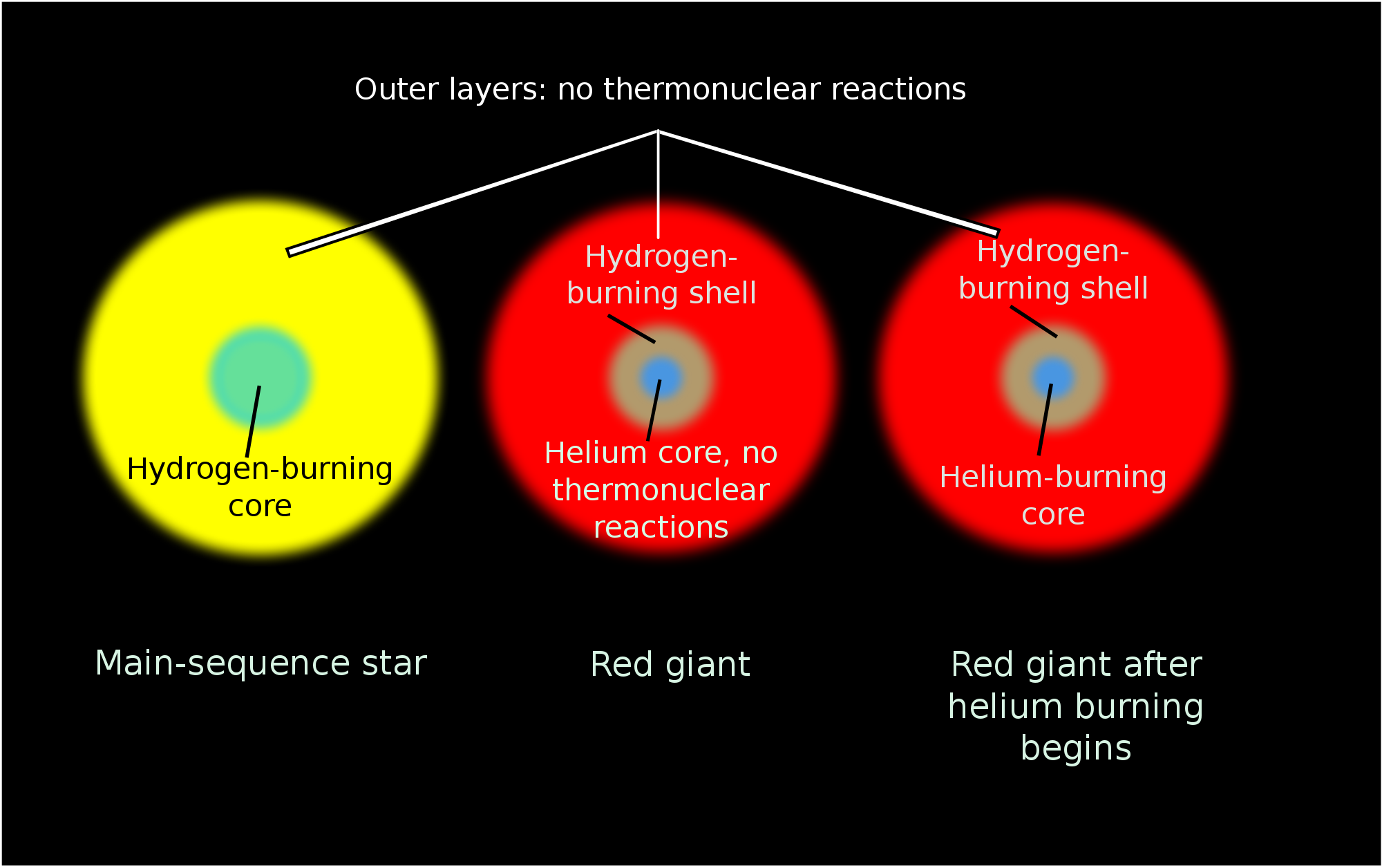
During the red giant phase of stellar evolution in stars with less than 2.0 M☉, the nuclear fusion of hydrogen ceases in the core as it is depleted, leaving a helium-rich core. Hydrogen fusion continues in a shell surrounding the core, which causes continued accumulation of helium in the core. This makes the core denser, but its temperature is still unable to reach the level required for helium fusion, as happens in more massive stars. Thus the thermal pressure from fusion is no longer sufficient to counter gravitational pressure and achieve the hydrostatic equilibrium found in most stars. This causes the star to start contracting and increasing in temperature until it eventually becomes compressed enough for the helium core to become degenerate matter. This degeneracy pressure is finally sufficient to stop further collapse of the most central material but the rest of the core continues to contract and the temperature continues to rise until it reaches ≈1×10⁸ K, at which point the helium can ignite and start to fuse.
The explosive nature of the helium flash arises from its taking place in degenerate matter. Once the temperature reaches 100–200 million kelvins and helium fusion begins using the triple-alpha process, the temperature rapidly increases, further raising the helium fusion rate and, because degenerate matter is a good conductor of heat, widening the reaction region. However, since degeneracy pressure (which is purely a function of density) is dominating thermal pressure (proportional to the product of density and temperature), the total pressure is only weakly dependent on temperature. Thus, the dramatic increase in temperature only causes a slight increase in pressure, so there is no stabilizing cooling expansion of the core.
This runaway reaction quickly climbs to about 100 billion times the star's normal energy production (for a few seconds) until the temperature increases to the point that thermal pressure again becomes dominant, eliminating the degeneracy. The core can then expand and cool down and a stable burning of helium will continue.
Hub AI
Helium flash AI simulator
(@Helium flash_simulator)
Helium flash
A helium flash is a very brief thermal runaway nuclear fusion of large quantities of helium into carbon through the triple-alpha process in the core of low-mass stars (between 0.8 solar masses (M☉) and 2.0 M☉) during their red giant phase. The Sun is predicted to experience a flash 1.2 billion years after it leaves the main sequence. A much rarer runaway helium fusion process can also occur on the surface of accreting white dwarf stars.
Low-mass stars do not produce enough gravitational pressure to initiate normal helium fusion. As the hydrogen in the core is exhausted, some of the helium left behind is instead compacted into degenerate matter, supported against gravitational collapse by quantum mechanical pressure rather than thermal pressure. Subsequent hydrogen shell fusion further increases the mass of the core until it reaches temperature of approximately 100 million kelvins, which is hot enough to initiate helium fusion (or "helium burning") in the core.
However, a property of degenerate matter is that increases in temperature do not produce an increase in the pressure of the matter until the thermal pressure becomes so very high that it exceeds degeneracy pressure. In main-sequence stars, thermal expansion regulates the core temperature, but in degenerate cores, this does not occur. Helium fusion increases the temperature, which increases the fusion rate, which further increases the temperature in a runaway reaction, which quickly spans the entire core. This produces a flash of very intense helium fusion that lasts only a few minutes, but during that time, produces energy at a rate comparable to the entire Milky Way galaxy.
In the case of normal low-mass stars, the vast energy release causes much of the core to come out of degeneracy, allowing it to thermally expand. This consumes most of the total energy released by the helium flash, and any left-over energy is absorbed into the star's upper layers. Thus the helium flash is mostly undetectable by observation and is described solely by astrophysical models. After the core's expansion and cooling, the star's surface rapidly cools and contracts in as little as 10,000 years until it is roughly 2% of its former radius and luminosity. It is estimated that the electron-degenerate helium core weighs about 40% of the star mass and that 6% of the core is converted into carbon.
Subflashes are pulsational instabilities that occur after the main helium flash. They are driven by stars that do not have good convective or radiative boundaries. Subflashes can last several hours to days and can occur for many years with each subsequent flash generally being weaker. Subflashes can be detected by applying fourier transforms to the light curve data.
During the red giant phase of stellar evolution in stars with less than 2.0 M☉, the nuclear fusion of hydrogen ceases in the core as it is depleted, leaving a helium-rich core. Hydrogen fusion continues in a shell surrounding the core, which causes continued accumulation of helium in the core. This makes the core denser, but its temperature is still unable to reach the level required for helium fusion, as happens in more massive stars. Thus the thermal pressure from fusion is no longer sufficient to counter gravitational pressure and achieve the hydrostatic equilibrium found in most stars. This causes the star to start contracting and increasing in temperature until it eventually becomes compressed enough for the helium core to become degenerate matter. This degeneracy pressure is finally sufficient to stop further collapse of the most central material but the rest of the core continues to contract and the temperature continues to rise until it reaches ≈1×10⁸ K, at which point the helium can ignite and start to fuse.
The explosive nature of the helium flash arises from its taking place in degenerate matter. Once the temperature reaches 100–200 million kelvins and helium fusion begins using the triple-alpha process, the temperature rapidly increases, further raising the helium fusion rate and, because degenerate matter is a good conductor of heat, widening the reaction region. However, since degeneracy pressure (which is purely a function of density) is dominating thermal pressure (proportional to the product of density and temperature), the total pressure is only weakly dependent on temperature. Thus, the dramatic increase in temperature only causes a slight increase in pressure, so there is no stabilizing cooling expansion of the core.
This runaway reaction quickly climbs to about 100 billion times the star's normal energy production (for a few seconds) until the temperature increases to the point that thermal pressure again becomes dominant, eliminating the degeneracy. The core can then expand and cool down and a stable burning of helium will continue.