
Recent from talks
Helmholtz decomposition
Knowledge base stats:
Talk channels stats:
Members stats:
Helmholtz decomposition
In physics and mathematics, the Helmholtz decomposition theorem or the fundamental theorem of vector calculus states that certain differentiable vector fields can be resolved into the sum of an irrotational (curl-free) vector field and a solenoidal (divergence-free) vector field. In physics, often only the decomposition of sufficiently smooth, rapidly decaying vector fields in three dimensions is discussed. It is named after Hermann von Helmholtz.
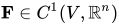
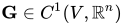
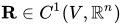
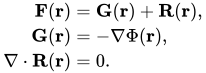
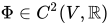
For a vector field defined on a domain , a Helmholtz decomposition is a pair of vector fields and such that: Here, is a scalar potential, is its gradient, and is the divergence of the vector field . The irrotational vector field is called a gradient field and is called a solenoidal field or rotation field. This decomposition does not exist for all vector fields and is not unique.



The Helmholtz decomposition in three dimensions was first described in 1849 by George Gabriel Stokes for a theory of diffraction. Hermann von Helmholtz published his paper on some hydrodynamic basic equations in 1858, which was part of his research on the Helmholtz's theorems describing the motion of fluid in the vicinity of vortex lines. Their derivation required the vector fields to decay sufficiently fast at infinity. Later, this condition could be relaxed, and the Helmholtz decomposition could be extended to higher dimensions. For Riemannian manifolds, the Helmholtz-Hodge decomposition using differential geometry and tensor calculus was derived.
The decomposition has become an important tool for many problems in theoretical physics, but has also found applications in animation, computer vision as well as robotics.
Many physics textbooks restrict the Helmholtz decomposition to the three-dimensional space and limit its application to vector fields that decay sufficiently fast at infinity or to bump functions that are defined on a bounded domain. Then, a vector potential can be defined, such that the rotation field is given by , using the curl of a vector field.


Let be a vector field on a bounded domain , which is twice continuously differentiable inside , and let be the surface that encloses the domain with outward surface normal . Then can be decomposed into a curl-free component and a divergence-free component as follows:


where

![{\displaystyle {\begin{aligned}\Phi (\mathbf {r} )&={\frac {1}{4\pi }}\int _{V}{\frac {\nabla '\cdot \mathbf {F} (\mathbf {r} ')}{|\mathbf {r} -\mathbf {r} '|}}\,\mathrm {d} V'-{\frac {1}{4\pi }}\oint _{S}\mathbf {\hat {n}} '\cdot {\frac {\mathbf {F} (\mathbf {r} ')}{|\mathbf {r} -\mathbf {r} '|}}\,\mathrm {d} S'\\[8pt]\mathbf {A} (\mathbf {r} )&={\frac {1}{4\pi }}\int _{V}{\frac {\nabla '\times \mathbf {F} (\mathbf {r} ')}{|\mathbf {r} -\mathbf {r} '|}}\,\mathrm {d} V'-{\frac {1}{4\pi }}\oint _{S}\mathbf {\hat {n}} '\times {\frac {\mathbf {F} (\mathbf {r} ')}{|\mathbf {r} -\mathbf {r} '|}}\,\mathrm {d} S'\end{aligned}}}](https://wikimedia.org/api/rest_v1/media/math/render/svg/eac70ccfda5b216df7e6fa4c0b885fca40b60768)
and is the nabla operator with respect to , not .


Hub AI
Helmholtz decomposition AI simulator
(@Helmholtz decomposition_simulator)
Helmholtz decomposition
In physics and mathematics, the Helmholtz decomposition theorem or the fundamental theorem of vector calculus states that certain differentiable vector fields can be resolved into the sum of an irrotational (curl-free) vector field and a solenoidal (divergence-free) vector field. In physics, often only the decomposition of sufficiently smooth, rapidly decaying vector fields in three dimensions is discussed. It is named after Hermann von Helmholtz.
For a vector field defined on a domain , a Helmholtz decomposition is a pair of vector fields and such that: Here, is a scalar potential, is its gradient, and is the divergence of the vector field . The irrotational vector field is called a gradient field and is called a solenoidal field or rotation field. This decomposition does not exist for all vector fields and is not unique.
The Helmholtz decomposition in three dimensions was first described in 1849 by George Gabriel Stokes for a theory of diffraction. Hermann von Helmholtz published his paper on some hydrodynamic basic equations in 1858, which was part of his research on the Helmholtz's theorems describing the motion of fluid in the vicinity of vortex lines. Their derivation required the vector fields to decay sufficiently fast at infinity. Later, this condition could be relaxed, and the Helmholtz decomposition could be extended to higher dimensions. For Riemannian manifolds, the Helmholtz-Hodge decomposition using differential geometry and tensor calculus was derived.
The decomposition has become an important tool for many problems in theoretical physics, but has also found applications in animation, computer vision as well as robotics.
Many physics textbooks restrict the Helmholtz decomposition to the three-dimensional space and limit its application to vector fields that decay sufficiently fast at infinity or to bump functions that are defined on a bounded domain. Then, a vector potential can be defined, such that the rotation field is given by , using the curl of a vector field.
Let be a vector field on a bounded domain , which is twice continuously differentiable inside , and let be the surface that encloses the domain with outward surface normal . Then can be decomposed into a curl-free component and a divergence-free component as follows:
where
and is the nabla operator with respect to , not .