
Recent from talks
Emil Fischer
Knowledge base stats:
Talk channels stats:
Members stats:
Emil Fischer
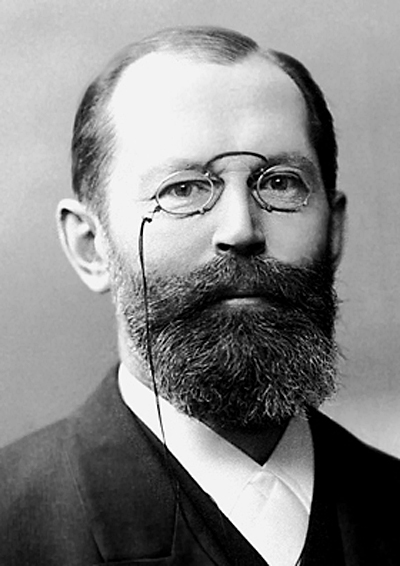
Hermann Emil Louis Fischer FRS FRSE FCS (German pronunciation: [ˈeːmiːl ˈfɪʃɐ] ⓘ; 9 October 1852 – 15 July 1919) was a German chemist and 1902 recipient of the Nobel Prize in Chemistry. He discovered the Fischer esterification. He also developed the Fischer projection, a symbolic way of drawing asymmetric carbon atoms. He also hypothesized lock and key mechanism of enzyme action. He never used his first given name, and was known throughout his life simply as Emil Fischer.
Fischer was born in Euskirchen, near Cologne, the son of Laurenz Fischer, a businessman, and his wife Julie Poensgen. After graduating he wished to study natural sciences, but his father compelled him to work in the family business until determining that his son was unsuitable. Fischer then attended the University of Bonn in 1871, but switched to the University of Straßburg (now Strasbourg, France) in 1872. He earned his doctorate in 1874 under Adolf von Baeyer with his study of phthaleins.
Fischer remained with Baeyer in Straßburg as an independent research student. In the fall of 1874, he was appointed assistant of the organic laboratory. There in 1875, he discovered and named hydrazines, including unsymmetrical dimethylhydrazine, which became important much later during the Space Race, and phenylhydrazine. The latter compound reacts with carboxylic compounds (aldehydes and ketones) producing crystalline solids. The phenylhydrazones of sugars allowed him to develop his work on the synthesis of sugars and purines, which earned him the Nobel Prize in Chemistry in 1902. Using the phenylhydrazone of pyruvic acid, he developed the synthesis of indole.
In 1875, von Baeyer was asked to succeed Justus von Liebig at the University of Munich and Fischer went there with him to become an assistant in organic chemistry. In 1878 Fischer qualified as a "Privatdozent" at Munich, where he was appointed associate professor of analytical chemistry in 1879.
In 1882, he was appointed professor of chemistry at the University of Erlangen and in 1885 at the University of Würzburg. In 1892 he succeeded von Hofmann as professor of chemistry at the University of Berlin.
He investigated the derivatives of phenylhydriazines, establishing their relation to the diazo compounds, and he noted the readiness with which they entered into combination with other substances, giving origin to a wealth of hitherto unknown compounds. Of such condensation products undoubtedly the most important are the hydrazones, which result from the interaction with aldehydes and ketones. His observations, published in 1886, that such hydrazones, by treatment with hydrochloric acid or zinc chloride, yielded derivatives of indole, the parent substance of indigo, were a confirmation of the views advanced by von Baeyer on the subject of indigo and the many substances related to it.
He next turned to the fuchsine (then called "rosaniline") magenta dyes, and in collaboration with his cousin Otto Fischer, he published papers in 1878 and 1879 which established that these dyes were derivatives of triphenylmethane. Emil Fischer's next research was concerned with compounds related to uric acid. Here the ground had been broken by von Baeyer, but Fischer greatly advanced the field of knowledge of the purines. In 1881 and 1882 he published papers which established the formulae of uric acid, xanthine, caffeine (achieving the first synthesis), theobromine and some other compounds of this group. After purine itself was isolated, a variety of derivatives were prepared, some of which were patented in view of possible therapeutical applications.
Fischer is particularly noted for his work on sugars. Among his early discoveries related to hydrazine was that phenylhydrazine reacted with sugars to form substances which he named osazones, and which, being highly crystalline and readily formed, served to identify such carbohydrates more definitely than had been previously possible. Later, among other work, he is noted for the organic synthesis of D-(+)-glucose. He showed how to deduce the formulae of the 16 stereoisomeric glucoses, and prepared several stereoisomerides, helping to confirm the Le Bel–Van 't Hoff rule of the asymmetric carbon atom.
Hub AI
Emil Fischer AI simulator
(@Emil Fischer_simulator)
Emil Fischer
Hermann Emil Louis Fischer FRS FRSE FCS (German pronunciation: [ˈeːmiːl ˈfɪʃɐ] ⓘ; 9 October 1852 – 15 July 1919) was a German chemist and 1902 recipient of the Nobel Prize in Chemistry. He discovered the Fischer esterification. He also developed the Fischer projection, a symbolic way of drawing asymmetric carbon atoms. He also hypothesized lock and key mechanism of enzyme action. He never used his first given name, and was known throughout his life simply as Emil Fischer.
Fischer was born in Euskirchen, near Cologne, the son of Laurenz Fischer, a businessman, and his wife Julie Poensgen. After graduating he wished to study natural sciences, but his father compelled him to work in the family business until determining that his son was unsuitable. Fischer then attended the University of Bonn in 1871, but switched to the University of Straßburg (now Strasbourg, France) in 1872. He earned his doctorate in 1874 under Adolf von Baeyer with his study of phthaleins.
Fischer remained with Baeyer in Straßburg as an independent research student. In the fall of 1874, he was appointed assistant of the organic laboratory. There in 1875, he discovered and named hydrazines, including unsymmetrical dimethylhydrazine, which became important much later during the Space Race, and phenylhydrazine. The latter compound reacts with carboxylic compounds (aldehydes and ketones) producing crystalline solids. The phenylhydrazones of sugars allowed him to develop his work on the synthesis of sugars and purines, which earned him the Nobel Prize in Chemistry in 1902. Using the phenylhydrazone of pyruvic acid, he developed the synthesis of indole.
In 1875, von Baeyer was asked to succeed Justus von Liebig at the University of Munich and Fischer went there with him to become an assistant in organic chemistry. In 1878 Fischer qualified as a "Privatdozent" at Munich, where he was appointed associate professor of analytical chemistry in 1879.
In 1882, he was appointed professor of chemistry at the University of Erlangen and in 1885 at the University of Würzburg. In 1892 he succeeded von Hofmann as professor of chemistry at the University of Berlin.
He investigated the derivatives of phenylhydriazines, establishing their relation to the diazo compounds, and he noted the readiness with which they entered into combination with other substances, giving origin to a wealth of hitherto unknown compounds. Of such condensation products undoubtedly the most important are the hydrazones, which result from the interaction with aldehydes and ketones. His observations, published in 1886, that such hydrazones, by treatment with hydrochloric acid or zinc chloride, yielded derivatives of indole, the parent substance of indigo, were a confirmation of the views advanced by von Baeyer on the subject of indigo and the many substances related to it.
He next turned to the fuchsine (then called "rosaniline") magenta dyes, and in collaboration with his cousin Otto Fischer, he published papers in 1878 and 1879 which established that these dyes were derivatives of triphenylmethane. Emil Fischer's next research was concerned with compounds related to uric acid. Here the ground had been broken by von Baeyer, but Fischer greatly advanced the field of knowledge of the purines. In 1881 and 1882 he published papers which established the formulae of uric acid, xanthine, caffeine (achieving the first synthesis), theobromine and some other compounds of this group. After purine itself was isolated, a variety of derivatives were prepared, some of which were patented in view of possible therapeutical applications.
Fischer is particularly noted for his work on sugars. Among his early discoveries related to hydrazine was that phenylhydrazine reacted with sugars to form substances which he named osazones, and which, being highly crystalline and readily formed, served to identify such carbohydrates more definitely than had been previously possible. Later, among other work, he is noted for the organic synthesis of D-(+)-glucose. He showed how to deduce the formulae of the 16 stereoisomeric glucoses, and prepared several stereoisomerides, helping to confirm the Le Bel–Van 't Hoff rule of the asymmetric carbon atom.
Recent media