Hubbry Logo
Hiatt speedcuffsHiatt speedcuffsMain
Open search
Hiatt speedcuffs
Community hub
Hiatt speedcuffs
logo
8 pages, 0 posts
0 subscribers
Be the first to start a discussion here.
Contribute something
Hiatt speedcuffs
Hiatt speedcuffs
from Wikipedia
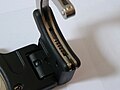
Hiatt speedcuffs in a design of holster
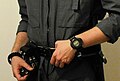
Handcuffed hands in speedcuffs

Speedcuffs are a model of handcuff characterised by their rigid grip between the two ratchet cuffs. Their rigid design and the inclusion of a grip makes them effective for gaining control over a struggling prisoner, even if only one cuff has been applied.[1][2] They are standard issue for most police forces within the United Kingdom and the State Police of Western Australia.

Construction

[edit]

Speedcuffs consist of two conventional ratchet handcuffs connected by a rigid metal bar, which is enclosed in a plastic grip secured with bolts. Removal of the grip offers no advantage to escape, as it is only present to facilitate the comfortable manipulation of the cuffs by the arresting officer. Weighing 390 g (13.75 oz) and with a maximum dilation of 23.2 cm (9.13 inches),[3] the speedcuffs are slightly larger than the chain-linked and hinged handcuffs previously manufactured by Hiatts, and accommodate a greater range of wrist sizes. They feature Hiatt's 'back loading' feature, which allows the ratchet to be pulled backwards for a few "clicks" through the lock casing to set the cuffs in the ideal position for quick application. The locks accept a standard handcuff key, and have a double locking facility which is activated through a small pin on the back of the cuff. The double locking facility must be depressed with a pointed object, such as the protrusion found on the top of the handcuff key; double locking prevents accidentally or knowingly tightening the cuff once it has been locked, helping to prevent paralysis or other injury.[3]

Application

[edit]
Speedcuffs

The mechanism of speedcuff application is the same as other modern "swing through" handcuffs. By pressing the pivoted arm of the cuff against the wrist, the arm can be made to swing around the wrist and engage with the lock. The officer may then tighten the cuff to an appropriate position before applying the other cuff, engaging the double locking system to prevent the handcuffs tightening further.

Owing to the rigid design, speedcuffs can be applied in one of four different positions, which also apply to hinged handcuffs but not chain-linked. In British police training, these positions are termed 'front stack', 'rear stack', 'palm to palm', and 'back to back'. Many forces teach two positions to their officers, but some teach all four.

The 'stacked' positions are those where, once applied (assuming a standing prisoner), the handcuffs are vertical and the wrists pass through the cuffs in opposite directions, resulting in one hand on each side of the handcuffs.

'Palm to palm' is the position that results when the handcuffs are applied in front of the body, with the palms of the hands facing each other. This is generally considered to be inferior in terms of security to a front stack, in which position it is extremely difficult for a prisoner to attempt to strike any person with their hands.

'Back to back' is the position that results when the handcuffs are applied with the hands behind the body, with the backs of the hands facing each other.

Rear 'palm to palm' and front 'back to back' are possible, but seldom used as 'back to back' is more secure in the rear, and 'palm to palm' is more comfortable in the front.

When these handcuffs are applied in a 'non stack' position, it is more secure for the keyholes to be on the opposite side of the hands so that the prisoner cannot reach the keyhole if he/she were to have a handcuff key.

In a confrontational situation, although the ultimate intention may be to apply the handcuffs to the rear in the back-to-back position, officers are often forced to settle for the first position in which they can get both of the suspect's wrists.[4]

Media

[edit]

These photos show how these handcuffs are used.

Hiatt folding handcuffs

[edit]

While conventional rigid handcuffs have traditionally been advantageous when the arresting officer has to try to keep the suspect under control, there has been increasing complaint from officers that such cuffs are bulky and inconvenient to carry. Hiatt developed a handcuff known as 'Rigid Folding Handcuffs' which work on the basis that they 'click' into place, staying rigid. It can be folded up, so they can be put on a belt or in a pocket. In the UK, undercover police have been known to use these covertly.[citation needed] They are roughly one and a half times the price of normal handcuffs.

After Hiatt ceased its business, its successor Total Control Handcuffs (TCH) continued to produce this model as the TCH 850 Folding Rigid Handcuffs.

References

[edit]
Revisions and contributorsEdit on WikipediaRead on Wikipedia
from Grokipedia
Hiatt Speedcuffs are a model of rigid produced by the British manufacturer Hiatt & Company, characterized by a solid connecting the two ratchet cuffs, which provides superior control and security during arrests. Designed for rapid deployment, they incorporate backloading capabilities and an 18-tooth, three-retaining-bar ratchet system for reliable locking. Established in Birmingham, , in 1780, Hiatt & Company has a long history of producing restraints, initially supplying and chains to various global markets. The Speedcuffs model, introduced as a modern rigid variant, emerged in the late to meet the needs of contemporary policing, building on Hiatt's legacy of durable steel construction. These are widely used by police forces in the , where they serve as standard issue equipment due to their enhanced manipulation of detainees and resistance to tampering. Available in nickel-plated (Model 2103) or finishes (Model 2105), they feature double-locking mechanisms to prevent constriction and reinforced swivels for added strength, making them suitable for high-risk scenarios. Hiatt Speedcuffs have also gained adoption in the United States and other countries through the Group, which acquired the brand around 2007 and reintroduced it to American markets in 2023.

History

Company Origins

Hiatt & Company was founded in 1780 in Birmingham, , initially as a manufacturer of prisoners' handcuffs, felons' leg irons, and gang chains for the trade. The company, established by a Mr. Hiatt, quickly gained prominence in the restraint industry during its early years. In its formative decades, Hiatt & Company played a significant role in supplying restraints for the transatlantic slave trade, providing steel collars, , and chains to traders well into the . Following the abolition of the slave trade in the in 1807 and its full enforcement by the 1830s, the company transitioned toward products for modern after the 1850s, coinciding with the expansion of organized policing in Britain. By the , Hiatt had established itself as a leading British manufacturer of police , developing a longstanding relationship with the London and other forces. The marked a period of expansion for Hiatt & Company, with the introduction of influential models such as the Hiatt Darby , which originated in the late and remained in use before the , and the Peerless model in the , Hiatt's first "swing-through" design issued to British police services. In July 2006, the company was acquired by , which was itself acquired by in 2007; this led to the closure of the facility in Birmingham in 2008, resulting in temporary shortages of Hiatt for British police forces as relocated abroad.

Development of Speedcuffs

The development of Speedcuffs occurred in the early amid Hiatt & Company's expansion into rigid handcuff technology, following the Quik-Cuffs that pioneered key elements of the rigid structure. This innovation built upon Hiatt's over two-century legacy in restraint production, adapting traditional designs to modern demands. In 1995, Hiatt launched the Speedcuffs as Model 2103, specifically engineered for rapid application in high-risk arrests, with a rigid bar providing superior control over resisting individuals. The design incorporated a grip-integrated bar to facilitate secure handling and resistance management, driven by police feedback highlighting the need for swift deployment in dynamic scenarios. Iterative enhancements followed, including the Model 2105 variant with a finish introduced for enhanced low-visibility operations in tactical environments. After ' acquisition of Hiatt in 2006 (with Armor integrated into in 2007), production shifted to the in 2008, with adaptations to comply with American manufacturing standards such as NIJ certification for durability and performance. In recent years, as of 2023, the Group reintroduced the Hiatt brand to the U.S. market, continuing production of Speedcuffs and other models.

Design and Construction

Materials and Components

Hiatt speedcuffs, specifically models 2103 and 2105, are constructed primarily from heavy-duty for both the cuffs and the rigid connecting bar, ensuring structural integrity under stress. The model 2103 features a finish for enhanced resistance, while the model 2105 uses a finish to provide similar protection alongside a low-visibility tactical appearance. The core components include two ratchet-style cuffs equipped with a back-loading mechanism for efficient application, connected by a non-folding rigid metal bar with an ergonomic grip for secure handling. Each integrates a double-lock pin to prevent tampering or tightening once applied. The assembly utilizes standard keyways designed for compatibility with universal handcuff keys. The total weight of the assembled unit is 390 grams, balancing robustness with portability. These materials and components contribute to the speedcuffs' ability to withstand high-tension struggles without deformation, thanks to reinforced swivels and the overall heavy-duty framework.

Key Features and Specifications

The Hiatt speedcuffs employ a rigid bar design that links two ratchet handcuff mechanisms via a solid metal bar encased in an ergonomic grip, delivering enhanced leverage and control for restraining individuals by significantly limiting articulation and rotation. This non-folding rigidity contrasts with the flexibility of traditional chain-link , promoting greater stability during application and transport, while the grip facilitates one-handed operation and subject control, even on resistant individuals with only one cuff applied. The locking system features double-locking via a dedicated pin mechanism, which prevents over-tightening to avoid and resists tampering attempts, complemented by a back-loading capability that enables rapid cuffing in high-movement scenarios by allowing the ratchet to engage from the rear position. Incorporating an 18-tooth configuration across three independent retaining bars, the system offers 25 precise locking positions for a secure and adjustable fit, with a balanced swing arm ensuring consistent centering on the . Reinforced swivels bolster overall durability. In terms of specifications, the speedcuffs weigh 14 ounces (390 grams), and demonstrate compatibility with standard holsters for swift deployment and storage. The design complies with NIJ Standard 0307.01 for reliable performance in demanding operational environments. These innovations, built on heavy-duty construction, emphasize functional reliability over flexibility.

Usage and Application

Application Techniques

The application of Hiatt speedcuffs typically begins with the positioning themselves behind the subject for and control. One is first applied to the subject's using a swing-through motion, akin to chain-linked , where the is swung open and snapped shut around the while maintaining on pressure-sensitive areas for compliance. The rigid connecting bar, equipped with an ergonomic grip, then allows the to leverage the partially restrained to guide the second into position, enabling secure double-locking without releasing control. This method benefits from the cuffs' backloading , which facilitates rapid engagement even in dynamic scenarios. Hiatt speedcuffs can be applied in four primary positions, each selected based on the level of restraint required and the subject's compliance. In the front stack position, the subject's hands are placed forward with wrists stacked vertically, palms facing outward; this allows limited mobility for or needs while maintaining officer safety. The rear stack position involves hands behind the back in a similar stacked alignment, providing greater restriction for non-compliant subjects. For the palm-to-palm position, wrists are positioned with palms facing inward (typically in front), which is less restrictive and used for cooperative individuals to minimize discomfort. The back-to-back position, with palms facing outward behind the back, offers the highest security for high-risk , as it limits wrist rotation and enhances overall immobilization. Tactically, speedcuffs excel in scenarios, where securing a single to one establishes initial control over a resisting subject; the rigid bar then functions as a to apply techniques or integrate with other restraints, such as leg irons, for full-body immobilization. This one-cuff approach is particularly effective in close-quarters encounters, allowing officers to maintain dominance before completing the restraint. For rapid deployment, Hiatt speedcuffs are stored in specialized belt-mounted pouches or holsters designed for quick-draw access, enabling officers to retrieve and apply them in seconds during high-stress responses. The rigid bar's , referenced briefly, supports this speed by preventing tangling and allowing one-handed manipulation in the holster.

Training Protocols

Training for the use of Hiatt speedcuffs is mandatory for police officers authorized to carry restraints, forming a core component of the National Personal Safety Training programme administered by the (NPCC). This training, outlined in Module 8 of the NPCC Personal Safety Manual, emphasizes lawful, reasonable, and proportionate application under powers such as Section 3 of the and Section 117 of the Police and Criminal Evidence Act 1984. Officers undergo initial instruction during probationary training, with practical sessions simulating resistant arrests, including scenarios involving ground pins and non-compliant subjects to build proficiency in control techniques. Policies vary slightly by police force, but all align with NPCC standards; for instance, some forces prioritize the rear back-to-back position as the default for secure restraint during high-risk encounters. Key training elements include double-locking procedures immediately after application to prevent inadvertent tightening and potential , such as handcuff neuropathy from over-compression. Instruction also covers keyhole positioning to ensure accessibility and subject safety during application and removal, with emphasis on checking cuff tightness through visual, verbal, and physical assessments. is integrated via the National Decision Model (formerly Conflict Management Model), requiring officers to consider alternatives before resorting to restraints and to use tactical communication to guide compliant positioning. Certification involves successful demonstration of techniques, including standing and prone removal to mitigate risks, with annual refresher courses mandated to maintain competency and incorporate updates to NPCC guidelines on minimizing force. Specialized units, such as firearms teams, receive adaptations focusing on rapid deployment in dynamic environments while adhering to the same core safety protocols. For application positions like front stack or rear stack, training reinforces mechanical best practices without overriding institutional policy. Internationally, following Safariland's acquisition of Hiatt, speedcuffs training has aligned with Peace Officer Standards and Training (POST) requirements through Safariland's certified programmes, such as the Defensive Tactics (Handcuffing) , which emphasizes similar control and safety principles for agencies adopting the restraints.

Variants and Models

Folding Handcuffs

The Hiatt Rigid Folding , introduced prior to , feature a unique design that allows the cuffs to fold compactly at the central bar joint for easy pocket carry, enabling officers to deploy them quickly by snapping or "clicking" the structure into a rigid position for secure restraint. This folding mechanism incorporates a hinged bar that maintains flexibility in storage mode while locking firmly during use, providing the control benefits of standard rigid cuffs without the bulk. Key features include double-locking mechanisms for added , triple ratchet bars with 25 locking positions for precise adjustment. Weighing about 455 grams when folded, these offer a 17% larger internal for comfort and are constructed from high-strength nickel-plated steel for durability. Primarily intended for covert applications, the folding design facilitates discreet storage and rapid deployment, making it particularly suitable for undercover officers who require low-profile equipment without compromising restraint effectiveness. Originally produced by Hiatt & Company as the UL1 model, the folding handcuffs were discontinued following the company's acquisition but were revived and continued under Total Control Handcuffs (TCH) as the TCH 850 model, with maintaining production rights for certain variants.

Other Hiatt Rigid Cuffs

Hiatt's Ultimate Handcuffs, such as the Model UL-5, serve as a heavy-duty hinged variant that snaps into a rigid configuration upon use, incorporating an 18-tooth locking system with three independent retaining bars—each with six teeth—for superior tamper resistance and security in high-risk detainee situations. Constructed from robust , these cuffs weigh approximately 16 ounces and include a double-locking mechanism to prevent over-tightening, distinguishing them as a fortified option for scenarios demanding heightened durability over standard chain or basic rigid designs. Following Safariland's acquisition of Hiatt in , the company adapted and reintroduced several rigid models under the Hiatt brand to align with international standards. Notable examples include the 2103H and 2105H non-folding rigid , which feature a solid for direct cuff linkage, an 18-tooth ratchet with three-retaining-bar system, and built-in backloading for rapid application, emphasizing reliability in professional restraint operations. These post-acquisition iterations maintain Hiatt's legacy of heavy-duty construction while incorporating reinforced swivels to withstand rigorous use, available in nickel or black finishes to enhance corrosion resistance in varied environmental conditions. Finish options, such as the coating on models like the 2105H, provide additional protection against and wear, catering to operational needs in humid or outdoor settings without compromising the core rigid integrity. Unlike folding variants optimized for compact storage, these non-folding rigid cuffs prioritize unwavering structural stability for standard duty applications.

Adoption and Impact

Use in the United Kingdom

Hiatt speedcuffs were adopted as the primary handcuff model by most police forces starting in the early , replacing earlier chain-link designs with their rigid bar for enhanced control and quicker application. This shift made them standard issue across the majority of the 43 territorial police forces in , as well as in and , due to their compliance with national standards for restraint equipment. In operational contexts, speedcuffs are routinely employed for arrests, during public order situations, and secure , where the rigid structure allows officers to maintain leverage over non-compliant individuals. Their design facilitates one-handed application in dynamic scenarios, reducing the risk of injury to officers. The 2008 closure of the Hiatt manufacturing facility in Birmingham led to a temporary nationwide , underscoring the UK's heavy reliance on these cuffs and prompting emergency procurement from alternative suppliers. Speedcuffs align with guidance on the , which emphasizes lawful, necessary, and proportionate restraint techniques, and are the approved model in policies such as those of the Metropolitan Police Service for high-volume urban operations. By the , they had become standard equipment for the vast majority of frontline officers, with the rigid bar credited for minimizing escape attempts compared to flexible alternatives by limiting wrist mobility and enhancing positional control.

International Adoption

Following the acquisition of Hiatt & Company by Armor Holdings in 2006 and its subsequent integration into the Safariland Group, the Hiatt speedcuffs were reintroduced to the United States market, gaining adoption among select law enforcement agencies for their rigid design and enhanced control features. These handcuffs comply with the National Institute of Justice (NIJ) Standard 0307.01 for handcuff performance, ensuring they meet requirements for strength, durability, and resistance to tampering. In one notable instance, the Los Angeles County Sheriff's Department trialed Hiatt steel handcuffs, including rigid variants, but recalled them in 2003 due to concerns over potential injury risks from their engineering. Beyond , Hiatt speedcuffs and related rigid restraints have seen limited but documented use in international detention contexts, such as at the Guantanamo Bay facility during the early , where British-made Hiatt products were employed for securing detainees. The rigid handcuff design pioneered by Hiatt has influenced global equipment, with exports supporting adoption in various agencies across , , and , though often alongside local preferences for chain or hinged models. The 2008 closure of Hiatt's Birmingham factory, which relocated production to the United States under , led to temporary global supply disruptions for speedcuffs and other models, exacerbating shortages for international users reliant on the as the primary manufacturing hub. This transition prompted some markets to seek alternatives, such as the TCH rigid handcuffs, while maintaining Hiatt's legacy in export-oriented adaptations for compliance with regional standards.

Controversies and Safety

Reported Injuries

A pilot study conducted in 1998 examined medical complications from the use of rigid handcuffs on 41 detainees at a Metropolitan Police station over a seven-month period. The study found that nearly all participants exhibited detectable wrist injuries, primarily minor bruising that required no specific treatment, though it highlighted the potential for such restraints to cause superficial trauma due to their rigid structure. No cases of nerve damage were specifically reported in this cohort, but the research emphasized the need for further investigation into rigid versus chain-linked handcuffs to assess comparative risks. In 2003, the recalled over 1,000 pairs of Hiatt Model 2010 rigid due to engineering flaws, including sharper internal edges that posed risks of cutting and causing bleeding. This action followed investigations into complaints, such as a 2001 excessive force case where a detainee suffered lacerations from the cuffs being applied too tightly. The department replaced them with alternative brands like Peerless and , citing the Hiatt model's design as unsuitable for preventing injuries despite standard double-locking features. Risk factors for injuries with Hiatt speedcuffs often involve application on struggling subjects, where the rigid bar can create if only one cuff is secured, potentially exacerbating bruising or compression. In the UK, the Police Complaints Authority investigated 1,048 cases of alleged improper handcuff use in 2000/01, many involving rigid models like speedcuffs not being double-locked, leading to complaints of wrist bruising and redness from over-tightening during resistance. Such incidents underscore the challenges of techniques, which demand precise control to avoid undue on wrists. Post-2000s refinements to speedcuff designs, including smoother edges on later models, aimed to mitigate cutting risks identified in earlier complaints, though empirical on reduced rates remains limited. Double-locking mechanisms continue to be emphasized in to prevent inadvertent tightening, particularly when applying cuffs to non-compliant individuals. The use of Hiatt speedcuffs in the must comply with the , particularly Article 3, which prohibits and inhuman or degrading treatment. As a form of force, handcuffing requires officers to ensure the application is lawful, necessary, and proportionate under Section 117 of the Police and Criminal Evidence Act 1984 and Section 3 of the , with routine or unjustified use deemed unlawful and potentially constituting . In the , concerns arose following a 2003 voluntary recall of Hiatt steel by the Los Angeles County Sheriff's Department due to reports of potential injuries from their , prompting over excessive force claims in arrests. Subsequent lawsuits have alleged excessive force from overly tight application of similar rigid cuffs, as seen in a 2001 UK case where an officer received £108,137 in damages for nerve damage caused by rigid during ; Hiatt speedcuffs were the standard issue at the time and likely used. Ethical debates surrounding Hiatt speedcuffs often highlight the company's historical involvement in the transatlantic slave trade, where it manufactured and supplied , leg irons, gang chains, and collars to traders from the late into the , even after Britain's abolition of the trade. This legacy has raised questions about the moral implications of continuing to use products from a firm tied to enslavement and colonial oppression, with critics arguing it perpetuates a history of racialized in modern policing. Additionally, advocates have called for softer restraint alternatives, such as padded or adjustable cuffs, in non-violent arrests to minimize harm, citing reports on how rigid designs like speedcuffs can exacerbate pain and injury without adequate training. Policy responses in the UK include guidelines from the Association of Chief Police Officers (ACPO), now incorporated into (NPCC) protocols, which mandate the use of minimal when applying , requiring objective justification based on factors like violence or escape attempts, while emphasizing regular checks for tightness and medical considerations. Internationally, Hiatt products have faced scrutiny in reports, notably for their use at Guantanamo Bay, where British-made and leg irons—part of a "three-piece " restraint system—were linked to detainee abuse, including bleeding and suspension tactics, prompting 2005 protests by and UK activists against exports lacking oversight. These protests contributed to the closure of Hiatt's Birmingham factory in 2008, with production relocating to the under ownership.

Cultural References

In Media and Film

Hiatt speedcuffs, as the standard-issue handcuffs for British police forces since their introduction in the , have been prominently featured in police procedurals to ensure realistic depictions of procedures. These portrayals often highlight their role in routine policing and restraint techniques. Documentaries and training-focused programs exploring front-line policing frequently showcase speedcuffs during restraint demonstrations to illustrate their design for rapid application and control. Visually, speedcuffs are typically depicted in holsters on officers' belts or during mid-application in dynamic sequences, emphasizing their ergonomic grip and quick-deployment mechanism to convey authority and procedural efficiency. These portrayals reinforce public perceptions of policing tools as reliable and specialized, contributing to broader cultural familiarity without generating notable fictional controversies specific to the model.

Notable Incidents

In 2008, the closure of Hiatt & Company's Birmingham factory led to a significant short-term shortage of for British police forces, as the company supplied the majority of restraints used across the . Production was transferred to a facility in , USA, under parent company , resulting in 15 job losses and prompting forces to seek alternatives, including online purchases and temporary reliance on plastic cable ties for restraints. The speedcuffs, Hiatt's rigid model preferred by officers for enhanced control, were among the affected products, exacerbating operational challenges during the transition. During the 2000s, Hiatt restraints, including rigid handcuff models supplied to the US military, faced intense media scrutiny for their use at . Human rights activists protested outside the company's headquarters in 2005, highlighting the export of "Made in " handcuffs, waist chains, and leg irons that formed a restrictive "three-piece suit" on detainees, often linked to reports of abuse. Campaigners, including former detainee and MPs and Lynne Jones, called for export bans, noting the devices' role in controversial restraint practices at the facility. Officers have credited the design's rigid bar and grip with positive outcomes, such as preventing assaults during arrests by enabling quicker application and better control over resisting subjects, contributing to overall reductions in injuries to both personnel and detainees. Media coverage of these events included detailed reporting on the 2008 shortages in outlets like The Telegraph, which noted police concerns over supply disruptions, and The Guardian's accounts of Guantanamo protests, emphasizing ethical questions around Hiatt's exports. Online demonstrations, such as those on video platforms, have showcased the speedcuffs' strengths in simulated real-world scenarios, reinforcing their reputation for reliability despite occasional challenges.

References

Add your contribution
Related Hubs
Contribute something
User Avatar
No comments yet.