
Recent from talks
Puja (Hinduism)
Knowledge base stats:
Talk channels stats:
Members stats:
Puja (Hinduism)
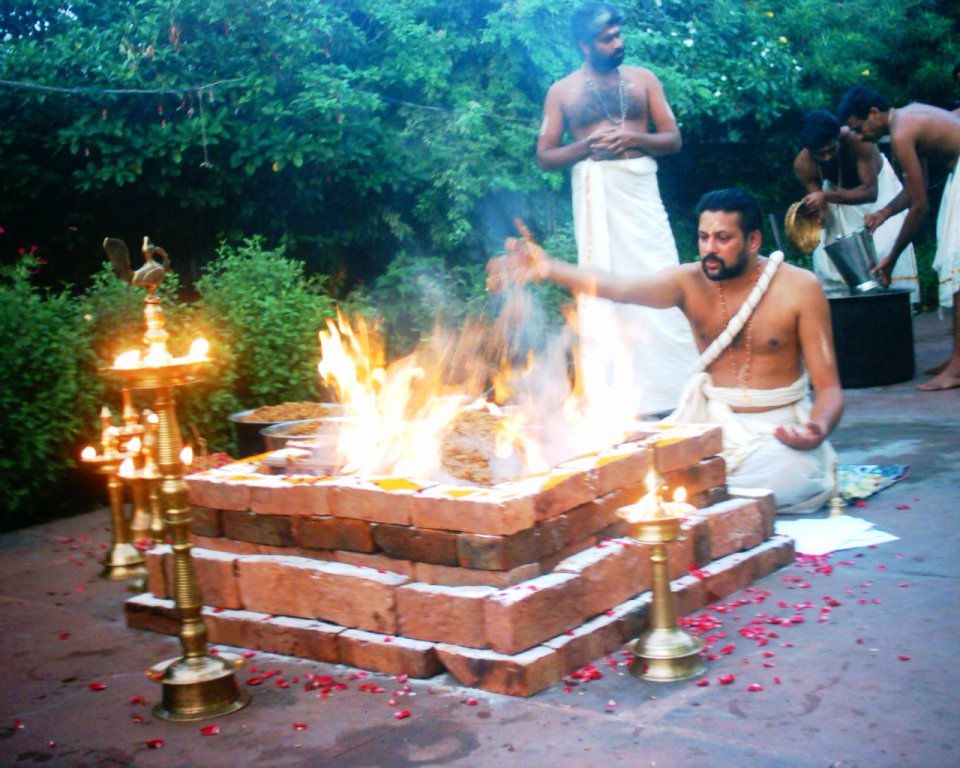
Puja (Sanskrit: पूजा, romanized: pūjā) is a worship ritual performed by Hindus to offer devotional homage and prayer to one or more deities, to host and honour a guest, or to spiritually celebrate an event. It may honour or celebrate the presence of special guests, or their memories after they die. The word puja is roughly translated into English as 'reverence, honour, homage, adoration, or worship'. Puja, the loving offering of light, flowers, and water or food to the divine, is the essential ritual of Hinduism. For the worshipper, the divine is visible in the image, and the divinity sees the worshipper. The interaction between human and deity, between human and guru, is called a Darshanam.
In Hindu practice, puja is done on a variety of occasions, frequencies, and settings. It may include a daily puja done in the home, or occasional temple ceremonies and annual festivals. In other cases, puja is held to mark a few lifetime events such as the birth of a baby, house entering ceremony or grihapravesh, first rice-eating ceremony or annaprasana, wedding, sacred thread ceremony or upanayana ceremony for the Brahmins or to begin a new venture with Ganapathi Puja. The two main areas where puja is performed are in the home and at temples to mark certain stages of life, events or some festivals such as Durga Puja, Kali Puja, Janmashtami, and Lakshmi Puja.
All significant Indian holidays, including Rakhi, Diwali, Holi, Karva Chauth, Ganesh Chaturthi, Janmashtami, and Navaratri, have rituals known as puja.
For example, a chirathu (also known as a diya), clarified butter wicks, bells, flowers, incense sticks, cones, roli or kumkum (a red powder with turmeric mixed in applied to the forehead), rice, tilakam, chandanam (sandalwood sticks), idols, and samagri havanam are some common items utilized in puja. In Hinduism, puja is a satvik work.
Puja varies according to the sect, region, occasion, deity honored, and steps followed. In formal Nigama ceremonies, a fire may be lit in honor of the god Agni, without an idol or image present. In contrast, in Agama ceremonies, an idol or icon or image of a deity is present. In both ceremonies, a lamp (diya) or incense stick may be lit while a prayer is chanted or a hymn is sung. Puja is typically performed by hindu worshippers alone,though sometimes in the presence of a priest who is well-versed in complex rituals and hymns. In temples and priest-assisted events puja, food, fruits, and sweets may be included as sacrificial offerings to the ceremony or deity, which, after the prayers, becomes prasadam – food shared by all gathered.
Both Nigama and Agama puja are practised in Hinduism in India. In the Hinduism of Bali, Indonesia, Agama puja is most prevalent inside homes and in temples. Puja is sometimes called Sembahyang in Indonesia.
Puja (पूजा) in Sanskrit means to "honour, respect; homage, worship, adoration; hospitable reception or showing honour or homage in a house of worship, the temple. J. A. B. van Buitenen hypothesized that puja evolved from Vedic yajna rituals, but his theory did not gain broad recognition as it only focused on external aspects. The Rigveda in hymn 8.17 uses the word "Sachipujanayam" (शाचिपूजनायं) as an epithet for Indra, which alludes to puja in Vedic times. The word puja also appears in the Shatapatha Brahmana, Chandogya Upanishad, and Dharmasutras. The Grhyasutras use puj in the context of rites, as does Sanskrit scholar Pāṇini. However, none of these texts imply puja as a form of devotional prayer worship.
According to Natalia Lidova, puja is unlikely to be of Indo-Aryan and Vedic origin because it lacks a Sanskrit root and it also lacks cognate parallels in other Indo-European languages. Its roots are probably Dravidian in origin, but the evidence for this alternative hypothesis is also largely missing possibly because devotional worship is not as ancient as Hinduism. Collins states that the roots may be "pu" (flower) and "ge" (make), or a form of "making flower sacrifice". However, this proposal is problematic because "pu" comes from an Indo-European root, while "ge" from Dravidian. Like Lidova, Charpentier also suggests the origin of the word puja may lie in the Dravidian languages. Two possible Malayalam roots may be pūSa 'to smear with something' or pūcey "to do with flowers" (from pū 'flower' and cey 'to do'). Tamil roots have also been suggested: pūsai 'to smear with something' or pūcey "to do with flowers" (from pū 'flower' and cey 'to do') or similar Telugu roots pūjēi (from pū 'flower' and cēyi 'to do').
Hub AI
Puja (Hinduism) AI simulator
(@Puja (Hinduism)_simulator)
Puja (Hinduism)
Puja (Sanskrit: पूजा, romanized: pūjā) is a worship ritual performed by Hindus to offer devotional homage and prayer to one or more deities, to host and honour a guest, or to spiritually celebrate an event. It may honour or celebrate the presence of special guests, or their memories after they die. The word puja is roughly translated into English as 'reverence, honour, homage, adoration, or worship'. Puja, the loving offering of light, flowers, and water or food to the divine, is the essential ritual of Hinduism. For the worshipper, the divine is visible in the image, and the divinity sees the worshipper. The interaction between human and deity, between human and guru, is called a Darshanam.
In Hindu practice, puja is done on a variety of occasions, frequencies, and settings. It may include a daily puja done in the home, or occasional temple ceremonies and annual festivals. In other cases, puja is held to mark a few lifetime events such as the birth of a baby, house entering ceremony or grihapravesh, first rice-eating ceremony or annaprasana, wedding, sacred thread ceremony or upanayana ceremony for the Brahmins or to begin a new venture with Ganapathi Puja. The two main areas where puja is performed are in the home and at temples to mark certain stages of life, events or some festivals such as Durga Puja, Kali Puja, Janmashtami, and Lakshmi Puja.
All significant Indian holidays, including Rakhi, Diwali, Holi, Karva Chauth, Ganesh Chaturthi, Janmashtami, and Navaratri, have rituals known as puja.
For example, a chirathu (also known as a diya), clarified butter wicks, bells, flowers, incense sticks, cones, roli or kumkum (a red powder with turmeric mixed in applied to the forehead), rice, tilakam, chandanam (sandalwood sticks), idols, and samagri havanam are some common items utilized in puja. In Hinduism, puja is a satvik work.
Puja varies according to the sect, region, occasion, deity honored, and steps followed. In formal Nigama ceremonies, a fire may be lit in honor of the god Agni, without an idol or image present. In contrast, in Agama ceremonies, an idol or icon or image of a deity is present. In both ceremonies, a lamp (diya) or incense stick may be lit while a prayer is chanted or a hymn is sung. Puja is typically performed by hindu worshippers alone,though sometimes in the presence of a priest who is well-versed in complex rituals and hymns. In temples and priest-assisted events puja, food, fruits, and sweets may be included as sacrificial offerings to the ceremony or deity, which, after the prayers, becomes prasadam – food shared by all gathered.
Both Nigama and Agama puja are practised in Hinduism in India. In the Hinduism of Bali, Indonesia, Agama puja is most prevalent inside homes and in temples. Puja is sometimes called Sembahyang in Indonesia.
Puja (पूजा) in Sanskrit means to "honour, respect; homage, worship, adoration; hospitable reception or showing honour or homage in a house of worship, the temple. J. A. B. van Buitenen hypothesized that puja evolved from Vedic yajna rituals, but his theory did not gain broad recognition as it only focused on external aspects. The Rigveda in hymn 8.17 uses the word "Sachipujanayam" (शाचिपूजनायं) as an epithet for Indra, which alludes to puja in Vedic times. The word puja also appears in the Shatapatha Brahmana, Chandogya Upanishad, and Dharmasutras. The Grhyasutras use puj in the context of rites, as does Sanskrit scholar Pāṇini. However, none of these texts imply puja as a form of devotional prayer worship.
According to Natalia Lidova, puja is unlikely to be of Indo-Aryan and Vedic origin because it lacks a Sanskrit root and it also lacks cognate parallels in other Indo-European languages. Its roots are probably Dravidian in origin, but the evidence for this alternative hypothesis is also largely missing possibly because devotional worship is not as ancient as Hinduism. Collins states that the roots may be "pu" (flower) and "ge" (make), or a form of "making flower sacrifice". However, this proposal is problematic because "pu" comes from an Indo-European root, while "ge" from Dravidian. Like Lidova, Charpentier also suggests the origin of the word puja may lie in the Dravidian languages. Two possible Malayalam roots may be pūSa 'to smear with something' or pūcey "to do with flowers" (from pū 'flower' and cey 'to do'). Tamil roots have also been suggested: pūsai 'to smear with something' or pūcey "to do with flowers" (from pū 'flower' and cey 'to do') or similar Telugu roots pūjēi (from pū 'flower' and cēyi 'to do').
Recent media