
Recent from talks
History of the Spanish language
Knowledge base stats:
Talk channels stats:
Members stats:
History of the Spanish language
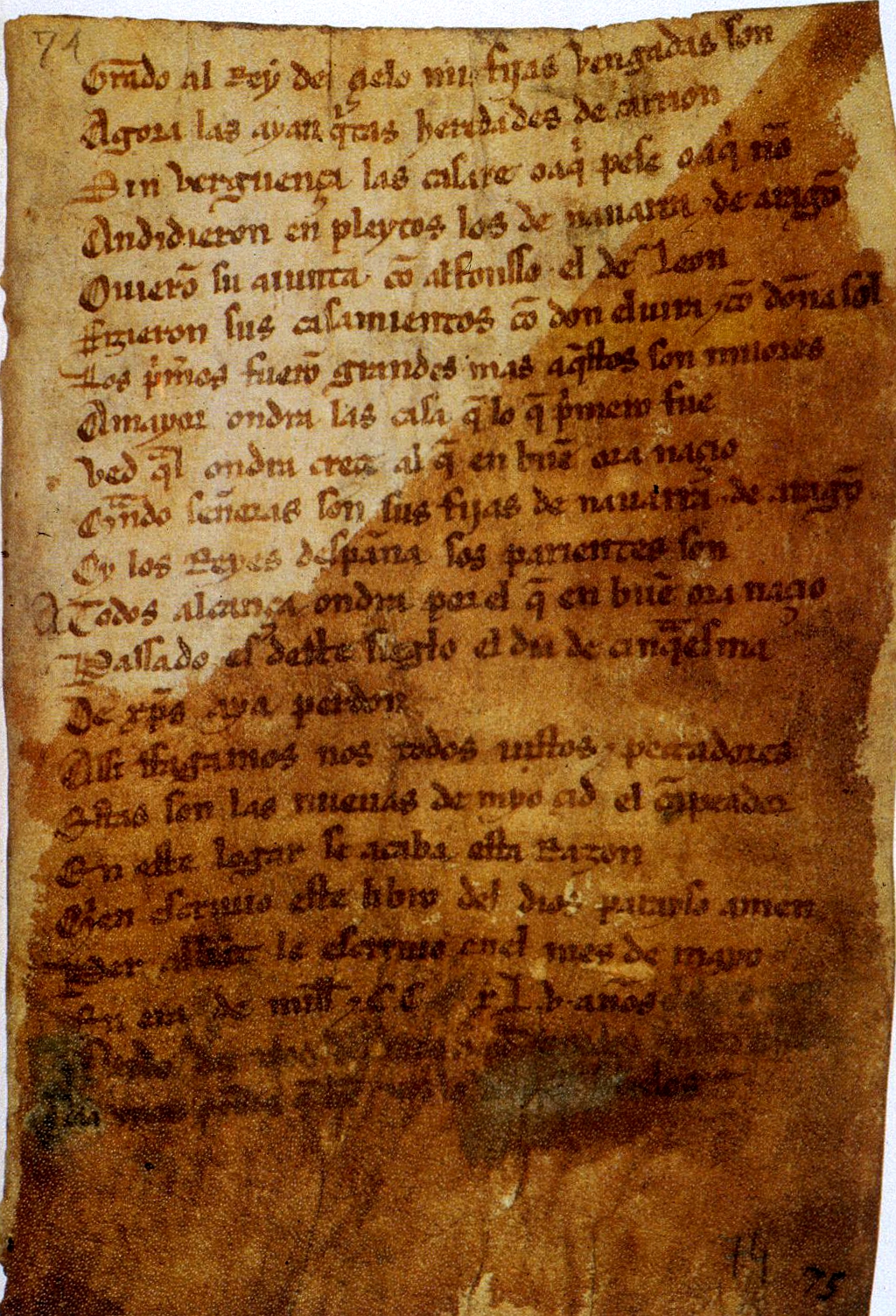
The language known today as Spanish is derived from spoken Latin, which was brought to the Iberian Peninsula by the Romans after their occupation of the peninsula that started in the late 3rd century BC. Today it is the world's 4th most widely spoken language, after English, Mandarin Chinese and Hindi. Influenced by the peninsular hegemony of Al-Andalus in the early middle ages, Hispano-Romance varieties borrowed substantial lexicon from Arabic. Upon the southward territorial expansion of the Kingdom of Castile, Hispano-Romance norms associated to this polity displaced both Arabic and the Mozarabic romance varieties in the conquered territories, even though the resulting speech also assimilated features from the latter in the process. The first standard written norm of Spanish was brought forward in the 13th century by Alfonso X the Wise (who used Castilian, i.e. Spanish, along with Latin as languages of the administration), probably drawing from the speech of the upper classes of Toledo. Features associated with the Castilian patterns of Hispano-Romance also spread west and east to the kingdoms of León and Aragón for the rest of the middle ages, owing to the political prestige achieved by the Kingdom of Castile in the peninsular context and to the lesser literary development of their vernacular norms. From the 1560s onward the standard written form followed Madrid's.
The Spanish language expanded overseas in the Early Modern period in the wake of the Spanish conquests in the Americas (as well as the Canary Islands). Besides the Caribbean, the colonial administration in the new territories had its main centres of power located in Mexico City and Lima, which retained more features from the central peninsular norm than other more peripheral territories of the Spanish Empire, where adoption of patterns from the southern peninsular norm of Seville (the largest city of the Crown in the 16th century and the port linking to the Americas) was more pervasive, even though in other regards the influence from the latter norm (associated to Andalusian Spanish) came to be preponderant in the entire Americas. Spanish varieties henceforth borrowed influence from Amerindian languages, primarily coming from the Caribbean, the Central-Andean and Mesoamerican regions. Today it is the official language of 20 countries, as well as an official language of numerous international organizations, including the United Nations.
The development of Spanish phonology is distinguished from those of other nearby Romance languages (e.g. Portuguese, Catalan) by several features:
The following features are characteristic of Spanish phonology and also of some other Ibero-Romance languages, but not the Romance languages as a whole:
The Latin system of four verb conjugations (form classes) is reduced to three in Spanish. The Latin infinitives with the endings -ĀRE, -ĒRE, and -ĪRE become Spanish infinitives in -ar, -er, and -ir respectively. The Latin third conjugation—infinitives ending in -ĔRE—are redistributed between the Spanish -er and -ir classes (e.g. facere → hacer, dicere → decir). Spanish verbal morphology continues the use of some Latin synthetic forms that were replaced by analytic ones in spoken French and (partly) Italian (cf. Sp. lavó, Fr. il a lavé), and the Spanish subjunctive mood maintains separate present and past-tense forms.
Spanish syntax provides overt marking for some direct objects (the so-called "personal a", see differential object marking for the general phenomenon), and uses clitic doubling with indirect objects, in which a "redundant" pronoun (le, les) appears even in the presence of an explicit noun phrase. (Neither feature occurs in other Western Romance languages,[citation needed] but both are features of Romanian, with pe < PER corresponding to Spanish a.) With regard to subject pronouns, Spanish is a pro-drop language, meaning that the verb phrase can often stand alone without the use of a subject pronoun (or a subject noun phrase). In some cases, such as with impersonal verbs referring to meteorological (llover "to rain", nevar "to snow") or other natural phenomena (amanecer "to get light out", anochecer "to get dark out"), it is ungrammatical to include a subject. Compared to other Romance languages, Spanish has a somewhat freer syntax with relatively fewer restrictions on subject-verb-object word order.
Due to prolonged language contact with other languages, the Spanish lexicon contains loanwords from Basque, Hispano-Celtic (Celtiberian and Gallaecian), Iberian, Germanic (Gothic), Arabic and indigenous languages of the Americas.
Accents—used in Modern Spanish to mark the vowel of the stressed syllable in words where stress is not predictable from rules—came into use sporadically in the 15th century, and massively in the 16th century. Their use began to be standardized with the advent of the Spanish Royal Academy in the 18th century. See also Spanish orthography.
Hub AI
History of the Spanish language AI simulator
(@History of the Spanish language_simulator)
History of the Spanish language
The language known today as Spanish is derived from spoken Latin, which was brought to the Iberian Peninsula by the Romans after their occupation of the peninsula that started in the late 3rd century BC. Today it is the world's 4th most widely spoken language, after English, Mandarin Chinese and Hindi. Influenced by the peninsular hegemony of Al-Andalus in the early middle ages, Hispano-Romance varieties borrowed substantial lexicon from Arabic. Upon the southward territorial expansion of the Kingdom of Castile, Hispano-Romance norms associated to this polity displaced both Arabic and the Mozarabic romance varieties in the conquered territories, even though the resulting speech also assimilated features from the latter in the process. The first standard written norm of Spanish was brought forward in the 13th century by Alfonso X the Wise (who used Castilian, i.e. Spanish, along with Latin as languages of the administration), probably drawing from the speech of the upper classes of Toledo. Features associated with the Castilian patterns of Hispano-Romance also spread west and east to the kingdoms of León and Aragón for the rest of the middle ages, owing to the political prestige achieved by the Kingdom of Castile in the peninsular context and to the lesser literary development of their vernacular norms. From the 1560s onward the standard written form followed Madrid's.
The Spanish language expanded overseas in the Early Modern period in the wake of the Spanish conquests in the Americas (as well as the Canary Islands). Besides the Caribbean, the colonial administration in the new territories had its main centres of power located in Mexico City and Lima, which retained more features from the central peninsular norm than other more peripheral territories of the Spanish Empire, where adoption of patterns from the southern peninsular norm of Seville (the largest city of the Crown in the 16th century and the port linking to the Americas) was more pervasive, even though in other regards the influence from the latter norm (associated to Andalusian Spanish) came to be preponderant in the entire Americas. Spanish varieties henceforth borrowed influence from Amerindian languages, primarily coming from the Caribbean, the Central-Andean and Mesoamerican regions. Today it is the official language of 20 countries, as well as an official language of numerous international organizations, including the United Nations.
The development of Spanish phonology is distinguished from those of other nearby Romance languages (e.g. Portuguese, Catalan) by several features:
The following features are characteristic of Spanish phonology and also of some other Ibero-Romance languages, but not the Romance languages as a whole:
The Latin system of four verb conjugations (form classes) is reduced to three in Spanish. The Latin infinitives with the endings -ĀRE, -ĒRE, and -ĪRE become Spanish infinitives in -ar, -er, and -ir respectively. The Latin third conjugation—infinitives ending in -ĔRE—are redistributed between the Spanish -er and -ir classes (e.g. facere → hacer, dicere → decir). Spanish verbal morphology continues the use of some Latin synthetic forms that were replaced by analytic ones in spoken French and (partly) Italian (cf. Sp. lavó, Fr. il a lavé), and the Spanish subjunctive mood maintains separate present and past-tense forms.
Spanish syntax provides overt marking for some direct objects (the so-called "personal a", see differential object marking for the general phenomenon), and uses clitic doubling with indirect objects, in which a "redundant" pronoun (le, les) appears even in the presence of an explicit noun phrase. (Neither feature occurs in other Western Romance languages,[citation needed] but both are features of Romanian, with pe < PER corresponding to Spanish a.) With regard to subject pronouns, Spanish is a pro-drop language, meaning that the verb phrase can often stand alone without the use of a subject pronoun (or a subject noun phrase). In some cases, such as with impersonal verbs referring to meteorological (llover "to rain", nevar "to snow") or other natural phenomena (amanecer "to get light out", anochecer "to get dark out"), it is ungrammatical to include a subject. Compared to other Romance languages, Spanish has a somewhat freer syntax with relatively fewer restrictions on subject-verb-object word order.
Due to prolonged language contact with other languages, the Spanish lexicon contains loanwords from Basque, Hispano-Celtic (Celtiberian and Gallaecian), Iberian, Germanic (Gothic), Arabic and indigenous languages of the Americas.
Accents—used in Modern Spanish to mark the vowel of the stressed syllable in words where stress is not predictable from rules—came into use sporadically in the 15th century, and massively in the 16th century. Their use began to be standardized with the advent of the Spanish Royal Academy in the 18th century. See also Spanish orthography.
Recent media