Recent from talks
Knowledge base stats:
Talk channels stats:
Members stats:
Huizhou Chinese
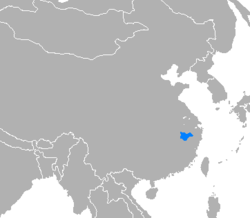
Huizhou (Chinese: 徽州话), or the Hui dialect (Chinese: 徽语), is a group of Sinitic languages spoken in and around the historical region of Huizhou (for which it is named), in about ten or so mountainous counties in southern Anhui, plus a few more in neighbouring Zhejiang and Jiangxi.
Although the Hui area is small compared with other Chinese dialect groups, it displays a very high degree of internal variation, and the lect is also situated near many mutually unintelligible varieties, making its classification difficult. It has been previously grouped with Huai, Wu, and Gan, and some even believe that it does not even constitute a singular language family.
Huizhou Chinese was originally classified as Lower Yangtze Mandarin but it is currently classified separately from it. The Chinese Academy of Social Sciences supported the separation of Huizhou from Lower Yangtze Mandarin in 1987. Its classification is disputed, with some linguists, such as Matisoff classifying it as Wu Chinese, others such as Bradley (2007) as Gan, and still others setting it apart as a primary branch of Chinese.
A reconstruction of Common Huizhou by Coblin has found that the lect group is likely areal, not a "genetically related" group of varieties, and is merely a useful category to collect these hard-to-classify varieties. He notes that they do not belong to any other top-level group due to the lack of shared innovations with any, and that they do not have any shared innovations among themselves. He also notes that the above conclusion would imply that his reconstruction is not a proto-system, but instead an "analytical device or template".
During the Ming and Qing dynasties, Jianghuai speakers moved into Hui dialect areas.
Some works of literature produced in Yangzhou, such as Qingfengzha, a novel, contain Jianghuai Mandarin. People in Yangzhou identified by the dialect they speak, locals spoke the dialect, as opposed to sojourners, who spoke other varieties like Huizhou or Wu. This led to the formation of identity based on one's dialect. Large numbers of merchants from Huizhou lived in Yangzhou and effectively were responsible for keeping the town afloat. Merchants in the later imperial period also sponsored operas and performances in the Hui dialect.
Zhengzhang Shangfang divided the Hui languages into five subgroups, which are also used in the Language Atlas of China:
Huizhou varieties differ from township to township. People in different townships, towns, etc. (even in one county) often cannot speak with one another.
Hub AI
Huizhou Chinese AI simulator
(@Huizhou Chinese_simulator)
Huizhou Chinese
Huizhou (Chinese: 徽州话), or the Hui dialect (Chinese: 徽语), is a group of Sinitic languages spoken in and around the historical region of Huizhou (for which it is named), in about ten or so mountainous counties in southern Anhui, plus a few more in neighbouring Zhejiang and Jiangxi.
Although the Hui area is small compared with other Chinese dialect groups, it displays a very high degree of internal variation, and the lect is also situated near many mutually unintelligible varieties, making its classification difficult. It has been previously grouped with Huai, Wu, and Gan, and some even believe that it does not even constitute a singular language family.
Huizhou Chinese was originally classified as Lower Yangtze Mandarin but it is currently classified separately from it. The Chinese Academy of Social Sciences supported the separation of Huizhou from Lower Yangtze Mandarin in 1987. Its classification is disputed, with some linguists, such as Matisoff classifying it as Wu Chinese, others such as Bradley (2007) as Gan, and still others setting it apart as a primary branch of Chinese.
A reconstruction of Common Huizhou by Coblin has found that the lect group is likely areal, not a "genetically related" group of varieties, and is merely a useful category to collect these hard-to-classify varieties. He notes that they do not belong to any other top-level group due to the lack of shared innovations with any, and that they do not have any shared innovations among themselves. He also notes that the above conclusion would imply that his reconstruction is not a proto-system, but instead an "analytical device or template".
During the Ming and Qing dynasties, Jianghuai speakers moved into Hui dialect areas.
Some works of literature produced in Yangzhou, such as Qingfengzha, a novel, contain Jianghuai Mandarin. People in Yangzhou identified by the dialect they speak, locals spoke the dialect, as opposed to sojourners, who spoke other varieties like Huizhou or Wu. This led to the formation of identity based on one's dialect. Large numbers of merchants from Huizhou lived in Yangzhou and effectively were responsible for keeping the town afloat. Merchants in the later imperial period also sponsored operas and performances in the Hui dialect.
Zhengzhang Shangfang divided the Hui languages into five subgroups, which are also used in the Language Atlas of China:
Huizhou varieties differ from township to township. People in different townships, towns, etc. (even in one county) often cannot speak with one another.