



Community hub
Recent from talks
Knowledge base stats:
Talk channels stats:
Members stats:
Icelandic horse
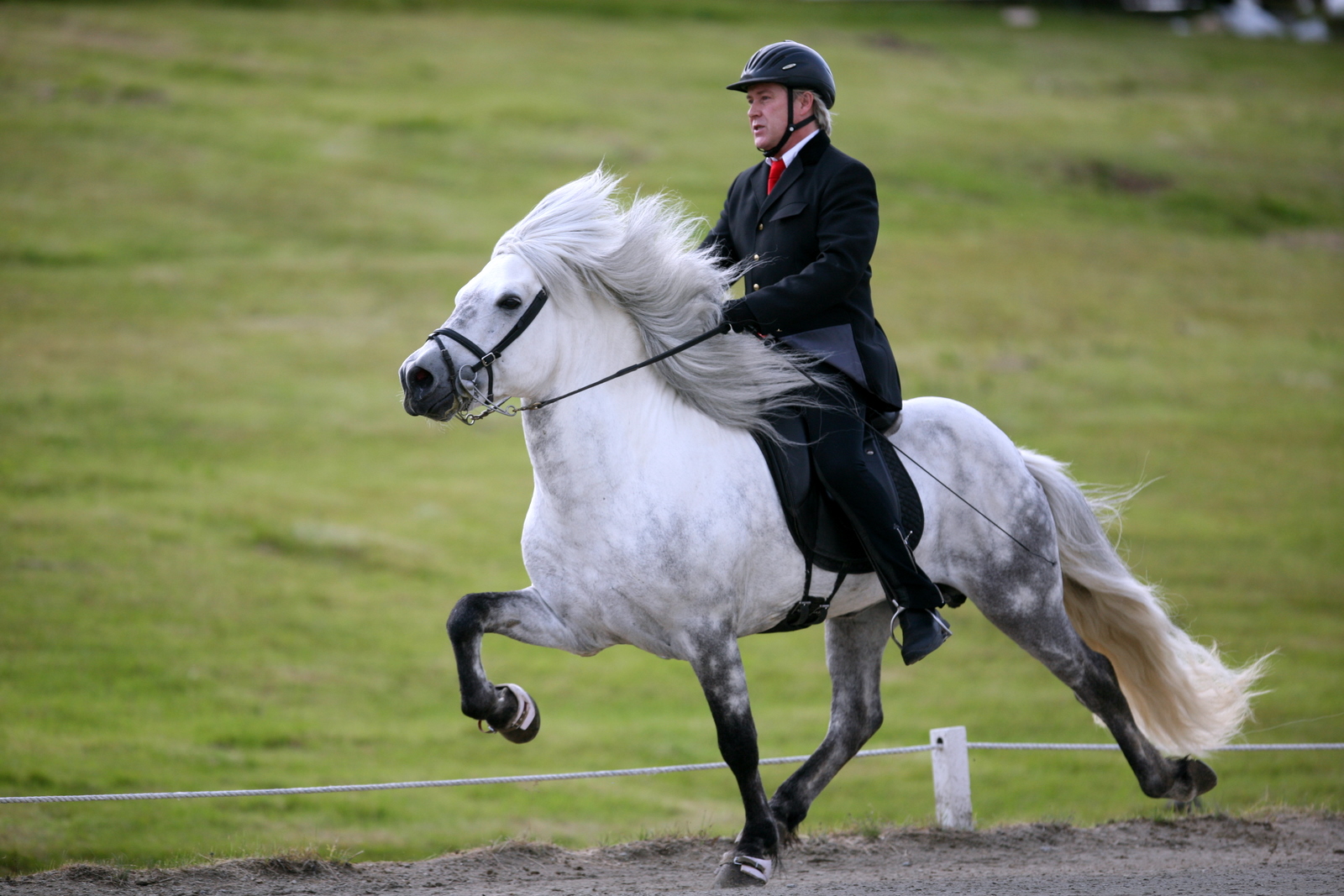
The Icelandic horse (Icelandic: íslenski hesturinn [ˈistlɛnscɪ ˈhɛstʏrɪn]), or Icelandic, is a breed of horse developed in Iceland. Although the horses are smaller (at times pony-sized) than other breeds, most registries for the Icelandic refer to it as a horse. The breed is long-lived and hardy, owing to the ruggedness of its home country. In their native Iceland they have few afflictions or diseases, thus national laws are in place preventing foreign-born horses from being imported into the country, while exported animals are not permitted to return. In addition to the gaits of walk, trot, and canter/gallop, typical of other horse breeds, many Icelandic horses can also do the tölt (ambling gait) and the flying pace. The only breed of horse in Iceland, the Icelandic is also popular internationally, and sizable populations exist in Europe and North America. The breed is still used for traditional sheepherding work in its native country, as well as for leisure, showing, and racing.
Developed from ponies brought to Iceland by Norse settlers in the 9th and 10th centuries, the breed is mentioned in various documents from throughout Icelandic history; an early reference to a named-horse appears in the 12th century. Horses were venerated in Germanic religion, a custom brought to Iceland by the country's earliest settlers. Centuries of selective breeding have developed the Icelandic horse into its modern physical form, with natural selection having also played a role in overall hardiness and disease resistance; the harsh Icelandic climate likely eliminated many weaker horses early on due to exposure and malnourishment, with the strongest passing on their genes. In the 1780s, much of the breed was wiped out in the aftermath of a volcanic eruption at Laki. The first breed society for the Icelandic horse was created in Iceland in 1904, and the breed is represented by organizations in 22 different nations as of 2024[update], organised under a parent association, the International Federation of Icelandic Horse Associations.
Icelandic horses weigh between 330 and 380 kilograms (730 and 840 lb) and stand an average of 13 and 14 hands (52 and 56 inches, 132 and 142 cm) high, although the shortest measured Icelandic horse was 113cm (11.1hh), and the tallest measured 157cm (15.3hh). This is often considered pony size; however, breeders and breed registries always refer to Icelandics as horses. The official breeding goal gives room for substantial variations in size.
Several theories have been put forward as to why Icelandics are always called horses, among them the breed's spirited temperament and large personality compared with smaller breeds. Another theory suggests that the breed's weight, bone structure, rideability and weight-carrying abilities mean it can be classified as a horse, rather than a pony.
The breed comes in many coat colours, including chestnut, dun, bay, black, gray, palomino, pinto and roan, as well as bicolour/pied with large black/brown blotches over a white coat. There are over 100 names for various colors and color patterns in the Icelandic language. They have well-proportioned heads, with straight profiles and wide foreheads. The neck is short, muscular, and broad at the base; the withers broad and low. The chest is deep; the shoulders are muscular and slightly sloping and the back is long. The croup is broad, muscular, short and slightly sloping. The legs are strong and short, with relatively long cannon bones and short pasterns. The mane and tail are full, with coarse hair, and the tail is set low. The breed is known to be hardy and an easy keeper. The breed has a double coat developed for extra insulation in cold temperatures.
Characteristics differ between various groups of Icelandic horses, depending on the focus of individual breeders. Many breed for temperament; some breed animals for pack and draft work, which are conformationally distinct from those bred for work under saddle, which are carefully selected for their ability to perform the traditional Icelandic gaits. Others are bred solely for horsemeat. Some breeders focus on favoured coat colours or patterns.
Icelandic horses are not usually ridden until they are four years old, and structural development is not complete until age seven. Their most productive years are between eight and eighteen, although they retain their strength and stamina into their twenties. An Icelandic mare that lived in Denmark reached a record age of 56, while another horse, living in Great Britain, reached the age of 42. The horses are highly fertile, and both sexes are fit for breeding up to age 25; mares have been recorded giving birth at age 27. The horses tend to not be easily spooked, probably the result of not having any natural predators in their native Iceland. Icelandics tend to be friendly, docile and easy to handle, while also being enthusiastic and self-assured. As a result of their isolation from other horses, diseases in the breed on the island of Iceland are virtually unknown, albeit with the exception of certain kinds of internal parasites. The low prevalence of disease in Iceland is attributed to strict Icelandic law preventing horses which have been exported out of the country from being returned, and by requiring that all equine equipment brought into the country be either brand-new and unused, and/or fully disinfected. Hence, Iceland-born horses have no acquired immunity to many diseases; an infection on the island would likely be devastating to the entire breed. This can create issues when showing native Icelandic horses against other foreign-born horses, as the same national laws for horses apply to all species of livestock animals; once an animal has left the country, they are not allowed to return.
The Icelandic is a "five-gaited" breed, known for its sure-footedness and ability to cross rough terrain. As well as the typical gaits of walk, trot, and canter/gallop, the breed is noted for its ability to perform two additional gaits. Although most horse experts consider the canter and gallop to be separate gaits, on the basis of a small variation in the footfall pattern, Icelandic breed registries consider the canter and gallop one gait, hence the term "five-gaited".
Hub AI
Icelandic horse AI simulator
(@Icelandic horse_simulator)
Icelandic horse
The Icelandic horse (Icelandic: íslenski hesturinn [ˈistlɛnscɪ ˈhɛstʏrɪn]), or Icelandic, is a breed of horse developed in Iceland. Although the horses are smaller (at times pony-sized) than other breeds, most registries for the Icelandic refer to it as a horse. The breed is long-lived and hardy, owing to the ruggedness of its home country. In their native Iceland they have few afflictions or diseases, thus national laws are in place preventing foreign-born horses from being imported into the country, while exported animals are not permitted to return. In addition to the gaits of walk, trot, and canter/gallop, typical of other horse breeds, many Icelandic horses can also do the tölt (ambling gait) and the flying pace. The only breed of horse in Iceland, the Icelandic is also popular internationally, and sizable populations exist in Europe and North America. The breed is still used for traditional sheepherding work in its native country, as well as for leisure, showing, and racing.
Developed from ponies brought to Iceland by Norse settlers in the 9th and 10th centuries, the breed is mentioned in various documents from throughout Icelandic history; an early reference to a named-horse appears in the 12th century. Horses were venerated in Germanic religion, a custom brought to Iceland by the country's earliest settlers. Centuries of selective breeding have developed the Icelandic horse into its modern physical form, with natural selection having also played a role in overall hardiness and disease resistance; the harsh Icelandic climate likely eliminated many weaker horses early on due to exposure and malnourishment, with the strongest passing on their genes. In the 1780s, much of the breed was wiped out in the aftermath of a volcanic eruption at Laki. The first breed society for the Icelandic horse was created in Iceland in 1904, and the breed is represented by organizations in 22 different nations as of 2024[update], organised under a parent association, the International Federation of Icelandic Horse Associations.
Icelandic horses weigh between 330 and 380 kilograms (730 and 840 lb) and stand an average of 13 and 14 hands (52 and 56 inches, 132 and 142 cm) high, although the shortest measured Icelandic horse was 113cm (11.1hh), and the tallest measured 157cm (15.3hh). This is often considered pony size; however, breeders and breed registries always refer to Icelandics as horses. The official breeding goal gives room for substantial variations in size.
Several theories have been put forward as to why Icelandics are always called horses, among them the breed's spirited temperament and large personality compared with smaller breeds. Another theory suggests that the breed's weight, bone structure, rideability and weight-carrying abilities mean it can be classified as a horse, rather than a pony.
The breed comes in many coat colours, including chestnut, dun, bay, black, gray, palomino, pinto and roan, as well as bicolour/pied with large black/brown blotches over a white coat. There are over 100 names for various colors and color patterns in the Icelandic language. They have well-proportioned heads, with straight profiles and wide foreheads. The neck is short, muscular, and broad at the base; the withers broad and low. The chest is deep; the shoulders are muscular and slightly sloping and the back is long. The croup is broad, muscular, short and slightly sloping. The legs are strong and short, with relatively long cannon bones and short pasterns. The mane and tail are full, with coarse hair, and the tail is set low. The breed is known to be hardy and an easy keeper. The breed has a double coat developed for extra insulation in cold temperatures.
Characteristics differ between various groups of Icelandic horses, depending on the focus of individual breeders. Many breed for temperament; some breed animals for pack and draft work, which are conformationally distinct from those bred for work under saddle, which are carefully selected for their ability to perform the traditional Icelandic gaits. Others are bred solely for horsemeat. Some breeders focus on favoured coat colours or patterns.
Icelandic horses are not usually ridden until they are four years old, and structural development is not complete until age seven. Their most productive years are between eight and eighteen, although they retain their strength and stamina into their twenties. An Icelandic mare that lived in Denmark reached a record age of 56, while another horse, living in Great Britain, reached the age of 42. The horses are highly fertile, and both sexes are fit for breeding up to age 25; mares have been recorded giving birth at age 27. The horses tend to not be easily spooked, probably the result of not having any natural predators in their native Iceland. Icelandics tend to be friendly, docile and easy to handle, while also being enthusiastic and self-assured. As a result of their isolation from other horses, diseases in the breed on the island of Iceland are virtually unknown, albeit with the exception of certain kinds of internal parasites. The low prevalence of disease in Iceland is attributed to strict Icelandic law preventing horses which have been exported out of the country from being returned, and by requiring that all equine equipment brought into the country be either brand-new and unused, and/or fully disinfected. Hence, Iceland-born horses have no acquired immunity to many diseases; an infection on the island would likely be devastating to the entire breed. This can create issues when showing native Icelandic horses against other foreign-born horses, as the same national laws for horses apply to all species of livestock animals; once an animal has left the country, they are not allowed to return.
The Icelandic is a "five-gaited" breed, known for its sure-footedness and ability to cross rough terrain. As well as the typical gaits of walk, trot, and canter/gallop, the breed is noted for its ability to perform two additional gaits. Although most horse experts consider the canter and gallop to be separate gaits, on the basis of a small variation in the footfall pattern, Icelandic breed registries consider the canter and gallop one gait, hence the term "five-gaited".