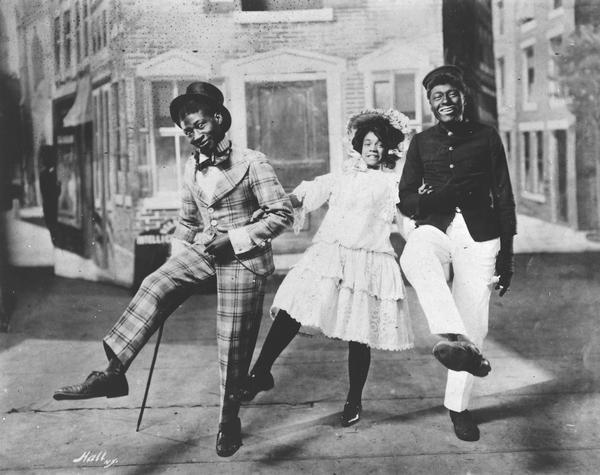

In Dahomey
View on Wikipedia| In Dahomey | |
|---|---|
 | |
| Music | Will Marion Cook |
| Lyrics | Paul Laurence Dunbar |
| Book | Jesse A. Shipp |
| Productions | 1903 Broadway 1904 New York City |

In Dahomey: A Negro Musical Comedy is a landmark 1903 American musical comedy described by theatre historian Gerald Bordman as "the first full-length musical written and played by blacks to be performed at a major Broadway house."[2] It features music by Will Marion Cook, book by Jesse A. Shipp, and lyrics by poet Paul Laurence Dunbar.[3] It was written by Jesse A. Shipp as a satire on the American Colonization Society's back-to-Africa movement of the earlier nineteenth century.
In Dahomey is regarded as a marquee turning point for African-American representation in vaudeville theater. It opened on February 18, 1903, at the New York Theatre, starring George Walker and Bert Williams, two iconic figures of vaudeville entertainment at the time. The musical ran for 53 completed performances and had two tours in the United States and one tour of the United Kingdom.[4] In total, In Dahomey ran for a combined four years.[5]
Production history
[edit]Produced by McVon Hurtig and Harry Seamon, In Dahomey was the first to star African-American performers George Walker and Bert Williams, two of the leading comedians in America at the time.[6] In Dahomey opened on February 18, 1903, at the New York Theatre, and closed on April 4, 1903 after 53 performances (then considered a successful run).[4]
It had a tour in the United Kingdom, followed by a highly successful tour of the United States, which lasted a total of four years.[5] It was the first American black musical to be performed abroad.[7]
The musical was revived on Broadway, opening at the Grand Opera House on August 27, 1904 and closing on September 10, 1904 after 17 performances. Bert Williams (as Shylock Homestead), George Walker (as Rareback Pinkerton) and Aida Overton Walker (as Rosetta Lightfoot) reprised their roles.[8]
Tours in England and America
[edit]
Based on the show's New York success, the producers of In Dahomey transferred the entire production to England on April 28, 1903, with a staging at the Shaftesbury Theatre, followed by a provincial tour around England. This was capped by a command performance celebrating the ninth birthday of the eldest son of the Prince of Wales at Buckingham Palace.[9] In Dahomey was heralded as "the most popular musical show in London."[10]
After a year touring England and Scotland, In Dahomey returned to New York. It reopened on August 27, 1904, at the Grand Opera House. This was followed by a major 40-week tour across the United States. It played such cities as San Francisco, California; Portland, Oregon; and St. Louis, Missouri; turning in a profit of $64,000.[11]
Themes
[edit]
Featuring the renowned comic pair of Bert Williams and George W. Walker, the show was the first to introduce a critical discourse of African Imperialism into the vaudeville theatre scene.[12] Walker and Williams were said to have emphasized some of the most important components of early 20th-century Black musicals: fast-changing scenery using tableaux (presumably painted backdrops), improvisation, traditional Black-facing, heavy pantomime, and interpolation of songs borrowed from other original source-texts.
Synopsis
[edit]The story tells of two conmen from Boston who, having found a pot of gold, devise a plan to move to Africa to colonize Dahomey (present-day Benin) with a group of poor American blacks.[13][14] Having suffered bad luck, the conmen, Shylock Homestead (played by Bert Williams) and Rareback Pinkerton (George Walker) are sent to Florida to con Cicero Lightfoot (Pete Hampton),[15] the president of a colonization society.[14] To his surprise, Pinkerton learns that Homestead is rich, and arranges to become his trustee to gain access to Homestead's wealth.[14] Once having been successful with that, Pinkerton struts around, acting as a dandy, or a refined figure in black society.[14] Upon realizing Pinkerton's schemes, Homestead refuses to continue to support Pinkerton's acts, and the show culminates with a spectacular cakewalk.[14]
In other sources, In Dahomey is described as following the attempts of two con men (played by Bert Williams and George Walker) charged with recovering a lost heirloom to be flipped for profit. The search for the heirloom crosses paths with a colonization society that intends to settle pioneers in Dahomey. The plot of the original source-text differs, according to many sources, but all agree there were three primary locales in In Dahomey: Boston, Gatorville (Florida), and Dahomey.
A February 1903 New York Theatre program has been found that printed a synopsis that generally concurs with the scenes depicted in extant scripts. The recovered synopsis reads:
An old Southern negro, Lightfoot by name, president of the Dahomey Colonization Society, loses a silver casket, which, to use his language, has a cat scratched on its back. He sends to Boston for detectives to search for the missing treasure. Shylock Homestead and Rareback Pinkerton (Williams and Walker), the detectives in the case, failing to find the casket at Gatorville, Florida, Lightfoot's home, accompany the colonists to Dahomey. Previous to leaving Boston on their perilous mission, the detectives join a syndicate. In Dahomey, rum of any kind, when given as a present, is a sign of appreciation. Shylock and Rareback, having free access to the syndicate's stock of whiskey, present the King of Dahomey with three barrels of appreciation and in return are made Caboceers (Governors of a Province). In the meantime, the colonists, having had a misunderstanding with the King, are made prisoners. Prisoners and criminals are executed on festival days, known in Dahomey as Customs Day. The new Caboceers, after supplying the King with his third barrel of appreciation whiskey), secure his consent to liberate the colonists after which an honor is conferred on Rareback and Shylock, which causes them to decide "There's No Place Like Home."[16]
Importance
[edit]In Dahomey marked an important milestone in the evolution of the American musical comedy. Its composer Will Marion Cook combined the "high operetta style" he had studied with the relatively new form of ragtime in the finale "The Czar of Dixie".[17] According to John Graziano, author of Black Theatre USA, it was "the first African American show. The score made use of the "high operetta style" that synthesized successfully the various genres of American musical theatre popular at the beginning of the twentieth century—minstrelsy, vaudeville, comic opera, and musical comedy."[18]
Significantly, the production of In Dahomey marked the first full-length African American musical to be staged in an indoor venue on Broadway, premiering at the New York Theatre on February 18, 1903.[14] The earlier Clorindy was produced in 1898 at the Roof Garden of a Broadway theater.[19] During its four-year tour, In Dahomey proved one of the most successful musical comedies of its era.[5] The show helped make its composer, lyricist, and leading performers household names. In Dahomey was the first black musical to have its score published (albeit in the UK, not the US).[20]
The play is thought to have marked a significant shift in black theatre performance. Limited by a demand for the comedy of ethnic and racial stereotypes— particularly black stereotypes as depicted through minstrel performance— African-American performers were restricted largely to perform variations of the "darky" and Chinese people as caricatures. While still featuring such racial caricatures, In Dahomey simultaneously builds on depictions of black characters. It creates a significant alternative to the dominant representations of blacks in the theatre during its era.[citation needed]
As the first show with an entirely African-American cast, In Dahomey is said to have been met with hostility from some. One New York Times report mentioned "troublemakers" who had warned for the play being the initiation of a potential race war, stressing in its mostly positive review that "the Negroes were in heaven". The play ran for the whole season with considerable success and without incidents. After 59 performances, the troupe was invited to play in London for six weeks, touring England and France for a couple of months after that.[21]
Music
[edit]
In Dahomey captures much of the perspective of early 20th-century Broadway. Many songs feature classic vaudevillian elements and dramatic flexibility. Fewer than a half-dozen songs were topically linear to In Dahomey's driving narrative. Only two songs, "My Dahomian Queen" and "On Broadway in Dahomey Bye and Bye", refer to the locations and plot integration. Many songs, such as "Brown-Skin Baby Mine", "My Castle on the Nile", "Evah Dahkey Is a King", "When It's All Goin' Out and Nothin' Comin In", and "Good Evenin'", have been performed in other vaudevillian Broadway shows.[16]
Musical numbers
[edit]| Title | Music and lyrics | Performer |
|---|---|---|
| "Dat Gal of Mine" | Benjamin L. Shook | Male Quartet |
| "Organ Quartette" | Unknown | Colonist |
| "Molly Green" | Will Marion Cook, Cecil Mack | Company |
| "When Sousa Comes to Coontown" | James Vaughn, Tom Lemonier, Alex Rogers | Rareback Pinkerton, Company |
| "(On) Broadway in Dahomey (Bye and Bye) | Al Johns, Alex Rogers | Shylock, Rareback Pinkerton, Company |
| "Leader of the Colored Aristocracy" | James Weldon Johnson | Cecillia, Company |
| "Society" | Will Marion Cook, Will Accooe | Chorus |
| "The Jonah Man" | Alex Rogers | Shylock |
| "I Want To Be A Real Lady" | Tom Lemonier, Alex Rogers | Rosetta |
| "The Czar" | John H. Cook, Will Marion Cook, Alex Rogers | Rareback Pinkerton, Company (female) |
| "(On) Emancipation Day" | Unknown | Shylock, Rareback Pinkerton, Company |
| "Caboceers Choral" | Unknown | Company |
| "Finale" | Unknown | Company[22] |
Original cast
[edit]| Characters | Players |
|---|---|
| Shylock Homestead, called "Shy" by his friends | Bert A. Williams |
| Rareback Pinkerton, "Shy's" personal friend and advisor | George W. Walker |
| Cicero Lightfoot, president of the colonization society | Pete Hampton |
| Dr. Straight (in name only), street fakir | Fred Douglas |
| Mose Lightfoot, brother of Cicero | Pete Hampton |
| George Reeder, keeps an intelligence office | Alex Rogers |
| Henry Stampfield, letter carrier | Walter Richardson |
| Me Sing, keeps a chop suey factory | Geo Catlin |
| Hustling Charley, promoter of Got-the-Coin syndicate | J.A. Shipp |
| Mrs Stringer, dealer in forsaken patterns; also editor of fashion notes in Beanville Agitator | Lottie Williams |
In its entirety, In Dahomey featured plenty more secondary characters than its opening stage at the Harry de Jur theatre could comfortably hold.[22]
Later works
[edit]Walker and Williams produced two more musicals featuring them as the stars, known by the full titles as Williams and Walker in Abyssinia and Walker and Williams in Bandanna Land (1907). These works had different themes, staging and locales.[7]
Cultural references
[edit]Percy Grainger wrote a virtuosic concert rag entitled In Dahomey (Cakewalk Smasher), in which he blended tunes from Cook's show and Arthur Pryor's popular cakewalk number, "A Coon Band Contest".[23] In this tribute to contemporary African-American music, the clash of the two tunes creates what has been called "a page of almost Ivesian dissonance".[23][24] Grainger may have seen Cook's In Dahomey on stage in London in 1903. He started composing his rag that year, completing the score six years later in 1909.[23]
Song from Show Boat
[edit]In 1894 the comedian Bert Williams was hired to play an African "native" at the California Midwinter International Exposition of 1894. The Dahomey natives who had been in the 1893 Chicago World's Fair were late reaching San Francisco, where they were again supposed to occupy the African pavilion.[25]
Having learned of the use of African and other foreign people in exhibits at the fairs, Jerome Kern and Oscar Hammerstein II wrote a song, "In Dahomey", for their 1927 musical, Show Boat. Intended as the last number in Act II, Scene I, "In Dahomey" is performed by a purported group of African natives featured in an exhibit at the 1893 Chicago World's Fair. The song begins with the "natives" chanting in what is supposedly an African language. After the watching crowd disperses, they switch to singing in an American dialect, revealing they are American blacks playing roles, not Dahomey natives.[25] The lyrics expressed the relief of the "natives" that they could soon go home to their New York apartments.[26] This scene earlier features the "Act II Opening (Sports of Gay Chicago)" and the hit love song "Why Do I Love You?"
The song was never a hit. After the 1946 revival of Show Boat on Broadway, the song "In Dahomey" was omitted from the score of Show Boat and from the cast album recorded of that Broadway production. It has never been used in a film version of the show. It is one of the few songs having no connection to the musical's storyline.
The song was recorded three times as part of the full musical: in 1928 by the original chorus who performed in the first London production of the show; in 1988 by the Ambrosian Chorus with John McGlinn conducting, who included it in his landmark 1988 EMI recording of the complete score of Show Boat; and in 1993 for the Studio Cast recording of the 1946 revival version.
1999 revival
[edit]A revival of In Dahomey, of title and songs only, was produced at the Henry Street Settlement from June 23-July 25, 1999 in New York City. It was written and directed by Shauneille Perry, who created a new script inspired by characters and songs from the original.[27]
See also
[edit]References
[edit]- ^ Obrecht, Jas. "Jas Obrecht Music Archive." Jas Obrecht Music Archive. N.p., 11 Aug. 2011. Web
- ^ Bordman, Gerald, Musical Theatre: A Chronicle (New York: Oxford University Press, 1978), p. 190.
- ^ Riis, Thomas L., ed. (1996). The music and scripts of In Dahomey. A-R Editions. ISBN 0-89579-342-3.
- ^ a b Riis, Thomas L., Just Before Jazz: Black Musical Theater in New York, 1890-1915 (London: Smithsonian Institution Press, 1989), p. 91
- ^ a b c Hatch, James. V. Black Theatre USA (New York: The Free Press, 1996), pp. 64-65
- ^ Charters, Ann. Nobody: The Story of Bert Williams (London: The MacMillan Company, 1970), pp. 69-71.
- ^ a b Southern, Eileen (1997). The Music of Black Americans: A History. W. W. Norton & Company. p. 222. ISBN 0393038432.
- ^ "'In Dahomey' 1904 Broadway" Internet Broadway Database, accessed September 24, 2015
- ^ The Times (London, England) 24 June 1903, p. 7
- ^ Graziano, John, " 'In Dahomey' ", in Black Theatre: U.S.A. (New York: The Free Press, 1996), p. 76.
- ^ Graziano, p. 77
- ^ Graziano, John, "In Dahomey", in Black Theatre: U.S.A. (New York: The Free Press, 1996)
- ^ History of The Musical Stage 1900-1910: Part III by John Kenrick (copyright 1996 & 2008).
- ^ a b c d e f Young, Harvey; Ndounoud, Monica White (2013). "Early black Americans on Broadway". The Cambridge Companion to African American Theatre. Cambridge: Cambridge University Press. pp. 59–70.
- ^ "In Dahomey". Archived from the original on 2015-09-25.
- ^ a b Riis, Thomas L. The Music and Scripts of In Dahomey. Madison: A-R Ed., 1996.
- ^ Graziano, p. 65.
- ^ Graziano, p. 64.
- ^ Carter, Marva Griffin (2008). Swing Along: The Musical Life of Will Marion Cook, Chapter 6. Oxford University Press. ISBN 978-0-19-510891-0
- ^ Graziano, p. 65
- ^ Sean Mayes, Sarah K. Whitfield, An Inconvenient Black History of British Musical Theatre: 1900 – 1950, London 2021
- ^ a b "In Dahomey." In Dahomey. Guide To Musical Theater, n.d. Web. <http://www.guidetomusicaltheatre.com/shows_i/InDahomey.html>
- ^ a b c Ould, Barry Peter (1996). Grainger piano music (pdf). Hyperion Records. Retrieved 2011-09-16.
- ^ Lewis, Thomas P (1991). A Source Guide to the Music of Percy Grainger, chapter 4: Program notes Archived 2011-07-27 at the Wayback Machine. White Plains: Pro-Am Music Resources. ISBN 978-0-912483-56-6. Retrieved 2011-09-16.
- ^ a b Mary Kay Duggan, "Publishing California Sheet Music: San Francisco Midwinter Exposition," Quarterly Newsletter of the Book Club of California (2010).
- ^ Show Boat, Ziegfeld Theatre. IBDb.
- ^ Kenneth Jones, "First Legit African-American Musical, In Dahomey, Inspires New Version in NYC June 23-July 25", Playbill, 23 June 1999; accessed 10 February 2019
External links
[edit]
- Jones, Kenneth. "First Legit African-American Musical, In Dahomey, Inspires New Version in NYC June 23-July 25", Playbill, 22 June 1999
- In Dahomey (New York Theatre, 1903) at the Internet Broadway Database
- In Dahomey (Grand Opera House, 1904) at the Internet Broadway Database
- In Dahomey (Grand Opera House, 1904) at Playbill Vault
- In Dahomey at Guide to Musical Theatre
- "'In Dahomey' at Music of the United States of America (MUSA)
- In Dahomey Overture for Orchestra
In Dahomey
View on GrokipediaProduction History
Development and Creation
The vaudeville duo of Bert Williams and George Walker, seeking to transition from short acts to a full-length production, conceived In Dahomey as a musical comedy emphasizing Black performers in non-minstrel roles, drawing on their prior successes in variety shows.[7] The project originated around 1902, with the comedic plot centering on the fictional Dahomey Colonisation Society, a group of African Americans attempting to relocate to Africa but facing humorous obstacles.[7] Williams and Walker enlisted Jesse A. Shipp to write the book, Will Marion Cook to compose the primary music, and poet Paul Laurence Dunbar to supply most lyrics, marking one of the earliest instances of a major American musical crafted predominantly by Black creators.[7][8] Development incorporated musical influences from the 1893 World's Columbian Exposition in Chicago, where Cook and others encountered rhythms from a Dahomean village exhibit, inspiring syncopated elements and cakewalk dances that rejected blackface traditions in favor of vernacular Black styles.[3] Additional contributions included lyrics from Cecil Mack and James Weldon Johnson, and music from J. Leubrie Hill, Alex Rogers, and Bert Williams himself, with songs like "Jonah Man" emerging during rehearsals to refine the score's blend of ragtime and folk motifs.[7] The production was initially tailored for Black-oriented variety houses before Hurtig and Seamon secured backing for broader appeal, involving tryouts to adapt vaudeville sketches into a cohesive prologue and two-act structure.[7] The show held its first performance on September 8, 1902, at the Grand Opera House in Stamford, Connecticut, allowing refinements such as the addition of "That's How the Cake Walk's Done" before its New York engagements.[7] This out-of-town premiere tested the ensemble's all-Black cast dynamics, with Williams and Walker starring alongside Aida Overton Walker, emphasizing dignified portrayals amid the era's racial constraints.[7][3]Premiere and Broadway Run
In Dahomey, a musical comedy produced by and starring George Walker and Bert Williams, opened on Broadway at the New York Theatre on February 18, 1903, following out-of-town tryouts.[9][7] The production featured music by Will Marion Cook, a libretto by Paul Laurence Dunbar and Jesse A. Shipp, and an all-Black cast, marking the first full-length musical written, composed, and performed entirely by African Americans to appear in a major New York legitimate theatre.[10][11] The show ran for 53 performances, closing on April 4, 1903.[9] Despite its relatively short initial engagement, critical reception highlighted the performers' talents, with Walker and Williams drawing praise for their comedic timing and vocal abilities, though some reviews noted the influence of minstrel traditions in the staging.[12] A brief revival followed at the Grand Opera House from August 27 to September 10, 1904, extending its Broadway presence.[13]Domestic and International Tours
Following its initial Broadway run from February 18 to April 4, 1903, In Dahomey undertook domestic tours across the United States, performing in major cities including San Francisco, Portland, Oregon, St. Louis, and Seattle, where it opened at the Grand Opera House on January 8, 1905.[14] [15] A brief Broadway revival from August 27 to September 10, 1904, at the Grand Opera House, comprising 17 performances, preceded an extended 40-week national tour that sustained the production's momentum and profitability.[14] These tours capitalized on the show's novelty as an all-Black musical comedy, drawing audiences in regional theaters despite prevailing racial barriers in legitimate stage productions.[14] Internationally, the production transferred to the United Kingdom, opening on May 16, 1903, at London's Shaftesbury Theatre, where it became the first musical comedy performed entirely by Black American artists to achieve a major West End run.[16] The engagement lasted nine months, concluding around Christmas 1903 when the theater closed for renovations, and included a special truncated performance for King Edward VII at Buckingham Palace on June 27, 1903.[17][16] Reception was generally positive, with outlets like the Daily Mail describing it as offering "a welcome sensation of surprise" and The Times hailing it as a "new sensation" for musical comedy enthusiasts.[16] After the original cast departed in mid-1904, variant troupes of American performers extended provincial tours across Britain, including Scotland and venues like Oldham in September 1904, perpetuating the show's influence on transatlantic perceptions of Black performance.[16]Historical Context
Origins of Black Musical Theater
The foundations of Black musical theater emerged from African diasporic performance traditions transported to the Americas during the transatlantic slave trade, encompassing improvisational storytelling, polyrhythmic drumming, call-and-response vocals, and communal dances that persisted in forms like ring shouts and spirituals despite prohibitions on enslaved gatherings.[18] These elements fused with European theatrical structures post-emancipation, enabling early Black ensembles to incorporate music and movement into dramatic works as a means of cultural expression and economic survival. By the early 19th century, free Black communities in urban centers like New York established venues such as the African Grove Theatre in 1821, founded by William Alexander Brown, which hosted concerts, Shakespearean adaptations, and variety programs blending songs, dances, and sketches for audiences of color, though often facing harassment and closure by authorities.[19] [20] After the Civil War, as Black performers gained mobility, they organized independent troupes that transitioned from sporadic entertainments to structured musical revues, drawing on folk idioms like the cakewalk—a stylized strut originating in plantation mockeries of white dances.[21] The Creole Show (1890), featuring an all-Black cast including women as singers and dancers under performers like Tom Fletcher, marked a shift by replacing white blackface minstrels with authentic Black artistry; it toured for three years, grossing significant revenue through ragtime-infused numbers and chorus lines that popularized syncopated rhythms nationwide.[21] This production's success, achieved amid Jim Crow restrictions, demonstrated viability for Black-led musical enterprises outside segregated circuits. The late 1890s crystallized Black musical theater's distinct form with full-fledged comedies integrating original scores and plots. A Trip to Coontown (1898), crafted and staged entirely by African Americans Bob Cole and Billy Johnson in New York, became the inaugural full-length musical comedy of its kind, satirizing urban Black life through 20+ songs and sketches over a 10-week run.[21] Concurrently, Clorindy, or The Origin of the Cakewalk (1898)—a one-act farce with music by Will Marion Cook and libretto by Paul Laurence Dunbar—premiered at the Casino Theatre Roof Garden with an all-Black cast led by Ernest Hogan, running 50 performances and introducing "Darktown Is Out Tonight" as a hit; it is recognized as the first Broadway musical featuring exclusively Black performers, emphasizing cakewalk choreography and early ragtime orchestration that influenced subsequent syncopated shows.[21] [22] These milestones, produced amid pervasive racial barriers, established precedents for self-authored narratives and scores, paving the way for expanded casts and tours in the early 1900s.Influence of Minstrelsy and Vaudeville
Bert Williams and George Walker, the creators and stars of In Dahomey, built their careers in vaudeville, beginning with duo acts in the mid-1890s that featured comedic sketches, dialect humor, and dance routines adapted from variety theater traditions.[23] Their vaudeville billing as "The Two Real Coons" emphasized exaggerated Black caricatures to appeal to predominantly white audiences, incorporating fast-paced banter and physical comedy that became staples of the show's structure.[24] This format influenced In Dahomey's blend of musical numbers, specialty acts, and interpolated songs, mirroring vaudeville's episodic variety style rather than a strictly linear narrative.[7] Minstrelsy's legacy permeated their work through the adoption of blackface makeup and "stage Negro" tropes, with Williams applying burnt cork and oversized painted lips to portray dim-witted characters like Rareback Pinkerton, a practice he began in 1896 to conform to commercial expectations despite initial resistance.[23] Elements such as the cakewalk dance, popularized in minstrel show contests as a satirical plantation strut, were central to In Dahomey, exemplified by numbers like "That's How the Cake Walk's Done" and "Chocolate Drops," which retained rhythmic syncopation and competitive flair from those origins while showcasing Black performers' athletic precision.[7] Walker critiqued minstrelsy's dehumanizing stereotypes publicly, yet the show's comedy relied on self-deprecating dialects and "coon" archetypes—urban tricksters derived from white minstrel inventions—to generate laughs, reflecting a pragmatic negotiation with audience familiarity rather than outright rejection.[24] Though In Dahomey marked a departure by employing an all-Black cast and creative team to reclaim agency over portrayals, its reliance on minstrel-vaudeville conventions underscored the era's limited theatrical vocabulary for Black expression, prioritizing market viability over radical innovation.[23] This hybrid approach enabled the musical's Broadway success in 1903 and subsequent London run, but it perpetuated visual and verbal signifiers that blurred lines between subversion and accommodation.[7]Synopsis
In Dahomey centers on Shylock "Shy" Homestead, a gullible figure portrayed by Bert Williams, and his scheming associate Rareback Pinkerton, played by George Walker, both operating as con artists from Boston. After experiencing misfortune, the pair discovers a pot of gold, prompting them to align with the Get-the-Coin Syndicate and promote the Dahomey Colonisation Society's initiative to relocate economically disadvantaged African Americans to the African kingdom of Dahomey as a form of repatriation.[4][7] The narrative unfolds across a prologue in Dahomey, Act I in Boston's public square, and Act II in Gatorville, Florida, where Pinkerton travels to extract funds from Homestead for the society's coffers, managed by figures including Hamilton Lightfoot. Pinkerton repeatedly swindles Homestead, pocketing much of the proceeds under the guise of advancing the colonization effort. Comedic elements arise from the duo's bungled deceptions and interactions with syndicate leaders like Hustling Charley.[25][7] Ultimately, Homestead recognizes Pinkerton's betrayals and redirects his remaining wealth directly to Dahomey's inhabitants, bypassing further scams and underscoring a resolution tied to African heritage amid the farce. The production, structured in a prologue and two acts, integrates musical numbers and dances to propel the plot of repatriation schemes and personal duplicity.[26][7]Themes and Racial Portrayals
Core Narrative Elements
The musical In Dahomey employs a loose framing narrative structured around a prologue set in Dahomey and two acts primarily in Boston and Gatorville, Florida, blending comedic sketches with a satirical storyline about African American colonization efforts in Africa.[25] The central plot follows Shylock Homestead, a naive and bumbling figure portrayed by Bert Williams, and his cunning partner Rareback Pinkney (or Pinkerton), played by George Walker, who join the Get-the-Coin Syndicate to finance the Dahomey Colonisation Society.[7][10] This society, founded by Hamilton Lightfoot and his brother Moses, seeks to relocate impoverished African Americans to the African kingdom of Dahomey as a means of economic opportunity and racial uplift.[7][25] Key events revolve around the duo's schemes: Homestead and Pinkney discover or amass a fortune—depicted variably as a pot of gold or misappropriated syndicate funds—which they intend to use for the transatlantic venture.[4] Pinkney swindles Homestead out of his share, leading to farcical pursuits and confrontations that parody back-to-Africa movements and American entrepreneurial colonialism.[7][10] The narrative incorporates vaudeville-style interruptions, such as cakewalk contests and romantic subplots involving supporting characters like Lightfoot's daughter Pansy, but maintains a throughline of the protagonists' failed ambitions upon arriving in Dahomey, where they encounter local "natives" and colonists in exaggerated, humorous scenarios.[25] This structure spoofs racial stereotypes while critiquing exploitative ventures, with the action culminating in chaotic resolutions that underscore the impracticality of the colonization dream.[7][27]Representations of Black Identity
In Dahomey depicted Black identity through comedic archetypes that navigated the era's theatrical constraints while introducing elements of cultural specificity. The central characters, Shylock Homestead (played by Bert Williams) and Rareback Pinkerton (played by George Walker), represented contrasting facets of Black masculinity: Homestead as a bumbling, superstitious everyman prone to mishaps, and Pinkerton as a scheming dandy aspiring to sophistication.[7] Williams performed Homestead in blackface, a practice he adopted to amplify comedic exaggeration for white audiences, despite the all-Black cast marking a departure from white minstrels in blackface.[7] This duality highlighted internal Black aspirations and follies, with the plot revolving around their fraudulent scheme to colonize Dahomey, satirizing back-to-Africa movements as impractical fantasies rooted in American opportunism rather than genuine ancestral reconnection.[8] The show's representations blended authenticity with stereotype accommodation. Music and lyrics drew from Black folk traditions, incorporating syncopated rhythms, vernacular dialects, and cakewalk dances that originated as subversive exaggerations of white plantation masters' formalities but evolved into stylized displays of Black elegance and endurance.[3] Numbers like "I'm a Jonah Man" and "Swing Along" evoked communal resilience and humor derived from shared racial experiences, rejecting overt minstrel grotesqueries in favor of subtler folk-derived expressions.[3] Yet, to ensure commercial viability before predominantly white audiences, the production retained dialect-driven comedy and scheming character tropes, which echoed vaudeville conventions and limited portrayals to palatable entertainments rather than unfiltered realism.[10] Scholarly analyses note these constraints as reflective of broader economic pressures on Black creators, who advanced ethnic visibility but often at the cost of reinforcing familiar racial caricatures.[8] In performance, Walker’s straight-man dandy—dressed in fine attire without blackface—signaled upward mobility and refinement, contrasting Williams' darkened, clownish persona and underscoring tensions in Black self-presentation between assimilationist polish and folk authenticity.[7] This pairing allowed Black performers agency in interpreting their identities, fostering a proto-realist lens on intra-community dynamics like envy and camaraderie, though filtered through humor to evade direct confrontation with systemic racism.[8] Overseas tours, including in England, amplified these depictions but faced reinterpretation as extended minstrelsy, revealing how audience expectations shaped global perceptions of Black identity.[28] Overall, In Dahomey advanced Black theatrical agency by centering Black-authored narratives and performers, yet its reliance on stereotype-infused comedy evidenced the causal interplay between artistic ambition and market-driven realism in early 20th-century racial representation.[10][8]Music and Performance Style
Composition and Key Numbers
The musical score for In Dahomey was composed primarily by Will Marion Cook, with lyrics contributed by Paul Laurence Dunbar, Cecil Mack, and others, reflecting a fusion of ragtime, cakewalk rhythms, and romantic-era influences adapted for vaudeville-style performance.[25][29] The show incorporated both original numbers and interpolated songs, as evidenced by surviving piano-vocal scores from its London run, which document additions made during tours to suit audience preferences and performer strengths.[30] Cook's training in classical composition at institutions like Oberlin Conservatory informed more structured ensemble pieces, while comedic solos drew on popular coon song conventions of the era.[29] Key numbers included the Act I opening chorus "Swing Along," a lively ensemble piece with music and lyrics by Cook that evoked communal migration themes through syncopated rhythms and call-and-response vocals, published in London in 1902.[29][25] Another prominent ensemble, "Molly Green," featured bright, upbeat melodies highlighting group harmony, while the "Caboceers' Entrance" in the prologue showcased percussive cakewalk elements mimicking African tribal processions.[25] Bert Williams popularized the solo "I'm a Jonah Man," a satirical ditty composed by John Rosamond Johnson that played on misfortune tropes with Williams' signature deadpan delivery and minimalistic piano accompaniment.[31]| Key Number | Performers/Style | Composer/Lyricist | Notes |
|---|---|---|---|
| "Swing Along" | Chorus/Ensemble | Will Marion Cook (music & lyrics) | Act I opener; ragtime-infused migration anthem, published 1902 by Keith, Prowse.[29] |
| "Molly Green" | Ensemble | Will Marion Cook | Upbeat group harmony number emphasizing optimism.[25] |
| "Caboceers' Entrance" | Caboceers/Chorus | Will Marion Cook | Prologue processional with cakewalk percussion simulating Dahomean royalty.[25] |
| "I'm a Jonah Man" | Bert Williams (solo) | John Rosamond Johnson (music); Alex Rogers (lyrics) | Comedic monologue on bad luck, interpolated for Williams' vaudeville persona.[31] |