Hubbry Logo
Aglais ioAglais ioMain
Open search
Aglais io
Community hub
Aglais io
logo
8 pages, 0 posts
0 subscribers
Be the first to start a discussion here.
Aglais io
Aglais io
from Wikipedia

European peacock
On blackthorn at Otmoor, Oxfordshire, England
Underside
Scientific classification Edit this classification
Kingdom: Animalia
Phylum: Arthropoda
Class: Insecta
Order: Lepidoptera
Family: Nymphalidae
Genus: Aglais
Species:
A. io
Binomial name
Aglais io
Subspecies
Synonyms[2]
List
  • Inachis io (Linnaeus, 1758)
  • Inachis nigrolimbata Verity, 1950
  • Inachis oligoio Reuss, 1939
  • Nymphalis antigone Fischer de Waldheim
  • Nymphalis belisaria Oberthür, 1889
  • Nymphalis fischeri Standfuss
  • Nymphalis griseocellata Lempke, 1956
  • Nymphalis io (Linnaeus, 1758)
  • Nymphalis ioides Ochsenheimer, 1807
  • Nymphalis sardoa Staudinger, 1871
  • Papilio io Linnaeus, 1758[1]
  • Papilio ioides Ochsenheimer, 1807
  • Vanessa astrida Derenne-Meyers, 1926
  • Vanessa basi-obscura Reuss, 1911
  • Vanessa bimaculata Tempel, 1924
  • Vanessa calorefacta Urich, 1897
  • Vanessa cyanosticta Raynor, 1903
  • Vanessa dyophthalmica Garbini, 1883
  • Vanessa exmaculata Reuss, 1911
  • Vanessa exoculata Weymer, 1878
  • Vanessa extrema Fischer de Waldheim, 1898
  • Vanessa fulva Oudemans, 1905
  • Vanessa hackrayi Cabeau, 1925
  • Vanessa io (Linnaeus, 1758)
  • Vanessa io subsp. ioides (Ochsenheimer, 1807)
  • Vanessa irenea Prüffer, 1921
  • Vanessa jo (Linnaeus, 1758)
  • Vanessa jocaste Urich, 1897
  • Vanessa lacteus Bandermann, 1935
  • Vanessa lucidocellata Reuss, 1911
  • Vanessa magnimaculata Reuss, 1911
  • Vanessa marginalis Reuss, 1911
  • Vanessa marginimaculata-obscura Reuss, 1911
  • Vanessa meilhani Frémont, 1926
  • Vanessa mesoides Reuss, 1910
  • Vanessa mesoides-brunnea Reuss, 1911
  • Vanessa mesoides-clara Reuss, 1911
  • Vanessa mesoides-lucidocellata Reuss, 1911
  • Vanessa mesoides-parvimaculata Reuss, 1911
  • Vanessa mesoides-sibirica Reuss, 1922
  • Vanessa mesoides-splendens Reuss, 1911
  • Vanessa mesoides-viridiocellata Reuss, 1911
  • Vanessa narses Schultz, 1899
  • Vanessa nigrifasciata Reuss, 1911
  • Vanessa nigriocellata Reuss, 1911
  • Vanessa nigromaculata Kleinschmidt, 1929
  • Vanessa pallens Knoch, 1927
  • Vanessa pallida Tutt, 1896
  • Vanessa parvimaculata Reuss, 1911
  • Vanessa pavo Stichel, 1902
  • Vanessa prochnovi Pronin, 1928
  • Vanessa silaceus Bandermann, 1935
  • Vanessa teloides-brunnea Reuss, 1911
  • Vanessa teloides-clara Reuss, 1911
  • Vanessa teloides-lucidocellata Reuss, 1911
  • Vanessa teloides-nigrifasciata Reuss, 1911
  • Vanessa teloides-splendens Reuss, 1911
  • Vanessa transparens Beuret, 1926

Aglais io, the European peacock,[3][4][5] or the peacock butterfly, is a colourful butterfly, found in Europe and temperate Asia as far east as Japan.[6][7] The peacock butterfly is resident in much of its range, often wintering in buildings or trees. It therefore often appears quite early in spring.[6]

The peacock butterfly has figured in research in which the role of eyespots as an anti-predator mechanism has been investigated.[8] The peacock is expanding its range[3][9] and is not known to be threatened.[9]

Characteristics

[edit]

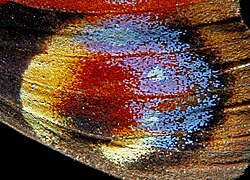
The butterfly has a wingspan of 50 to 55 millimetres (2 to 2+18 in). The base colour of the wings is a rusty red, and at each wingtip it bears a distinctive, black, blue and yellow eyespot. The underside is a cryptically coloured dark brown or black, mimicking a dead leaf.

There are two subspecies: A. io caucasica (Jachontov, 1912), found in Azerbaijan, and A. io geisha (Stichel, 1908), found in Japan and the Russian Far East.

Natural history

[edit]

The peacock can be found in woods, fields, meadows, pastures, parks, and gardens, from lowlands up to 2,500 metres (8,200 ft) elevation. It is a relatively common butterfly, seen in many European parks and gardens. The peacock male exhibits territorial behaviour, in many cases territories being selected in route of the females to oviposition sites.[10]

The butterfly hibernates over winter before laying its eggs in early spring, in batches of up to 400 at a time.[3] However, recent studies in Belgium have shown that peacock butterflies reproduce in two periods: early spring and early summer, and a possible third period in autumn. They found that peacock butterflies show flight peaks in early July and early August to early October, with the emergence of butterflies with good-conditioned wings, which shows signs of new offspring.[11] The olive green eggs are ribbed. They are laid on both the upper parts and the undersides of leaves of nettle species[12] and hops.[citation needed] The caterpillars hatch after about a week. They are shiny black with six rows of barbed spikes and a series of white dots on each segment. The chrysalis may be either grey, brown or green, and may have a blackish tinge.[12] The caterpillars grow up to 42 millimetres (1+58 in) in length.

The primary food plants of European peacock larvae are stinging nettle (Urtica dioica), hop (Humulus lupulus), and the small nettle (Urtica urens).[3]

The adult butterflies drink nectar from a wide variety of flowering plants, including buddleia, willows, dandelions, wild marjoram, danewort, hemp agrimony, and clover; they also use tree sap and rotten fruits.

Behaviour

[edit]

Mating system and territorial behaviour

[edit]

Aglais io employs a monogamous mating system, which means that they only mate with one partner for a period of time.[citation needed] This is due to their life cycle in which females are receptive only during an eclosion period, after overwintering. The pairs only mate once after overwintering, as it is very difficult to find a receptive female after that period.[13] In species where the range of the females is not defensible by a male, the males must defend a single desirable area that females will come through, such as dense food areas, watering holes, or favourable nesting sites. The males then attempt to mate with the females as they are passing through.

Holding a desirable territory increases the male's likelihood of finding a mate and therefore increases his reproductive success. However, each individual needs to weigh the benefits of mating with the costs of defending a territory.[14] Aglais io exhibits this type of territorial behaviour, and must defend a desirable territory from other males. If only one of the males knows the territory well, he will successfully chase off any intruders. On the other hand, if both males are familiar with the territory, there will be a contest between the two to determine which of them stays in the territory. The most desirable sites are those that will increase the male's quota of females. These sites are generally feeding and oviposition sites, which are sought after by females. This territorial behaviour is reinforced by the fact that these sites are all concentrated. If the valuable resources were dispersed, there would be less observable territorial behaviour.[15]

To find mates and defend their territory, Aglais io exhibits perching behaviour. The male butterflies will perch on an object at a specific height where they can observe passing flying objects. Every time they see a passing object of their own species or of a relevant species, they will fly straight towards the object until they are approximately 10 cm away. If they encounter a male, the resident male will chase him off his territory. If the resident male encounters a female, he will pursue her until she lands and mating will occur.[16] The courtship is extended in this species. The male goes through a long chase before the female allows him to mate. He must demonstrate high performance flight.[17]

The monandrous mating system has caused the evolution of a shorter life span in males of this species. In polygynous butterflies, the male's reproductive success is largely dependent on life span. Therefore, the longer a male lives, the more he can reproduce, so he has a higher fitness. Therefore, males tend to live as long as the females. In A. io the synchronous eclosion at the end of winter cause males to only mate once. Their reproductive success is therefore not linked to how long they live, and there is no selective pressure to live longer. Therefore, the life span of males is shorter than the lifespan of the females.[13]

Anti-predator defense mechanisms

[edit]

Like many other butterflies that hibernate, the peacock butterfly exhibits many anti-predator defence mechanisms against would-be predators. The peacock butterfly's most obvious defense comes from the four large eyespots that it has on its wings. It also uses camouflage and can emit a hissing sound.[18]

The eyespots are brilliantly coloured concentric circles. Avian predators of the butterfly include blue tits, pied flycatchers and other small passerine birds. The first line of defence against these predators for many hibernating butterflies is crypsis, a process in which the butterflies blend into their environment by mimicking a leaf and staying immobile.[19] Some hibernating butterflies such as the peacock have a second line of defence: when attacked, they open their wings and expose their eyespots in an intimidating threat display, which gives the butterfly a much better chance at escaping predators than butterflies that rely solely on leaf mimicry.[19] While the main targets of these anti-predation measures are small passerine birds, even larger birds such as chickens have been shown to react to the stimuli and avoid the butterfly when exposed to eyespots.[20]

Avian predators

[edit]

Research has shown that avian predators attempting to attack a butterfly hesitate for a much longer time if they encounter butterflies that display their eyespots than if they encounter butterflies whose eyespots are covered. In addition, the predators delay their return to the butterfly if it displays eyespots[20][21] and some predators even flee before attacking the butterfly.[21] By intimidating the predator so that it delays or gives up its attack, the peacock butterfly has a much greater chance of escaping predation.

According to the eye mimicry hypothesis, the eyespots serve an anti-predatory purpose by imitating the eyes of the avian predators' natural enemies.[20] In contrast, the conspicuousness hypothesis posits that rather than recognition of the eyespots as belonging to an enemy, the conspicuous nature of the eyespots, which are typically large and bright, causes a response in the visual system of the predator that leads to avoidance of the butterfly.[22]

In one experiment, observed responses of the avian predators to the eyespots included increased vigilance, a delay in their return to the peacock butterfly, and the production of alarm calls associated with ground-based predators.[20] These responses to the eyespot stimuli lend support to the eye mimicry hypothesis as they indicated that the avian predator sensed that the eyespots belonged to a potential enemy. When faced with avian predators like the blue tit, the peacock butterfly makes a hissing noise as well as threateningly displaying its eyespots. However, it is the eyespots that protect the butterfly the most; peacock butterflies that have had their sound production capability removed still defend themselves extremely well against avian predators if their eyespots are present.[23]

Rodent predators

[edit]

While hibernating in dark wintering areas, the peacock butterfly frequently encounters rodent predators such as small mice. Against these predators, however, the visual display of eyespots is ineffective due to the darkness of the environment. Instead, these rodent predators show a much stronger adverse reaction to the butterfly when it produces its auditory hissing signal. This indicates that for rodent predators, it is the auditory signal produced by the butterfly that serves as a deterrent.[18]

Taxonomy

[edit]

Aglais io was formerly classified as the only member of the genus Inachis (the name is derived from Greek mythology, meaning Io, the daughter of Inachus[citation needed]). It should not be confused or classified with the "American peacocks" in the genus Anartia; while belonging to the same family as the European peacock, Nymphalidae, the American peacocks are not close relatives of the Eurasian species.

Io is a figure in Greek mythology. She was a priestess of Hera in Argos.

[edit]

See also

[edit]

References

[edit]
[edit]
Revisions and contributorsEdit on WikipediaRead on Wikipedia
from Grokipedia
Aglais io, commonly known as the peacock butterfly or European peacock, is a colorful of belonging to the , characterized by its striking dorsal wing patterns of reddish-brown with black bars and prominent blue-centered eyespots that mimic the eyes of larger animals to deter predators. With a wingspan measuring 63-69 mm, adults exhibit a mottled dark brown ventral surface resembling dead leaves for during . Native to and temperate regions of as far east as , and introduced in parts of , it inhabits a wide variety of environments including woodlands, meadows, gardens, and urban areas up to elevations of 8,200 feet. The life cycle of Aglais io typically spans one generation per year in much of its range, though recent climate warming has led to the emergence of a second generation (bivoltine pattern) in parts of such as , , and . Eggs are laid in clusters during spring on host plants like stinging nettles (Urtica dioica) or hops (Humulus lupulus), hatching into black, spiny larvae that feed gregariously before pupating into grey or brown chrysalids; emerging adults then nectar on flowers such as buddleia while overwintering in sheltered spots like sheds or tree hollows to survive cold periods. Adults are strong fliers active year-round, with peak flights in spring, summer, and autumn, and males often defend territories aggressively. Behaviorally, Aglais io employs multiple defenses beyond its eyespots, including the production of a hissing sound by rubbing wings together and ultrasonic clicks to startle predators like birds. As a common and widespread species, it faces no major conservation threats but benefits from garden habitats rich in nectar sources and larval host plants; its adaptability underscores its resilience amid environmental changes.

Description

Physical features

The adult Aglais io butterfly measures 63 to 69 mm in wingspan. These dimensions contribute to its medium to large size within the family. The body of A. io is covered in microscopic scales, a characteristic feature of that provides protection and sensory functions. It features a robust adapted for supporting the large wings and flight muscles, and a slender housing reproductive and digestive organs. The antennae are clubbed at the tips, typical of nymphalid , aiding in and detection. is evident in size, with females generally larger than males to support egg production. The wings also possess prominent eye-like spots, though their detailed patterns are addressed elsewhere.

Wing patterns and coloration

The upperwings of Aglais io display a vibrant reddish-brown ground color, marked by a series of spots and distinctive eyespots, particularly prominent on the hindwings where each features a encircled by a ring, often with subtle accents. These eyespots arise from specialized scale structures, with coloration produced by in the lower lamina of scales backed by melanin-rich ground scales, while the reddish tones stem from ommochrome pigments in the wing scales. In contrast, the underwings exhibit a cryptic pattern of mottled browns and blacks that closely resemble decaying leaves, enabling effective against predators when the wings are folded at rest. This subdued coloration relies on high density in the scales for the dark tones and layered scale stacking to diffuse light and reduce visibility. The eyespots on the upperwings primarily function to deflect predator attacks toward the expendable wing margins rather than the body, while also intimidating potential threats through their conspicuous, eye-like appearance, as demonstrated in experiments with avian predators. Overwintering adults emerging in spring show increased wing wear accumulated during hibernation compared to summer emergents. Additionally, the wings exhibit (UV) reflectance patterns, particularly in the scale structures contributing to the blue eyespots, which create visual contrasts detectable by pollinators and conspecifics that perceive UV light.

Taxonomy

Etymology and naming

The binomial name Aglais io was established through taxonomic revisions, with the species originally described by in his (10th edition) in 1758 as Papilio io, placing it within the broad genus that encompassed many butterflies at the time. The current genus Aglais was introduced by Swedish naturalist Johan Wilhelm Dalman in 1816 to better reflect the species' characteristics within the family. The genus name Aglais derives from the Latin Aglaia, which originates from the Ἀγλαΐα, meaning "splendid" or "shining," alluding to the butterfly's bright and attractive coloration; in , Aglaia was the youngest of the three (Graces), embodying beauty and splendor. The specific epithet io comes from the Ἰώ, referring to Io, a figure in who was the daughter of the river god Inachus and a priestess of ; this name may also evoke the prominent eyespots on the butterfly's wings, which resemble watchful eyes. The common name "peacock butterfly" (or "European peacock") arose from the striking resemblance of its wing eyespots to the iridescent tail feathers of a peacock (Pavo cristatus), a comparison noted in early descriptions. Historical synonyms include Inachis io (used until 2003, with Inachis derived from Io's father Inachus), Vanessa io, and Nymphalis io, reflecting shifts in generic classifications over time.

Phylogenetic relationships

Aglais io is classified within the kingdom Animalia, phylum Arthropoda, class Insecta, order Lepidoptera, family Nymphalidae, subfamily Nymphalinae, tribe Nymphalini, and genus Aglais. This placement situates it among the , a diverse group characterized by reduced forelegs and vibrant wing patterns adapted for and predation deterrence. Within the genus Aglais, A. io shares close phylogenetic ties with species such as Aglais urticae (), Aglais milberti (Milbert's tortoiseshell), Aglais ladakensis (Ladak tortoiseshell), and Aglais caschmirensis (Indian tortoiseshell), all of which exhibit similar morphological and ecological traits, including overwintering as adults and utilization of nettles as larval host plants. These relatives highlight the genus's primarily Holarctic distribution, with extensions into the Nearctic and Oriental regions. Molecular phylogenetic studies have robustly confirmed the of the Aglais genus, positioning it as a distinct sister to other genera within the tribe Nymphalini with strong bootstrap support. These analyses, drawing from comprehensive datasets across , underscore the evolutionary cohesion of Aglais based on shared genetic signatures and morphological synapomorphies. Estimates from Bayesian relaxed-clock models indicate that diversification within the Aglais genus occurred approximately 30–34 million years ago during the , with the broader Nymphalis-group (including Aglais) diverging earlier in the Eocene; this aligns with fossil evidence of early Aglais-like forms from the middle around 14 million years ago. This temporal framework reflects diversification driven by climatic shifts and in . In its core European range, A. io lacks recognized , with observed variations in wing coloration and size regarded as ecophenotypic forms rather than distinct taxa. such as A. i. caucasica (in the region) and A. i. geisha (in and the ) are confined to peripheral Asian populations, reflecting localized adaptations without broader phylogenetic divergence.

Distribution and

Geographic range

Aglais io, commonly known as the European peacock butterfly, is native to the , with its range encompassing much of —from and the eastward across the continent—and extending through temperate to . The distribution reaches northward to . The species is absent from high Arctic areas, such as remote islands beyond its northern temperate limits, and from extreme environments, reflecting its preference for milder climatic conditions. Introduced populations appeared in in the late 20th century, with the earliest confirmed record from Québec in 1997, likely via accidental transport on cargo ships. These have become established in the Greater Montréal region and southwestern Québec, with further records in as of 2023 and as of 2022; sightings in the , including since around 2017, remain sporadic and unconfirmed as breeding populations. In response to climate warming, A. io has exhibited northward range expansions in , with shifts averaging 30 km per decade in northern areas like and . Overwintering is confined to temperate zones, where adults seek shelter in trees, buildings, or other protected sites to endure winters with temperatures rarely dropping below -20°C.

Habitat preferences

_Aglais io, commonly known as the peacock butterfly, prefers a variety of temperate habitats including open , meadows, gardens, and hedgerows where stinging nettles are abundant. These environments provide the necessary vegetation structure for shelter and across its lifecycle. The species is particularly associated with woodland clearings, rides, and edges, as well as open fields and pastures that offer diverse microhabitats. The requires sunny, sheltered areas for basking to regulate body temperature, often selecting spots along margins or in gardens with partial shade. sources such as buddleia and thistles are essential in these habitats, supporting adult feeding during warm months. It occurs across an altitudinal range from up to approximately 2,500 m (8,200 ft) in mountainous regions, adapting to varied elevations within its Eurasian distribution. Aglais io demonstrates strong urban adaptability, thriving in parks and suburban gardens where suitable conditions persist. Despite its adaptability, the species shows sensitivity to habitat fragmentation, requiring landscape connectivity such as hedgerows or corridors to facilitate dispersal and maintain viability.

Life cycle

Developmental stages

The life cycle of Aglais io consists of four distinct developmental stages: , , , and , with the traditionally exhibiting univoltine (one generation per year) in northern regions and bivoltine (two generations per year) in southern areas, though recent warming has led to the emergence of a second generation in parts of , including , , and . The entire non-hibernating portion of the cycle from to emergence generally spans about 6 weeks under favorable conditions. Eggs are olive-green and ovoid in shape, often described as barrel-like with ribbing, and are laid by females in large clusters numbering 100 to 500 on the undersides of leaves of host plants such as common nettle (Urtica dioica). These clusters are deposited in batches during , with hatching occurring after 7 to 14 days, depending on temperature. Upon hatching, the larvae are initially gregarious, forming communal silk webs on the host plant foliage in their early instars for . The caterpillars are shiny black with a velvety texture, featuring rows of small white spots along the sides and short black branched spines covering the body. They undergo five instars over 3 to 4 weeks, growing to a length of up to 40 mm before dispersing individually in later stages. The pupal stage, or chrysalis, is angular and camouflaged, appearing grayish-green or brown with two horn-like projections at the head end; it is suspended upside down from the host via a silk pad and girth. This stage lasts 10 to 14 days, during which the transformation to the adult form occurs. Adults emerge in from the first generation or in late summer from the second in bivoltine populations, with an overall lifespan of 8 to 11 months that includes a period. Overwintering takes place as sexually immature adults, which seek shelter in leaf litter, crevices, hollow trees, or human structures from autumn until early spring.

Host plants and diet

The larvae of Aglais io, known as the European peacock butterfly, primarily feed on the leaves of Urtica dioica (stinging nettle), which serves as the main host plant throughout their development in the wild. Occasionally, they utilize Urtica urens (small nettle) or Humulus lupulus (hop) as secondary hosts, though these are far less common. In natural conditions, the species primarily exhibits oligophagous behavior, with larval feeding restricted mainly to nettles in the Urticaceae family (Urtica spp.) and occasionally hops in the Cannabaceae family (Humulus lupulus), whereas in captivity, larvae demonstrate limited polyphagous tendencies and can accept alternative herbaceous plants under controlled conditions. Females select oviposition sites on nettles based on plant quality, preferentially laying eggs on leaves with higher content to optimize larval growth and survival, as elevated nitrogen levels in U. dioica enhance development rates and overall performance. This host plant selection reflects an adaptation to nitrogen-enriched environments, allowing A. io to thrive in anthropogenically altered habitats where nettle nutrition has improved due to fertilization. Adult A. io obtain nutrition primarily from sources, favoring flowers in the family such as dandelions (), thistles ( spp.), and ragwort (), as well as other including sallows (Salix spp.), wild marjoram (Origanum vulgare), danewort (Sambucus ebulus), and hemp agrimony (). They also feed on fruit sap and honeydew, supplementing their diet with these carbohydrate-rich resources during the active season. Additionally, adults engage in mud-puddling behavior at damp soil or moist surfaces to acquire essential minerals like sodium, which are absent from floral and support reproductive functions. Prior to overwintering, adults accumulate reserves through extended feeding on and other sources, relying on these body fat stores to sustain metabolism during without further intake. This nutritional strategy enables survival through winter, with lipid depletion occurring gradually at low temperatures to minimize loss.

Behavior

Mating and territoriality

Males of Aglais io establish territories in sunny microhabitats, such as hilltops, paths, slope tops, or open woodland edges, where they perch on elevated spots to intercept passing females and defend against . Territorial disputes between males are resolved through non-contact aerial contests. Courtship begins when a territorial male detects a female, initiating a prolonged aerial pursuit to demonstrate vigor and size; receptive females eventually land, permitting copulation, which lasts several hours, often extending from late afternoon into the night.

Foraging and migration

Aglais io adults engage in diurnal foraging, actively seeking nectar from a variety of flowers during daylight hours, with activity peaking in the midday when ambient temperatures are optimal for flight and energy expenditure. This behavior is supported by their reliance on both visual and olfactory cues to locate rewarding flowers, where antennal responses to floral scents such as phenylacetaldehyde and linalool elicit proboscis extensions for feeding. The species prefers sucrose-rich nectaries, using its proboscis to access deep floral structures, allowing efficient extraction from plants like thistles and brambles. To maintain optimal body temperature for and flight, A. io exhibits , positioning its wings open on sunlit surfaces to absorb heat until the thoracic temperature reaches around 30°C. If shaded or low on energy, individuals may shiver their wings to generate internal heat, ensuring sustained activity during . In terms of movement, A. io demonstrates local dispersal capabilities, typically traveling 1-2 km daily in search of sources and suitable habitats, though distances can extend to 5 km under favorable conditions. The does not undertake long-distance migrations but exhibits nomadic tendencies and occasional vagrancy; it has become locally established in parts of since the late , with regular records as of 2025. Adults show strong site fidelity to overwintering shelters, often returning to the same locations such as outbuildings or dense foliage for .

Ecology and interactions

Predators and defenses

The primary predators of Aglais io, the European peacock butterfly, include avian species such as blue tits (Parus caeruleus), which actively hunt adult butterflies during foraging activities. Rodents like wood mice (Apodemus sylvaticus) and yellow-necked mice (Apodemus flavicollis) prey on hibernating adults in winter shelters, often targeting them in crevices or leaf litter. Certain spiders consume the caterpillars, while predatory wasps, such as those emitting electric fields detectable by larvae, attack the immature stages. To counter these threats, A. io employs morphological defenses centered on its prominent wing eyespots, which serve to intimidate and deflect attacks from birds by mimicking the gaze of larger predators, thereby eliciting hesitation or withdrawal in avian hunters like blue tits. When disturbed, the butterfly activates a startle display by rapidly opening its wings to flash the colorful eyespots, often accompanied by a hissing sound produced by wing friction, which further disrupts predator approach and increases survival rates—experimental trials showed only 3% mortality for intact individuals versus 65% for those with obscured eyespots. At rest, adults adopt a cryptic posture with wings closed, resembling a dead leaf through the dark, irregular ventral patterns, providing camouflage against visual predators. Larval stages benefit from chemical defenses, as caterpillars feeding on stinging nettles (Urtica dioica) sequester and regurgitate noxious juices containing irritants, deterring insectivores and rendering them unpalatable. Adults, however, rely less on chemical unpalatability and more on behavioral evasion; upon detection of a threat, they initiate erratic, zigzagging escape flights, complicating pursuit by agile predators like birds or wasps. Against mammalian predators during hibernation, adults may employ wing-flicking to dislodge attackers or produce auditory clicks to trigger escape responses in mice.

Role in ecosystems

Aglais io, the European peacock butterfly, serves as an important pollinator in temperate ecosystems, particularly for wildflowers that are less frequented by bees. Adult butterflies feed on nectar from a variety of plants, including sallows, dandelions, and thistles, transferring pollen between flowers during foraging bouts. This pollination service complements that of bees by targeting outer flower edges. As prey for higher trophic levels, A. io supports bird and populations within food webs. Both larval and adult stages are consumed by various predators, contributing to the energy transfer across levels and maintaining balance in and avian communities. A. io functions as an indicator species for health in temperate regions, with population fluctuations signaling environmental stressors such as fragmentation or . Declines in this species often reflect broader , while its adaptability to urban edges highlights resilience in modified landscapes.

Conservation

In northern Europe, populations of Aglais io have remained stable to increasing, largely due to climate warming facilitating range expansions and phenological shifts. Over the past century in and , cumulative butterfly , including A. io, has risen in response to warmer conditions, with northern expansions documented for many species. In central regions like , the species has transitioned from univoltine to bivoltine reproduction since the early , driven by rising temperatures; the second (autumn) generation now produces the largest flight peak, 23% larger than the summer one, enhancing overall abundance. At southern range edges, populations have shown declines, though trends vary regionally. In the , overall abundance decreased by 3% from 1976 to 2019, with steeper drops in southern areas such as (-31% over the same period) and (-4%), potentially reflecting habitat pressures and climate mismatches. Recent UK garden monitoring from 2007 to 2020 indicates a modest +14% increase in sightings, suggesting stabilization in human-modified habitats by the early 2020s, while 2024 counts were low amid a broader butterfly decline but 2025 showed average numbers for A. io. The species typically produces two broods annually in , compared to one in northern areas, which influences local densities by allowing higher reproductive output in warmer climates. Introduced populations in , first established in the Greater Montréal area around 1997, have persisted and appear to be expanding as of 2023, indicating successful adaptation outside the native range, though long-term growth rates remain undocumented. No global IUCN assessment exists for A. io, but it holds Least Concern status across and is considered nationally secure in most countries within its range.

Threats and management

The primary anthropogenic threat to Aglais io is habitat loss and degradation due to agricultural intensification, which reduces suitable areas for its larval host plant, common nettle (Urtica dioica), particularly in farmlands where nettle patches have declined amid land use changes and effects. use, especially s applied to crops like oilseed rape, has been linked to population declines in A. io, with a 24% reduction in abundance observed in from 2000 to 2009 and a strong negative correlation between neonicotinoid application rates and butterfly indices (parameter estimate: -0.058 for A. io). Climate extremes, including wet winters, pose risks to overwintering adults by increasing mortality through higher humidity levels, which correlate with reduced survival rates compared to drier conditions. In introduced or expanding ranges, such as , A. io faces competition from range-expanding species like Araschnia levana, which constrains its through resource overlap and altered biotic interactions, including shared parasitoids. In the , population trends indicate relative stability, with a -3% change in abundance from 1976 to 2019, though localized declines persist in agricultural areas. Conservation management focuses on habitat enhancement through targeted planting of common nettle in gardens and field margins to support larval stages, as nettles thrive in disturbed, nitrogen-rich soils and can be easily integrated into urban and rural green spaces. In the , agri-environment schemes under the incentivize farmers to create nettle-rich buffer strips and wildflower margins, contributing to broader habitat restoration efforts aimed at reversing declines by 2030. platforms, including and national monitoring schemes like the UK Butterfly Monitoring Scheme, enable widespread tracking of A. io and distribution, with mass observational data revealing shifts such as the recent adoption of bivoltine generations in . Legally, A. io is classified as Least Concern on the European Red List and Red List (2022), with no listing under Appendix II, though it appears on national red lists in peripheral regions like parts of where populations are more vulnerable; protection emphasizes habitat safeguards rather than species-specific bans.

References

Add your contribution
Related Hubs
User Avatar
No comments yet.