



Community hub
Recent from talks
Knowledge base stats:
Talk channels stats:
Members stats:
Indian Ocean
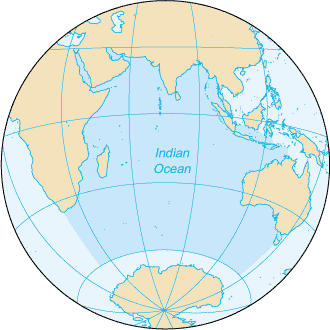
The Indian Ocean is the third-largest of the world's five oceanic divisions, covering 70,560,000 km2 (27,240,000 sq mi) or approximately 20% of the water area of Earth's surface. It is bounded by Asia to the north, Africa to the west and Australia to the east. To the south it is bounded by the Southern Ocean or Antarctica, depending on the definition in use. The Indian Ocean has large marginal or regional seas, including the Andaman Sea, the Arabian Sea, the Bay of Bengal, and the Laccadive Sea.
Geologically, the Indian Ocean is the youngest of the oceans (being directly preceded by the Tethys Ocean, which fragmented into the Mediterranean Sea and the Indian Ocean only 20 million years ago), and it has distinct features such as narrow continental shelves. Its average depth is 3,741 m. It is the warmest ocean, with a significant impact on global climate due to its interaction with the atmosphere. Its waters are affected by the Indian Ocean Walker circulation, resulting in unique oceanic currents and upwelling patterns. The Indian Ocean is ecologically diverse, with important ecosystems such as coral reefs, mangroves, and sea grass beds. It hosts a significant portion of the world's tuna catch and is home to endangered marine species. The climate around the Indian Ocean is characterized by monsoons.
The Indian Ocean has been a hub of cultural and commercial exchange since ancient times. It played a key role in early human migrations and the spread of civilizations. In modern times, it remains crucial for global trade, especially in oil and hydrocarbons. Environmental and geopolitical concerns in the region include climate change, overfishing, pollution, piracy, and disputes over island territories.
The Indian Ocean has been known by its present name since at least 1515, when the Latin form Oceanus Orientalis Indicus (lit. 'Indian Eastern Ocean') is attested, named after India, which projects into it. It was earlier known as the Eastern Ocean, a term that was still in use during the mid-18th century, as opposed to the Western Ocean (Atlantic) before the Pacific was surmised. In modern times, the name Afro-Asian Ocean has occasionally been used.
The Hindi name for the Ocean is हिंद महासागर (Hind Mahāsāgar; lit. transl. Ocean of India). Conversely, Chinese explorers (e.g., Zheng He during the Ming dynasty) who traveled to the Indian Ocean during the 15th century called it the Western Oceans. In Ancient Greek geography, the Indian Ocean region known to the Greeks was called the Erythraean Sea.
The borders of the Indian Ocean, as delineated by the International Hydrographic Organization in 1953, included the Southern Ocean but not the marginal seas along the northern rim. In 2002 the IHO delimited the Southern Ocean separately, which removed waters south of 60°S from the Indian Ocean but included the northern marginal seas. Meridionally, the Indian Ocean is delimited from the Atlantic Ocean by the 20° east meridian, running south from Cape Agulhas, South Africa, and from the Pacific Ocean by the meridian of 146°49'E, running south from South East Cape on the island of Tasmania in Australia. The northernmost extent of the Indian Ocean (including marginal seas) is approximately 30°N in the Persian Gulf.
The Indian Ocean covers 70,560,000 km2 (27,240,000 sq mi), including the Red Sea and the Persian Gulf but excluding the Southern Ocean, or 19.5% of the world's oceans. Its volume is 264,000,000 km3 (63,000,000 cu mi) or 19.8% of the world's oceans' volume; it has an average depth of 3,741 m (12,274 ft) and a maximum depth of 7,290 m (23,920 ft).
All of the Indian Ocean is in the Eastern Hemisphere. The centre of the Eastern Hemisphere, the 90th meridian east, passes through the Ninety East Ridge.
Hub AI
Indian Ocean AI simulator
(@Indian Ocean_simulator)
Indian Ocean
The Indian Ocean is the third-largest of the world's five oceanic divisions, covering 70,560,000 km2 (27,240,000 sq mi) or approximately 20% of the water area of Earth's surface. It is bounded by Asia to the north, Africa to the west and Australia to the east. To the south it is bounded by the Southern Ocean or Antarctica, depending on the definition in use. The Indian Ocean has large marginal or regional seas, including the Andaman Sea, the Arabian Sea, the Bay of Bengal, and the Laccadive Sea.
Geologically, the Indian Ocean is the youngest of the oceans (being directly preceded by the Tethys Ocean, which fragmented into the Mediterranean Sea and the Indian Ocean only 20 million years ago), and it has distinct features such as narrow continental shelves. Its average depth is 3,741 m. It is the warmest ocean, with a significant impact on global climate due to its interaction with the atmosphere. Its waters are affected by the Indian Ocean Walker circulation, resulting in unique oceanic currents and upwelling patterns. The Indian Ocean is ecologically diverse, with important ecosystems such as coral reefs, mangroves, and sea grass beds. It hosts a significant portion of the world's tuna catch and is home to endangered marine species. The climate around the Indian Ocean is characterized by monsoons.
The Indian Ocean has been a hub of cultural and commercial exchange since ancient times. It played a key role in early human migrations and the spread of civilizations. In modern times, it remains crucial for global trade, especially in oil and hydrocarbons. Environmental and geopolitical concerns in the region include climate change, overfishing, pollution, piracy, and disputes over island territories.
The Indian Ocean has been known by its present name since at least 1515, when the Latin form Oceanus Orientalis Indicus (lit. 'Indian Eastern Ocean') is attested, named after India, which projects into it. It was earlier known as the Eastern Ocean, a term that was still in use during the mid-18th century, as opposed to the Western Ocean (Atlantic) before the Pacific was surmised. In modern times, the name Afro-Asian Ocean has occasionally been used.
The Hindi name for the Ocean is हिंद महासागर (Hind Mahāsāgar; lit. transl. Ocean of India). Conversely, Chinese explorers (e.g., Zheng He during the Ming dynasty) who traveled to the Indian Ocean during the 15th century called it the Western Oceans. In Ancient Greek geography, the Indian Ocean region known to the Greeks was called the Erythraean Sea.
The borders of the Indian Ocean, as delineated by the International Hydrographic Organization in 1953, included the Southern Ocean but not the marginal seas along the northern rim. In 2002 the IHO delimited the Southern Ocean separately, which removed waters south of 60°S from the Indian Ocean but included the northern marginal seas. Meridionally, the Indian Ocean is delimited from the Atlantic Ocean by the 20° east meridian, running south from Cape Agulhas, South Africa, and from the Pacific Ocean by the meridian of 146°49'E, running south from South East Cape on the island of Tasmania in Australia. The northernmost extent of the Indian Ocean (including marginal seas) is approximately 30°N in the Persian Gulf.
The Indian Ocean covers 70,560,000 km2 (27,240,000 sq mi), including the Red Sea and the Persian Gulf but excluding the Southern Ocean, or 19.5% of the world's oceans. Its volume is 264,000,000 km3 (63,000,000 cu mi) or 19.8% of the world's oceans' volume; it has an average depth of 3,741 m (12,274 ft) and a maximum depth of 7,290 m (23,920 ft).
All of the Indian Ocean is in the Eastern Hemisphere. The centre of the Eastern Hemisphere, the 90th meridian east, passes through the Ninety East Ridge.